Writing a list may seem simple, but knowing how to punctuate, format, and organize it correctly can make a big difference in your writing. Whether you are writing an email, an article, an academic assignment, or a social media post, a well written list helps readers understand information quickly and easily.
The basic rule is to keep list items grammatically consistent, use appropriate punctuation, and choose a suitable format. For example, you can use commas to separate a short list within a sentence, or bullet points and numbers when presenting information on separate lines. You should also know when to capitalize list items, when to use a colon, and whether to place a full stop after each item.
This guide explains how to write lists correctly in English, with simple rules, examples, and common mistakes to avoid.
Quick Answer: How Do You Write a List Correctly?
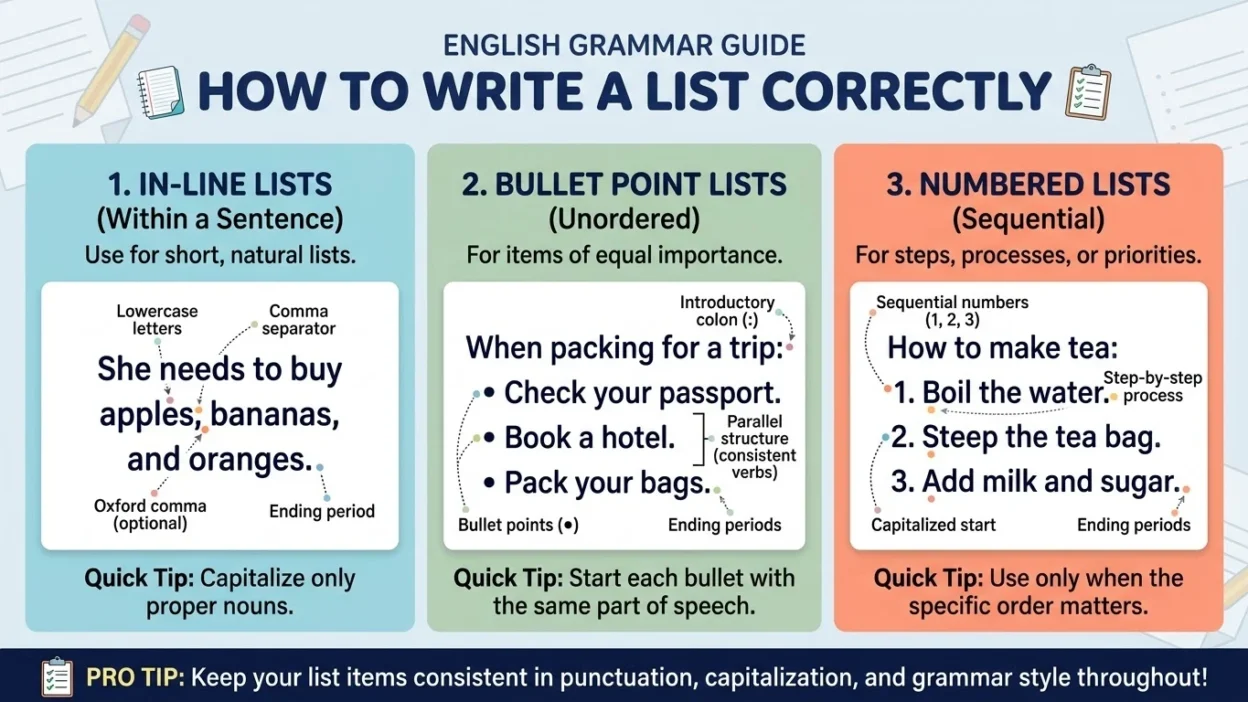
To write a list correctly, introduce it with a suitable sentence or heading, use a colon when appropriate, and separate the items clearly. Keep the grammatical structure consistent throughout the list. Use commas for short lists within sentences, bullet points for unordered items, and numbers when the order matters. Apply capitalization and punctuation consistently.
1. Use a Colon to Introduce a List
A colon is commonly used to introduce a list when the words before it form a complete sentence.
Correct:
I need to buy the following items: bread, milk, eggs, and butter.
Please bring these documents:
- Your passport
- Your identity card
- Your application form
Incorrect:
I need to buy: bread, milk, eggs, and butter.
The words before the colon do not form a complete sentence in this example.
Important Rule
Do not automatically place a colon after every heading or introductory phrase. A colon is most useful when the introductory words form a complete sentence.
For example:
Items to buy:
- Bread
- Milk
- Eggs
A heading can also introduce a list without a colon, depending on the style and formatting.
2. Use Commas to Separate Items in a Short List
When listing three or more items within a sentence, separate them with commas.
Examples:
- I like apples, oranges, and bananas.
- She bought a dress, a pair of shoes, and a handbag.
- We visited Lahore, Karachi, and Islamabad.
- He enjoys reading, writing, and travelling.
- The room contains a table, two chairs, and a bookshelf.
What Is the Oxford Comma?
The Oxford comma, also called the serial comma, is the comma placed before and or or in a list of three or more items.
For example:
- With the Oxford comma: I bought apples, oranges, and bananas.
- Without the Oxford comma: I bought apples, oranges and bananas.
Both styles are accepted in English. However, the Oxford comma can help prevent confusion, especially when list items are complex or could be misunderstood.
For example:
With the Oxford comma:
I invited my parents, Ali, and Sara.
This clearly identifies three groups or individuals: my parents, Ali, and Sara.
Without the Oxford comma, the sentence could be interpreted differently.
The most important rule is to follow one style consistently unless a particular publication or style guide requires otherwise.
3. Use Bullet Points for Unordered Lists
Bullet points are useful when presenting information that does not need to follow a particular order.
For example:
Benefits of reading:
- It improves vocabulary.
- It develops writing skills.
- It increases general knowledge.
- It encourages critical thinking.
You can also use short phrases instead of complete sentences:
Things to pack:
- Clothes
- Shoes
- Toiletries
- Travel documents
When Should You Use Bullet Points?
Use bullet points when:
- The order of the items does not matter.
- You want information to be easy to scan.
- You are presenting examples or features.
- You are listing ingredients, requirements, or benefits.
Avoid using bullet points for information that needs to be followed in a particular sequence. Use a numbered list instead.
4. Use Numbered Lists When Order Matters
A numbered list is appropriate when the items follow a sequence or when you want to show a particular order.
For example:
How to make a cup of tea:
- Boil some water.
- Place a tea bag in a cup.
- Pour the hot water into the cup.
- Allow the tea to steep.
- Add milk or sugar if desired.
Numbered lists are particularly useful for:
- Instructions
- Recipes
- Procedures
- Rankings
- Step by step explanations
- Ordered recommendations
You can also use numbers when the sequence does not matter but you want to make it easier to refer to individual items.
5. Keep List Items Grammatically Consistent
One of the most important rules of list writing is parallel structure. This means that list items should follow the same grammatical pattern whenever possible.
Incorrect Example
My favourite activities are:
- Reading books
- To watch movies
- Playing football
- I enjoy travelling
The items do not follow the same grammatical structure.
Correct Example
My favourite activities are:
- Reading books
- Watching movies
- Playing football
- Travelling
All the items use the same grammatical form.
Another correct version would be:
I enjoy doing the following activities:
- Reading books
- Watching movies
- Playing football
- Travelling
More Examples of Parallel Lists
Incorrect:
To become a better writer, you should:
- Read regularly.
- Writing every day.
- Improve your vocabulary.
- Good grammar.
Correct:
To become a better writer, you should:
- Read regularly.
- Write every day.
- Improve your vocabulary.
- Practise grammar.
Keeping list items parallel makes your writing clearer and more professional.
6. Should List Items Begin With Capital Letters?
Capitalization depends on the structure of your list.
When Using Complete Sentences
Start each item with a capital letter and end it with appropriate punctuation.
Example:
You should follow these rules:
- Read the instructions carefully.
- Check your spelling before submitting your work.
- Use punctuation correctly.
When Using Single Words or Short Phrases
You can use lowercase letters or capital letters, depending on your chosen style.
Example:
You need the following ingredients:
- Flour
- Sugar
- Eggs
- Milk
You could also write:
You need the following ingredients:
- flour
- sugar
- eggs
- milk
Both approaches can be acceptable. The important thing is to remain consistent.
7. How to Punctuate a List Correctly
Punctuation depends on whether your list items are complete sentences or short phrases.
A. Complete Sentences
When every item is a complete sentence, begin each item with a capital letter and end it with a full stop.
Example:
Before submitting your assignment:
- Check your grammar.
- Review your arguments.
- Correct any spelling mistakes.
- Submit your work before the deadline.
B. Short Phrases
When list items are short phrases, you can omit full stops.
Example:
You will need:
- A notebook
- A pen
- A ruler
- An eraser
C. Longer Phrases
For longer list items that complete an introductory sentence, you may use semicolons, especially in formal writing.
Example:
The committee considered three important matters:
- The financial position of the organisation;
- The progress of ongoing projects; and
- The proposed changes to the annual budget.
A final full stop can close the list.
This style is particularly useful when list items contain internal commas.
8. How to Write a List Within a Sentence
Not every list needs bullet points or separate lines. You can include a list naturally within a sentence.
Examples:
- She likes reading, writing, and painting.
- We need chairs, tables, and other furniture.
- He bought apples, bananas, grapes, and oranges.
- The course covers grammar, vocabulary, pronunciation, and writing.
- Please bring your notebook, pen, and textbook.
Use commas to separate the items, and consider the Oxford comma when it improves clarity.
9. How to Write a List With Subpoints
Sometimes a list contains items that need additional explanations or examples. In such cases, you can use a nested list, which is a list within another list.
Example:
There are three important areas of English learning:
- Grammar
- Tenses
- Articles
- Prepositions
- Vocabulary
- Synonyms
- Antonyms
- Idioms
- Pronunciation
- Vowel sounds
- Consonant sounds
- Word stress
Make sure the subpoints are visually separated from the main points. Consistent indentation helps readers understand the relationship between them.
10. Common List Writing Mistakes to Avoid
Here are some frequent mistakes and their corrections.
| Incorrect practice | Better approach |
|---|---|
| Using a colon after an incomplete sentence | Introduce the list with a complete sentence or use a heading |
| Mixing verbs and nouns in the same list | Keep list items grammatically parallel |
| Using numbers for an unordered list without a reason | Use bullet points when order does not matter |
| Using bullet points for sequential instructions | Use a numbered list |
| Capitalizing some items but not others without a reason | Follow a consistent capitalization style |
| Adding full stops to some short phrases but not others | Apply punctuation consistently |
| Making list items unnecessarily long | Keep each item clear and focused |
| Using too many nested lists | Organize the information into manageable groups |
11. Examples of Correctly Written Lists
Here are several practical examples showing how to format lists for different purposes.
Example 1: Shopping List
Shopping list:
- Milk
- Bread
- Eggs
- Rice
- Apples
Example 2: Instructions
How to prepare for an examination:
- Review your notes.
- Practise previous questions.
- Identify topics that need more attention.
- Prepare your stationery.
- Get enough sleep before the examination.
Example 3: Complete Sentence List
Good writing requires several skills:
- Writers should understand grammar.
- They should organize their ideas clearly.
- They should choose appropriate vocabulary.
- They should proofread their work.
Example 4: List Within a Sentence
I enjoy several outdoor activities, including hiking, cycling, swimming, and camping.
Example 5: List With Explanations
Three common parts of speech include:
- Noun: A word that names a person, place, thing, or idea.
- Verb: A word that expresses an action or state.
- Adjective: A word that describes a noun or pronoun.
12. American vs British English: List Formatting
American and British English generally follow the same basic principles of list writing. However, individual style guides and publishers may have different preferences.
Some differences include:
- The Oxford comma is more commonly expected in some American style guides, although it is not compulsory in every context.
- British publications may omit the Oxford comma more frequently, although many British writers use it.
- Punctuation around quotations and other details may vary according to the chosen style guide.
There is no single punctuation rule that every American or British publication follows. Consistency and clarity are the most important considerations.
13. A Simple Checklist for Writing Lists Correctly
Before publishing or submitting a list, check the following:
- Is the list introduced clearly?
- Have I used a colon appropriately?
- Are the list items grammatically consistent?
- Have I chosen bullets or numbers correctly?
- Is capitalization consistent?
- Is punctuation consistent?
- Are the items arranged logically?
- Have I removed unnecessary words?
- Can readers understand each item easily?
Frequently Asked Questions
1. Should I use a colon before a list?
Use a colon when the introductory words form a complete sentence.
Correct: I need three things: a pen, a notebook, and a ruler.
Avoid placing a colon directly after a verb or preposition when it separates that word from its complement.
2. Should list items start with capital letters?
Complete sentences should begin with capital letters. Short phrases can begin with capital or lowercase letters, depending on the chosen style. Be consistent throughout the list.
3. Should I put a full stop after every bullet point?
Use full stops when bullet points are complete sentences. For short words or phrases, full stops are generally unnecessary.
4. Is it better to use bullet points or numbers?
Use bullet points when the order does not matter. Use numbers when the items follow a sequence, such as instructions, or when you want to identify a specific order.
5. What is the Oxford comma?
The Oxford comma is the comma placed before and or or in a list of three or more items.
Example: I bought bread, milk, and eggs.
6. Can I use semicolons in a list?
Yes. Semicolons can separate long or complex list items, particularly when the items already contain commas. They are often used in formal writing.
7. Do all items in a list need to follow the same grammatical structure?
Ideally, yes. Parallel structure makes a list easier to read and understand. For example, if one item begins with a verb, the other items should generally follow the same pattern.
8. Can a list contain complete sentences and short phrases together?
It is possible, but it is usually better to maintain a consistent grammatical structure. Mixing complete sentences and short phrases can make a list look uneven or confusing.
Remember This
A correctly written list should be:
- Clear and easy to read.
- Grammatically consistent.
- Properly punctuated.
- Organized in a logical order.
- Formatted consistently.
Use commas for short lists within sentences, bullet points for unordered information, and numbered lists for instructions or ordered information.
Conclusion
Writing a list correctly is not difficult once you understand a few basic principles. Introduce your list clearly, choose the right format, maintain parallel grammatical structure, and use capitalization and punctuation consistently.
Whether you are preparing a shopping list, writing an academic assignment, creating an article, or explaining a process, a well organized list makes your message easier to understand. Focus on clarity and consistency, and your lists will look more professional and be more useful to readers.

Adam Aaron is a language enthusiast and content writer at SimileHive, creating clear, engaging guides on similes, idioms, metaphors, and figurative language to help readers improve English confidently every day.