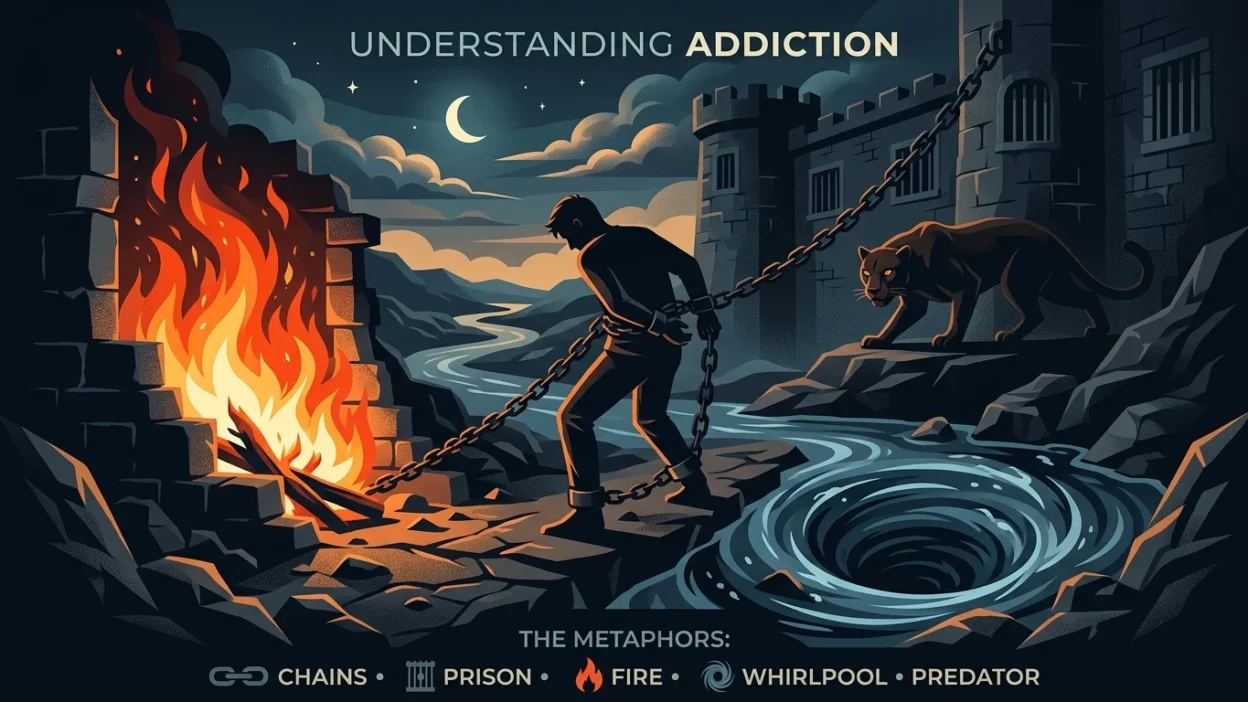
Addiction is more than a habit. In figurative language, it can represent control, struggle, temptation, captivity, or a difficult journey. Writers often use metaphors for addiction to describe how powerful and consuming addiction can feel.
If you are writing a story, poem, speech, personal reflection, or school assignment, these original metaphors will help you express the idea of addiction in a vivid and thoughtful way.
Quick Answer
Metaphors for addiction are figurative expressions that describe addiction as something else, such as a chain, a prison, a storm, or a hungry fire. These literary devices add imagery and emotion to writing.
They help readers understand addiction as a force that can trap, control, tempt, or consume a person.
What Are Metaphors for Addiction?
A metaphor compares addiction to another object or idea to highlight a particular quality.
For example:
“Addiction is a chain.”
This does not mean addiction is literally a chain. It means addiction can make a person feel trapped and unable to break free.
Metaphors are useful in:
- Creative writing
- Poetry
- Speeches
- Personal essays
- Journals
- Storytelling
20 Original Metaphors for Addiction
| Metaphor | Main Meaning |
|---|---|
| Addiction is a chain. | Captivity and restraint |
| Addiction is a prison. | Loss of freedom |
| Addiction is a hungry fire. | Constant desire |
| Addiction is a storm. | Chaos and struggle |
| Addiction is quicksand. | Harder to escape over time |
| Addiction is a shadow. | Always present |
| Addiction is a puppet master. | Control over actions |
| Addiction is a maze. | Confusion and difficulty |
| Addiction is a thief. | Steals time and peace |
| Addiction is a cage. | Feeling trapped |
| Addiction is a whirlpool. | Pulling a person inward |
| Addiction is a vampire. | Draining energy and life |
| Addiction is a poison vine. | Growing and spreading |
| Addiction is a black hole. | Consuming everything |
| Addiction is a broken compass. | Loss of direction |
| Addiction is an anchor. | Holding someone back |
| Addiction is a cracked mirror. | Distorted self-image |
| Addiction is a relentless wave. | Repeated pressure |
| Addiction is a locked door. | Blocking freedom |
| Addiction is a silent predator. | Danger that creeps in quietly |
Detailed Meanings and Example Sentences
1. Addiction is a chain.
Meaning: Addiction can make a person feel trapped.
Example sentences:
- The chain of addiction grew heavier each year.
- He struggled to break the chain around his life.
2. Addiction is a prison.
Meaning: It limits freedom and choices.
Example sentences:
- She felt trapped inside a prison of addiction.
- The prison walls seemed invisible but powerful.
3. Addiction is a hungry fire.
Meaning: The desire keeps growing.
Example sentences:
- The hungry fire demanded more every day.
- He tried to starve the hungry fire inside him.
4. Addiction is a storm.
Meaning: It creates chaos and emotional struggle.
Example sentences:
- A storm of addiction swept through his life.
- Her family stood together against the storm.
5. Addiction is quicksand.
Meaning: The deeper someone goes, the harder it is to escape.
Example sentences:
- Quicksand pulled him lower each month.
- She realized she was sinking into quicksand.
6. Addiction is a shadow.
Meaning: It follows a person constantly.
Example sentences:
- The shadow of addiction followed him everywhere.
- Even during good days, the shadow remained nearby.
7. Addiction is a puppet master.
Meaning: It controls behavior.
Example sentences:
- The puppet master pulled him toward another bad choice.
- She wanted to cut the strings of the puppet master.
8. Addiction is a maze.
Meaning: Recovery can feel confusing.
Example sentences:
- He wandered through the maze searching for a way out.
- The maze of addiction seemed endless.
9. Addiction is a thief.
Meaning: It steals important things from life.
Example sentences:
- The thief stole years from his future.
- She watched the thief take away her peace.
10. Addiction is a cage.
Meaning: Feeling trapped and restricted.
Example sentences:
- The cage grew smaller around him.
- She dreamed of escaping the cage.
11. Addiction is a whirlpool.
Meaning: It pulls a person deeper.
Example sentences:
- The whirlpool dragged him away from his goals.
- Friends tried to pull her out of the whirlpool.
12. Addiction is a vampire.
Meaning: It drains energy and life.
Example sentences:
- The vampire fed on his strength and hope.
- She felt exhausted by the vampire of addiction.
13. Addiction is a poison vine.
Meaning: It spreads gradually.
Example sentences:
- The poison vine wrapped around every part of his life.
- She cut away the poison vine one step at a time.
14. Addiction is a black hole.
Meaning: It consumes time, energy, and relationships.
Example sentences:
- The black hole swallowed his dreams.
- She feared losing everything to the black hole.
15. Addiction is a broken compass.
Meaning: A person loses direction.
Example sentences:
- The broken compass led him away from his values.
- She worked hard to repair the broken compass.
16. Addiction is an anchor.
Meaning: It holds someone back from progress.
Example sentences:
- The anchor kept him from moving forward.
- She finally lifted the anchor from her life.
17. Addiction is a cracked mirror.
Meaning: It distorts how a person sees themselves.
Example sentences:
- The cracked mirror reflected shame and confusion.
- Recovery helped her replace the cracked mirror.
18. Addiction is a relentless wave.
Meaning: The pressure keeps returning.
Example sentences:
- A relentless wave crashed against his resolve.
- She learned to stand firm against the wave.
19. Addiction is a locked door.
Meaning: It blocks freedom and opportunity.
Example sentences:
- The locked door kept him from a better future.
- She searched for the key to the locked door.
20. Addiction is a silent predator.
Meaning: It approaches gradually and dangerously.
Example sentences:
- The silent predator moved closer with every bad choice.
- He did not notice the silent predator until it was too late.
How to Use Metaphors for Addiction in Writing
Creative writing
Stories & novels
“The chain of addiction rattled with every step he took.”
Poetry
Imagery & emotion
“A hungry fire burned through the quiet corners of his heart.”
Speeches
Memorable language
“Let us help people break the chains that hold them back.”
School essays
Figurative language
“The author presents addiction as a prison that limits personal freedom.”
Common Mistakes
| Mistake | Better Choice |
|---|---|
| Using too many metaphors at once | Choose one strong image |
| Mixing unrelated images | Keep the same theme |
| Explaining the metaphor too much | Let the image speak |
| Using a metaphor without context | Connect it to the situation |
Similar Expressions
- Breaking free
- Fighting demons
- Carrying a burden
- Being trapped
- Losing control
- Walking through darkness
- Seeking a way out
Creative Writing Tips
- Choose a metaphor that matches the emotion of the scene.
- Use darker images for struggle and conflict.
- Use hopeful images when describing recovery.
- Add sensory details such as sound, weight, heat, or movement.
- Connect the metaphor to the character’s thoughts and actions.
For example:
Weak: “Addiction was difficult.”
Stronger: “Addiction was a whirlpool that pulled him farther from the shore each day.”
Practice Questions
Choose the best metaphor.
1. Which metaphor suggests being trapped?
- A. Chain
- B. Sunrise
- C. Garden
Answer: A
Explanation: A chain represents restraint and captivity.
2. Which metaphor suggests constant desire?
- A. Hungry fire
- B. Broken compass
- C. Mirror
Answer: A
Explanation: Fire keeps demanding more fuel.
3. Which metaphor suggests confusion?
- A. Maze
- B. Anchor
- C. Star
Answer: A
Explanation: A maze is difficult to navigate.
4. Which metaphor suggests something being stolen?
- A. Thief
- B. River
- C. Candle
Answer: A
Explanation: A thief takes away valuable things.
5. Which metaphor suggests losing direction?
- A. Broken compass
- B. Fortress
- C. Garden
Answer: A
Explanation: A broken compass cannot guide someone correctly.
6. Which metaphor suggests repeated pressure?
- A. Relentless wave
- B. Key
- C. Tree
Answer: A
Explanation: Waves keep returning again and again.
7. Which metaphor suggests being consumed?
- A. Black hole
- B. Candle
- C. Bridge
Answer: A
Explanation: A black hole pulls everything inward.
8. Which metaphor suggests draining energy?
- A. Vampire
- B. Compass
- C. Puzzle
Answer: A
Explanation: A vampire symbolizes draining life and strength.
9. Which metaphor suggests being held back?
- A. Anchor
- B. Sunrise
- C. Star
Answer: A
Explanation: An anchor prevents movement forward.
10. Which metaphor suggests hidden danger?
- A. Silent predator
- B. Garden
- C. Lighthouse
Answer: A
Explanation: A predator approaches quietly and can be dangerous.
Frequently Asked Questions
What is a metaphor for addiction?
A metaphor for addiction is a figurative expression that compares addiction to something else, such as a chain, prison, or storm.
Why do writers use metaphors for addiction?
They help readers understand the emotional and psychological effects of addiction more clearly.
Can I use addiction metaphors in a school essay?
Yes. They can strengthen descriptive writing and literary analysis.
What is a common metaphor for addiction?
“Addiction is a chain” is one of the most common metaphors.
Are metaphors useful in recovery stories?
Yes. They can describe both struggle and healing in a powerful way.
How many metaphors should I use in one paragraph?
Usually one or two strong metaphors are enough.
Can I create my own addiction metaphor?
Absolutely. Original metaphors often make writing more personal and memorable.
Conclusion
Metaphors for addiction help writers describe a complex experience in a vivid and emotional way. By comparing addiction to a chain, a prison, a hungry fire, a whirlpool, or a silent predator, readers can better understand the feelings of struggle, control, temptation, and loss of freedom that often accompany addiction.
These figurative expressions are useful in stories, poems, speeches, personal reflections, and school assignments. The key is to choose a metaphor that matches the emotion and message of your writing.
With practice, you can use metaphors for addiction to create stronger imagery, deeper emotion, and more meaningful communication.

Adam Aaron is a language enthusiast and content writer at SimileHive, creating clear, engaging guides on similes, idioms, metaphors, and figurative language to help readers improve English confidently every day.