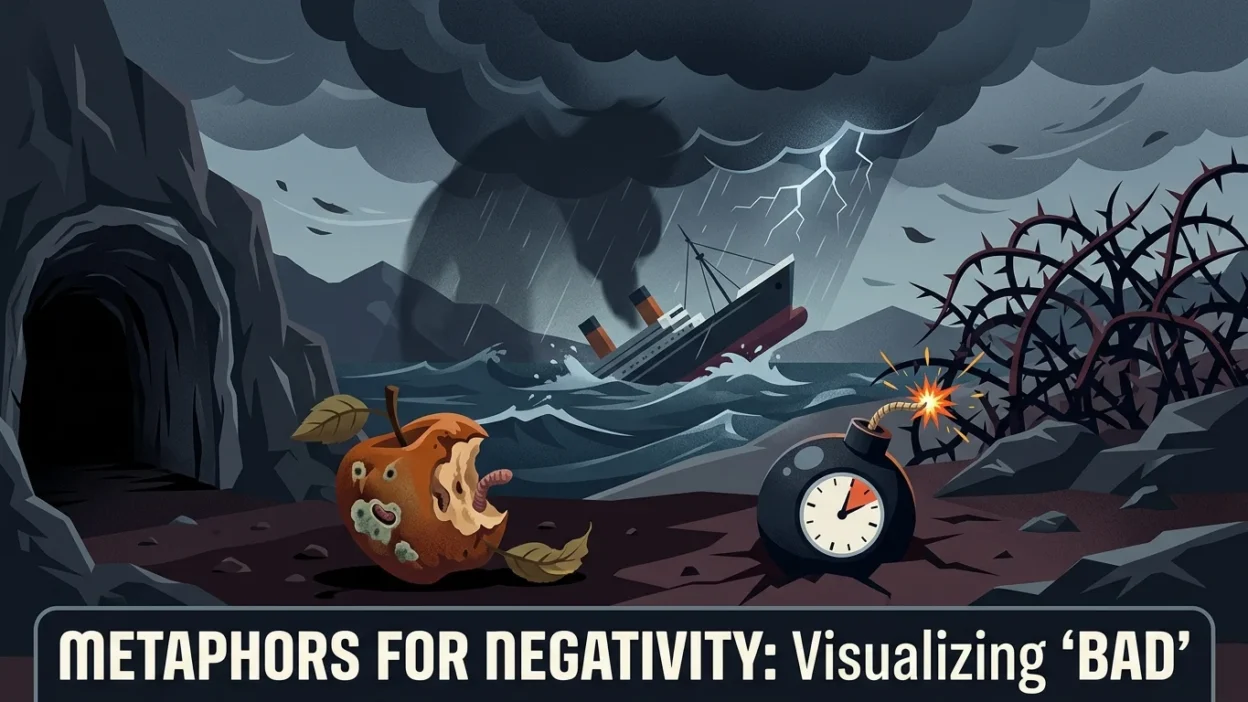
Something bad can be harmful, unpleasant, disappointing, dangerous, or difficult. Writers often use metaphors for bad to create stronger imagery and help readers feel the negative effect of a person, situation, decision, or experience.
If you are writing a story, poem, speech, review, or school assignment, these original metaphors will help you describe “bad” in a more vivid and memorable way.
Quick Answer
Metaphors for bad are figurative expressions that compare something negative to another image, such as a storm cloud, a rotten apple, a sinking ship, or a thorn bush. These literary devices add emotion and imagery to writing. They help readers understand that something is harmful, unpleasant, disappointing, or troublesome.
What Are Metaphors for Bad?
A metaphor compares something bad to another object or idea to highlight a negative quality.
For example:
“The project was a sinking ship.”
This does not mean the project was literally a ship. It means the project was failing and becoming difficult to save.
Metaphors are useful in:
- Creative writing
- Poetry
- Speeches
- Reviews
- School essays
- Storytelling
20 Original Metaphors for Bad
| Metaphor | Main Meaning |
|---|---|
| A storm cloud | Trouble approaching |
| A rotten apple | Something spoiled or harmful |
| A sinking ship | Failure and decline |
| A thorn bush | Pain and difficulty |
| A dead battery | No energy or usefulness |
| A cracked mirror | Something damaged |
| A poison vine | Harm that spreads |
| A black hole | Consuming resources or hope |
| A broken compass | Wrong direction |
| A rusted chain | Something weak and unreliable |
| A swamp | Stuck in a bad situation |
| A wildfire | Problems spreading quickly |
| A dark tunnel | Fear and uncertainty |
| A leaking roof | Ongoing problems |
| A tangled web | Complicated trouble |
| A shadow | Persistent negativity |
| A ticking bomb | Danger waiting to happen |
| A broken bridge | Lost connection or trust |
| A muddy road | Difficult progress |
| A frozen river | Stagnation and inability to move |
Detailed Meanings and Example Sentences
1. A storm cloud
Meaning: Trouble is coming.
Example sentences:
- A storm cloud hung over the company.
- The argument became a storm cloud over the family.
2. A rotten apple
Meaning: Something spoiled or harmful.
Example sentences:
- One rotten apple damaged the team.
- The dishonest worker was a rotten apple in the office.
3. A sinking ship
Meaning: A failing situation.
Example sentences:
- The business became a sinking ship.
- Investors left the sinking ship quickly.
4. A thorn bush
Meaning: Painful and difficult.
Example sentences:
- The negotiation was a thorn bush.
- Every conversation became a thorn bush of arguments.
5. A dead battery
Meaning: Lacking energy or usefulness.
Example sentences:
- After the long meeting, he felt like a dead battery.
- The old system was a dead battery.
6. A cracked mirror
Meaning: Damaged and imperfect.
Example sentences:
- The relationship became a cracked mirror.
- His confidence looked like a cracked mirror.
7. A poison vine
Meaning: Harm that spreads.
Example sentences:
- Rumors grew like a poison vine.
- The poison vine wrapped around the entire project.
8. A black hole
Meaning: Consuming resources or hope.
Example sentences:
- The debt became a black hole.
- The failed project turned into a black hole of money.
9. A broken compass
Meaning: Wrong direction.
Example sentences:
- The team followed a broken compass.
- His advice was a broken compass for young workers.
10. A rusted chain
Meaning: Weak and unreliable.
Example sentences:
- The agreement was a rusted chain.
- The old plan held together like a rusted chain.
11. A swamp
Meaning: Stuck in a bad situation.
Example sentences:
- The company was trapped in a swamp of debt.
- He felt stuck in a swamp of problems.
12. A wildfire
Meaning: Problems spreading rapidly.
Example sentences:
- The scandal became a wildfire.
- Anger spread through the crowd like a wildfire.
13. A dark tunnel
Meaning: Fear and uncertainty.
Example sentences:
- The future looked like a dark tunnel.
- She walked through a dark tunnel of worry.
14. A leaking roof
Meaning: Constant ongoing problems.
Example sentences:
- The old software was a leaking roof.
- Every week brought another drip from the leaking roof.
15. A tangled web
Meaning: Complicated trouble.
Example sentences:
- The lies created a tangled web.
- He became trapped in a tangled web of mistakes.
16. A shadow
Meaning: Persistent negativity.
Example sentences:
- A shadow followed the celebration.
- The failure cast a shadow over the team.
17. A ticking bomb
Meaning: Danger waiting to happen.
Example sentences:
- The unresolved issue was a ticking bomb.
- Everyone feared the ticking bomb would explode.
18. A broken bridge
Meaning: Lost trust or connection.
Example sentences:
- The argument left a broken bridge between them.
- Trust collapsed into a broken bridge.
19. A muddy road
Meaning: Difficult progress.
Example sentences:
- Recovery became a muddy road.
- The project moved slowly along a muddy road.
20. A frozen river
Meaning: Stagnation and inability to move.
Example sentences:
- The organization became a frozen river.
- His career felt like a frozen river.
How to Use Metaphors for Bad in Writing
Creative writing
Stories & novels
“A storm cloud gathered over the village.”
Poetry
Imagery & emotion
“A shadow stretched across the garden of hope.”
Speeches
Memorable language
“We must repair the broken bridge between our communities.”
School essays
Figurative language
“The author presents the conflict as a wildfire that spreads through the town.”
Common Mistakes
| Mistake | Better Choice |
|---|---|
| Using too many metaphors together | Choose one strong image |
| Mixing unrelated images | Keep the same theme |
| Explaining the metaphor too much | Let the image speak |
| Repeating the same metaphor | Use different negative images |
Similar Expressions
- A recipe for disaster
- A train wreck
- A nightmare
- A disaster waiting to happen
- A bad omen
- A lost cause
- A dangerous path
Creative Writing Tips
- Use storm cloud for approaching trouble.
- Use sinking ship for failure.
- Use ticking bomb for hidden danger.
- Use swamp for being stuck.
- Use dark tunnel for uncertainty and fear.
For example:
Weak: “The situation was bad.”
Stronger: “The situation had become a sinking ship drifting toward disaster.”
Practice Questions
Choose the best metaphor.
1. Which metaphor suggests failure?
- A. Sinking ship
- B. Sunrise
- C. Diamond
Answer: A
Explanation: A sinking ship represents a failing situation.
2. Which metaphor suggests approaching trouble?
- A. Storm cloud
- B. Treasure chest
- C. Rainbow
Answer: A
Explanation: Storm clouds signal trouble ahead.
3. Which metaphor suggests spreading harm?
- A. Poison vine
- B. Crystal waterfall
- C. Swan
Answer: A
Explanation: A vine grows and spreads.
4. Which metaphor suggests hidden danger?
- A. Ticking bomb
- B. Mountain peak
- C. Lighthouse
Answer: A
Explanation: A ticking bomb may explode unexpectedly.
5. Which metaphor suggests being stuck?
- A. Swamp
- B. Rocket
- C. Eagle
Answer: A
Explanation: A swamp makes movement difficult.
6. Which metaphor suggests damaged trust?
- A. Broken bridge
- B. Fireworks show
- C. Crown jewel
Answer: A
Explanation: A broken bridge symbolizes a lost connection.
7. Which metaphor suggests ongoing problems?
- A. Leaking roof
- B. Sunrise
- C. Butterfly
Answer: A
Explanation: A leaking roof keeps causing trouble.
8. Which metaphor suggests confusion and trouble?
- A. Tangled web
- B. Diamond
- C. Symphony
Answer: A
Explanation: A web can trap and confuse.
9. Which metaphor suggests difficulty moving forward?
- A. Muddy road
- B. Shooting star
- C. Treasure chest
Answer: A
Explanation: A muddy road slows progress.
10. Which metaphor suggests stagnation?
- A. Frozen river
- B. Rocket launch
- C. Peacock
Answer: A
Explanation: A frozen river cannot flow.
Frequently Asked Questions
What is a metaphor for bad?
A metaphor for bad is a figurative expression that compares something negative to another image, such as a storm cloud, sinking ship, or thorn bush.
Why do writers use metaphors for bad?
They create vivid imagery and help readers feel the negative impact more clearly.
Can I use these metaphors in a school essay?
Yes. They can improve descriptive writing and literary analysis.
What is a common metaphor for a bad situation?
“A sinking ship” is a common metaphor for a failing situation.
Are metaphors useful in reviews?
Yes. They make reviews more engaging and expressive.
How many metaphors should I use in one paragraph?
Usually one or two strong metaphors are enough.
Can I create my own metaphor for bad?
Absolutely. Original metaphors often make writing more creative and memorable.
Conclusion
Metaphors for bad help writers describe negative people, situations, experiences, and outcomes in a vivid and memorable way. By comparing something bad to a storm cloud, a rotten apple, a sinking ship, a thorn bush, or a ticking bomb, readers can better understand the feelings of trouble, failure, danger, and disappointment.
These figurative expressions are useful in stories, poems, speeches, reviews, and school assignments. The key is to choose a metaphor that matches the type of negativity you want to express.
With practice, you can use metaphors for bad naturally and make your writing more expressive, emotional, and engaging.

Charles Kevin is a passionate language writer and researcher at SimileHive, creating clear, engaging content about similes, idioms, metaphors, and figurative language to help readers improve English communication confidently every day.