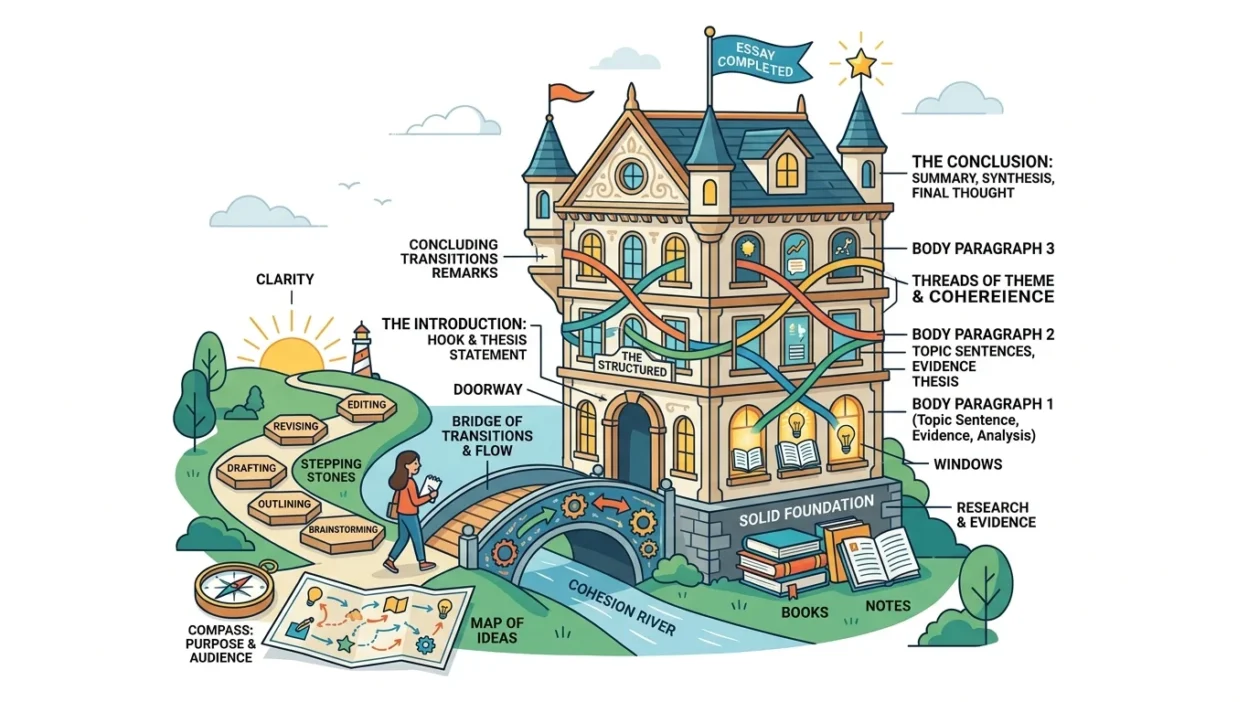
An essay is more than a collection of sentences. It is a way to share ideas, explain a topic, tell a story, or persuade a reader. Good metaphors can make an essay more interesting because they turn simple ideas into clear pictures. Instead of only saying that an essay has a strong argument, you can say “The argument is a sturdy bridge.” This gives the reader a stronger image.
Metaphors for essays are especially useful when writing introductions, body paragraphs, conclusions, and personal reflections. They can help explain education, knowledge, arguments, ideas, problems, progress, and many other topics. However, a metaphor should support your meaning rather than make the writing confusing.
In this guide, you will find 20 original metaphors for essays, with simple meanings, explanations, and example sentences. You will also learn how to use these metaphors in creative writing, common mistakes to avoid, similar expressions, and practical tips for making your essays clearer and more engaging.
Quick Answer
Metaphors for essays describe writing, ideas, arguments, and structure through familiar images. Examples include an essay is a building, an argument is a bridge, an introduction is a doorway, and a conclusion is a landing place. These metaphors make abstract writing ideas easier to understand.
What Are Metaphors for Essays?
A metaphor directly compares one thing to another without using like or as.
For example:
“An essay is a journey.”
An essay is not literally a journey. The metaphor means that an essay takes the reader through a series of ideas.
Metaphors can describe both the essay itself and the ideas inside it.
Why Use Metaphors in Essays?
Metaphors can:
- Make writing more interesting
- Explain complex ideas simply
- Create memorable images
- Add personality to an essay
- Make arguments easier to understand
- Help readers connect with abstract ideas
20 Original Metaphors for Essays
| Metaphor | Meaning |
|---|---|
| An essay is a journey. | It takes readers through connected ideas. |
| An essay is a building. | Different parts work together to create a whole. |
| An introduction is a doorway. | It welcomes readers into the topic. |
| A conclusion is a landing place. | It brings the discussion to a clear end. |
| An argument is a bridge. | It connects ideas and evidence. |
| Evidence is a foundation. | It supports the main argument. |
| A thesis is a compass. | It gives the essay direction. |
| A paragraph is a stepping stone. | Each paragraph moves the reader forward. |
| Ideas are seeds. | Small ideas can grow into strong arguments. |
| Words are paint. | They add detail and feeling to writing. |
| An essay is a map. | It shows readers where the discussion is going. |
| Research is a toolbox. | It provides useful information and evidence. |
| A topic is a doorway. | It opens into a larger discussion. |
| A strong argument is an anchor. | It keeps the essay focused. |
| Transitions are roads. | They connect different parts of the essay. |
| Examples are windows. | They help readers see an idea clearly. |
| A weak argument is a shaky bridge. | It cannot support the reader’s trust. |
| Editing is a polishing cloth. | It improves and cleans the writing. |
| A conclusion is a final note. | It leaves the reader with a lasting thought. |
| A good essay is a woven fabric. | Ideas and evidence work together. |
An Essay Is a Journey
Meaning
An essay takes the reader from one idea to another.
Explanation
A journey has a beginning, a path, and an ending. A well organized essay has an introduction, connected body paragraphs, and a conclusion.
Example Sentences
- An essay is a journey through the writer’s ideas.
- Her essay took the reader on a journey from the problem to the solution.
An Essay Is a Building
Meaning
An essay has different parts that work together.
Explanation
A building needs a foundation, walls, and a roof. An essay also needs a thesis, supporting paragraphs, evidence, and a conclusion.
Example Sentences
- An essay is a building made from ideas.
- Each paragraph became another strong part of the building.
An Introduction Is a Doorway
Meaning
An introduction welcomes readers into the topic.
Explanation
A doorway is the entrance to a building. An introduction is the entrance to an essay.
Example Sentences
- The introduction was a doorway into the main argument.
- Her opening paragraph opened a doorway to the topic.
A Conclusion Is a Landing Place
Meaning
A conclusion gives the essay a clear ending.
Explanation
A landing place is where a journey comes to rest. A conclusion gives readers a final understanding of the topic.
Example Sentences
- The conclusion was a peaceful landing place.
- His final paragraph brought the essay to its landing place.
An Argument Is a Bridge
Meaning
An argument connects ideas and evidence.
Explanation
A bridge connects two sides. A strong argument connects a claim with reasons and evidence.
Example Sentences
- Her argument was a bridge between the problem and the solution.
- Strong evidence strengthened the bridge.
Evidence Is a Foundation
Meaning
Evidence supports an argument.
Explanation
A building needs a strong foundation to remain stable. An argument also needs reliable support.
Example Sentences
- Evidence is the foundation of a strong essay.
- His facts created a solid foundation for the argument.
A Thesis Is a Compass
Meaning
A thesis gives an essay direction.
Explanation
A compass helps travelers know which way to go. A thesis helps writers stay focused on the main point.
Example Sentences
- The thesis was a compass guiding the entire essay.
- Without a clear thesis, the writer lost the compass.
A Paragraph Is a Stepping Stone
Meaning
Each paragraph moves the reader toward the main conclusion.
Explanation
Stepping stones help someone cross from one side to another.
Example Sentences
- Every paragraph was a stepping stone toward the final idea.
- The writer used clear stepping stones to build the argument.
Ideas Are Seeds
Meaning
Small ideas can develop into strong arguments.
Explanation
A seed begins small but can grow into something much larger.
Example Sentences
- Her first idea was a seed that grew into an entire essay.
- Good questions planted seeds for deeper thinking.
Words Are Paint
Meaning
Words add detail and expression to writing.
Explanation
Paint adds color and detail to a picture. Carefully chosen words can do the same for an essay.
Example Sentences
- Words are the paint of a writer’s canvas.
- He used simple words to paint a clear picture.
An Essay Is a Map
Meaning
An essay gives readers a path through the topic.
Explanation
A map helps travelers understand where they are going.
Example Sentences
- Her essay was a map through a difficult subject.
- Clear headings made the essay an easy map to follow.
Research Is a Toolbox
Meaning
Research provides information that writers can use.
Explanation
A toolbox contains different tools for different jobs. Research provides facts, examples, and ideas for building an essay.
Example Sentences
- Research is a toolbox for thoughtful writers.
- Each source added another useful tool.
A Topic Is a Doorway
Meaning
A topic can lead to many ideas.
Explanation
A doorway provides access to another space. A topic can open the way to a larger discussion.
Example Sentences
- The topic was a doorway into a deeper conversation.
- Climate change became a doorway to many related questions.
A Strong Argument Is an Anchor
Meaning
A strong argument keeps an essay focused.
Explanation
An anchor keeps a boat from drifting away.
Example Sentences
- Her thesis was an anchor for the entire essay.
- A clear argument kept the discussion anchored.
Transitions Are Roads
Meaning
Transitions connect different ideas.
Explanation
Roads connect different places. Transition words connect sentences and paragraphs.
Example Sentences
- Transitions are roads between ideas.
- Clear transitions created a smooth road through the essay.
Examples Are Windows
Meaning
Examples help readers understand an idea.
Explanation
A window lets people see something more clearly. Examples give readers a clearer view of an argument.
Example Sentences
- Examples are windows into difficult ideas.
- Her real life examples opened windows for the reader.
A Weak Argument Is a Shaky Bridge
Meaning
A weak argument does not provide enough support.
Explanation
A shaky bridge makes travelers uncertain and unsafe. A poorly supported argument can make readers doubt the writer’s point.
Example Sentences
- Without evidence, the argument was a shaky bridge.
- Weak facts left the bridge unstable.
Editing Is a Polishing Cloth
Meaning
Editing improves the quality of writing.
Explanation
A polishing cloth removes marks and makes something look better. Editing removes errors and improves clarity.
Example Sentences
- Editing is a polishing cloth for an essay.
- Careful editing polished every paragraph.
A Conclusion Is a Final Note
Meaning
A conclusion leaves the reader with a final idea.
Explanation
A final note completes a piece of music. A conclusion completes an essay.
Example Sentences
- The conclusion was a final note of hope.
- Her final paragraph left a powerful note in the reader’s mind.
A Good Essay Is a Woven Fabric
Meaning
Different parts of an essay work together.
Explanation
Fabric is made by weaving many threads together. A strong essay connects ideas, evidence, examples, and explanations.
Example Sentences
- A good essay is a woven fabric of ideas.
- Each piece of evidence became another thread in the essay.
Common Mistakes
- Using too many metaphors in one essay.
- Mixing unrelated metaphors.
- Choosing metaphors that are difficult to understand.
- Using a metaphor without explaining its connection.
- Allowing figurative language to replace clear evidence.
- Repeating the same comparison too often.
Similar Expressions
- Build an argument
- Support a claim
- Lay the foundation
- Follow a line of thought
- Open the discussion
- Explore an idea
- Connect the dots
- Reach a conclusion
- Strengthen an argument
- Develop an idea
Creative Writing Tips
- Use one strong metaphor rather than several weak ones.
- Choose metaphors that match your topic.
- Use familiar images such as roads, bridges, buildings, and windows.
- Keep your main argument clear.
- Use metaphors to support your ideas rather than replace evidence.
- Create original comparisons that fit your own message.
Practice Questions
1. Which metaphor represents the whole structure of an essay?
Answer: An essay is a building.
Explanation: A building has different parts that work together, just like an essay.
2. Which metaphor represents the beginning of an essay?
Answer: An introduction is a doorway.
Explanation: A doorway is an entrance, just as an introduction brings readers into the topic.
3. Which metaphor represents the main direction of an essay?
Answer: A thesis is a compass.
Explanation: A compass gives direction, while a thesis keeps an essay focused.
4. Which metaphor represents support for an argument?
Answer: Evidence is a foundation.
Explanation: A foundation supports a building, while evidence supports an argument.
5. Which metaphor represents connected ideas?
Answer: An argument is a bridge.
Explanation: A bridge connects two sides, just as an argument connects claims and evidence.
6. Which metaphor represents paragraph structure?
Answer: A paragraph is a stepping stone.
Explanation: Each paragraph helps move the reader toward the main conclusion.
7. Which metaphor represents examples?
Answer: Examples are windows.
Explanation: Examples help readers see an idea more clearly.
8. Which metaphor represents editing?
Answer: Editing is a polishing cloth.
Explanation: Editing removes mistakes and makes writing clearer, just as polishing improves an object.
9. Which metaphor represents transitions?
Answer: Transitions are roads.
Explanation: Roads connect places, while transitions connect ideas.
10. Why do writers use metaphors in essays?
Answer: They make abstract ideas clearer, more vivid, and more memorable.
Explanation: Metaphors connect difficult ideas with familiar images that readers can easily understand.
FAQs
What are metaphors for essays?
Metaphors for essays compare writing, arguments, evidence, and ideas to familiar objects or experiences.
Why use metaphors in an essay?
Metaphors can make abstract ideas easier to understand and make writing more engaging.
Can metaphors make an essay better?
Yes, when used carefully. A clear metaphor can add depth and help readers understand an idea.
What is a good metaphor for an introduction?
An introduction is a doorway is a useful metaphor because it shows that the introduction welcomes readers into the topic.
What is a good metaphor for a thesis?
A thesis is a compass works well because a thesis gives the essay direction.
What is a metaphor for evidence?
Evidence is a foundation shows that facts and examples provide support for an argument.
Should every essay contain metaphors?
No. Metaphors are optional. They should be used when they make an idea clearer or more interesting.
What is the difference between a metaphor and a simile?
A metaphor directly says one thing is another, while a simile uses like or as to make a comparison.
Conclusion
Metaphors can make essays more vivid by turning abstract writing ideas into familiar pictures. An essay can become a journey, a building, a map, or a woven fabric. A thesis can act as a compass, evidence can form a foundation, and examples can become windows that help readers see an idea clearly.
These comparisons are useful in creative writing because they add meaning without making the message difficult to understand. However, good essays still need clear arguments, strong evidence, and logical organization. Use metaphors as helpful tools, not as replacements for clear writing.
With practice, you can use them naturally to make your essays more engaging and memorable.

Adam Aaron is a language enthusiast and content writer at SimileHive, creating clear, engaging guides on similes, idioms, metaphors, and figurative language to help readers improve English confidently every day.