
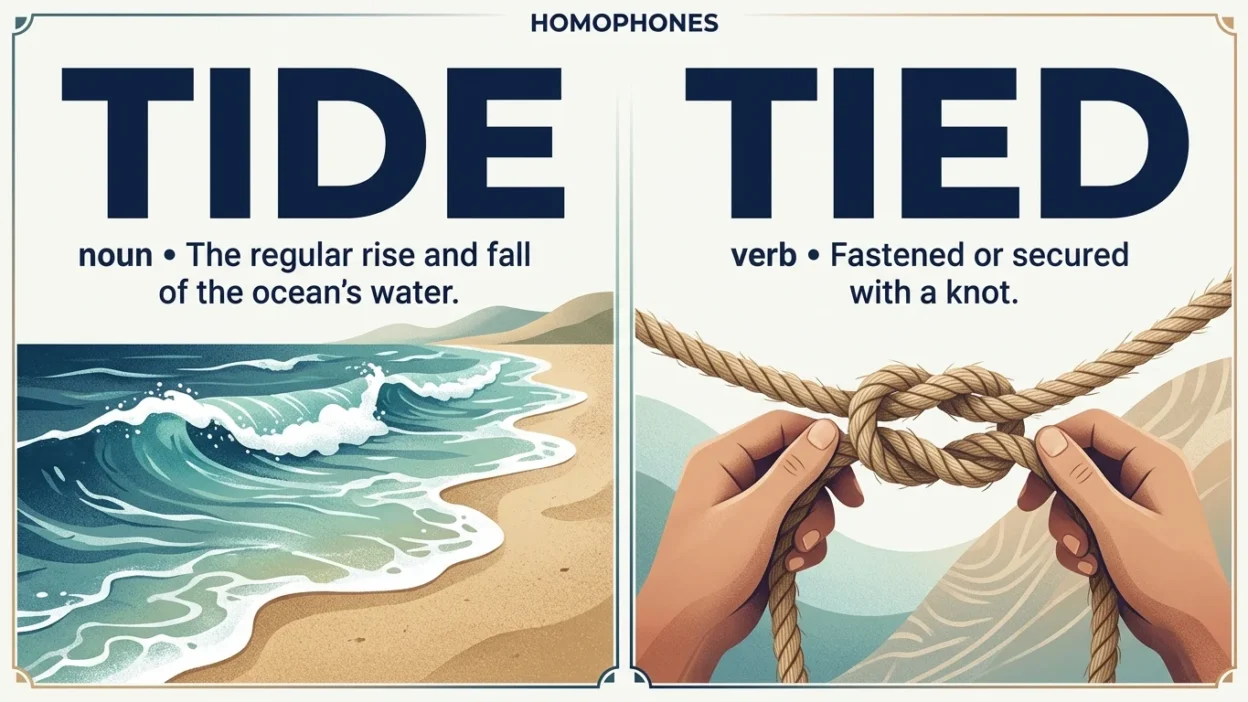
Tide and tied are two commonly confused English words. They sound exactly alike, but they have different spellings, meanings, and grammatical uses. The main difference is that tide is a noun that usually refers to the regular rise and fall of the sea, while tied is the past tense and past participle of the verb tie, meaning fastened, connected, or secured with something.
For example, you might watch the tide come in at the beach, or you might have tied your shoes before going outside. Although these words are pronounced identically, using one in place of the other can change the meaning of a sentence completely.
Understanding the difference between tide and tied will help you avoid spelling mistakes and use both words confidently in everyday writing.
Quick Answer: Tide vs Tied
Tide refers to the regular rise and fall of the sea, or a general movement or change in circumstances. Tied is the past tense and past participle of tie, meaning fastened, attached, or connected. Both words sound alike, but their meanings and grammatical functions are different. Use tide for the sea and tied for something that has been fastened or linked.
What Does Tide Mean?
Tide is a noun that primarily describes the regular rise and fall of sea levels caused mainly by the gravitational forces of the Moon and the Sun.
It can also refer figuratively to a general movement, trend, or change in public opinion, events, or circumstances.
Examples of Tide in a Sentence
- The tide is coming in, so we should move away from the shore.
- We watched the tide go out in the evening.
- The fishermen waited for the right tide.
- The boat was carried toward the shore by the incoming tide.
- The children enjoyed playing in the sand at low tide.
- The high tide covered most of the beach.
- The tide changed direction as the evening progressed.
- The tide of public opinion began to turn.
- The government struggled to reverse the tide of criticism.
- A new tide of enthusiasm swept through the community.
Common Expressions With Tide
Here are some common expressions that use the word tide:
1. High tide
The period when the sea reaches its highest level.
Example: We arrived at the beach just before high tide.
2. Low tide
The period when the sea reaches its lowest level.
Example: The rocks became visible during low tide.
3. Turn the tide
To change a situation, especially one that is becoming difficult or unfavorable.
Example: The new strategy helped turn the tide of the competition.
4. Stem the tide
To stop or slow down an unwanted development.
Example: The authorities introduced new measures to stem the tide of illegal activities.
5. A rising tide lifts all boats
An expression suggesting that improving economic or social conditions can benefit many people.
Example: The mayor believes that a stronger economy will help everyone because a rising tide lifts all boats.
What Does Tied Mean?
Tied is the past tense and past participle of the verb tie. It means fastened, secured, attached, or connected using a string, rope, ribbon, or another method.
It can also describe a situation in which two or more people or teams have the same score.
Additionally, tied can mean closely connected or associated with something.
Examples of Tied in a Sentence
- She tied her hair with a ribbon.
- He tied his shoes before leaving the house.
- The package was tied with a piece of string.
- They tied the boat to the wooden post.
- The dog was tied to a tree.
- I tied the two ropes together.
- The football match ended with both teams tied at two goals each.
- The candidates were tied in the final round.
- His success is closely tied to his hard work.
- The company is financially tied to several international partners.
Common Expressions With Tied
1. Tied up
Busy or occupied with something.
Example: I cannot talk right now because I am tied up with work.
2. Tied down
Restricted or prevented from acting freely because of responsibilities or obligations.
Example: She does not want to feel tied down by unnecessary commitments.
3. Be tied to
To be connected or associated with someone or something.
Example: The company’s future is closely tied to the economy.
4. Tie the knot
An informal expression meaning to get married. Its past form is tied the knot.
Example: They tied the knot in a small ceremony last year.
5. Tied for first place
To share first place because two or more competitors have the same score.
Example: The two athletes are tied for first place.
Tide vs Tied: Comparison Table
| Feature | Tide | Tied |
|---|---|---|
| Part of speech | Noun | Past tense and past participle of a verb |
| Main meaning | Rise and fall of sea levels | Fastened, secured, or connected |
| Pronunciation | /taɪd/ | /taɪd/ |
| Example | The tide is high. | She tied her hair. |
| Common association | Sea, ocean, movement, trends | Knots, ropes, connections, scores |
When Should You Use Tide?
Use tide when discussing the sea’s movement or describing a general change or trend.
Examples:
- The tide is unusually high today.
- We waited for the tide to go out.
- The incoming tide brought the boat closer to shore.
- A tide of public support helped the candidate win.
- The team hopes to turn the tide in the second half.
Remember that tide is generally a noun. It does not mean that something has been fastened.
When Should You Use Tied?
Use tied when referring to something that has been fastened, secured, connected, or linked.
It is also used when describing equal scores or positions in a competition.
Examples:
- I tied the package with a ribbon.
- The horse was tied to a fence.
- Their scores were tied at the end of the game.
- She tied her hair into a ponytail.
- His career is closely tied to the entertainment industry.
Remember that tied is the past tense or past participle of tie.
Tide vs Tied: How to Remember the Difference
A simple memory trick can help you distinguish these words.
- Tide contains the letter combination associated with side and ride. Think of the seaside and ocean movement.
- Tied contains the same spelling pattern as the past tense of tie. Think of tying a shoelace or knot.
Another useful trick is to replace the word in your sentence.
If you mean the sea’s movement, use tide.
If you mean something was fastened, connected, or equal in score, use tied.
Common Mistakes to Avoid
Mistake 1: Using Tied When Referring to the Sea
Incorrect: The tied is coming in.
Correct: The tide is coming in.
Use tide when talking about the movement of the sea.
Mistake 2: Using Tide When Referring to Something Fastened
Incorrect: She tide her shoes.
Correct: She tied her shoes.
Use tied as the past tense of tie.
Mistake 3: Confusing Tied With Tidy
Tied means fastened or connected, while tidy means neat and organized.
Examples:
- She tied the ribbon around the gift.
- She kept her bedroom tidy.
Mistake 4: Forgetting That Tied Can Describe Equal Scores
Incorrect: The two teams were tide at the end of the match.
Correct: The two teams were tied at the end of the match.
Use tied when competitors have the same score.
Are Tide and Tied Homophones?
Yes. Tide and tied are homophones because they have the same pronunciation but different spellings and meanings.
Other common examples of homophones include:
- Sea and see
- Right and write
- Pair and pear
- One and won
- Flour and flower
- Break and brake
Homophones can cause spelling mistakes because you cannot always identify the correct word by listening to it. You need to understand the meaning of the sentence.
Frequently Asked Questions
1. Is it tide or tied?
Both words are correct, but they have different meanings. Tide refers mainly to the rise and fall of the sea, while tied means fastened, connected, or equal in score.
2. What is the past tense of tide?
Tide is primarily a noun, so it does not have a regular past tense. The verb tide exists in certain expressions, such as tide someone over, meaning to help someone through a difficult period. Its past tense is tided.
3. Is tied the past tense of tie?
Yes. Tied is both the simple past tense and the past participle of tie.
Examples:
- Past tense: She tied the rope.
- Present perfect: She has tied the rope.
4. Do tide and tied sound the same?
Yes. Both are pronounced /taɪd/. They are homophones, meaning they sound alike but have different spellings and meanings.
5. What does tied mean in sports?
In sports, tied means that two or more competitors have the same score.
Example: The match was tied at 1 to 1.
6. What does turn the tide mean?
Turn the tide means to change the direction of a situation, especially one that is unfavorable.
Example: The new coach helped turn the tide and improve the team’s performance.
7. Is it tied up or tide up?
The correct expression is tied up. It can mean fastened, occupied, or restricted, depending on the context.
Example: I am tied up with work today.
Remember This
- Tide = the rise and fall of the sea, or a general movement or trend.
- Tied = fastened, connected, or equal in score.
- Both words sound the same.
- Tied is the past tense and past participle of tie.
- Tide is commonly used in expressions such as high tide, low tide, and turn the tide.
Final Verdict
The difference between tide and tied is simple once you understand their meanings. Tide is mainly a noun referring to the regular movement of the sea, although it can also describe a general trend or change. Tied is the past tense and past participle of tie, meaning fastened, secured, connected, or equal in score.
Although they sound exactly alike, they cannot be used interchangeably. Remember to use tide when discussing the sea or a changing trend and tied when describing something that has been fastened or connected.

Charles Kevin is a passionate language writer and researcher at SimileHive, creating clear, engaging content about similes, idioms, metaphors, and figurative language to help readers improve English communication confidently every day.


