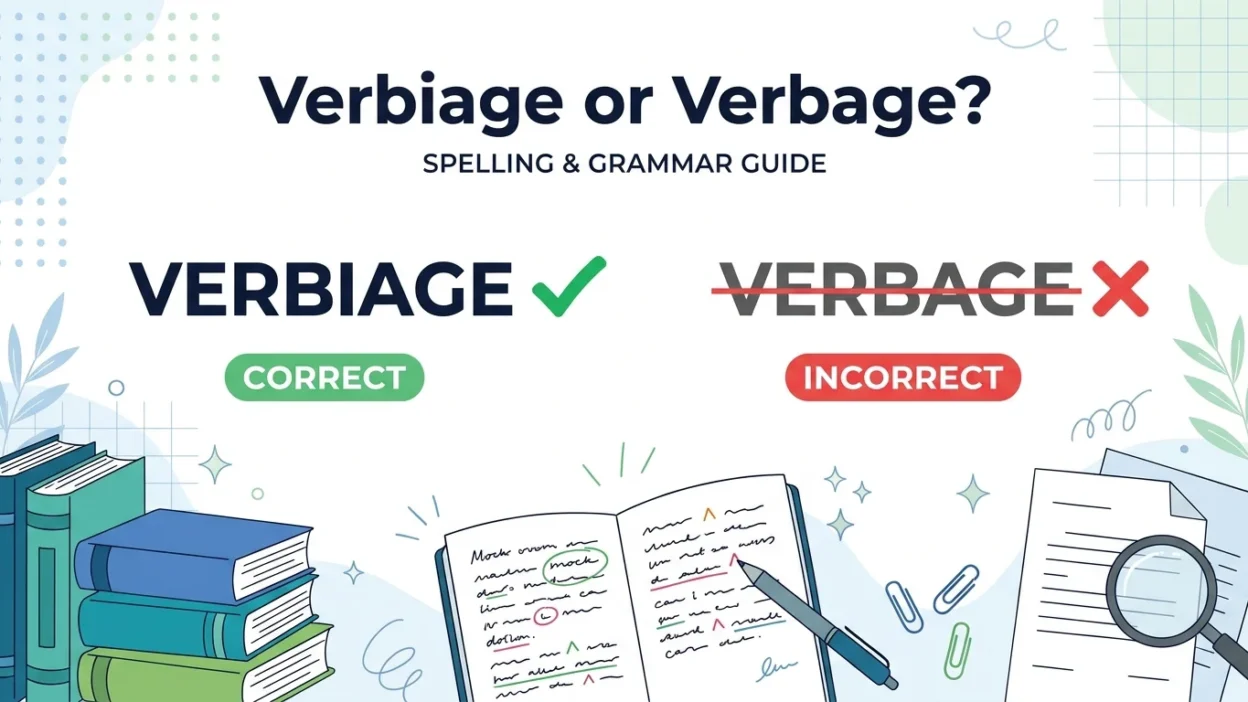
Is it verbiage or verbage? If you have ever been unsure about these two spellings, you are not alone. The correct spelling in standard English is verbiage, with an extra letter i. The word verbage is a common misspelling and is not accepted as the standard spelling.
Verbiage is a noun that refers to the words used to express something, especially when the language is unnecessarily complicated, excessive, or wordy. It can also refer more neutrally to the wording or language used in a document, speech, or conversation. Understanding the correct spelling and meaning can help you communicate more clearly in academic, professional, and everyday writing.
Quick Answer: Verbiage or Verbage?
Verbiage is the correct spelling. It refers to the words or wording used to express an idea, often suggesting unnecessarily complicated or excessive language. Verbage is a misspelling and should generally be avoided in formal and standard English writing. For example: “The report contains too much unnecessary verbiage.”
What Does Verbiage Mean?
Verbiage is a noun referring to the words, expressions, or wording used to communicate something.
It is often used when someone thinks that a person is using too many words or making a simple message unnecessarily complicated.
However, the word does not always have a negative meaning. It can also refer simply to the wording of a document or statement.
Examples:
- The contract contains complicated legal verbiage.
- Please remove unnecessary verbiage from your essay.
- The manager asked us to simplify the verbiage in the report.
- I found the verbiage of the instructions difficult to understand.
In these examples, verbiage refers to the language or wording being used.
What Does Verbage Mean?
Verbage is generally considered a misspelling of verbiage.
Although people sometimes write or use it informally, it is not the standard spelling found in accepted English usage.
If you want to refer to excessive wording, complicated language, or the wording of a document, use verbiage, not verbage.
Incorrect: The article contains unnecessary verbage.
Correct: The article contains unnecessary verbiage.
Verbiage vs Verbage: Key Differences
| Feature | Verbiage | Verbage |
|---|---|---|
| Spelling | Correct | Incorrect |
| Part of speech | Noun | Not standard |
| Meaning | Words or wording used to express something | Usually intended as verbiage |
| Standard English | Accepted | Not accepted as the standard spelling |
| Formal writing | Recommended | Avoid |
When Should You Use Verbiage?
Use verbiage when discussing the wording, language, or amount of language used in communication.
1. When Referring to Excessive Words
Verbiage often describes language that contains more words than necessary.
Example: The introduction contains unnecessary verbiage that should be removed.
2. When Discussing Complicated Language
Use the word when referring to language that is difficult to understand because of its complexity.
Example: The legal verbiage made the agreement confusing for ordinary readers.
3. When Discussing the Wording of a Document
Verbiage can also refer neutrally to the exact wording used in written material.
Example: The company revised the verbiage of its privacy policy.
4. When Editing or Improving Writing
Writers and editors may use the term when discussing unnecessary or unclear wording.
Example: The editor suggested removing repetitive verbiage from the article.
10 Example Sentences With Verbiage
Here are ten examples showing how to use verbiage correctly:
- The report contains too much unnecessary verbiage.
- Please simplify the verbiage so everyone can understand the instructions.
- The lawyer explained the complicated legal verbiage.
- The company changed the verbiage in its official statement.
- Good writing communicates ideas without excessive verbiage.
- I struggled to understand the technical verbiage in the manual.
- The teacher advised students to avoid unnecessary verbiage in their essays.
- The contract uses formal verbiage throughout.
- The speaker’s message was clear despite the complicated verbiage.
- We need to review the verbiage before publishing the document.
Common Mistakes to Avoid
Here are some common mistakes involving verbiage.
Mistake 1: Writing verbage instead of verbiage
Incorrect: The report contains too much verbage.
Correct: The report contains too much verbiage.
Mistake 2: Assuming verbiage always means unnecessary words
Verbiage often has a negative meaning, but it can also refer neutrally to the wording used in a document or statement.
Mistake 3: Using verbiage when a simpler word would be clearer
Sometimes words such as wording, language, or text are more appropriate.
For example:
- Original: The verbiage of the message was confusing.
- Simpler: The wording of the message was confusing.
Verbiage Synonyms and Related Words
Depending on the context, you can use several alternatives to verbiage.
| Word | Meaning |
|---|---|
| Wording | The particular words used to express something |
| Language | Words and expressions used in communication |
| Wordiness | The use of more words than necessary |
| Verbosity | Excessive use of words |
| Phrasing | The way something is expressed |
| Expression | A way of communicating an idea |
| Text | Written words or material |
| Prose | Written or spoken language in its ordinary form |
Remember that these words are not always interchangeable. For example, wordiness and verbosity specifically suggest excessive wording, while wording is usually neutral.
How to Remember the Correct Spelling
A simple way to remember the correct spelling is to focus on the middle letters:
VERB + I + AGE = VERBIAGE
Remember that verbiage contains the letter i after verb.
You can also remember this example:
“Good writing avoids unnecessary verbiage.”
Whenever you need this word, remember to include the extra i.
Frequently Asked Questions
1. Is verbiage or verbage correct?
Verbiage is the correct standard spelling. Verbage is a common misspelling and should be avoided in formal writing.
2. What does verbiage mean?
Verbiage refers to the words or wording used to express something. It often describes language that is unnecessarily complicated or excessive.
3. Is verbiage a real word?
Yes. Verbiage is an established English noun used in everyday, academic, and professional communication.
4. Is verbiage always a negative word?
No. Although it often suggests excessive or complicated wording, it can also refer neutrally to the language used in a document, statement, or speech.
5. What is another word for verbiage?
Depending on the context, alternatives include wording, language, phrasing, wordiness, and verbosity.
6. How do you pronounce verbiage?
Verbiage is commonly pronounced VUR-bee-ij. Its pronunciation can vary slightly between English accents.
7. What is the plural of verbiage?
Verbiage is generally used as an uncountable noun, so it normally does not have a plural form. For example, say “unnecessary verbiage” rather than “unnecessary verbiages.”
8. Can I use verbiage in formal writing?
Yes. Verbiage is an accepted word in formal English. It is particularly useful when discussing wording, complicated language, or excessive use of words.
Remember This
- Verbiage is the correct spelling.
- Verbage is a common misspelling.
- Verbiage is a noun referring to words, wording, or language.
- It often suggests excessive or unnecessarily complicated language.
- The letter i after verb is essential to the correct spelling.
Conclusion
The correct spelling is verbiage, not verbage. Although the incorrect version may appear in informal writing or online conversations, it is not the standard form. Remember to include the letter i when writing this word.
Verbiage can describe excessive wording, complicated language, or simply the wording used in a particular document or statement. Once you remember its spelling and meaning, you can use it confidently in both everyday and professional English.

Charles Kevin is a passionate language writer and researcher at SimileHive, creating clear, engaging content about similes, idioms, metaphors, and figurative language to help readers improve English communication confidently every day.