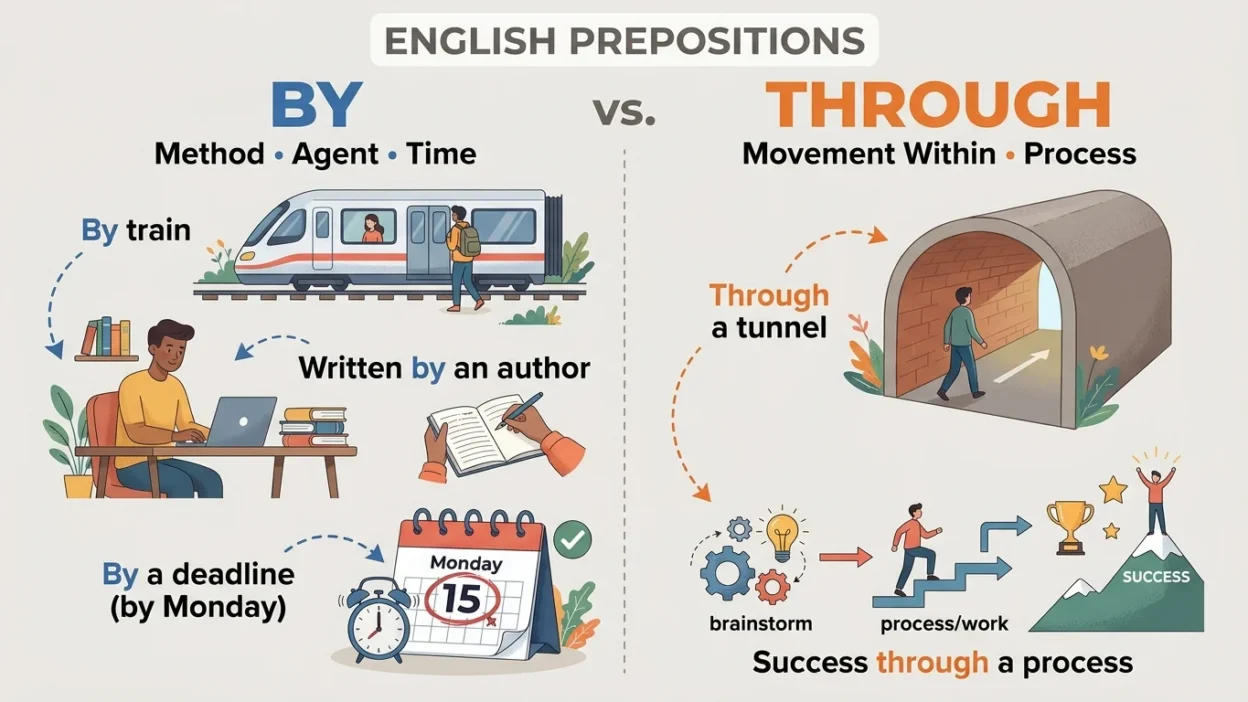
The words by and through are common English prepositions, but they are not always interchangeable. Both can describe how something happens or how someone achieves a result. However, by usually identifies the person, method, means, or deadline involved, while through often emphasizes a process, route, medium, or experience. For example, “I travelled by train” identifies the means of transportation, while “I walked through the tunnel” describes movement from one side of a passage to the other.
Choosing between these prepositions can sometimes be confusing because their meanings overlap in certain expressions. You might say that you received information by email or through email, depending on the intended emphasis. Understanding their differences will help you write more naturally and communicate your meaning clearly.
Quick Answer: By vs Through
By generally identifies the person who performs an action, the method used, or the deadline for completing something. Through usually describes movement from one side of something to another, a process, an experience, or a channel through which something happens. For example, “I sent the document by email” identifies the method, while “I learned about the opportunity through a friend” emphasizes the source or channel.
1. What Does By Mean?
By is a preposition with several meanings. It is commonly used to identify the person who performs an action, the method used to achieve something, or the latest time by which an action should be completed.
Here are its most common uses.
A. By to Identify the Person Performing an Action
Use by in passive sentences to identify the person or thing responsible for an action.
Examples:
- The novel was written by a famous author.
- The painting was created by a local artist.
- The report was prepared by the manager.
- The building was designed by an experienced architect.
- The song was performed by a talented musician.
In these sentences, by introduces the person responsible for the action.
B. By to Describe a Method or Means
Use by to explain how something is done or achieved.
Examples:
- I travel to work by bus.
- She improved her English by practising every day.
- You can contact me by email.
- He paid the bill by credit card.
- They solved the problem by working together.
Here, by identifies the method or means used.
C. By to Indicate a Deadline
Use by when something must happen no later than a particular time.
Examples:
- Please submit the assignment by Monday.
- I will finish the report by tomorrow.
- You must arrive by 9 a.m.
- The payment should be made by the end of the month.
- She promised to return by sunset.
Remember that by Monday means on Monday or before Monday, but not after the deadline.
D. By to Describe Proximity
Use by to indicate that something is near or beside another thing.
Examples:
- She sat by the window.
- There is a small shop by the station.
- He was standing by the door.
- We walked by the river.
- I left my bag by the sofa.
In these examples, by means near or beside.
E. By to Describe Differences or Measurements
Use by when expressing the amount of a difference or change.
Examples:
- The price increased by 10 percent.
- She won the race by two seconds.
- The company reduced its expenses by $5,000.
- He missed the target by a few centimetres.
- The population grew by 2 percent.
2. What Does Through Mean?
Through is a preposition and adverb that commonly describes movement from one side of something to another. It can also refer to a process, experience, or channel used to achieve or communicate something.
Here are its common uses.
A. Through to Describe Movement
Use through when someone or something moves from one side of an enclosed space, opening, or area to another.
Examples:
- We walked through the tunnel.
- The train passed through the mountain.
- Sunlight came through the window.
- The children ran through the garden.
- The road goes through the forest.
In these examples, through emphasizes movement within a space or from one side to another.
B. Through to Describe a Process
Use through when something happens as a result of a process or series of steps.
Examples:
- She succeeded through hard work.
- He learned patience through experience.
- The company improved its services through careful planning.
- They achieved their goals through teamwork.
- I gained confidence through regular practice.
Here, through emphasizes the process or experience that leads to a result.
C. Through to Describe a Channel or Source
Use through when identifying a person, organization, or channel that makes something possible or provides access to information.
Examples:
- I found the job through a friend.
- She received the invitation through her colleague.
- We learned about the event through social media.
- He got the information through an official source.
- They contacted the company through its website.
In these examples, through identifies the channel or intermediary involved.
D. Through to Describe an Experience
Use through when referring to something a person experiences or endures.
Examples:
- She went through a difficult period.
- We have been through many challenges.
- He went through a painful experience.
- They are going through financial difficulties.
- I went through a lot before finding a suitable job.
This use often refers to difficult or significant experiences.
E. Through to Describe Completion
Use through in expressions that indicate completion or reaching the end of something.
Examples:
- I am through with my homework.
- She read through the entire report.
- We worked through the night.
- He went through the documents carefully.
- The team is nearly through with the project.
The precise meaning depends on the expression and context.
3. By vs Through: What Is the Difference?
The main difference is that by often identifies an agent, method, means, or deadline, while through often emphasizes a route, process, experience, or channel.
| Feature | By | Through |
|---|---|---|
| Main meaning | Identifies an agent, method, means, or deadline | Describes a route, process, experience, or channel |
| Person performing an action | Yes | Not usually in passive sentences |
| Method | Yes | Yes, in certain contexts |
| Movement | Near or past something | From one side to another or within a space |
| Deadline | Yes | No, not in the same sense |
| Process | Sometimes | Commonly |
| Experience | Limited use | Commonly |
| Example | The book was written by Sarah. | We walked through the forest. |
Compare These Examples
Example 1: Learning English
- I improved my English by practising daily.
- I improved my English through regular practice.
Both are correct. The first emphasizes the method, while the second emphasizes the process or experience.
Example 2: Communication
- I contacted him by email.
- I contacted him through his assistant.
The first identifies the communication method. The second identifies the person who acted as an intermediary.
Example 3: Transportation
- We travelled by train.
- We travelled through the tunnel.
The first identifies the means of transportation. The second describes the route.
Example 4: Time
- Please complete the work by Friday.
- We worked through Friday.
The first gives a deadline. The second suggests that the work continued throughout Friday.
4. When Should You Use By?
Use by when you want to identify the person responsible for an action, the method used, a deadline, or something located nearby.
Common expressions include:
- By hand
- By chance
- By mistake
- By accident
- By email
- By phone
- By car
- By train
- By Monday
- By the end of the day
- By yourself
- By all means
More Examples
- The letter was written by my brother.
- She completed the task by herself.
- I usually travel by bus.
- Please send your response by email.
- We need to finish the project by Thursday.
- He succeeded by working hard.
- I found the wallet by accident.
- She stood by the entrance.
- The price increased by five dollars.
- They solved the issue by discussing it calmly.
5. When Should You Use Through?
Use through when describing movement, a process, an experience, or a channel that connects you with something.
Common expressions include:
- Through experience
- Through hard work
- Through a friend
- Through the window
- Through the tunnel
- Through the forest
- Through the night
- Go through a difficult time
- Read through a document
- Look through the files
- Get through a problem
- Break through a barrier
More Examples
- We walked through the park.
- She gained confidence through experience.
- I heard about the vacancy through a friend.
- The sunlight entered through the window.
- He went through a difficult childhood.
- They worked through the night.
- I looked through the documents.
- The river flows through the valley.
- She got through the examination successfully.
- The company reached new customers through social media.
6. By vs Through in Communication
Both prepositions can describe communication, but the intended meaning may differ.
By Email vs Through Email
By email identifies email as the method of communication.
Example: Please send me the documents by email.
Through email can emphasize email as a channel through which communication or information takes place.
Example: We received the invitation through email.
Both expressions are possible, although by email is often the more natural choice when simply identifying the method of sending something.
By Phone vs Through a Phone
By phone means using a telephone to communicate.
Example: I confirmed the appointment by phone.
Through a phone generally means something happens by means of a phone as a device or channel.
Example: He received the notification through his phone.
The choice depends on what you want to emphasize.
7. By vs Through in Time Expressions
One important difference appears when these prepositions are used with time.
By usually establishes a deadline. It means that something should happen no later than a specified time.
Through can indicate that something continues throughout a period.
Compare:
| Expression | Meaning | Example |
|---|---|---|
| By Friday | No later than Friday | Submit the report by Friday. |
| Through Friday | Continuing until the end of Friday | The office will remain open through Friday. |
| By tomorrow | No later than tomorrow | I will complete the work by tomorrow. |
| Through tomorrow | Continuing until the end of tomorrow | The promotion is available through tomorrow. |
Remember that by focuses on the latest time something can happen, while through emphasizes the duration of an activity or condition.
8. By vs Through in Passive Sentences
Both prepositions can appear in passive constructions, but they perform different functions.
Use by to identify the person or thing that performs the action.
Example:
- The book was written by an experienced author.
Use through to identify the process, channel, or means through which something happens.
Example:
- The problem was solved through careful investigation.
Another comparison:
- The agreement was reached by the two companies.
- The agreement was reached through lengthy negotiations.
In the first sentence, by identifies the parties responsible. In the second, through identifies the process that led to the agreement.
9. Common Mistakes When Using By and Through
Mistake 1: Confusing a Deadline With a Duration
Incorrect: I will work by midnight.
If you mean that you will continue working until midnight, use:
Correct: I will work through midnight.
If you mean that you will finish no later than midnight, say:
Correct: I will finish the work by midnight.
Mistake 2: Using Through Instead of By for Transportation
Incorrect: I travel through bus.
Correct: I travel by bus.
Use by to identify the usual means of transportation.
Mistake 3: Using By to Describe Movement Inside a Space
Incorrect: We walked by the tunnel.
If you mean that you entered and crossed the tunnel, say:
Correct: We walked through the tunnel.
However, walked by the tunnel can be correct if you mean that you passed near it.
Mistake 4: Confusing the Agent With the Process
Incorrect: The novel was written through the author.
Correct: The novel was written by the author.
Use by to identify who wrote the novel.
Mistake 5: Assuming Both Words Are Always Interchangeable
Incorrect: Please submit the assignment through Monday.
If Monday is the deadline, the natural expression is:
Correct: Please submit the assignment by Monday.
If submissions are accepted for the entire day on Monday, through Monday may also be appropriate.
10. Is By or Through More Formal?
Neither word is inherently more formal than the other. Both are standard prepositions used in formal and informal English.
The choice depends on the intended meaning rather than the level of formality.
Examples:
- Formal: The report was prepared by the research team.
- Formal: The information was collected through interviews.
- Informal: I usually travel by bus.
- Informal: We walked through the park.
Both words are appropriate in academic writing, business communication, everyday conversation, and professional documents.
Frequently Asked Questions
1. What is the main difference between by and through?
By commonly identifies an agent, method, means, or deadline. Through commonly describes movement, a process, an experience, or a channel.
2. Should I say by email or through email?
Both are possible. By email is generally the more common choice when identifying email as the method of communication. Through email can emphasize email as a channel.
3. Is it by Friday or through Friday?
Use by Friday when Friday is the deadline. Use through Friday when something continues until the end of Friday.
4. Is it by bus or through bus?
The correct expression is by bus when describing your means of transportation.
Example: I travel to school by bus.
5. Can I use through to describe a process?
Yes. Through is commonly used to describe a process or experience that leads to a result.
Example: She gained knowledge through practical experience.
6. Is by yourself or through yourself correct?
By yourself means alone or without help.
Example: You should complete the assignment by yourself.
Through yourself is not normally used to express this meaning.
7. Can by and through be used in the same sentence?
Yes. They can have different functions in the same sentence.
Example: The information was collected by researchers through interviews.
Here, by identifies the people responsible for collecting the information, while through identifies the method they used.
8. Is through always about physical movement?
No. It can also describe a process, experience, communication channel, or means of achieving something.
Example: He became successful through hard work.
Remember This
- By identifies an agent, method, means, deadline, or nearby location.
- Through describes movement, a process, an experience, or a channel.
- Use by bus, not through bus, when describing transportation.
- Use by Friday for a deadline.
- Use through Friday when something continues throughout that day.
- Use written by to identify the author.
- Use through experience to describe learning or development.
- Both words can sometimes describe methods, but the emphasis may differ.
Conclusion
Although by and through sometimes have similar meanings, they serve different purposes in English. By is commonly used to identify who performs an action, how something is done, or when something must be completed. Through usually emphasizes movement, a process, an experience, or a channel that makes something possible.
The easiest way to remember the distinction is to think of by as identifying the agent, method, or deadline, while through emphasizes the route, process, or experience. Once you understand these common uses, choosing the correct preposition becomes much easier.

Charles Kevin is a passionate language writer and researcher at SimileHive, creating clear, engaging content about similes, idioms, metaphors, and figurative language to help readers improve English communication confidently every day.