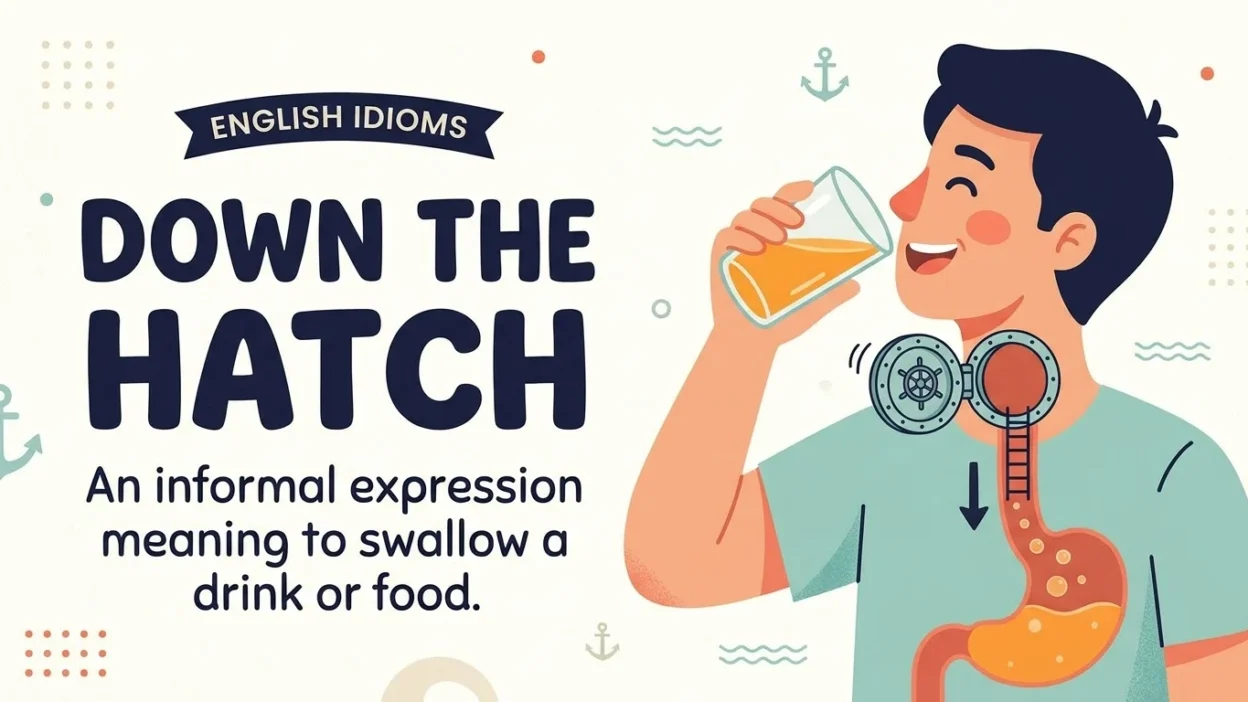
Have you ever heard someone say “Down the hatch!” before drinking something? This informal English expression is commonly used when someone is about to swallow a drink, take a sip, or sometimes eat something. It is often said jokingly or cheerfully, especially when people are enjoying a meal or sharing drinks with friends.
The word hatch traditionally refers to an opening or entrance, particularly on a ship. In this expression, it humorously represents the mouth or throat. Therefore, telling someone “Down the hatch!” is like encouraging them to send their drink or food down their throat.
Although the expression is often associated with drinking alcohol, it is not limited to alcoholic beverages. It can also be used when someone is taking medicine, drinking water, or swallowing food. Understanding its meaning and context will help you recognize and use this popular idiom naturally.
Quick Answer: What Does Down the Hatch Mean?
“Down the hatch” is an informal English expression used when someone is about to swallow a drink or food. It is often said playfully before taking a drink, particularly an alcoholic one. For example, someone might say, “Here’s your juice. Down the hatch!” It humorously compares the mouth or throat to an opening through which something passes.
1. What Does Down the Hatch Mean?
Down the hatch is an informal idiom that means to swallow something, especially a drink.
It is commonly used as a cheerful or humorous comment just before someone drinks something. The expression can also be used when encouraging someone to take medicine or swallow food.
Examples of Down the Hatch in Sentences
- He raised his glass and said, “Down the hatch!”
- Here’s your medicine. Down the hatch!
- She finished her glass of water in one go. Down the hatch!
- Everyone laughed when Mark said, “Down the hatch!” before drinking his juice.
- The doctor gave him a spoonful of medicine and encouraged him to get it down the hatch.
- I was thirsty, so I poured myself a glass of water and sent it down the hatch.
- The children were reluctant to take their medicine, but their mother encouraged them to get it down the hatch.
- He drank the entire glass without stopping. Down the hatch!
- Before taking the unpleasant tasting medicine, she took a deep breath and swallowed it.
- “Down the hatch!” he joked before taking a sip of his coffee.
2. Is Down the Hatch an Idiom or a Slang Expression?
Down the hatch is generally classified as an idiom or informal expression.
An idiom is a phrase whose meaning cannot always be understood from the individual words. In this case, hatch does not literally mean a person’s mouth. Instead, it is used humorously to represent the opening through which food or drink passes.
The expression is informal, so it is more suitable for casual conversations than formal writing.
For example:
Informal:
“Down the hatch!” he said before drinking his lemonade.
Formal:
He drank his lemonade.
Both sentences communicate the action, but the first includes a playful expression.
3. When Do People Use Down the Hatch?
People use this expression in several everyday situations.
A. Before Drinking Alcohol
This is one of the most familiar contexts for the expression.
Example:
Everyone raised their glasses, and Tom said, “Down the hatch!”
Here, the expression is used playfully before drinking.
B. Before Drinking Water or Juice
The phrase is not restricted to alcoholic beverages.
Example:
She handed me a glass of water and said, “Down the hatch!”
C. When Taking Medicine
People sometimes use the expression to encourage someone to swallow medicine, particularly when it tastes unpleasant.
Example:
“Come on, take your medicine. Down the hatch!”
D. When Eating Food
Although less common than its use with drinks, the expression can also refer to swallowing food.
Example:
He took a large bite of the sandwich and sent it down the hatch.
E. As a Joke Among Friends
The expression is often used humorously in informal conversations.
Example:
“Are you ready for that extra spicy sauce?”
“Down the hatch!” she replied.
4. Where Does the Expression Down the Hatch Come From?
The expression is associated with the word hatch, which refers to an opening or entrance, particularly an opening in the deck or structure of a ship.
A hatch allows people or objects to pass from one area to another. The expression humorously compares the mouth or throat to such an opening.
The idea is that food or drink goes down through the mouth and throat, just as something might pass through a hatch.
The phrase became associated with drinking and swallowing. Its exact historical development is less certain than its modern meaning, but its figurative image makes the expression easy to understand.
5. Is Down the Hatch Only Used for Alcohol?
No. Although the expression is frequently associated with drinking alcoholic beverages, it can be used for many other things.
Here are some examples:
| Situation | Example |
|---|---|
| Drinking alcohol | He raised his glass and said, “Down the hatch!” |
| Drinking water | She drank the cold water. Down the hatch! |
| Taking medicine | Take your medicine. Down the hatch! |
| Drinking juice | He finished his orange juice in seconds. |
| Swallowing food | He swallowed the last bite and sent it down the hatch. |
The expression is most natural when someone is about to swallow something. Its use with food is possible, although less common.
6. Similar Expressions to Down the Hatch
Several other English expressions are used when people are drinking or swallowing something.
| Expression | Meaning | Example |
|---|---|---|
| Bottoms up! | A cheerful expression encouraging someone to drink | Everyone raised their glasses. Bottoms up! |
| Cheers! | An expression used when raising glasses or wishing someone well | Cheers to a wonderful evening! |
| Drink up! | Finish your drink | Drink up before we leave. |
| Take a sip | Drink a small amount | Take a sip of water. |
| Knock it back | Drink something quickly | He knocked back his glass of juice. |
| Swallow it down | Make something go down the throat | She swallowed the medicine down. |
Down the Hatch vs Bottoms Up
Both expressions are commonly used before drinking, but they have slightly different tones.
- Down the hatch: A playful expression that focuses on swallowing the drink.
- Bottoms up: A cheerful expression that often encourages someone to finish a drink.
Examples:
- “Down the hatch!” he said before taking his medicine.
- “Bottoms up!” she said before drinking with her friends.
Bottoms up is more strongly associated with drinking, while down the hatch can also refer to medicine and food.
7. Common Mistakes When Using Down the Hatch
Although the expression is easy to understand, learners sometimes misunderstand its meaning or use it in unsuitable situations.
| Mistake | Correct understanding |
|---|---|
| Thinking it only refers to alcohol | It can refer to water, juice, medicine, and food. |
| Using it in formal reports | It is an informal expression best suited to casual situations. |
| Thinking a hatch literally means the mouth | The mouth or throat is represented figuratively. |
| Assuming it always means drinking quickly | It can simply be said before swallowing something. |
| Treating it as a greeting | It is an expression associated with swallowing, not a general greeting. |
8. How to Remember Down the Hatch
Think of a hatch as an opening through which something passes.
When you drink water, juice, or another beverage, it travels through your mouth and down your throat. The expression humorously describes this action.
Memory trick:
- Hatch: An opening.
- Down: Moving through or toward a lower point.
- Down the hatch: Swallow it!
For example, when someone says, “Down the hatch!” before drinking a glass of water, they are playfully referring to swallowing the drink.
Frequently Asked Questions
1. What does down the hatch mean in simple words?
It means to swallow something, usually a drink. It is an informal expression often said just before someone drinks or takes medicine.
2. Is down the hatch a drinking expression?
Yes. It is commonly used before drinking, particularly in casual or humorous situations. However, it can also refer to swallowing medicine or food.
3. Does down the hatch mean drink quickly?
Not necessarily. It is often used before someone takes a drink, but it does not always mean that the person must drink quickly or finish the entire glass.
4. Is down the hatch the same as bottoms up?
They have similar uses because both can be said before drinking. However, bottoms up more directly encourages someone to drink, while down the hatch humorously refers to swallowing something.
5. Can you say down the hatch when taking medicine?
Yes. You can use it humorously to encourage someone to swallow medicine.
Example: “Here’s your cough syrup. Down the hatch!”
6. Is down the hatch formal or informal?
It is informal. It is suitable for conversations with friends, family members, and people in relaxed social settings. It is generally unsuitable for formal or academic writing.
7. What is the origin of down the hatch?
The expression draws on the meaning of hatch as an opening, particularly on a ship. It humorously compares the mouth or throat to an opening through which food and drink pass.
8. Can down the hatch be used for food?
Yes. It can refer to swallowing food, although it is more commonly associated with drinking.
Example: “He took another bite and sent it down the hatch.”
Remember This
- Down the hatch is an informal English idiom.
- It means to swallow something, especially a drink.
- It is commonly used before drinking.
- It can also refer to taking medicine or eating food.
- It is often humorous and playful.
- It is similar to expressions such as bottoms up and drink up.
Conclusion
The expression down the hatch is a playful and informal way to refer to swallowing something. Although it is commonly associated with drinking alcohol, it can also be used when someone drinks water, takes medicine, or swallows food.
The phrase uses the image of a hatch, or opening, to represent the mouth and throat. Once you understand this figurative meaning, it becomes easy to recognize and use the expression in everyday English. Just remember that it is best suited to casual conversations rather than formal writing.

Charles Kevin is a passionate language writer and researcher at SimileHive, creating clear, engaging content about similes, idioms, metaphors, and figurative language to help readers improve English communication confidently every day.