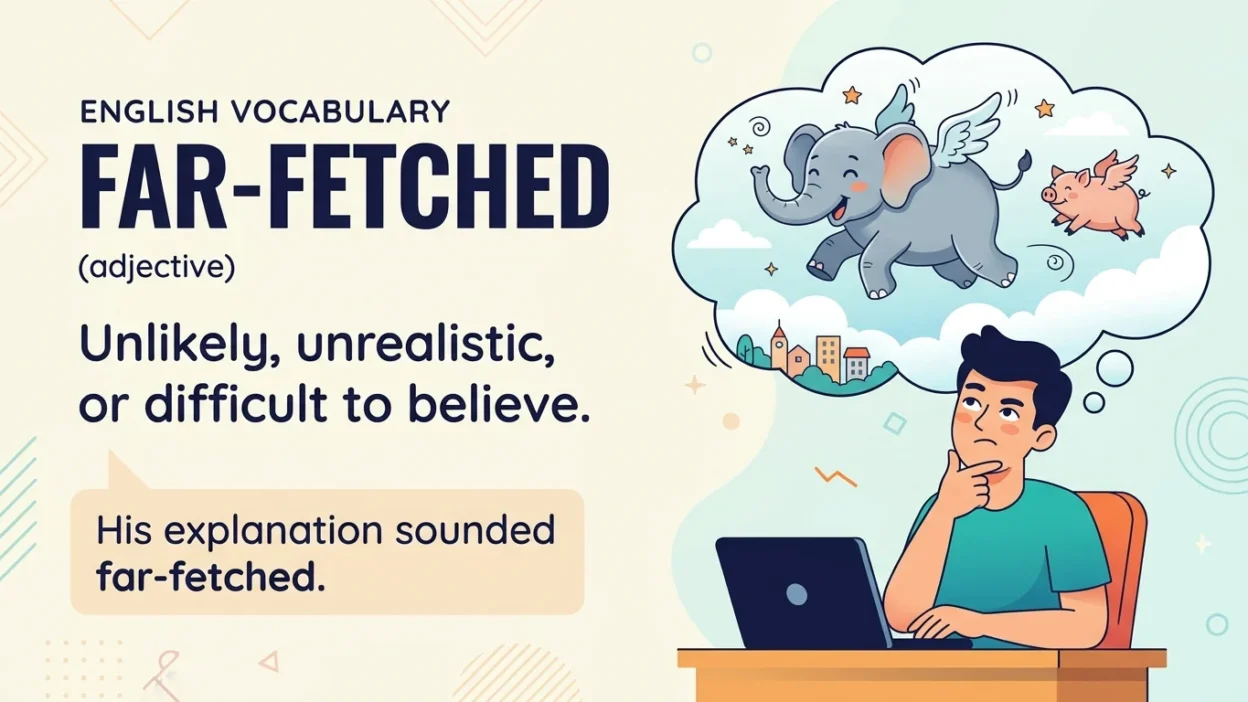
Have you ever heard someone describe an explanation, story, or idea as far-fetched? The expression far-fetched means unlikely, difficult to believe, or not supported by convincing evidence. It is commonly used when an idea or explanation seems unrealistic, exaggerated, or too improbable to be accepted easily.
For example, if someone claims that they saw a dinosaur walking through a modern city, you might describe that claim as far-fetched. The expression does not necessarily mean something is impossible. Instead, it suggests that the idea is so unusual or unlikely that people may find it difficult to believe.
Far-fetched is often used in everyday conversations, storytelling, discussions, reviews, and arguments. Understanding its meaning and proper usage will help you express doubt or question the credibility of an idea without always calling it impossible.
Quick Answer: What Does Far-Fetched Mean?
Far-fetched is an adjective that describes something unlikely, unrealistic, or difficult to believe. It is often used for explanations, stories, excuses, claims, and theories that seem exaggerated or lack convincing evidence. For example, “His excuse for missing the meeting sounded far-fetched” means his explanation was difficult to believe.
1. What Does Far-Fetched Mean?
Far-fetched means unlikely to be true, difficult to believe, or not very convincing.
It describes something that seems too unusual, exaggerated, or improbable to be accepted as reasonable.
The expression is commonly used when someone doubts the truthfulness or credibility of a statement, explanation, story, or idea.
Examples of Far-Fetched in Sentences
- His explanation for arriving late sounded far-fetched.
- The movie has an interesting story, but some of its scenes are far-fetched.
- She gave a far-fetched excuse for not attending the meeting.
- The detective rejected the suspect’s far-fetched explanation.
- It seems far-fetched to believe that one person could complete all this work in an hour.
- His theory about the mysterious lights was too far-fetched to convince anyone.
- The journalist questioned the far-fetched claims made by the politician.
- Although the story was entertaining, its ending felt far-fetched.
- I find it far-fetched that they completed the entire project without any assistance.
- The explanation sounded so far-fetched that nobody took it seriously.
In these examples, far-fetched expresses doubt about whether something is realistic or believable.
2. Is Far-Fetched an Idiom or an Adjective?
Far-fetched is an adjective. It is also commonly described as an idiomatic expression because its figurative meaning is different from the literal meanings of its individual words.
It describes nouns such as:
- Explanation
- Excuse
- Story
- Claim
- Theory
- Idea
- Argument
- Scenario
- Suggestion
- Assumption
Examples
- A far-fetched explanation
- A far-fetched excuse
- A far-fetched story
- A far-fetched theory
- A far-fetched claim
You can also use it after linking verbs such as seem, sound, look, and feel.
Examples:
- His story sounds far-fetched.
- The explanation seems far-fetched.
- That theory looks far-fetched.
- The ending feels far-fetched.
3. Why Is It Called Far-Fetched?
The expression comes from the idea of fetching or bringing something from far away.
In its figurative sense, an idea that is far-fetched seems to have been brought from so far away from ordinary experience or reality that it is difficult to accept.
In other words, the idea stretches the limits of what people consider reasonable or believable.
For example:
“His explanation was far-fetched.”
This suggests that his explanation was so unusual or unlikely that it was difficult to believe.
The expression has developed into a common way of describing improbable ideas, exaggerated claims, and unrealistic explanations.
4. When Should You Use Far-Fetched?
Use far-fetched when you want to express doubt about the credibility or realism of something.
Here are some common situations.
A. When Discussing an Unbelievable Story
You can use far-fetched when a story contains events that seem unlikely or unrealistic.
Example:
The novel was entertaining, but its plot was rather far-fetched.
B. When Questioning an Excuse
If someone gives an explanation that you find difficult to believe, you can describe it as far-fetched.
Example:
His excuse for forgetting the appointment was far-fetched.
C. When Discussing a Theory
The expression is useful when a theory seems unlikely or lacks convincing support.
Example:
The theory that aliens built every ancient monument is far-fetched.
D. When Reviewing Movies or Books
Writers and reviewers often use far-fetched to criticize unrealistic plots or characters.
Example:
The film’s ending was so far-fetched that it weakened the entire story.
E. When Evaluating an Argument
You can use the expression when someone’s reasoning seems unreasonable or improbable.
Example:
It is far-fetched to assume that everyone will agree with the proposal.
5. Far-Fetched vs Far Fetched: Which Spelling Is Correct?
The standard spelling is far-fetched, with a hyphen.
It is a compound adjective made up of far and fetched. The hyphen connects the two words and shows that they work together to express one meaning.
| Form | Correctness | Example |
|---|---|---|
| Far-fetched | Standard spelling | That explanation sounds far-fetched. |
| Far fetched | Nonstandard in this expression | That explanation sounds far fetched. |
| Farfetched | Nonstandard spelling | That explanation sounds farfetched. |
Use far-fetched in standard written English.
6. Far-Fetched vs Unbelievable vs Improbable
These words have similar meanings, but they are not always interchangeable.
| Word | Meaning | Example |
|---|---|---|
| Far-fetched | Unlikely or difficult to believe because it seems unrealistic | His explanation was far-fetched. |
| Unbelievable | So surprising or unlikely that it is difficult to believe | The news was unbelievable. |
| Improbable | Unlikely to happen or be true | It is improbable that they will arrive today. |
| Implausible | Not seeming reasonable or believable | The witness gave an implausible account. |
| Absurd | Extremely unreasonable or ridiculous | That is an absurd suggestion. |
| Outlandish | Very unusual, strange, or unconventional | He made an outlandish claim. |
What Is the Difference?
- Far-fetched: Often suggests that an idea or explanation stretches the limits of credibility.
- Unbelievable: Can describe something extremely surprising, whether positively or negatively.
- Improbable: Focuses on the low likelihood of something happening or being true.
- Implausible: Suggests that something does not seem reasonable or convincing.
- Absurd: Expresses a stronger judgment that something is ridiculous or unreasonable.
Example:
“His story is far-fetched” suggests that the story is difficult to believe.
“His story is absurd” expresses a much stronger criticism.
7. Synonyms and Antonyms of Far-Fetched
Synonyms of Far-Fetched
Depending on the context, you can use these alternatives:
- Improbable
- Implausible
- Unbelievable
- Unlikely
- Unrealistic
- Incredible
- Outlandish
- Exaggerated
- Unconvincing
- Preposterous
Antonyms of Far-Fetched
The following words express the opposite idea:
- Believable
- Plausible
- Credible
- Convincing
- Reasonable
- Realistic
- Probable
- Sensible
- Logical
- Likely
Examples:
- Far-fetched: His explanation sounded far-fetched.
- Plausible: His explanation sounded plausible.
- Far-fetched: The theory is highly unlikely.
- Credible: The theory is supported by credible evidence.
8. Common Expressions With Far-Fetched
Here are some common combinations that will help you use the expression naturally.
| Expression | Example |
|---|---|
| Far-fetched idea | That is a far-fetched idea. |
| Far-fetched theory | The researcher rejected the far-fetched theory. |
| Far-fetched explanation | His far-fetched explanation confused everyone. |
| Far-fetched excuse | She gave a far-fetched excuse for being absent. |
| Far-fetched story | Nobody believed his far-fetched story. |
| Far-fetched claim | The newspaper questioned the far-fetched claim. |
| Far-fetched assumption | That is a far-fetched assumption. |
| Too far-fetched | The movie’s plot was too far-fetched. |
9. Common Mistakes When Using Far-Fetched
Here are some mistakes to avoid.
| Incorrect or less natural | Correct or better |
|---|---|
| His explanation was farfetched. | His explanation was far-fetched. |
| That is a far fetched idea. | That is a far-fetched idea. |
| He gave a far-fetch excuse. | He gave a far-fetched excuse. |
| The story is far-fetching. | The story is far-fetched. |
| It is very far-fetchedly explained. | The explanation is very far-fetched. |
Important Grammar Tips
1. Far-fetched is an adjective.
It describes a person’s explanation, an idea, a theory, or another noun.
2. Use a hyphen.
The standard spelling is far-fetched.
3. Do not confuse it with far-reaching.
Far-reaching means having a wide or significant effect, while far-fetched means unlikely or difficult to believe.
Example:
- The decision had far-reaching consequences.
- His explanation was far-fetched.
10. Far-Fetched vs Far-Reaching
These expressions look similar, but their meanings are quite different.
| Expression | Meaning | Example |
|---|---|---|
| Far-fetched | Unlikely or difficult to believe | That sounds like a far-fetched theory. |
| Far-reaching | Having a wide or significant effect | The law introduced far-reaching changes. |
Remember that far-fetched relates to credibility, while far-reaching relates to impact or influence.
Frequently Asked Questions
1. What does far-fetched mean in simple words?
Far-fetched means unlikely, unrealistic, or difficult to believe. It is used when a story, excuse, explanation, or idea seems too unusual or improbable to be true.
2. Is far-fetched positive or negative?
It is generally negative because it expresses doubt or criticism about the credibility of something. However, it can be used playfully when discussing an imaginative or unusual story.
3. Is far-fetched one word or two?
It is written as two words connected by a hyphen: far-fetched. This is the standard spelling.
4. Can far-fetched describe a person?
It does not normally describe a person directly. Instead, it describes something associated with that person, such as their explanation, excuse, theory, or claim.
For example: “His explanation was far-fetched.”
5. What is another word for far-fetched?
Common alternatives include implausible, improbable, unbelievable, unrealistic, and unconvincing. The best choice depends on the context.
6. What is the opposite of far-fetched?
Common opposites include plausible, believable, credible, reasonable, and realistic.
7. Is far-fetched the same as unrealistic?
They have similar meanings, but there is a slight difference. Unrealistic describes something that does not reflect reality or practical conditions. Far-fetched specifically suggests that something is so unlikely or unusual that it is difficult to believe.
8. What is the difference between far-fetched and far-reaching?
Far-fetched means unlikely or difficult to believe. Far-reaching means having a wide or significant impact.
For example, a far-fetched theory is difficult to believe, while a far-reaching decision has consequences in many areas.
Remember This
- Far-fetched means unlikely, unrealistic, or difficult to believe.
- It is an adjective.
- It is commonly used to describe stories, explanations, excuses, claims, and theories.
- The standard spelling includes a hyphen.
- Similar words include implausible, improbable, and unbelievable.
- Opposites include plausible, credible, and believable.
- Do not confuse far-fetched with far-reaching.
Conclusion
The expression far-fetched is used to describe something that seems unlikely, unrealistic, or difficult to believe. It is especially useful when discussing exaggerated stories, questionable explanations, unusual theories, or claims that lack credibility. Although it does not always mean something is impossible, it suggests that the idea stretches the limits of what seems reasonable.
Remember to write it with a hyphen and use it as an adjective. When you hear someone say that an explanation is far-fetched, they are expressing doubt about whether it is believable. Understanding this expression will help you communicate your opinions more naturally and precisely.

Adam Aaron is a language enthusiast and content writer at SimileHive, creating clear, engaging guides on similes, idioms, metaphors, and figurative language to help readers improve English confidently every day.