The terms sociopath and psychopath are often used to describe people who show little empathy, disregard other people’s feelings, or engage in harmful behavior. Although the two words are sometimes used interchangeably, they are not exactly the same in popular psychological discussions. Both are commonly associated with antisocial personality traits, but people often use them to describe different patterns of behavior.
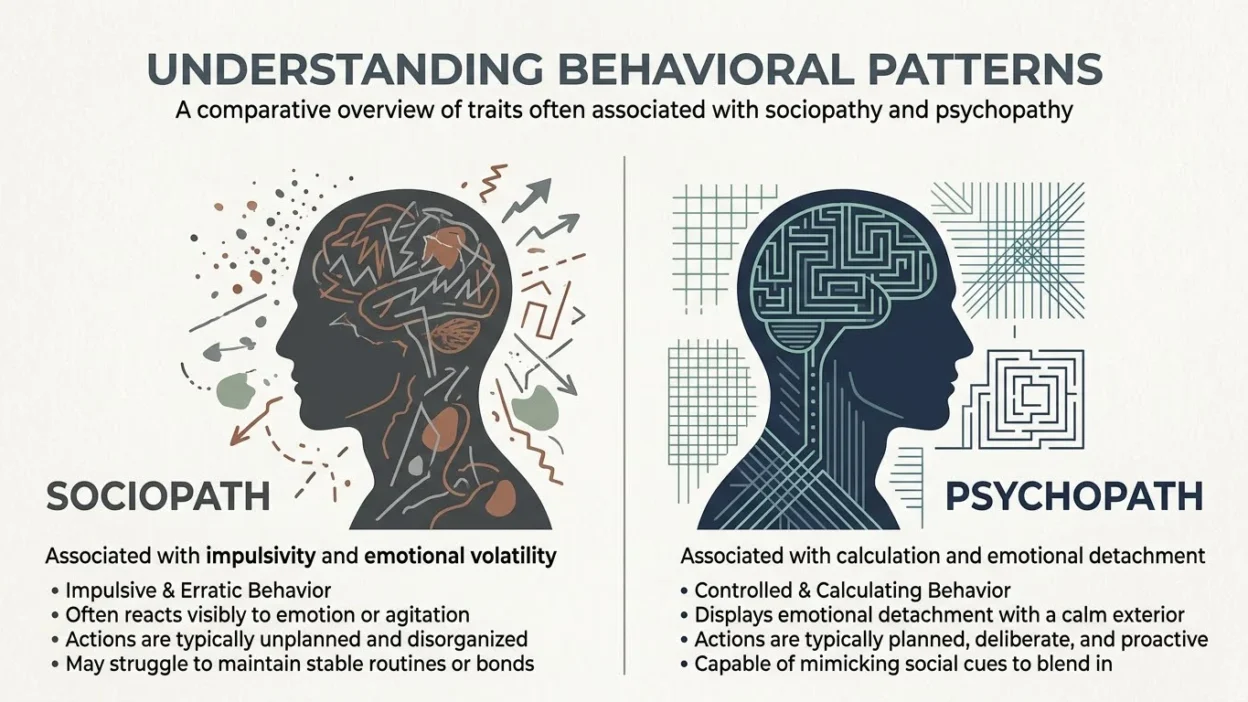
A common distinction is that a sociopath is thought to have difficulty controlling impulsive behavior and may develop harmful patterns through environmental influences, while a psychopath is traditionally described as having more pronounced emotional detachment, limited remorse, and calculated behavior. However, these distinctions are not formal medical diagnoses. Modern psychology does not officially recognize sociopathy and psychopathy as separate clinical disorders. Understanding this difference can help you use the terms accurately without confusing popular descriptions with established medical terminology.
Quick Answer: What Is the Difference Between a Sociopath and a Psychopath?
A sociopath is commonly described as someone who shows antisocial behavior, poor impulse control, and limited concern for others. A psychopath is traditionally described as someone who displays more severe emotional detachment, little remorse, and sometimes calculated manipulation. Both terms are associated with antisocial personality traits, but neither is a separate official clinical diagnosis.
1. What Does Sociopath Mean?
A sociopath is an informal term used to describe a person who repeatedly disregards other people’s rights, feelings, or social rules.
In popular psychological descriptions, sociopathy is often associated with environmental influences, such as childhood neglect, abuse, or difficult life experiences. However, these factors do not automatically cause someone to develop antisocial behavior.
A person described as a sociopath may show characteristics such as:
- Difficulty controlling anger or frustration
- Impulsive or reckless behavior
- Disregard for social rules
- Limited remorse after hurting others
- Difficulty maintaining healthy relationships
- Manipulative or dishonest behavior
- Aggressive reactions to conflict
Not everyone described as a sociopath displays all these characteristics. The term is informal, and it should not be used to diagnose someone based on a few behaviors.
Examples of Sociopath in Sentences
- The fictional character was portrayed as a sociopath who repeatedly ignored other people’s feelings.
- People sometimes use the word sociopath to describe someone who behaves without remorse.
- His reckless actions led others to describe him as a sociopath.
- The documentary explored the popular concept of sociopathy.
- A person should not be labelled a sociopath simply because they appear emotionally distant.
2. What Does Psychopath Mean?
A psychopath is an informal term traditionally used to describe a person with pronounced psychopathic traits, including emotional detachment, limited empathy, lack of remorse, and manipulative behavior.
In psychological research, psychopathy is studied as a collection of personality traits rather than as a separate official diagnosis.
People with pronounced psychopathic traits may display characteristics such as:
- Limited emotional empathy
- Lack of guilt or remorse
- Superficial charm
- Manipulative behavior
- Repeated dishonesty
- Shallow emotional responses
- A tendency to exploit others
- Reduced concern about the consequences of harmful actions
Some popular descriptions suggest that psychopaths are more calculating and controlled than sociopaths. However, this is a simplified distinction, not a reliable rule for identifying people.
Examples of Psychopath in Sentences
- The novel features a psychopath who manipulates people without showing remorse.
- The character’s lack of empathy is one of the reasons readers describe him as a psychopath.
- Psychopathy is studied in psychology as a combination of personality traits.
- The film portrays the criminal as a cold and calculating psychopath.
- A person’s quiet personality does not mean that they are a psychopath.
3. Sociopath vs Psychopath: What Is the Difference?
The main difference in popular usage concerns the way antisocial traits are thought to develop and appear. Sociopathy is often associated with environmental influences and impulsive behavior, while psychopathy is traditionally associated with emotional detachment and calculated behavior.
| Feature | Sociopath | Psychopath |
|---|---|---|
| Meaning | Informal term for someone with antisocial traits | Informal term associated with pronounced psychopathic traits |
| Commonly suggested influences | Environmental experiences | A combination of possible genetic, biological, and environmental influences |
| Emotional responses | May experience strong emotions | Traditionally described as having shallow emotional responses |
| Empathy | Often described as limited | Often described as significantly reduced |
| Impulse control | Commonly associated with impulsive behavior | Traditionally associated with more controlled behavior |
| Remorse | May show limited remorse | Traditionally described as showing little or no remorse |
| Relationships | May form emotional attachments | May have difficulty forming genuine emotional connections |
| Clinical status | Not a separate official diagnosis | Not a separate official diagnosis |
Important: This table reflects common descriptions, not a scientifically established method of separating two distinct disorders. The terms overlap considerably, and individual behavior varies.
4. Are Sociopath and Psychopath Official Medical Diagnoses?
No. Neither sociopath nor psychopath is a separate official diagnosis in standard psychiatric diagnostic systems.
The recognized clinical diagnosis most closely associated with these terms is antisocial personality disorder (ASPD).
Antisocial personality disorder is a mental health condition involving a persistent pattern of disregarding or violating the rights of others. It can involve repeated dishonesty, impulsive behavior, aggression, irresponsibility, and a lack of remorse.
However, not everyone with antisocial personality disorder has the same personality traits. Similarly, not everyone described as a sociopath or psychopath necessarily meets the clinical criteria for this disorder.
A qualified mental health professional must assess a person’s behavior and history before making a diagnosis.
5. Sociopathy vs Psychopathy: Which Is More Dangerous?
Neither term automatically indicates that a person is more dangerous than the other.
Popular descriptions sometimes portray psychopaths as more calculating and sociopaths as more impulsive. However, these generalizations cannot reliably predict whether someone will harm another person.
The risk of harmful behavior depends on several factors, including:
- A person’s history of aggression
- Their current behavior and circumstances
- Substance misuse
- Impulse control
- Other mental health or behavioral difficulties
- Access to potential victims or opportunities to cause harm
It is inaccurate to assume that every person with antisocial personality traits is violent or criminal. Likewise, a person who behaves calmly or appears charming cannot automatically be considered harmless.
6. Can Someone Be Both a Sociopath and a Psychopath?
There is no official clinical distinction that allows someone to be diagnosed as both a sociopath and a psychopath.
The terms are often used to describe overlapping characteristics. For example, a person may show impulsivity, limited empathy, manipulative behavior, and a lack of remorse.
Rather than treating sociopathy and psychopathy as two completely separate conditions, it is more accurate to understand them as informal labels associated with different descriptions of antisocial traits.
7. What Causes Sociopathy and Psychopathy?
There is no single cause of the personality traits associated with sociopathy or psychopathy.
Researchers study several possible influences, including biological, psychological, and environmental factors.
Possible Influences on Antisocial Traits
A. Genetics and biology
Inherited characteristics and differences in brain development or functioning may contribute to certain personality traits and behavioral tendencies.
B. Childhood experiences
Childhood neglect, abuse, instability, and exposure to violence may increase the risk of developing harmful behavioral patterns. However, many people who experience difficult childhoods do not develop antisocial traits.
C. Social environment
Family relationships, social surroundings, peer influences, and exposure to harmful behavior may affect how a person’s personality and behavior develop.
D. Psychological development
Emotional regulation, attachment, and the development of empathy may also play a role in understanding antisocial behavior.
These factors interact in complex ways. It is not accurate to assume that a person becomes a sociopath because of a difficult childhood or becomes a psychopath solely because of genetics.
8. Common Misconceptions About Sociopaths and Psychopaths
Several popular beliefs about these terms are misleading.
Misconception 1: Every Sociopath Is Violent
This is incorrect. Antisocial traits do not automatically mean that someone will engage in physical violence.
Misconception 2: Psychopaths Cannot Feel Any Emotions
This is an oversimplification. People with psychopathic traits may experience emotions, but their emotional responses and empathy can differ from those of other people.
Misconception 3: Sociopaths Are Always Made by Their Environment
Environmental experiences may contribute to antisocial behavior, but genetics and other biological factors can also play a role.
Misconception 4: Psychopaths Are Always Intelligent Criminals
There is no basis for assuming that everyone with psychopathic traits is highly intelligent, successful, or involved in crime.
Misconception 5: You Can Identify a Psychopath by Looking at Someone
Appearance, facial expressions, and body language cannot reliably identify psychopathy or antisocial personality disorder.
9. Sociopath vs Psychopath: Examples in Everyday Language
Here are examples showing how the two terms are commonly used.
- Sociopath: The television series portrays him as a sociopath who frequently acts without considering the consequences.
- Psychopath: The movie features a psychopath who manipulates people to achieve his goals.
- Sociopath: She used the term sociopath to describe a fictional character with little concern for others.
- Psychopath: The detective suspected that the criminal displayed psychopathic traits.
- Sociopath: It is inaccurate to call someone a sociopath simply because they are selfish.
- Psychopath: The character’s lack of remorse is presented as a sign of psychopathy.
- Sociopath: The article discusses how the term sociopath is used in popular culture.
- Psychopath: The researcher studies psychopathy and its relationship with antisocial behavior.
- Sociopath: His impulsive actions reminded viewers of the traditional description of a sociopath.
- Psychopath: The fictional psychopath carefully planned his actions.
10. Sociopath vs Psychopath vs Antisocial Personality Disorder
These three expressions are related, but they do not mean exactly the same thing.
| Term | Meaning | Official clinical diagnosis? |
|---|---|---|
| Sociopath | Informal label for someone displaying antisocial traits | No |
| Psychopath | Informal label associated with psychopathic personality traits | No |
| Antisocial personality disorder | A recognized mental health condition involving a persistent pattern of disregard for others’ rights | Yes |
The most important distinction is that antisocial personality disorder is a formal clinical diagnosis, whereas sociopathy and psychopathy are commonly used descriptive terms.
11. Common Mistakes When Using Sociopath and Psychopath
Here are some mistakes to avoid:
Mistake 1: Treating both words as exact synonyms
Although they overlap in meaning, the terms have different traditional descriptions.
Mistake 2: Using the words as casual insults
Calling someone a psychopath because they are rude, selfish, or inconsiderate is inaccurate.
Mistake 3: Assuming every person with these traits commits crimes
Antisocial personality traits do not automatically mean that someone is a criminal.
Mistake 4: Treating popular descriptions as medical facts
The traditional distinction between an impulsive sociopath and a calculating psychopath is not a formal diagnostic rule.
Mistake 5: Confusing antisocial behavior with antisocial personality disorder
In everyday English, antisocial can mean avoiding social interaction. In the clinical term antisocial personality disorder, it refers to a persistent pattern of disregarding other people’s rights.
12. Memory Trick: How to Remember Sociopath vs Psychopath
A simple way to remember the traditional distinction is:
- Sociopath: Think of impulsive behavior and possible environmental influences.
- Psychopath: Think of emotional detachment and traditionally described calculated behavior.
Remember that this is only a simplified memory aid. It does not establish a clinical difference between two separate disorders.
Frequently Asked Questions
1. What is the main difference between a sociopath and a psychopath?
In traditional descriptions, sociopaths are associated with impulsive behavior and environmental influences, while psychopaths are associated with emotional detachment and calculated behavior. However, these are informal distinctions rather than separate clinical diagnoses.
2. Is a sociopath worse than a psychopath?
Neither term automatically describes someone as worse or more dangerous. A person’s actual behavior, circumstances, and history are more important than an informal label.
3. Are sociopaths and psychopaths born or made?
There is no simple answer. Genetic, biological, psychological, and environmental factors may all contribute to antisocial personality traits.
4. Can psychopaths feel love?
People with psychopathic traits may experience attachment and certain emotions, but their emotional responses and ability to form relationships can differ. It is inaccurate to claim that every person with these traits is completely incapable of love.
5. Can a sociopath feel empathy?
Some people described as sociopaths may experience certain forms of empathy or emotional attachment. Empathy is complex, and it should not be treated as an all or nothing ability.
6. Is psychopathy a mental illness?
Psychopathy is not a separate official psychiatric diagnosis. It is a personality construct studied in psychology and is associated with certain antisocial traits.
7. Is sociopathy the same as antisocial personality disorder?
No. Sociopathy is an informal term, while antisocial personality disorder is a recognized clinical diagnosis. The terms are related, but they are not interchangeable in every context.
8. Can someone be a sociopath without being violent?
Yes. Antisocial traits do not automatically lead to violence. People should be assessed according to their actual behavior rather than stereotypes.
Remember This
- Sociopath is an informal term associated with antisocial personality traits.
- Psychopath is an informal term associated with pronounced psychopathic traits.
- Sociopathy is traditionally linked with impulsive behavior and environmental influences.
- Psychopathy is traditionally linked with emotional detachment and calculated behavior.
- Neither term is a separate official clinical diagnosis.
- Antisocial personality disorder is a recognized psychiatric diagnosis.
- Neither label automatically means that someone is violent or criminal.
Conclusion
The main difference between a sociopath and a psychopath comes from their traditional descriptions. A sociopath is commonly portrayed as more impulsive and influenced by environmental experiences, while a psychopath is often described as emotionally detached, manipulative, and calculating. Both terms are associated with antisocial personality traits, but their meanings overlap.
It is important to remember that neither sociopathy nor psychopathy is a separate official medical diagnosis. Antisocial personality disorder is the recognized clinical condition most closely related to these terms. When discussing real people, avoid making assumptions or assigning psychological labels without a proper professional assessment.

Charles Kevin is a passionate language writer and researcher at SimileHive, creating clear, engaging content about similes, idioms, metaphors, and figurative language to help readers improve English communication confidently every day.