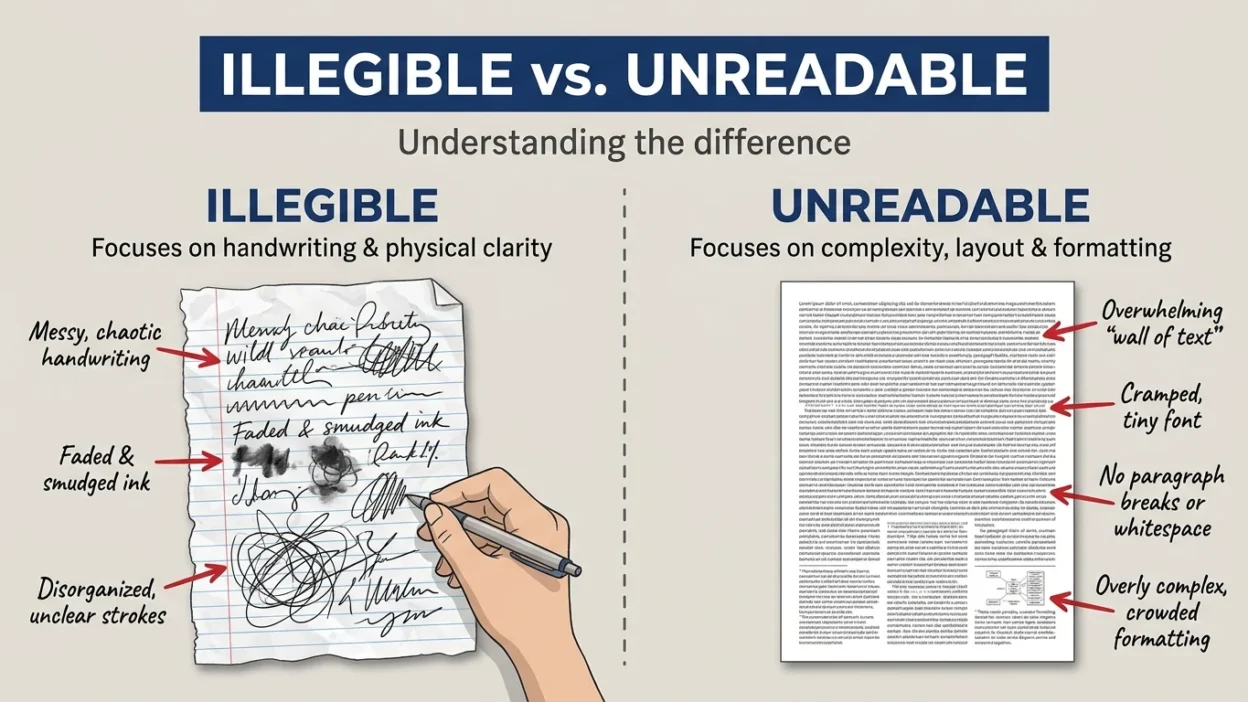
The words illegible and unreadable are closely related, but they do not have exactly the same meaning. Both can describe writing, text, or printed material that someone cannot read. However, illegible specifically means that letters or words are difficult or impossible to recognize, usually because of poor handwriting, unclear printing, or damaged text. Unreadable has a broader meaning. It can describe text that is difficult to read for many reasons, including poor formatting, complicated language, tiny print, or unclear writing.
For example, if a doctor’s handwriting is too messy to understand, it is illegible. If a book contains extremely complicated sentences, it may be unreadable even though every word is clearly printed. Understanding this distinction will help you choose the right word when describing handwriting, documents, books, signs, and other written material.
Quick Answer: Illegible vs Unreadable
Illegible means impossible or difficult to read because the letters or words cannot be identified clearly. Unreadable means difficult or impossible to read or understand for any reason. Illegible usually refers to unclear handwriting or text, while unreadable can also describe complicated language, poor formatting, tiny print, or confusing content.
1. What Does Illegible Mean?
Illegible is an adjective that means impossible or difficult to read because the writing, printing, or characters are not clear enough to recognize.
It is commonly used when handwriting is messy, letters are poorly formed, or printed words are damaged or unclear.
For example:
- The doctor’s handwriting was illegible.
- I could not read the illegible note.
- The signature on the document was almost illegible.
- The old photograph contained an illegible address.
In these examples, the problem is the appearance of the written characters. The reader cannot easily identify the letters or words.
Common Situations Where You Can Use Illegible
You can use illegible in the following situations:
- Messy handwriting
- Unclear signatures
- Faded or damaged documents
- Poorly printed letters
- Blurred text
- Letters written too close together
- Text that is difficult to identify visually
Examples of Illegible in Sentences
- The teacher asked the student to rewrite the illegible paragraph.
- His handwriting is so illegible that I can barely understand it.
- The old document contains several illegible words.
- The signature at the bottom of the form is illegible.
- The ink had faded, making the address illegible.
- Please write clearly because your handwriting is sometimes illegible.
- The photograph was too blurry to reveal the illegible text.
- I received an illegible message written on a small piece of paper.
- The examiner could not mark the answer because it was illegible.
- Several lines of the handwritten letter were completely illegible.
2. What Does Unreadable Mean?
Unreadable is an adjective that means impossible or difficult to read or understand.
Unlike illegible, which usually refers to the clarity of written characters, unreadable has a much broader meaning. It can describe text that is unclear in appearance, too complicated, poorly organized, or difficult to understand.
For example:
- The handwriting was unreadable.
- The book was so poorly written that it became unreadable.
- The text on the screen was unreadable because the font was too small.
- The report was filled with complicated technical language and was almost unreadable.
In the first example, unreadable refers to unclear handwriting. In the other examples, it describes problems that go beyond the appearance of letters.
Common Situations Where You Can Use Unreadable
You can use unreadable to describe:
- Messy handwriting
- Complicated writing
- Poorly formatted documents
- Extremely small text
- Blurred or damaged printing
- Confusing sentences
- Poorly organized books or reports
- Text that is difficult to understand
Examples of Unreadable in Sentences
- The instructions were so confusing that they were almost unreadable.
- The text on the screen became unreadable in bright sunlight.
- His handwriting was unreadable.
- The report was filled with technical terms and was difficult for beginners to read.
- The scanned document was unreadable because of its poor quality.
- The author used such complicated language that the book became unreadable.
- The small font made the entire page unreadable.
- The old newspaper was almost unreadable because its ink had faded.
- The paragraph was poorly organized and practically unreadable.
- I found the document unreadable because the sentences were too complicated.
3. Illegible vs Unreadable: What Is the Difference?
The main difference is that illegible focuses on the appearance and clarity of written characters, while unreadable can refer to both the appearance and the meaning or overall quality of written material.
| Feature | Illegible | Unreadable |
|---|---|---|
| Meaning | Difficult or impossible to read because characters are unclear | Difficult or impossible to read or understand |
| Main focus | Appearance of letters and words | Appearance, language, formatting, or content |
| Common use | Handwriting, signatures, printed characters | Books, documents, handwriting, reports, and screens |
| Scope | More specific | Broader |
| Complicated language | Not usually used | Commonly used |
| Messy handwriting | Yes | Yes |
| Tiny print | Possible, but less natural | Yes |
| Confusing content | No, not usually | Yes |
Compare These Examples
Example 1: Messy Handwriting
- The doctor’s handwriting is illegible.
- The doctor’s handwriting is unreadable.
Both sentences are correct. They mean that the handwriting is too unclear to read.
Example 2: Complicated Language
- The book is illegible.
- The book is unreadable.
The second sentence is more appropriate if the book is difficult to understand because of complicated language.
Example 3: Small Font
- The text is illegible.
- The text is unreadable.
Both can work, but unreadable is generally more natural when the font is too small to read comfortably.
Example 4: Damaged Letters
- The damaged words are illegible.
- The damaged words are unreadable.
Both are correct because the letters cannot be identified clearly.
4. When Should You Use Illegible?
Use illegible when the main problem is that the letters, words, or characters cannot be recognized clearly.
It is particularly useful when discussing handwriting and documents.
Examples:
- The student’s handwriting was illegible.
- The signature on the cheque was illegible.
- The faded ink made the date illegible.
- Some words in the handwritten letter were illegible.
- The photocopy contained several illegible lines.
A useful rule is to choose illegible when you cannot identify what the written characters say.
5. When Should You Use Unreadable?
Use unreadable when something is difficult or impossible to read or understand, regardless of the reason.
It is appropriate for both visual problems and problems involving language or presentation.
Examples:
- The book was unreadable because of its complicated language.
- The text was unreadable because the font was too small.
- The document was unreadable after being damaged by water.
- The report was unreadable because it lacked proper organization.
- The handwriting was unreadable because the letters were poorly formed.
A useful rule is to choose unreadable when the overall reading experience is difficult, whether because of unclear characters, poor presentation, or confusing content.
6. Can Illegible and Unreadable Be Used Interchangeably?
Sometimes, yes.
When describing unclear handwriting, damaged text, or poorly printed words, both adjectives can be used.
For example:
- His handwriting is illegible.
- His handwriting is unreadable.
Both sentences communicate that the writing is difficult or impossible to read.
However, they are not interchangeable in every situation.
Consider these examples:
Correct and natural:
- The book is unreadable because the language is too complicated.
- The signature is illegible because the letters are unclear.
Less natural or unsuitable:
- The book is illegible because the ideas are too complicated.
Here, unreadable is the better choice because the problem concerns the difficulty of understanding the content, not identifying the letters.
7. Illegible vs Incomprehensible vs Unintelligible
These three words are also related, but they emphasize different problems.
| Word | Meaning | Example |
|---|---|---|
| Illegible | Impossible or difficult to read because characters are unclear | His handwriting is illegible. |
| Incomprehensible | Impossible or difficult to understand | The explanation was incomprehensible. |
| Unintelligible | Impossible or difficult to understand, hear, or interpret | His speech was unintelligible. |
| Unreadable | Difficult or impossible to read or understand | The report was unreadable. |
Illegible
Use illegible when written characters cannot be recognized.
Example: The handwritten address was illegible.
Incomprehensible
Use incomprehensible when something is difficult or impossible to understand.
Example: The professor’s explanation was incomprehensible to the beginners.
Unintelligible
Use unintelligible when speech, sounds, writing, or other information cannot be understood.
Example: The recording was so unclear that the speaker’s words were unintelligible.
Unreadable
Use unreadable when written material is difficult to read or understand.
Example: The report was unreadable because it contained too much technical language.
8. Common Mistakes When Using Illegible and Unreadable
Mistake 1: Thinking Both Words Have Exactly the Same Meaning
They overlap, but illegible is more specific. Unreadable covers a wider range of reading difficulties.
Mistake 2: Using Illegible for Complicated Ideas
If a book is difficult to understand because of its ideas or language, unreadable or incomprehensible is usually more appropriate.
Mistake 3: Assuming Illegible Only Refers to Handwriting
Illegible can also describe printed text, signatures, numbers, and other written characters that cannot be recognized clearly.
Mistake 4: Assuming Unreadable Only Refers to Poor Writing
Unreadable can describe text that is too small, blurred, poorly formatted, damaged, or complicated.
Mistake 5: Confusing Illegible With Illiterate
These words have completely different meanings.
- Illegible: Difficult or impossible to read.
- Illiterate: Unable to read or write, or having very limited reading and writing skills.
Example:
The handwriting was illegible, but the writer was not illiterate.
9. Word Forms and Related Expressions
Understanding the related forms can help you use these words correctly.
| Word | Part of speech | Meaning |
|---|---|---|
| Illegible | Adjective | Difficult or impossible to read |
| Illegibility | Noun | The quality of being illegible |
| Illegibly | Adverb | In an illegible manner |
| Unreadable | Adjective | Difficult or impossible to read or understand |
| Unreadability | Noun | The quality of being unreadable |
| Unreadably | Adverb | In an unreadable manner |
Examples
- Illegible: The handwriting is illegible.
- Illegibility: The illegibility of the document caused a problem.
- Illegibly: He wrote his name illegibly.
- Unreadable: The report is unreadable.
- Unreadability: The unreadability of the text frustrated the readers.
- Unreadably: The instructions were written in an unreadably small font.
Frequently Asked Questions
1. Is illegible the same as unreadable?
Not exactly. Both words describe something that is difficult or impossible to read. However, illegible usually refers to unclear letters or handwriting, while unreadable has a broader meaning that includes confusing language and poor formatting.
2. Is handwriting illegible or unreadable?
Both are correct. Illegible is particularly appropriate when the letters are poorly formed or difficult to identify. Unreadable is also natural when the handwriting cannot be read.
3. What is the opposite of illegible?
The most common opposite is legible, which means clear enough to read.
Example: Please make sure your handwriting is legible.
4. What is the opposite of unreadable?
Possible opposites include readable, clear, and easy to read.
Example: The revised document is now readable and well organized.
5. Can printed text be illegible?
Yes. Printed text can be illegible if the letters are blurred, faded, distorted, or poorly reproduced.
6. Can a book be unreadable but not illegible?
Yes. A book can have perfectly clear printing but still be unreadable because its language is too complicated, its structure is confusing, or its content is poorly organized.
7. Is illegible a negative word?
It usually has a negative meaning because it describes a problem with reading or recognizing written characters. However, it is a neutral descriptive word rather than an insult.
8. What is the difference between illegible and illiterate?
Illegible describes writing that is difficult or impossible to read. Illiterate describes a person who cannot read or write, or has very limited literacy skills. They should not be confused.
Remember This
- Illegible means difficult or impossible to read because the characters are unclear.
- Unreadable means difficult or impossible to read or understand for any reason.
- Illegible is commonly used for messy handwriting and unclear printing.
- Unreadable can describe handwriting, complicated books, tiny text, and poorly organized documents.
- Both words can describe writing that cannot be read.
- Legible is the opposite of illegible.
- Readable is the opposite of unreadable.
- Illiterate means unable to read or write, not difficult to read.
Conclusion
Although illegible and unreadable are similar, they have different areas of emphasis. Use illegible when letters, words, or handwriting are too unclear to recognize. Use unreadable when written material is difficult to read or understand because of unclear text, complicated language, poor formatting, or other problems.
The easiest way to remember the distinction is that illegibility concerns the clarity of written characters, while unreadability covers a broader range of reading difficulties. When describing messy handwriting, both words are usually acceptable, but when discussing complicated language or confusing content, unreadable is generally the better choice.

Adam Aaron is a language enthusiast and content writer at SimileHive, creating clear, engaging guides on similes, idioms, metaphors, and figurative language to help readers improve English confidently every day.