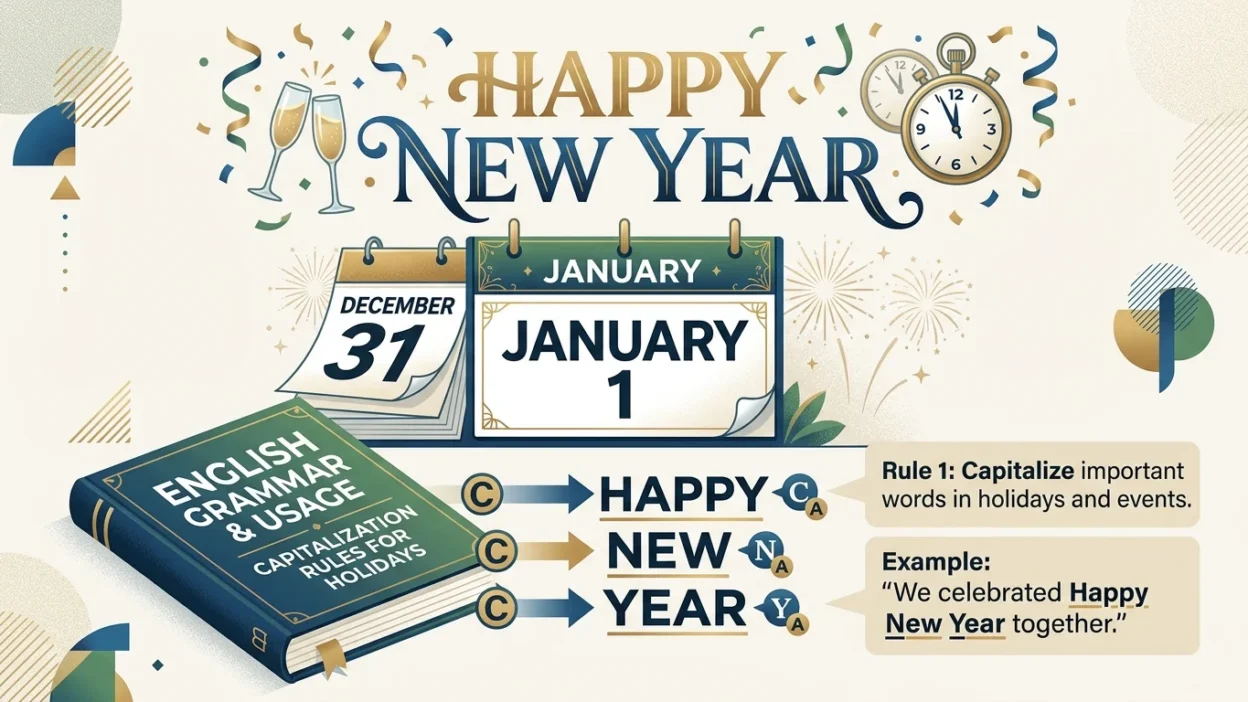
“Happy New Year” is the standard capitalization when you are using the phrase as a holiday greeting. Happy and New Year are capitalized because New Year refers to the holiday, and Happy New Year is commonly written as a greeting. For example, you can write, “Happy New Year!” when wishing someone well at the beginning of a new year.
However, capitalization can change when new year is used as a general phrase rather than as the name of the holiday. For example, “I hope the new year brings you happiness” usually uses lowercase letters because new year is being used descriptively rather than as the holiday name. Knowing when to capitalize New Year, New Year’s, and related expressions will help you write holiday greetings and sentences correctly.
Quick Answer
Write “Happy New Year!” when using it as a holiday greeting. New Year is capitalized because it refers to the holiday, while happy is capitalized because it begins the greeting. In phrases such as “I hope you have a happy new year,” lowercase may be appropriate when new year simply refers to the coming year.
Why Do People Confuse “Happy New Year” Capitalization?
The confusion comes from the fact that new year can be used in more than one way.
Sometimes it refers to the holiday:
Happy New Year!
Here, New Year is capitalized.
At other times, it simply describes the year that is beginning:
I hope the new year is peaceful.
Here, new year is a general phrase, so lowercase is usually appropriate.
There is also an important distinction between New Year and New Year’s.
For example:
New Year’s Day
New Year’s Eve
These are names associated with the holiday and are capitalized.
First Word: Happy
Happy is capitalized in “Happy New Year!” because it is the first word of the greeting.
For example:
Happy New Year!
The word happy itself does not need to be capitalized simply because it is an adjective. It is capitalized here because it begins the greeting.
Compare:
I hope you have a happy new year.
Here, happy is lowercase because it appears in the middle of a sentence and is not part of a title or greeting.
Second Phrase: New Year
New Year is capitalized when it refers to the holiday or a recognized holiday period.
Examples include:
Happy New Year!
New Year’s Day
New Year’s Eve
We celebrated New Year with our family.
However, when new year simply means the year that is beginning, lowercase is often used:
I hope the new year brings you success.
We have many plans for the new year.
The context determines the capitalization.
Happy New Year vs Happy new year
| Form | Correct? | Typical Use | Example |
|---|---|---|---|
| Happy New Year! | Yes | Holiday greeting | Happy New Year! |
| Happy new year! | Usually no | Greeting | Happy New Year! |
| happy New Year! | Usually no | Greeting | Happy New Year! |
| happy new year! | No as a standard greeting | Casual lowercase style | Happy New Year! |
| a happy new year | Yes | General description | I wish you a happy new year. |
The standard greeting is:
Happy New Year!
When Should You Capitalize “Happy New Year”?
Capitalize Happy New Year when it is used as a greeting or refers to the holiday.
As a greeting
Happy New Year!
In a greeting card
Wishing you a Happy New Year!
In a message
Happy New Year to you and your family!
As part of a holiday name
We celebrated New Year’s Eve together.
The phrase is often treated as a conventional holiday greeting.
When Should You Use Lowercase “new year”?
Use lowercase new year when you are referring generally to the year that is beginning rather than naming the holiday.
Examples:
I hope the new year brings you happiness.
We have several goals for the new year.
She wants to learn a new skill in the new year.
The new year may bring many opportunities.
Here, new year is functioning as an ordinary noun phrase rather than a holiday name.
Happy New Year vs New Year’s Day vs New Year’s Eve
These expressions are related but should be written carefully.
Happy New Year
A common holiday greeting.
Happy New Year!
New Year’s Day
The holiday on January 1.
We visited our relatives on New Year’s Day.
New Year’s Eve
The evening or day before New Year’s Day.
We stayed up late on New Year’s Eve.
Notice that New Year’s contains an apostrophe because it is traditionally written as the possessive form of New Year.
15 Examples of “Happy New Year”
- Happy New Year!
- Happy New Year to you and your family!
- We would like to wish you a Happy New Year.
- She sent me a Happy New Year message.
- He called his parents to say Happy New Year.
- Happy New Year, everyone!
- The children shouted, “Happy New Year!”
- I sent my friends a Happy New Year greeting.
- Happy New Year from our family to yours!
- The card said, “Happy New Year!”
- We gathered together to celebrate and say Happy New Year.
- She posted a Happy New Year message online.
- Happy New Year to everyone!
- They exchanged Happy New Year wishes.
- The sign outside the store read, “Happy New Year!”
15 Examples With Lowercase “new year”
- I hope the new year brings you happiness.
- We have many goals for the new year.
- She plans to exercise more in the new year.
- The new year gives us a chance to start fresh.
- I hope the new year is peaceful.
- They are making plans for the new year.
- The new year will bring several changes.
- We want to travel more in the new year.
- He made several resolutions for the new year.
- The new year began with exciting opportunities.
- I hope you enjoy the new year.
- She wants to save more money in the new year.
- We are looking forward to the new year.
- The new year is just around the corner.
- They have big plans for the new year.
Capitalization in New Year’s Greetings
Holiday greetings often contain several words that can be confusing.
Here are some common forms:
Happy New Year!
Wishing you a Happy New Year!
Have a Happy New Year!
Happy New Year to you and your family!
In ordinary sentences, however, capitalization may change:
I hope you have a happy new year.
This is because the phrase is being used as a general description rather than as the name of the greeting or holiday.
Common Mistakes
1. Writing “Happy new year”
❌ Happy new year!
✅ Happy New Year!
When used as the standard holiday greeting, New Year is capitalized.
2. Writing “happy New Year”
❌ happy New Year!
✅ Happy New Year!
Happy is capitalized because it begins the greeting.
3. Writing “New years”
❌ Happy New years!
✅ Happy New Year!
When referring to the holiday, Year is singular.
4. Forgetting the apostrophe in New Year’s
When referring to the holidays:
✅ New Year’s Eve
✅ New Year’s Day
The apostrophe belongs in New Year’s.
5. Capitalizing every word unnecessarily
You may see:
Happy New Year To You And Your Family!
For a normal sentence or greeting, there is usually no need to capitalize to, you, and, or your simply because they appear in the greeting.
A natural version is:
Happy New Year to you and your family!
Happy New Year Capitalization in Titles
If Happy New Year is part of a title or heading, capitalization can depend on the title style being used.
For example:
Happy New Year: Best Wishes for the Year Ahead
In title case, important words are capitalized.
In sentence case:
Happy New Year: best wishes for the year ahead
The exact style may depend on the publication or style guide.
American vs British English
The capitalization of Happy New Year, New Year’s Day, and New Year’s Eve is generally similar in American and British English.
Both varieties commonly write:
Happy New Year!
New Year’s Day
New Year’s Eve
The main difference is not usually between American and British capitalization. Instead, the important distinction is whether New Year is being used as a holiday name or as a general reference to the coming year.
For example:
I hope the new year is successful.
Here, lowercase is appropriate in both varieties in ordinary usage.
Similar Holiday Greetings
New Year greetings follow a pattern similar to other holiday greetings.
Merry Christmas
Merry Christmas!
Happy Easter
Happy Easter!
Happy Thanksgiving
Happy Thanksgiving!
Happy New Year
Happy New Year!
The capitalization helps identify the holiday name in these conventional greetings.
Final Verdict
The standard holiday greeting is:
Happy New Year!
Capitalize Happy because it begins the greeting and New Year because it refers to the holiday.
However, use lowercase new year when you are simply talking about the year that is beginning:
I hope the new year brings you success.
Also remember:
New Year’s Day
New Year’s Eve
The key is to look at how the phrase is being used in the sentence.
Frequently Asked Questions
Is “Happy New Year” capitalized correctly?
Yes. Happy New Year! is the standard capitalization for the holiday greeting.
Should “New Year” be capitalized?
Capitalize New Year when referring to the holiday or using it in the conventional greeting Happy New Year. Use lowercase new year when referring generally to the coming year.
Is it “Happy New Year” or “Happy new year”?
For the standard holiday greeting, write Happy New Year!
Should I capitalize “new year” in a sentence?
Not always. If you are referring generally to the coming year, lowercase is usually appropriate:
I hope the new year brings you peace.
Is “New Year’s Day” capitalized?
Yes. New Year’s Day is the standard capitalization for the holiday on January 1.
Is “New Year’s Eve” capitalized?
Yes. New Year’s Eve is the standard capitalization for the evening before New Year’s Day.
Is “Happy New Year to you and your family” correct?
Yes. A standard version is:
Happy New Year to you and your family!
Only the important holiday words need capitalization.
Should “Happy New Year” be capitalized in an email?
If it is used as a greeting, yes:
Happy New Year!
If it appears as part of a sentence, capitalization depends on the context.
Remember This
Use:
Happy New Year! → holiday greeting
New Year’s Day → January 1 holiday
New Year’s Eve → December 31 evening
new year → the year that is beginning
A simple rule is:
Holiday name = capitalize.
General reference = usually lowercase.
Conclusion
The correct capitalization for the familiar holiday greeting is “Happy New Year!” Both Happy and New Year are capitalized in this expression. New Year’s Day and New Year’s Eve are also capitalized because they are names associated with the holiday.
However, new year is usually lowercase when it simply refers to the year that is beginning. For example, “I hope the new year brings you happiness” does not use the phrase as a holiday name. Understanding this difference between the holiday and the general reference makes New Year capitalization much easier.
When in doubt, remember the simple distinction: Happy New Year! is the greeting, while the new year is the year ahead. Once you recognize the context, choosing the correct capitalization becomes straightforward.

Adam Aaron is a language enthusiast and content writer at SimileHive, creating clear, engaging guides on similes, idioms, metaphors, and figurative language to help readers improve English confidently every day.