
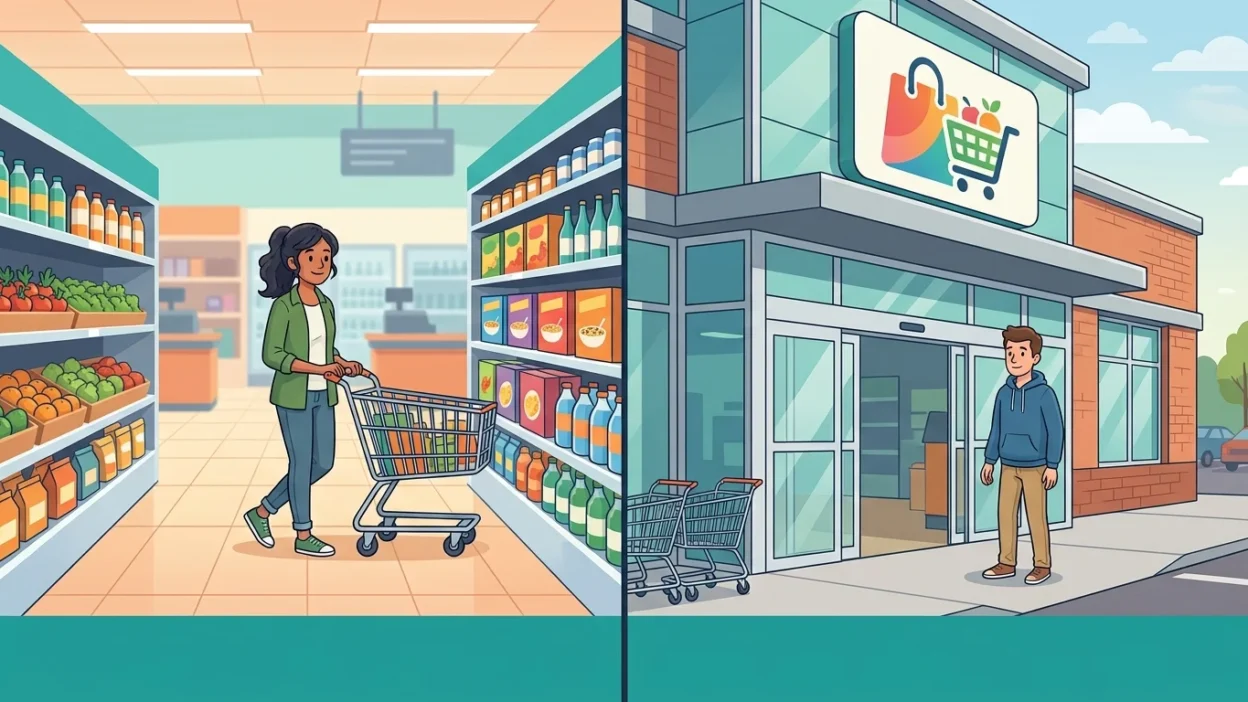
“In the store” and “at the store” can both mean that someone is at a store, but they emphasize different things. “In the store” focuses on being inside the store, while “at the store” focuses more generally on being at the store or at its location. In everyday American English, both expressions are natural and common.
For example, if you say, “She is in the store,” you usually mean she is physically inside the building. If you say, “She is at the store,” you mean she is at that store, perhaps shopping, working, waiting outside, or doing something related to the store. The difference is small, but understanding it helps English learners choose the right preposition. The same idea applies to other expressions such as “in the office” vs. “at the office” and “in the restaurant” vs. “at the restaurant.”
Quick Answer
“In the store” emphasizes being physically inside the store. “At the store” means being at the store or its location and does not necessarily emphasize being inside. For example, “John is in the store” means he is inside, while “John is at the store” simply tells us where John is.
Why Do People Confuse “In the Store” and “At the Store”?
The confusion comes from the fact that in and at can both describe location.
The key difference is:
- In → focuses on being inside an area or enclosed space.
- At → focuses on being at a particular place or point/location.
Compare:
“Maria is in the store.”
This suggests Maria is physically inside the store.
“Maria is at the store.”
This tells us Maria is at the store, but it does not strongly emphasize whether she is inside.
In normal conversation, the two can sometimes describe the same situation.
What Does “In the Store” Mean?
“In the store” means physically inside the store.
It emphasizes the interior of the building.
Examples
- “My mother is in the store.”
- “There are many customers in the store.”
- “I left my phone in the store.”
- “We waited in the store until the rain stopped.”
- “He works in the store.”
If you want to make it clear that someone is inside, “in the store” is usually the better choice.
What Does “At the Store” Mean?
“At the store” means at the store’s location or engaged with the store in some way.
It does not necessarily tell us exactly where the person is.
For example:
“Dad is at the store.”
He might be inside shopping, standing outside, waiting near the entrance, or otherwise at the store.
Examples
- “Mom is at the store buying groceries.”
- “I’ll meet you at the store.”
- “He is at the store right now.”
- “She works at the store.”
- “We stopped at the store on our way home.”
In the Store vs. At the Store
| Expression | Main Focus | Does It Emphasize Being Inside? | Example |
|---|---|---|---|
| In the store | Interior location | Yes | “He is in the store.” |
| At the store | General location | No | “He is at the store.” |
| Into the store | Movement inside | Yes | “She walked into the store.” |
| To the store | Movement toward the store | No | “She went to the store.” |
When Should You Use Each?
Use “in the store” when you mean inside
“I saw him in the store.”
The sentence suggests you saw him inside the store.
“There are five people in the store.”
The focus is on the people being inside.
Use “at the store” when the exact position does not matter
“I’m at the store. Do you need anything?”
The important information is that the speaker is at the store and can possibly buy something.
Use “at the store” for meeting locations
“Let’s meet at the store.”
The store is the meeting location. You do not need to specify whether the person will be inside or outside.
Use “in the store” for something physically located inside
“I left my bag in the store.”
This strongly suggests that the bag is inside the building.
12 Examples of “In the Store”
- “I saw your brother in the store.”
- “There are too many people in the store today.”
- “She is looking for a new dress in the store.”
- “We waited in the store because it was raining.”
- “My wallet is somewhere in the store.”
- “The children are playing in the store.”
- “I found this book in the store.”
- “He is talking to the manager in the store.”
- “The music in the store was very loud.”
- “I left my umbrella in the store.”
- “Several employees are working in the store.”
- “I bumped into an old friend in the store.”
12 Examples of “At the Store”
- “I’m at the store right now.”
- “Mom is at the store buying food.”
- “Can you pick me up at the store?”
- “I’ll meet you at the store.”
- “He works at the store near our house.”
- “We stopped at the store after work.”
- “She spent an hour at the store.”
- “My dad is still at the store.”
- “I forgot to buy milk while I was at the store.”
- “There was a long line at the store.”
- “I ran into Sarah at the store.”
- “We can get it at the store.”
What Is the Difference Between “I’m in the Store” and “I’m at the Store”?
Consider these two sentences:
“I’m in the store.”
This emphasizes inside.
“I’m at the store.”
This emphasizes location.
Imagine your friend calls you:
Friend: “Where are you?”
You: “I’m at the store.”
This is a natural answer because you are giving your location.
If your friend asks:
Friend: “Are you inside?”
You: “Yes, I’m in the store.”
Here, “in” is more precise because the question is about being inside.
Is “At the Store” More Common Than “In the Store”?
In many everyday situations, “at the store” is very natural when talking about someone’s general location or activity.
For example:
“I’m at the store. Do you want anything?”
This is extremely natural.
But when the physical position inside matters, “in the store” is more precise:
“I dropped my keys in the store.”
The choice depends on what you want to emphasize.
Common Mistakes
Mistake 1: Thinking “at” always means outside
It does not.
“She is at the store.”
She can absolutely be inside the store.
“At” simply does not emphasize the interior.
Mistake 2: Thinking “in” and “at” always mean exactly the same thing
They overlap, but their focus differs.
In emphasizes an interior space.
At emphasizes a location or point.
Mistake 3: Saying “at inside the store”
Do not combine them this way.
❌ “I am at inside the store.”
✅ “I am in the store.”
If you want to emphasize the general location:
✅ “I am at the store.”
Mistake 4: Confusing “at the store” with “to the store”
These describe different ideas.
“I am at the store.”
You are currently there.
“I am going to the store.”
You are traveling there.
Memory Trick
Remember:
IN = inside
AT = location
Think of a store as a box:
IN the store → you are inside the box.
AT the store → you are at the location of the box.
This simple trick works with many other places:
- in the office → inside the office
- at the office → at the office location
- in the restaurant → inside the restaurant
- at the restaurant → at the restaurant location
- in the school → inside the school
- at the school → at the school location
American vs. British English
Both “in the store” and “at the store” are grammatical in American English.
There is one useful vocabulary difference to remember: store is especially common in American English, while shop is very common in British English.
So you may hear:
American English:
“I’m at the store.”
British English:
“I’m at the shop.”
You can also say “in the shop” in British English when you specifically mean inside.
The preposition difference remains essentially the same.
Similar Expressions
Here are some related location expressions:
- in the store → inside the store
- at the store → at the store’s location
- to the store → toward or into the store
- from the store → coming from the store
- near the store → close to the store
- outside the store → on the exterior side of the store
- inside the store → clearly within the store
Final Verdict
“In the store” and “at the store” are both correct, but they emphasize different things.
Use “in the store” when you want to emphasize that someone or something is physically inside the store.
Use “at the store” when you simply want to say someone is at that location or is doing something associated with the store.
The easiest rule is:
IN = inside. AT = location.
Frequently Asked Questions
Is it “in the store” or “at the store”?
Both are correct. “In the store” emphasizes being inside, while “at the store” focuses on the general location.
Does “at the store” mean inside the store?
Not necessarily. Someone who is “at the store” could be inside, outside the entrance, or somewhere immediately associated with the store.
Does “in the store” mean inside?
Yes. “In the store” normally means physically inside the store.
Which is more natural: “I’m in the store” or “I’m at the store”?
Both can be natural. “I’m at the store” is common when simply giving your location. “I’m in the store” is better when emphasizing that you are inside.
Should I say “go in the store” or “go to the store”?
Usually, “go to the store” means travel to the store. “Go in the store” means enter the store or go inside it, depending on context.
Is “at the store” American English?
Yes, “at the store” is very common in American English. British speakers commonly use “at the shop” because “shop” is a common British term for a retail store.
What is the easiest way to remember “in” and “at”?
Remember: “in” focuses on being inside, while “at” focuses on being at a location.
Remember This
In the store = inside the store.
At the store = at the store’s location.
If you are talking about inside, choose in. If you are simply giving a location, choose at.
Conclusion
The difference between “in the store” and “at the store” is small but useful. “In” gives a more specific picture of someone or something being inside the store. “At” gives the broader idea of being at the store’s location or engaging in an activity connected with it.
For everyday English, both expressions are natural. When you are unsure, ask yourself what you want to communicate: Am I emphasizing the inside of the building? Use “in.” Am I simply identifying the location? Use “at.” Once you understand that distinction, choosing between the two becomes much easier.

Adam Aaron is a language enthusiast and content writer at SimileHive, creating clear, engaging guides on similes, idioms, metaphors, and figurative language to help readers improve English confidently every day.