
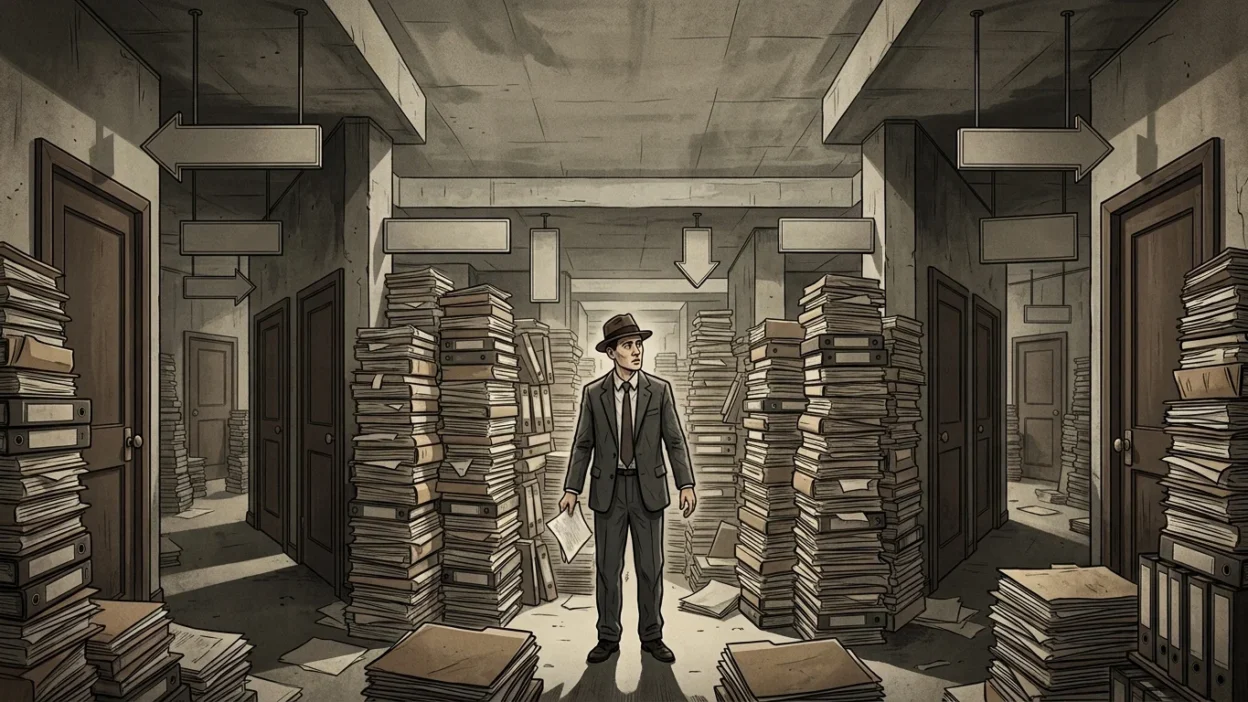
“Kafkaesque” means a situation that is confusing, frightening, absurd, or strangely complicated because of an unfair or uncontrollable system. It often describes situations where a person feels trapped in a maze of rules, bureaucracy, or meaningless procedures and cannot understand how to escape or make things right.
The word comes from the name of Franz Kafka, a famous German language writer whose stories often feature ordinary people caught in mysterious, unreasonable, and oppressive systems. Today, “Kafkaesque” is used beyond literature.
You might describe a government process, workplace problem, legal situation, or frustrating bureaucracy as Kafkaesque when it becomes bizarre and impossible to navigate. For example, if an office demands a document that can only be obtained from another office, while that second office requires the first document, you might call the situation Kafkaesque.
Quick Answer
Kafkaesque describes a strange, confusing, and often disturbing situation in which a person feels trapped by an irrational, complicated, or powerful system. The word comes from writer Franz Kafka. It is commonly used for absurd bureaucracy, helplessness, confusing rules, and situations where logic seems to have disappeared.
Why Do People Find “Kafkaesque” Difficult to Understand?
The word does not simply mean “weird” or “strange.”
A situation is more likely to be Kafkaesque when it combines several ideas:
- Confusing or absurd circumstances
- Complicated rules or bureaucracy
- A feeling of helplessness
- An impersonal or powerful system
- Difficulty understanding what is happening
- No clear way to solve the problem
- Anxiety, fear, or frustration
For example:
“The paperwork was so Kafkaesque that nobody could explain what form I actually needed.”
The speaker is describing more than ordinary confusion. The system itself seems irrational and impossible to navigate.
Where Does the Word “Kafkaesque” Come From?
Kafkaesque comes from the name of Franz Kafka (1883–1924).
Kafka was a German-language writer whose works often explored alienation, anxiety, bureaucracy, guilt, power, and helplessness.
His name became an adjective:
Kafka → Kafkaesque
The suffix “-esque” means something like “in the style or manner of.”
So, literally, Kafkaesque means something resembling the strange or unsettling world found in Kafka’s writing.
What Makes Something Kafkaesque?
A situation does not have to involve a government office or paperwork to be Kafkaesque.
The central idea is the feeling that you are trapped inside a system that operates according to confusing or irrational rules, while you have little power to change it.
Imagine this situation:
You receive a letter saying you must prove your identity.
You visit an office to get the required document.
The office says you cannot get the document without another form.
You try to get that form.
You are told you need the first document before the second form can be issued.
That circular system could reasonably be described as Kafkaesque.
10 Examples of “Kafkaesque”
1. Government bureaucracy
“The process of getting the permit was completely Kafkaesque.”
Meaning: The permit process was extremely complicated, confusing, and difficult to escape.
2. Workplace rules
“The company’s approval system became Kafkaesque.”
Meaning: The workplace procedures had become absurd and impossible to navigate.
3. Legal problems
“He found himself trapped in a Kafkaesque legal system.”
Meaning: The legal process made him feel powerless and unable to understand or control what was happening.
4. Endless paperwork
“Applying for the license turned into a Kafkaesque nightmare.”
Meaning: The paperwork and procedures became irrationally complicated.
5. Technology
“Trying to cancel the subscription was a Kafkaesque experience.”
Meaning: The cancellation process was confusing, frustrating, and seemingly designed to prevent the user from succeeding.
6. School administration
“The university’s registration process was Kafkaesque.”
Meaning: The registration system was unnecessarily complicated and confusing.
7. Customer service
“Every department sent me to another department. It was Kafkaesque.”
Meaning: The person was trapped in a pointless cycle with no clear solution.
8. A strange situation
“He was accused of breaking a rule that nobody could explain.”
This could be described as Kafkaesque because the person is expected to follow an unclear rule while having little ability to challenge it.
9. Conflicting requirements
“The application process was Kafkaesque: they needed a certificate that could only be issued after the application was approved.”
Meaning: The rules created an impossible cycle.
10. Feeling powerless
“She spent months trying to correct an error in the system, but nobody had the authority to fix it. The whole experience was Kafkaesque.”
Meaning: An impersonal system trapped her in a situation she could not control.
Kafkaesque vs. Strange vs. Absurd
| Word | Meaning | Example |
|---|---|---|
| Kafkaesque | Absurd, oppressive, confusing, and often bureaucratic | “The visa process was Kafkaesque.” |
| Strange | Unusual or unfamiliar | “He had a strange dream.” |
| Absurd | Completely unreasonable or ridiculous | “That rule is absurd.” |
| Surreal | Dreamlike, unreal, or bizarre | “The empty city felt surreal.” |
| Bizarre | Very unusual or strange | “It was a bizarre coincidence.” |
Kafkaesque is more specific than simply “strange.”
Kafkaesque vs. Surreal
These words are sometimes confused.
Surreal usually describes something that feels dreamlike, unreal, or disconnected from normal reality.
“Walking through the empty city felt surreal.”
Kafkaesque usually involves absurdity, helplessness, bureaucracy, confusing rules, or an oppressive system.
“Being sent from office to office without anyone explaining the rules was Kafkaesque.”
A situation can be both surreal and Kafkaesque, but the words emphasize different qualities.
Kafkaesque vs. Orwellian
Kafkaesque and Orwellian are both literary adjectives, but they describe different kinds of unsettling situations.
| Term | Main Idea | Typical Features |
|---|---|---|
| Kafkaesque | Feeling trapped in an absurd system | Bureaucracy, confusion, helplessness |
| Orwellian | Extreme control or manipulation by authorities | Surveillance, propaganda, censorship |
| Dystopian | A deeply undesirable society | Oppression, inequality, loss of freedom |
For example:
“The endless government paperwork was Kafkaesque.”
But:
“The government constantly monitored its citizens. The society was Orwellian.”
When Should You Use “Kafkaesque”?
Use Kafkaesque when you want to describe a situation that feels:
- Irrational
- Bureaucratic
- Oppressive
- Confusing
- Impossible to escape
- Controlled by an impersonal system
- Frustratingly circular
- Absurd in a disturbing way
It is especially useful when ordinary people are caught in systems that seem to have rules but do not operate according to understandable logic.
Common Mistakes
Mistake 1: Using “Kafkaesque” for anything strange
Not every unusual event is Kafkaesque.
❌ “I saw a purple dog today. It was Kafkaesque.”
That is strange, but there is no obvious oppressive or irrational system.
Better:
“The government required three different forms to obtain a document that proved I had already submitted those forms. It was Kafkaesque.”
Mistake 2: Thinking it only means “scary”
Kafkaesque situations can be frightening, but fear is not required.
The key idea is often absurdity combined with helplessness or institutional confusion.
Mistake 3: Thinking it only describes government offices
Government bureaucracy is a common example, but workplaces, schools, banks, legal systems, technology platforms, and other institutions can also be Kafkaesque.
Mistake 4: Pronouncing it like “kaff-ka-esk”
The usual English pronunciation is approximately:
kahf-kuh-ESK
The stress is on the final part: ESK.
Memory Trick
Think:
Kafkaesque = trapped in a confusing system with no clear way out.
Imagine a maze where every door leads to another office, every office gives you a new rule, and nobody can explain who is in charge.
That feeling is Kafkaesque.
American vs. British English
“Kafkaesque” is used in both American and British English with essentially the same meaning.
It is more common in educated, literary, journalistic, academic, and formal contexts than in very casual conversation.
You might see it in:
- Newspaper articles
- Book reviews
- Essays
- Political commentary
- Legal discussions
- Workplace writing
- Literary criticism
Similar Words
Depending on the exact situation, related words include:
- Absurd — unreasonable or ridiculous
- Surreal — dreamlike or unreal
- Bizarre — extremely unusual
- Dystopian — describing a deeply troubled society
- Orwellian — involving oppressive surveillance or political control
- Bureaucratic — involving complicated administrative procedures
- Nightmarish — extremely frightening or unpleasant
- Illogical — lacking sensible reasoning
- Oppressive — cruelly controlling
- Confusing — difficult to understand
None of these is a perfect replacement for Kafkaesque, because the word combines several ideas.
Final Verdict
Kafkaesque means strangely absurd, confusing, and often oppressive, especially when a person feels trapped by an irrational or uncontrollable system.
The word comes from Franz Kafka, whose fiction often portrayed individuals facing mysterious authorities, impossible rules, and situations they could not understand or escape.
The easiest way to remember it is:
Kafkaesque = an absurd system that makes you feel powerless and trapped.
Frequently Asked Questions
What does Kafkaesque mean in simple English?
Kafkaesque means confusing, absurd, and often frightening because you are trapped in a complicated or unreasonable system that you cannot control.
Is Kafkaesque a negative word?
Usually, yes. It generally describes an unpleasant, frustrating, disturbing, or oppressive situation.
What is an example of a Kafkaesque situation?
Being sent between several government offices, with each office demanding a document that another office requires before it will issue its own document, is a classic example of a Kafkaesque situation.
Why is it called Kafkaesque?
The word comes from Franz Kafka, whose stories often showed ordinary people caught in mysterious, irrational, and oppressive systems.
Is Kafkaesque the same as absurd?
Not exactly. Absurd means unreasonable or ridiculous, while Kafkaesque usually suggests absurdity combined with confusion, helplessness, bureaucracy, or an oppressive system.
What is the opposite of Kafkaesque?
There is no single exact opposite. Depending on the context, words such as simple, straightforward, transparent, logical, or easy to navigate may express the opposite idea.
Is Kafkaesque an adjective?
Yes. Kafkaesque is an adjective.
For example:
“The situation was Kafkaesque.”
“They faced a Kafkaesque bureaucracy.”
Can Kafkaesque be used for everyday situations?
Yes, especially when an everyday situation becomes unusually complicated or irrational. However, it is a relatively sophisticated word, so “confusing,” “absurd,” or “complicated” may be clearer for beginners.
Remember This
Kafkaesque = absurd + confusing + powerless + trapped in a system.
If a situation feels like a maze of irrational rules with no obvious way out, “Kafkaesque” may be the right word.
Conclusion
“Kafkaesque” is a powerful English adjective for describing situations that are more than simply strange. It captures the unsettling feeling of being caught in an irrational, confusing, or oppressive system. Bureaucracy, endless paperwork, contradictory rules, and institutions that seem impossible to challenge are common examples.
The word comes from Franz Kafka and his distinctive literary world, but you do not need to be discussing literature to use it. Today, people use “Kafkaesque” to describe real world experiences in government, business, law, education, technology, and everyday life.
Remember the central idea: you are caught in a confusing system, the rules do not seem to make sense, and you feel powerless to escape.

Charles Kevin is a passionate language writer and researcher at SimileHive, creating clear, engaging content about similes, idioms, metaphors, and figurative language to help readers improve English communication confidently every day.