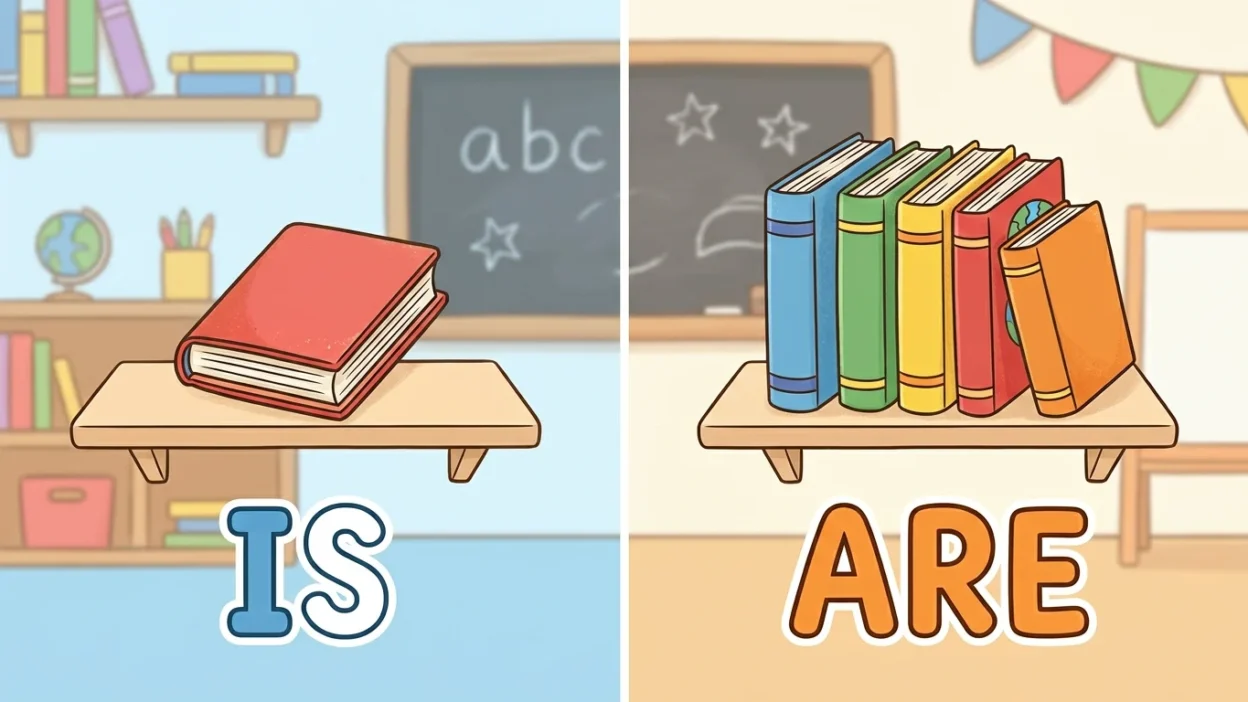
“Is” and “are” are forms of the verb “to be.” Both are used in the present tense, but the correct choice depends mainly on the subject of the sentence. Use is with singular subjects such as “he,” “she,” “it,” and singular nouns. Use are with plural subjects such as “we,” “they,” and plural nouns. The word “you” always takes “are,” whether you are talking to one person or several people.
Knowing when to use “is” and “are” is one of the most important parts of English grammar. These words appear in everyday conversations, questions, descriptions, and written sentences. However, they can sometimes be confusing, especially when a sentence contains extra words between the subject and the verb.
In this guide, you will learn the basic rules for “is” and “are,” see plenty of examples, understand common mistakes, and learn a simple trick to choose the correct form.
Quick Answer
Use is with singular subjects and are with plural subjects. For example, “The boy is happy” and “The boys are happy.” Use is with he, she, and it. Use are with we, they, and you. The word “you” always takes “are.”
Why People Confuse Is and Are
The main reason people confuse “is” and “are” is that the correct verb depends on the subject, not simply on the words closest to the verb.
For example:
“The box of books is heavy.”
The word “books” is plural, but the subject is “box,” which is singular. Therefore, we use “is.”
Compare:
“The books in the box are heavy.”
Here, “books” is the subject, so we use “are.”
This is called subject verb agreement. The verb must agree with the subject in number.
Is
“Is” is the present tense form of “to be” used with singular subjects and with “he,” “she,” and “it.”
Use Is With:
• He
• She
• It
• A singular noun
• An uncountable noun
Examples
“He is tired.”
“She is a teacher.”
“The dog is hungry.”
“My brother is at home.”
“The water is cold.”
“The information is useful.”
Are
“Are” is the present tense form of “to be” used with plural subjects and with “you,” “we,” and “they.”
Use Are With:
• You
• We
• They
• Plural nouns
Examples
“You are kind.”
“We are ready.”
“They are students.”
“The children are outside.”
“My parents are busy.”
Is vs Are at a Glance
| Subject | Correct Verb | Example |
|---|---|---|
| He | Is | He is happy. |
| She | Is | She is ready. |
| It | Is | It is cold. |
| Singular noun | Is | The car is new. |
| Uncountable noun | Is | The milk is fresh. |
| You | Are | You are late. |
| We | Are | We are ready. |
| They | Are | They are busy. |
| Plural noun | Are | The cars are new. |
The Basic Rule
The easiest rule is:
One person or thing = is
Two or more people or things = are
For example:
“The student is ready.”
One student means is.
“The students are ready.”
More than one student means are.
Is With Singular Nouns
Use “is” when the subject is one person, place, thing, or idea.
Examples:
“The house is beautiful.”
“My sister is a doctor.”
“The book is interesting.”
“The weather is pleasant.”
“This problem is difficult.”
Even if other words appear between the subject and verb, look at the main subject.
“The box of toys is under the table.”
The subject is “box,” not “toys.”
Are With Plural Nouns
Use “are” when the subject refers to more than one person, place, thing, or idea.
Examples:
“The houses are beautiful.”
“My sisters are doctors.”
“The books are interesting.”
“The students are studying.”
“These problems are difficult.”
Is and Are With Pronouns
Pronouns make the rule easy to remember.
| Pronoun | Correct Form |
|---|---|
| I | Am |
| He | Is |
| She | Is |
| It | Is |
| You | Are |
| We | Are |
| They | Are |
Notice that I does not use “is” or “are.” It uses am.
“I am ready.”
Also remember that “you” always takes “are.”
“You are my friend.”
“You are my friends.”
The number of people does not change the verb after “you.”
Is vs Are With There
“There” can make subject verb agreement confusing.
Look at the noun that comes after the verb.
Use Is With a Singular Noun
“There is a book on the table.”
There is one book.
“There is a problem.”
There is one problem.
Use Are With a Plural Noun
“There are two books on the table.”
There are multiple books.
“There are several problems.”
There are multiple problems.
Is vs Are With Questions
The same rule applies when asking questions.
Singular
“Is he ready?”
“Is she your sister?”
“Is the food hot?”
Plural
“Are they ready?”
“Are your parents home?”
“Are the children asleep?”
With You
“Are you okay?”
“Are you busy?”
Never say:
“Is you okay?”
The correct form is:
“Are you okay?”
Is vs Are With Negative Sentences
Use “is not” with singular subjects.
“He is not tired.”
“She is not here.”
“The car is not ready.”
Use “are not” with plural subjects.
“They are not tired.”
“We are not ready.”
“The cars are not clean.”
The common short forms are:
| Full Form | Short Form |
|---|---|
| Is not | Isn’t |
| Are not | Aren’t |
Examples:
“He isn’t here.”
“They aren’t here.”
Two Useful Comparison Tables
| Sentence | Why? |
|---|---|
| The child is happy. | One child |
| The children are happy. | More than one child |
| The book is useful. | One book |
| The books are useful. | More than one book |
| She is tired. | Singular pronoun |
| They are tired. | Plural pronoun |
| You are correct. | “You” always uses “are” |
| There is a problem. | One problem |
| There are problems. | More than one problem |
| Incorrect | Correct | Reason |
|---|---|---|
| He are tired. | He is tired. | “He” is singular |
| They is happy. | They are happy. | “They” is plural |
| You is late. | You are late. | “You” uses “are” |
| The dogs is hungry. | The dogs are hungry. | “Dogs” is plural |
| The dog are hungry. | The dog is hungry. | “Dog” is singular |
| There is two books. | There are two books. | “Books” is plural |
12 Examples of Is and Are
1. One Person
“Sarah is at school.”
Sarah is one person, so we use “is.”
2. Several People
“Sarah and John are at school.”
There are two people, so we use “are.”
3. One Thing
“The computer is new.”
“Computer” is singular.
4. Several Things
“The computers are new.”
“Computers” is plural.
5. With He
“He is my brother.”
“He” takes “is.”
6. With They
“They are my friends.”
“They” takes “are.”
7. With You
“You are very helpful.”
“You” always takes “are.”
8. With There
“There is a cat outside.”
There is one cat.
9. With Multiple Things
“There are three cats outside.”
There are several cats.
10. With an Uncountable Noun
“The information is important.”
“Information” is treated as an uncountable noun, so we use “is.”
11. With a Group of People
“The students are ready.”
“Students” is plural.
12. With Extra Words
“The list of names is on the desk.”
The subject is “list,” which is singular. The plural word “names” does not change the verb.
Common Mistakes
Mistake 1: Using Is With They
Incorrect:
“They is happy.”
Correct:
“They are happy.”
“They” is plural.
Mistake 2: Using Are With He
Incorrect:
“He are busy.”
Correct:
“He is busy.”
“He” is singular.
Mistake 3: Using Is With You
Incorrect:
“You is late.”
Correct:
“You are late.”
“You” always uses “are.”
Mistake 4: Looking at the Closest Noun
Incorrect:
“The box of books are heavy.”
Correct:
“The box of books is heavy.”
The subject is “box,” not “books.”
Mistake 5: Forgetting About Uncountable Nouns
Incorrect:
“The information are useful.”
Correct:
“The information is useful.”
Words such as “information,” “advice,” and “furniture” are normally uncountable in English and take a singular verb.
Memory Trick
Use this simple pattern:
He, she, it = is
You, we, they = are
For nouns:
One = is
More than one = are
You can remember it like this:
One is, many are.
There is one important exception to remember:
You are
Even when “you” refers to only one person, the correct verb is “are.”
American vs British English
The basic rules for “is” and “are” are the same in American and British English.
However, collective nouns can sometimes behave differently.
For example, British English may use either a singular or plural verb with some collective nouns depending on whether the group is viewed as one unit or as individuals.
“The team is playing well.”
“The team are wearing their new shirts.”
American English more commonly treats collective nouns as singular:
“The team is playing well.”
For ordinary sentences, however, the basic rule remains the same in both varieties.
Similar Words and Forms
“Is” and “are” are forms of the verb be.
Here are the main present tense forms:
| Subject | Form of Be |
|---|---|
| I | Am |
| He | Is |
| She | Is |
| It | Is |
| You | Are |
| We | Are |
| They | Are |
In the past tense, “was” and “were” are used.
“He was tired.”
“They were tired.”
Final Verdict
Use is with singular subjects, including “he,” “she,” and “it.” Use are with plural subjects, including “we” and “they.” The word you always takes “are.”
The simplest rule to remember is:
One is, many are.
Just make sure you identify the real subject of the sentence rather than choosing the verb based on the nearest noun.
FAQs
When should I use “is”?
Use “is” with singular subjects such as “he,” “she,” “it,” and singular nouns.
“The boy is happy.”
When should I use “are”?
Use “are” with plural subjects such as “we,” “they,” and plural nouns. Use “are” with “you” as well.
“The boys are happy.”
Is it “you is” or “you are”?
The correct form is “you are.”
“You are my friend.”
This is true whether “you” refers to one person or several people.
Is it “there is” or “there are”?
Use “there is” with a singular noun and “there are” with a plural noun.
“There is a problem.”
“There are two problems.”
Is “information is” or “information are” correct?
“Information is” is correct because “information” is normally an uncountable noun.
“The information is useful.”
Is it “the team is” or “the team are”?
Both can be possible depending on the variety of English and the meaning. American English generally uses “the team is,” while British English can use either depending on whether the team is viewed as one unit or as individual members.
What is the easiest way to remember is and are?
Remember one is, many are. Also memorize the pronoun pattern: he, she, it is and you, we, they are.
Remember This
Is goes with one.
Are goes with more than one.
But remember:
You are
not
You is
Examples:
“The cat is hungry.”
“The cats are hungry.”
“She is ready.”
“They are ready.”
“You are welcome.”
Conclusion
Understanding “is” and “are” becomes much easier when you focus on the subject of the sentence. Use “is” for singular subjects and “are” for plural subjects. The pronouns also give you a simple pattern: he, she, and it use “is,” while you, we, and they use “are.”
The most useful memory rule is one is, many are. Always check the main subject before choosing the verb, especially when extra words appear between the subject and the verb. With regular practice, choosing between “is” and “are” will become automatic.

Lucas Luke is a passionate language writer and content creator at SimileHive, specializing in similes, idioms, metaphors, and figurative language. He enjoys making complex English expressions simple, engaging, and easy to understand for students, writers, and language enthusiasts through well-researched, practical content.