Do you sometimes confuse knew and new when writing in English? These two words sound exactly the same in standard English pronunciation, but they have completely different meanings and grammatical uses. Choosing the wrong one can make a sentence confusing or grammatically incorrect.
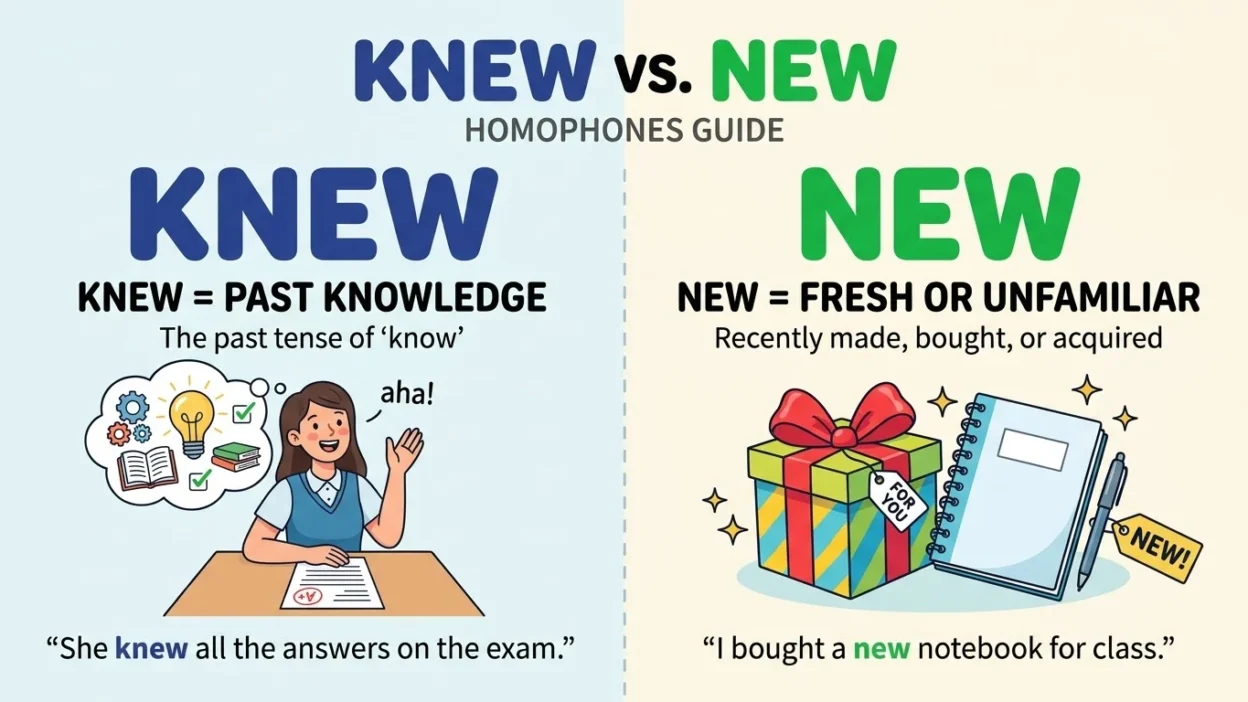
The main difference is that knew is the past tense of the verb know, while new is an adjective that describes something recently made, discovered, purchased, or introduced. For example, you might say, “I knew the answer yesterday,” but “I bought a new phone yesterday.”
Because knew and new are pronounced alike, they are easy to mix up in writing. However, understanding their meanings and looking at the context of a sentence can help you choose the correct spelling every time.
Quick Answer: Knew vs New
Knew is the past tense of know and means that someone had knowledge or information about something in the past. New is an adjective meaning recently made, introduced, discovered, or not previously used. For example, “I knew the teacher” refers to past knowledge, while “I met a new teacher” describes someone unfamiliar.
Why Do People Confuse Knew and New?
People often confuse these words because they are homophones. Homophones are words that have the same pronunciation but different spellings and meanings.
Knew and new are particularly easy to mix up because:
- They sound exactly alike in standard English.
- Their spellings differ by only one letter.
- Both are common words used in everyday conversations.
- Spellcheck may not identify the mistake because both are correctly spelled words.
The important thing to remember is that knew relates to knowledge in the past, while new relates to something fresh or unfamiliar.
What Does Knew Mean?
Knew is the simple past tense of the verb know. It means that someone had information, understanding, awareness, or familiarity with something or someone in the past.
The verb forms are:
| Verb form | Word |
|---|---|
| Base form | Know |
| Simple past | Knew |
| Past participle | Known |
Examples of Knew in Sentences
- I knew the answer to the question.
- She knew that something was wrong.
- They knew each other from childhood.
- He knew about the meeting before I told him.
- We knew the journey would take several hours.
- I never knew you could play the guitar.
- She knew exactly what she wanted.
- Everyone knew that he was an honest person.
- He knew the risks before starting the business.
- I knew I had made the right decision.
Common Expressions With Knew
I knew it: Used when something happens as expected or confirms what you already suspected.
Example: I knew it! He was going to win the competition.
As far as I knew: Used to describe what someone believed or understood at a particular time.
Example: As far as I knew, the office was closed on Sundays.
I never knew: Used to express surprise about information that was previously unknown.
Example: I never knew she had written a book.
What Does New Mean?
New is an adjective that describes something recently created, purchased, introduced, discovered, or not previously used or experienced.
It can describe objects, people, ideas, experiences, opportunities, places, and situations.
Examples of New in Sentences
- I bought a new laptop yesterday.
- She has a new job.
- They moved into a new house last month.
- We need a new plan to solve this problem.
- He introduced me to his new friend.
- The company launched a new product.
- I am learning a new language.
- She wants to try a new restaurant.
- The school has a new principal.
- This is a new opportunity for everyone.
Common Expressions With New
Brand new: Completely new or unused.
Example: He bought a brand new car.
New to something: Not familiar with an activity, subject, or situation.
Example: I am new to this job.
New beginning: A fresh start or opportunity to do something differently.
Example: Moving to another city gave her a new beginning.
New experience: Something someone has not experienced before.
Example: Travelling alone was a new experience for him.
Knew vs New: Key Differences
| Feature | Knew | New |
|---|---|---|
| Part of speech | Verb | Adjective |
| Meaning | Had knowledge in the past | Recently made, introduced, or unfamiliar |
| Base form | Know | New has no verb form |
| Grammatical role | Describes a past state of knowing | Describes a noun |
| Example | I knew the answer. | I bought a new book. |
When Should You Use Knew?
Use knew when talking about knowledge, awareness, or familiarity that existed in the past.
For example:
- Use knew when discussing past knowledge: I knew the answer.
- Use knew when describing past awareness: She knew about the problem.
- Use knew when discussing familiarity: We knew each other at school.
- Use knew when describing a past realization: He knew he was making a mistake.
- Use knew when talking about something someone understood: They knew what to do.
When Should You Use New?
Use new when describing something that is recently made, purchased, introduced, discovered, or unfamiliar.
For example:
- Use new when describing a recently purchased item: I bought a new phone.
- Use new when discussing a recent job: She started a new job.
- Use new when describing an unfamiliar person: He is my new neighbour.
- Use new when discussing a fresh idea: We need a new approach.
- Use new when describing something recently introduced: The school has a new policy.
Knew vs New: Sentence Comparison
Looking at both words in similar contexts can make their difference easier to understand.
| With Knew | With New |
|---|---|
| I knew the teacher. | I met a new teacher. |
| She knew the answer. | She wrote a new answer. |
| He knew about the project. | He started a new project. |
| We knew the place. | We visited a new place. |
| They knew the rules. | They introduced new rules. |
| I knew his name. | I learned a new name. |
Common Mistakes to Avoid
Here are some examples of incorrect and correct usage.
| Incorrect sentence | Correct sentence |
|---|---|
| I new the answer. | I knew the answer. |
| She bought a knew dress. | She bought a new dress. |
| They new about the problem. | They knew about the problem. |
| He has a knew car. | He has a new car. |
| I never new that. | I never knew that. |
| We need a knew plan. | We need a new plan. |
Remember that knew is connected to the verb know, while new describes a person, object, idea, or situation.
Easy Memory Trick: How to Remember Knew and New
Here is a simple way to remember these words.
Knew = Know in the past
Think of the word know. When you change it to the past tense, it becomes knew.
Example: I know the answer today. I knew the answer yesterday.
New = Something fresh or unfamiliar
Think of a new phone, a new house, or a new opportunity. The word describes something that is recent or unfamiliar.
Example: She bought a new phone.
A quick reminder:
- If you are talking about past knowledge, use knew.
- If you are describing something fresh or unfamiliar, use new.
American vs British English: Knew and New
There is no spelling difference between American and British English for these words.
Both varieties use:
- Knew as the past tense of know.
- New as an adjective describing something recently made, introduced, or unfamiliar.
Their pronunciation is also generally the same in both varieties. The two words are homophones, so context helps readers understand which word is intended.
Similar Words and Related Expressions
Understanding these related words can help you use knew and new more confidently.
| Word | Meaning |
|---|---|
| Know | To have information or understanding |
| Known | The past participle of know |
| Knowledge | Information, understanding, or awareness |
| Familiar | Known or recognized through experience |
| Recent | Happening or occurring not long ago |
| Fresh | Recently made, prepared, or introduced |
| Novel | New, original, or unfamiliar |
| Unfamiliar | Not previously known or experienced |
Final Verdict: Knew or New?
The correct word depends on the meaning of your sentence.
- Knew is the past tense of know. Use it when talking about something you understood, recognized, or were aware of in the past.
- New is an adjective. Use it when describing something recently made, purchased, introduced, or unfamiliar.
For example, “I knew about the new restaurant” is correct because knew describes past knowledge, while new describes the restaurant.
Frequently Asked Questions
1. What is the main difference between knew and new?
Knew is the past tense of know, meaning someone had knowledge or awareness in the past. New is an adjective meaning recently made, introduced, or unfamiliar.
2. Are knew and new pronounced the same?
Yes. Knew and new are homophones in standard English. They have the same pronunciation but different spellings and meanings.
3. Is knew the past tense of know?
Yes. Knew is the simple past tense of know.
Example: I know her now, but I knew her years ago.
4. Is new an adjective or a noun?
New is primarily an adjective. It describes something recently made, introduced, purchased, or unfamiliar.
Example: She bought a new dress.
5. Is it I never knew or I never new?
The correct expression is I never knew. It means that you did not have certain information or awareness in the past.
Example: I never knew you lived here.
6. Is it a new idea or a knew idea?
The correct phrase is a new idea. New describes an idea that is fresh, original, or unfamiliar. Knew cannot be used as an adjective in this expression.
7. What are knew and new called in English?
They are called homophones because they have the same pronunciation but different spellings and meanings.
Remember This
Knew = Past knowledge.
New = Something fresh or unfamiliar.
For example, you might say, “I knew about the new school.” Here, knew refers to past knowledge, while new describes the school.
Conclusion
Although knew and new sound exactly alike, they have different meanings and grammatical functions. Knew is the past tense of know and refers to information, awareness, or familiarity someone had in the past. New is an adjective used to describe something recently made, introduced, purchased, or unfamiliar.
The easiest way to remember the difference is to connect knew with knowledge and new with something fresh. Pay attention to the meaning of your sentence, and you will be able to choose the correct word confidently.

Adam Aaron is a language enthusiast and content writer at SimileHive, creating clear, engaging guides on similes, idioms, metaphors, and figurative language to help readers improve English confidently every day.