
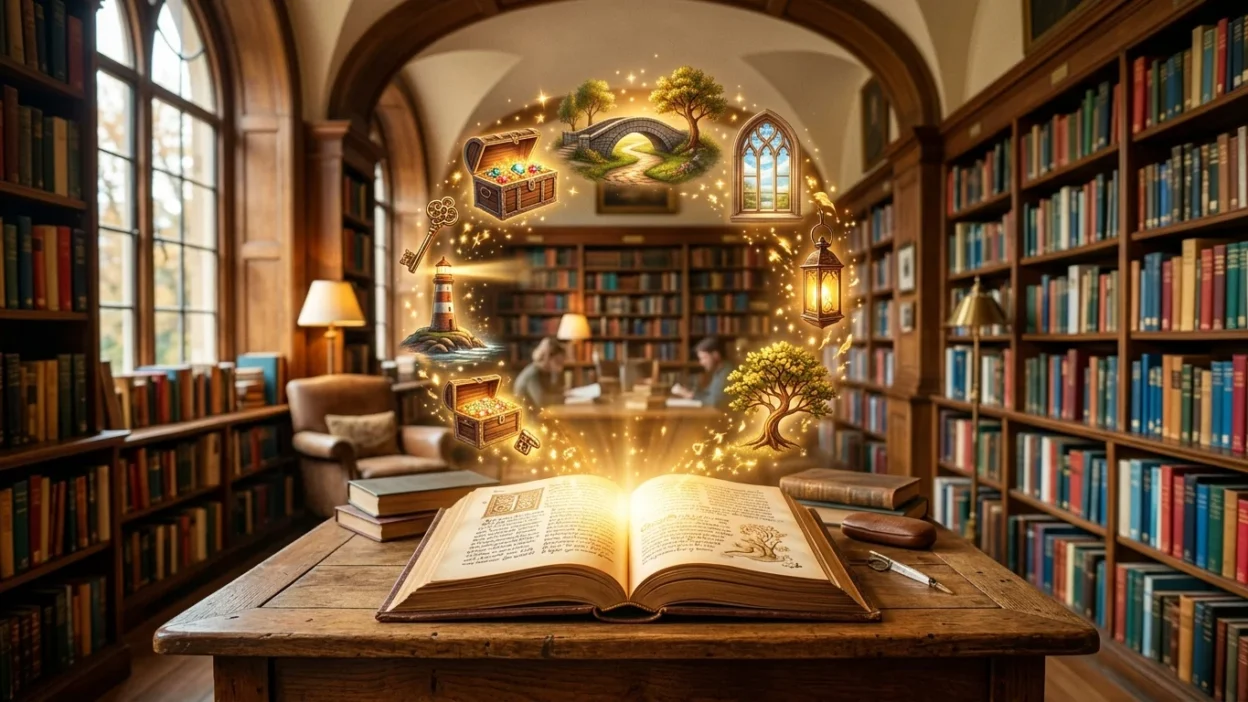
Books are much more than paper and ink. They can take us to new places, teach valuable lessons, spark our imagination, and help us understand ourselves and others.
Because books have such a powerful effect, writers often describe them using metaphors. A metaphor compares one thing to another without using words like as or like. It helps readers picture ideas in a fresh and memorable way.
Learning metaphors for books is useful for students, teachers, authors, and anyone who enjoys reading or creative writing. These figurative expressions make stories, essays, speeches, and poems more interesting. They also help you explain the importance of books in a simple but powerful way.
In this guide, you will discover the meaning of book metaphors, learn how to use them correctly, and explore twenty original metaphors with easy explanations and example sentences. Each metaphor is written in clear, simple English so readers of all ages can understand and use them with confidence.
Quick Answer
Metaphors for books describe books by comparing them to something else without using like or as. They show the value, power, and purpose of books in creative ways. Examples include a window to the world, a silent teacher, and a treasure chest of ideas, each helping readers express thoughts more vividly.
Is “Metaphors for Books” a Metaphor?
No. Metaphors for books is a topic, not a metaphor itself. It refers to different creative comparisons used to describe books. These comparisons are examples of figurative language, a literary device that makes writing more colourful and meaningful.
What Do Book Metaphors Mean?
A metaphor gives a book a new identity to highlight one of its qualities. Instead of saying a book is helpful, you might say a book is a lighthouse. This comparison suggests that a book guides people through confusion just as a lighthouse guides ships.
Book metaphors can describe knowledge, imagination, learning, adventure, comfort, hope, or personal growth.
Why Writers Use Metaphors for Books
Writers use metaphors because they:
- Make writing more engaging.
- Help readers picture ideas clearly.
- Add emotion and creativity.
- Improve storytelling.
- Make descriptions easier to remember.
Whether you are writing a story, speech, essay, or poem, book metaphors can make your words more powerful.
20 Original Metaphors for Books
1. A Book Is a Window to the World
Meaning
Books help people see places, cultures, and ideas beyond their own lives.
Explanation
Just as a window lets you look outside, a book lets you explore new experiences without leaving home.
Example Sentences
The history book became a window to the world, showing me ancient civilizations.
Every novel is a window to the world waiting to be opened.
2. A Book Is a Treasure Chest
Meaning
Books hold valuable knowledge, stories, and wisdom.
Explanation
Like a treasure chest filled with precious items, every book contains ideas worth discovering.
Example Sentences
Her science textbook was a treasure chest full of amazing discoveries.
The old library holds treasure chests on every shelf.
3. A Book Is a Silent Teacher
Meaning
Books educate without speaking.
Explanation
A good book teaches lessons through its words while remaining quiet.
Example Sentences
That biography became my silent teacher during difficult times.
Every good book is a silent teacher that never grows tired.
4. A Book Is a Bridge
Meaning
Books connect people with new ideas, cultures, and generations.
Explanation
Like a bridge joins two places, books connect readers with knowledge and experiences.
Example Sentences
The novel became a bridge between different cultures.
Reading built a bridge between my past and future.
5. A Book Is a Garden
Meaning
Books are full of ideas that grow in the reader’s mind.
Explanation
Each page is like a seed that can grow into understanding and imagination.
Example Sentences
His favourite novel became a garden of endless inspiration.
Every chapter planted new flowers in her imagination.
6. A Book Is a Lighthouse
Meaning
Books provide guidance during confusing times.
Explanation
Just as a lighthouse helps ships find safety, books help people make wise decisions.
Example Sentences
That self improvement book became my lighthouse after graduation.
Great books often shine like lighthouses during life’s storms.
7. A Book Is a Key
Meaning
Books unlock knowledge and opportunity.
Explanation
Reading opens doors that might otherwise remain closed.
Example Sentences
Education gave her the key she needed through books.
Every textbook is a key to future success.
8. A Book Is a Time Machine
Meaning
Books allow readers to experience different periods.
Explanation
Through reading, people can visit the past or imagine the future.
Example Sentences
The historical novel became a time machine to ancient Rome.
Science fiction books act as time machines into tomorrow.
9. A Book Is a Compass
Meaning
Books help people find direction.
Explanation
They guide readers toward better choices and greater understanding.
Example Sentences
His favourite leadership book became a compass for his career.
Good books often serve as a compass during uncertain moments.
10. A Book Is a Friend
Meaning
Books provide comfort, support, and companionship.
Explanation
A favourite book can bring joy whenever you need encouragement.
Example Sentences
The novel became my closest friend during the long holiday.
A good book is a friend that is always ready to welcome you.
How to Use Book Metaphors in Creative Writing
Book metaphors work best when they match the message of your writing.
For example:
- Use a lighthouse when writing about guidance.
- Use a treasure chest when discussing knowledge.
- Use a garden when describing imagination.
- Use a bridge when talking about understanding others.
- Use a key when explaining learning and opportunity.
Keep your metaphors simple and relevant so readers understand them easily.
11. A Book Is a Door
Meaning
Books open new opportunities, ideas, and adventures.
Explanation
Just as a door leads to another place, a book leads readers into new worlds and fresh experiences.
Example Sentences
The mystery novel became a door to an exciting adventure.
Every good book is a door waiting for someone to open it.
12. A Book Is a Map
Meaning
Books show readers the way to knowledge or understanding.
Explanation
A map helps people find the right path, and books guide readers toward learning and discovery.
Example Sentences
The travel guide was a map to unforgettable experiences.
His favourite history book became a map of the past.
13. A Book Is a Lantern
Meaning
Books bring light to confusing ideas.
Explanation
A lantern helps people see in the dark, just as books help readers understand difficult topics.
Example Sentences
The science book was a lantern during exam preparation.
Great books shine as lanterns in moments of uncertainty.
14. A Book Is a Seed
Meaning
Books plant ideas that grow over time.
Explanation
A single story or lesson can inspire lifelong learning and personal growth.
Example Sentences
The novel planted a seed of kindness in every reader.
That inspiring book became a seed for her future dreams.
15. A Book Is a Mirror
Meaning
Books help readers understand themselves.
Explanation
Characters and stories often reflect our own feelings, hopes, and challenges.
Example Sentences
The memoir became a mirror that reflected my own experiences.
Many readers find a mirror within their favourite stories.
16. A Book Is a River
Meaning
Books carry readers on a continuous journey.
Explanation
Like a flowing river, a story moves from one event to the next while leading readers forward.
Example Sentences
The adventure novel flowed like a river from beginning to end.
Every chapter carried us farther down the river of imagination.
17. A Book Is a Fire
Meaning
Books ignite curiosity and passion.
Explanation
A powerful book can spark new interests, dreams, or ideas.
Example Sentences
The biography lit a fire inside the young student.
One inspiring book can become a fire that changes a life.
18. A Book Is a Backpack
Meaning
Books carry valuable lessons wherever readers go.
Explanation
Just as a backpack holds useful items, books hold knowledge that stays with us.
Example Sentences
Every textbook became a backpack filled with practical skills.
Good books give readers knowledge they can carry for life.
19. A Book Is a Puzzle
Meaning
Books encourage readers to think deeply.
Explanation
Some stories reveal their meaning piece by piece, rewarding careful reading.
Example Sentences
The detective novel was a fascinating puzzle from the first page.
Every clue added another piece to the book’s puzzle.
20. A Book Is a Star
Meaning
Books inspire hope and point readers in the right direction.
Explanation
Just as travellers once followed the stars, readers often look to books for inspiration.
Example Sentences
That classic novel became a bright star during difficult times.
Wonderful books continue to shine long after they are finished.
Common Mistakes When Using Metaphors for Books
Many people make small mistakes when using metaphors. Avoid these common errors.
| Mistake | Better Choice |
|---|---|
| Mixing several metaphors in one sentence | Use one clear metaphor at a time. |
| Choosing a metaphor that does not match the topic | Pick a comparison that supports your message. |
| Explaining the metaphor too much | Let the image speak naturally. |
| Using the same metaphor repeatedly | Vary your expressions to keep writing fresh. |
| Confusing metaphors with similes | Remember that metaphors do not use like or as. |
Similar Expressions for Books
If you want more variety in your writing, try these expressions.
- A source of wisdom
- A world of imagination
- A fountain of knowledge
- A path to learning
- A library of dreams
- A guide through life
- A collection of adventures
- A home for ideas
- A voice from the past
- A journey through words
Practical Creative Writing Tips
Use these simple tips to write stronger metaphors.
- Think about the main purpose of the book.
- Choose an object that shares the same quality.
- Keep the comparison easy to understand.
- Avoid using too many metaphors in one paragraph.
- Read your sentence aloud to see if it sounds natural.
- Create your own original comparisons instead of copying famous ones.
- Match the metaphor to your audience and writing style.
Practice Questions
1. Which metaphor suggests that books help people learn?
Answer: A book is a silent teacher.
Explanation: It shows that books educate readers without speaking.
2. Which metaphor represents guidance?
Answer: A book is a lighthouse.
Explanation: It shows that books help people find the right direction.
3. Which metaphor describes books as opening opportunities?
Answer: A book is a door.
Explanation: Books lead readers to new ideas and experiences.
4. Which metaphor shows that books contain valuable knowledge?
Answer: A book is a treasure chest.
Explanation: Books hold information and ideas that are worth discovering.
5. Which metaphor compares books to personal reflection?
Answer: A book is a mirror.
Explanation: Stories often help readers understand themselves.
6. Which metaphor suggests books inspire curiosity?
Answer: A book is a fire.
Explanation: Reading can spark excitement and new interests.
7. Which metaphor represents imagination growing?
Answer: A book is a garden.
Explanation: Ideas grow in the reader’s mind just as plants grow in a garden.
8. Which metaphor shows books connecting people?
Answer: A book is a bridge.
Explanation: Books connect readers with different cultures and ideas.
9. Which metaphor represents exploration of history?
Answer: A book is a time machine.
Explanation: Reading allows people to experience different periods.
10. Write your own metaphor for a book.
Sample Answer: A book is a mountain because every chapter brings a new view.
Explanation: This compares reading to climbing higher and gaining a broader perspective.
Frequently Asked Questions
What is a metaphor for books?
A metaphor for books is a creative comparison that describes books as something else, such as a lighthouse, a treasure chest, or a window to the world, without using like or as.
Why are metaphors for books useful?
They make writing more interesting, help readers understand ideas more clearly, and add emotion to stories, essays, speeches, and poems.
Are metaphors and similes the same?
No. A metaphor makes a direct comparison, while a simile uses words such as like or as.
Can I create my own book metaphors?
Yes. Original metaphors often make your writing more creative and memorable. Think about what a book does, then compare it with something that has a similar purpose.
Which metaphor is best for learning?
A silent teacher, a key, and a compass are excellent metaphors for learning because they show guidance, knowledge, and personal growth.
How can students use book metaphors?
Students can use them in essays, speeches, creative writing, poems, book reviews, classroom presentations, and storytelling activities.
Can one book have more than one metaphor?
Yes. A single book can be described as a key, a friend, a lighthouse, or a treasure chest, depending on the idea you want to express.
What is the easiest metaphor for beginners?
A book is a window to the world is one of the simplest and most meaningful metaphors because it clearly shows how books help us see beyond our own experiences.
Conclusion
Books have inspired people for centuries, and metaphors help us describe their value in creative and meaningful ways. Whether you call a book a window to the world, a silent teacher, a treasure chest, or a lighthouse, each metaphor highlights a different quality of reading.
These comparisons make writing more vivid, improve creative expression, and help readers connect with ideas on a deeper level. As you practise using these metaphors, try creating your own unique comparisons that match your message.
With a little imagination, your writing will become more engaging, memorable, and enjoyable for every reader

Charles Kevin is a passionate language writer and researcher at SimileHive, creating clear, engaging content about similes, idioms, metaphors, and figurative language to help readers improve English communication confidently every day.