
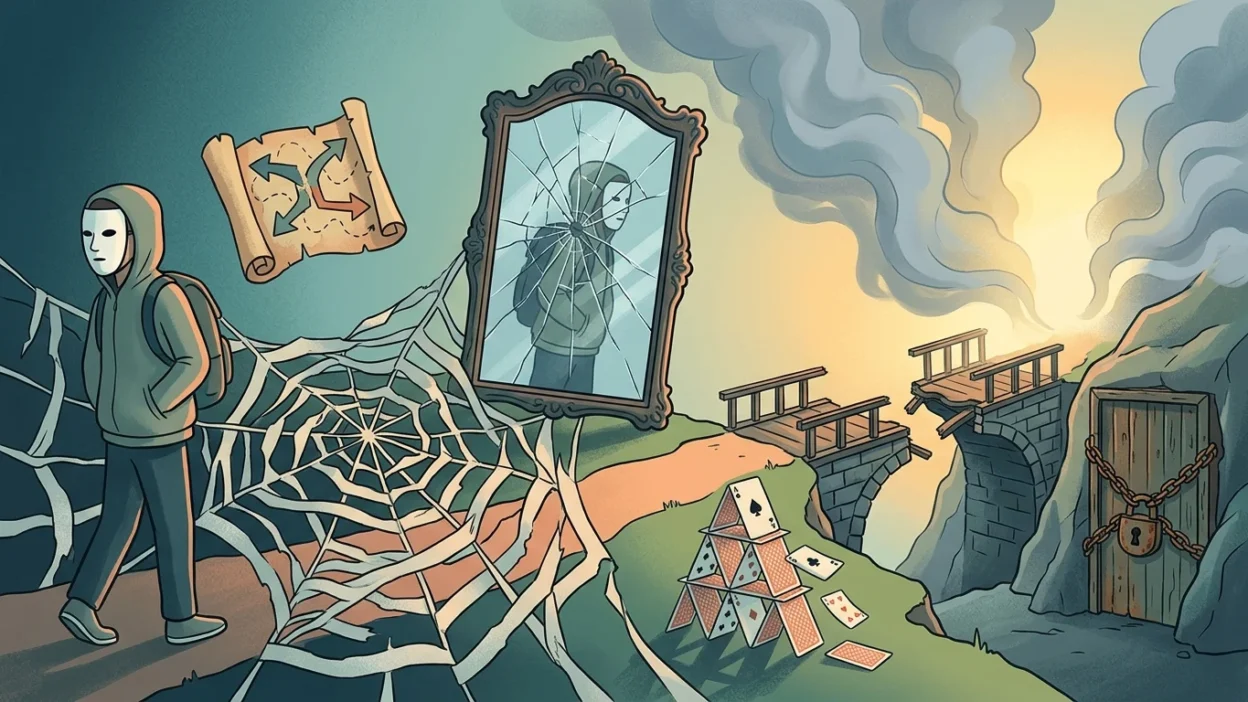
Lying means saying something that is not true on purpose. Sometimes a lie is small, such as saying you finished your homework when you did not. Other times, a lie can be much bigger and hurt trust between people. Because lying can have many effects, writers often use metaphors to describe it in a stronger and more creative way.
Metaphors for lying compare lies or dishonest behavior to familiar things such as masks, shadows, webs, walls, smoke, or broken bridges. These comparisons help readers understand what a lie feels like and what it can do. For example, saying “The lie was a spider web” suggests that one lie can lead to more lies and become difficult to escape.
These metaphors are useful in stories, poems, essays, speeches, and creative writing. They can show secrecy, fear, confusion, guilt, dishonesty, or broken trust without simply saying, “The person was lying.”
Quick Answer
Metaphors for lying describe dishonesty through creative images such as masks, shadows, webs, smoke, walls, and broken bridges. They show how lies can hide the truth, create confusion, or damage trust. For example, “His lie was a mask” means he used false words to hide what was really true.
What Are Metaphors for Lying?
A metaphor directly compares one thing to another. It does not use “like” or “as.”
For example:
Her lie was a locked door.
The lie is not really a door. The metaphor means that the lie kept the truth hidden and made it difficult for others to discover what was real.
Lying can be connected with many ideas:
• Hiding the truth
• Fear
• Secrecy
• Confusion
• Guilt
• Broken trust
• Manipulation
• Avoiding responsibility
• Creating false stories
A good metaphor helps the reader understand one of these ideas through a simple picture.
What Can Lying Symbolize?
Lying can symbolize different things depending on the situation.
A mask: A person may hide their true thoughts or feelings.
A shadow: A lie may follow someone even after they try to forget it.
A web: One lie can lead to many more lies.
Smoke: A lie can make the truth difficult to see.
A wall: A lie can create distance between people.
A broken bridge: Dishonesty can damage trust.
A locked box: A lie can keep information hidden.
A cracked mirror: A lie can distort the truth.
When using figurative language, think about what the lie is doing. Is it hiding something, damaging trust, creating confusion, or growing into something bigger?
20 Metaphors for Lying
1. The lie was a mask
Meaning: The lie was used to hide the truth.
Explanation: A mask covers someone’s face and hides their real appearance. This makes it a strong metaphor for dishonest words that hide what is really happening.
Example sentences:
- His lie was a mask hiding his true feelings.
- She wore a mask of false confidence through every conversation.
2. The lie was a spider web
Meaning: One lie led to many more lies.
Explanation: A spider web has many connected parts. Once someone begins lying, they may need more lies to support the first one.
Example sentences:
- His first lie became a spider web of excuses.
- She was trapped in a spider web of lies.
3. The lie was a shadow
Meaning: The lie continued to follow the person.
Explanation: A shadow follows you as you move. This metaphor shows that a lie can remain in someone’s mind or life even after it has been told.
Example sentences:
- His lie was a shadow that followed him for years.
- The old lie remained a shadow over their friendship.
4. The lie was smoke
Meaning: The lie made the truth difficult to see.
Explanation: Smoke can block someone’s view. This metaphor shows how false information can confuse people and hide what really happened.
Example sentences:
- Her story was smoke hiding the truth.
- The false explanation filled the room with smoke.
5. The lie was a locked door
Meaning: The lie kept the truth hidden.
Explanation: A locked door prevents people from entering. In the same way, a lie can stop others from discovering the truth.
Example sentences:
- His lie was a locked door between him and his friends.
- Every false answer became another locked door.
6. The lie was a cracked mirror
Meaning: The lie showed a distorted version of reality.
Explanation: A cracked mirror does not show a clear reflection. This metaphor suggests that lying changes or twists the truth.
Example sentences:
- Her story was a cracked mirror of what really happened.
- The lie became a cracked mirror reflecting a false version of the past.
7. The lie was a wall
Meaning: The lie created distance between people.
Explanation: A wall separates one place from another. A lie can also separate people by making trust more difficult.
Example sentences:
- His lie became a wall between the two brothers.
- Every false word added another stone to the wall.
8. The lie was a broken bridge
Meaning: The lie damaged a relationship.
Explanation: A bridge connects two places. When a bridge breaks, crossing becomes difficult. In the same way, dishonesty can make it difficult for people to trust each other.
Example sentences:
- Her lie was a broken bridge between old friends.
- Trust became difficult after the broken bridge of dishonesty.
9. The lie was a seed
Meaning: A small lie could grow into a much bigger problem.
Explanation: A seed can grow into something much larger. This metaphor shows how one small lie can lead to serious consequences.
Example sentences:
- His little lie was a seed that grew into a huge problem.
- She planted a seed of dishonesty with one false answer.
10. The lie was a tangled knot
Meaning: The lie became difficult to explain or escape.
Explanation: A tangled knot is difficult to loosen. A complicated lie can become harder to manage as more false details are added.
Example sentences:
- His story became a tangled knot of excuses.
- Every new lie tightened the tangled knot.
11. The lie was a hidden trap
Meaning: The lie could cause problems for the person who told it.
Explanation: A hidden trap is difficult to see before it causes trouble. This metaphor shows that lying may seem useful at first but can create problems later.
Example sentences:
- Her lie was a hidden trap waiting to catch her.
- The false story became a hidden trap when the truth appeared.
12. The lie was a curtain
Meaning: The lie covered or hid the truth.
Explanation: A curtain can cover something behind it. This makes it a simple metaphor for dishonest words that keep facts hidden.
Example sentences:
- His lie was a curtain covering the truth.
- She pulled a curtain of false words over the real story.
13. The lie was a false map
Meaning: The lie gave someone the wrong idea about reality.
Explanation: A map is supposed to guide people in the right direction. A false map leads them somewhere they did not intend to go.
Example sentences:
- His lie was a false map that led everyone away from the truth.
- The rumor became a false map for people searching for answers.
14. The lie was a leaking boat
Meaning: The lie could not remain hidden forever.
Explanation: A leaking boat may stay afloat for some time, but eventually the water becomes a serious problem. This metaphor shows that a lie can eventually fall apart.
Example sentences:
- His story was a leaking boat that could not stay afloat.
- Every question made another hole in the leaking boat of his lie.
15. The lie was a house of cards
Meaning: The lie depended on many weak parts and could easily collapse.
Explanation: A house of cards can stand for a while, but one small movement can make it fall. A complicated lie can work in the same way.
Example sentences:
- His excuse was a house of cards ready to collapse.
- One simple question brought down her house of cards.
16. The lie was a poisoned gift
Meaning: The lie may seem helpful at first but causes harm later.
Explanation: A gift is normally something good, while poison is harmful. Putting these ideas together shows how a lie can appear useful while causing damage.
Example sentences:
- His comforting lie was a poisoned gift.
- She realized that the false promise was a poisoned gift.
17. The lie was a dark cloud
Meaning: The lie created worry, doubt, or sadness.
Explanation: A dark cloud can make a place feel gloomy. This metaphor shows how dishonesty can affect people’s feelings and relationships.
Example sentences:
- The lie became a dark cloud over their friendship.
- Doubt hung like a dark cloud after his story changed.
18. The lie was a slippery slope
Meaning: One lie made it easier to tell another.
Explanation: A slippery slope is difficult to climb back up once you start moving downward. This metaphor shows how one dishonest choice can lead to another.
Example sentences:
- That small lie became a slippery slope.
- He did not realize that his first false answer was a slippery slope.
19. The lie was a broken compass
Meaning: The lie gave someone false direction.
Explanation: A compass helps people find the right direction. A broken compass cannot guide them properly, just as a lie can lead people away from the truth.
Example sentences:
- His false story was a broken compass leading everyone in the wrong direction.
- The rumor became a broken compass for those searching for answers.
20. The lie was a fading photograph
Meaning: The lie could not remain clear or believable forever.
Explanation: An old photograph may slowly lose its clear details. This metaphor suggests that false stories can become weaker as people discover more facts.
Example sentences:
- Her story became a fading photograph as new facts appeared.
- The old lie was a fading photograph that no longer fooled anyone.
Comparison Table
| Metaphor | What It Shows | Best Used For |
|---|---|---|
| Lie was a mask | Hiding the truth | Secrets |
| Lie was a spider web | More lies growing | Complicated lies |
| Lie was a shadow | Lasting effect | Guilt or memories |
| Lie was smoke | Confusion | Unclear situations |
| Lie was a locked door | Hidden truth | Secrets |
| Lie was a cracked mirror | Distorted truth | False stories |
| Lie was a wall | Separation | Relationships |
| Lie was a broken bridge | Damaged trust | Friendships |
| Lie was a seed | Growing problem | Small lies |
| Lie was a tangled knot | Difficult story | Complicated lies |
| Lie was a hidden trap | Future trouble | Consequences |
| Lie was a curtain | Covering truth | Secrecy |
| Lie was a false map | Wrong direction | False information |
| Lie was a leaking boat | Falling apart | Weak lies |
| Lie was a house of cards | Easily destroyed | Fragile stories |
| Lie was a poisoned gift | Hidden harm | False promises |
| Lie was a dark cloud | Worry and doubt | Relationships |
| Lie was a slippery slope | More lies | Repeated dishonesty |
| Lie was a broken compass | Wrong direction | Misleading information |
| Lie was a fading photograph | Losing power | Old lies |
How to Use Metaphors for Lying
The best metaphor depends on what you want to show about the lie.
If the lie hides the truth, use a mask, curtain, or locked door.
If the lie creates more lies, use a spider web, seed, or tangled knot.
If the lie damages trust, use a wall or broken bridge.
If the lie creates confusion, use smoke, a false map, or a broken compass.
If the lie eventually falls apart, use a leaking boat, house of cards, or fading photograph.
For example:
Simple:
He told many lies.
With a metaphor:
His lies were a spider web.
The second sentence shows that the lies were connected and becoming more difficult to escape.
Common Mistakes When Using Metaphors for Lying
1. Making the metaphor too hard to understand
A metaphor should help the reader understand the idea.
Simple images such as masks, walls, shadows, and webs are often easy to picture.
2. Using a metaphor that does not match the situation
A lie that damages a friendship may be a broken bridge.
A lie that hides information may be a curtain.
Choose the image based on what the lie does.
3. Explaining the metaphor too much
Once readers understand the comparison, let them imagine it.
You do not need to explain every part of the image.
4. Using too many metaphors together
One strong metaphor is often better than several weak ones.
For example, “The lie was a mask” is clear and powerful by itself.
5. Forgetting the emotional effect
Lies can create fear, guilt, anger, sadness, or confusion.
Think about the emotion you want your reader to feel before choosing your metaphor.
Similar Expressions for Lying
You can also use simple expressions to describe lying and dishonesty.
• Hide the truth
• Tell a false story
• Bend the truth
• Keep something secret
• Mislead someone
• Make up a story
• Give false information
• Break someone’s trust
• Cover something up
• Avoid the truth
• Tell a half truth
• Pretend something is true
These expressions can be combined with figurative language.
For example:
He tried to hide the truth.
Or:
His lie was a curtain hiding the truth.
The first sentence is direct. The second creates a stronger image.
Metaphors for Lying in Creative Writing
Metaphors can make a story about dishonesty more powerful because they show the effect of lying.
Instead of:
She lied to her friend, and their friendship became difficult.
You could write:
Her lie became a wall between them.
Instead of:
He kept telling more lies to support his first lie.
You could write:
His first lie became a spider web.
Instead of:
The lie made it difficult to discover what really happened.
You could write:
The lie was smoke hiding the truth.
These examples help readers feel the problem instead of simply being told about it.
Tips for Creating Your Own Metaphors for Lying
Think about what the lie does
Does it hide something?
Does it damage trust?
Does it create confusion?
Does it grow into a bigger problem?
Your answer can help you choose the right image.
Use familiar objects
Think about objects that hide, cover, break, trap, or confuse.
Good choices include:
• Masks
• Curtains
• Walls
• Webs
• Shadows
• Doors
• Mirrors
• Maps
• Knots
• Traps
Think about the result
A lie may seem small at first but cause a large problem later.
That is why metaphors such as “The lie was a seed” can be powerful.
Match the image to the feeling
If the lie creates sadness, a dark cloud may work.
If it creates confusion, smoke may work.
If it damages trust, a broken bridge may work.
Keep your metaphor natural
Do not force a comparison simply because it sounds creative.
The best metaphor should fit the meaning of the sentence.
Practice Questions
Question 1
Which metaphor best describes a lie that hides the truth?
A. The lie was a mask.
B. The lie was a rainbow.
C. The lie was a window.
Answer: A
Explanation: A mask covers something and hides what is underneath, making it a good metaphor for a lie.
Question 2
What does “The lie was a spider web” mean?
A. The lie was about an insect.
B. One lie led to many connected lies.
C. The person was cleaning a room.
Answer: B
Explanation: A spider web has many connected parts, just as one lie can lead to more lies.
Question 3
Which metaphor best shows damaged trust?
A. A broken bridge
B. A bright star
C. A soft pillow
Answer: A
Explanation: A broken bridge cannot connect two sides easily, just as a lie can damage the connection between people.
Question 4
What does “The lie was smoke” suggest?
A. The lie made the truth difficult to see.
B. The lie was made of fire.
C. The person was outside.
Answer: A
Explanation: Smoke blocks vision, so it can represent confusion and hidden truth.
Question 5
Which metaphor suggests that a small lie became a big problem?
A. The lie was a seed.
B. The lie was a stone.
C. The lie was a cup.
Answer: A
Explanation: A seed can grow into something much larger, just as a small lie can grow into a serious problem.
Question 6
What does “The lie was a tangled knot” mean?
A. The lie was easy to explain.
B. The lie became complicated and difficult to escape.
C. The lie was about clothing.
Answer: B
Explanation: A tangled knot is difficult to loosen, just like a complicated lie can become difficult to manage.
Question 7
Which metaphor describes a lie that may collapse easily?
A. A house of cards
B. A mountain
C. A river
Answer: A
Explanation: A house of cards can fall from one small disturbance, making it a good image for a weak lie.
Question 8
What does “The lie was a false map” mean?
A. The lie gave people the wrong direction or information.
B. The person was reading a real map.
C. The lie was about traveling.
Answer: A
Explanation: A map should guide people correctly. A false map leads them in the wrong direction.
Question 9
Create your own metaphor for a lie that damages a friendship.
Possible answer: The lie was a broken bridge.
Explanation: A bridge connects two sides, so a broken bridge clearly represents damaged trust between friends.
Question 10
Why are metaphors useful when writing about lying?
Answer: They help readers understand the effects of dishonesty through clear and memorable images.
Explanation: Instead of simply saying that a lie caused problems, a metaphor can show the problem as a wall, web, shadow, or broken bridge.
Frequently Asked Questions
What is a metaphor for lying?
A metaphor for lying compares dishonesty to another familiar thing. For example, “The lie was a mask” means the lie was used to hide the truth.
What is a good metaphor for a lie?
“The lie was a mask” is a simple metaphor because a mask hides what is underneath. Other choices include “The lie was smoke” and “The lie was a locked door.”
What is a metaphor for many lies?
“The lies were a spider web” is a strong metaphor for many connected lies. It suggests that one lie has led to several others.
What is a metaphor for a lie that hurts someone?
“The lie was a broken bridge” works well when a lie damages trust between people. It shows that the relationship has become harder to cross.
What is a metaphor for hiding the truth?
“The lie was a curtain” is a simple metaphor for hiding the truth. A curtain covers what is behind it, just as a lie can cover real facts.
Can metaphors describe the effects of lying?
Yes. Metaphors can describe confusion, guilt, damaged trust, fear, secrecy, and other effects of lying.
What is the difference between a metaphor and a simile about lying?
A metaphor directly compares two things, such as “The lie was a mask.” A simile uses “like” or “as,” such as “The lie was like a mask.”
How can I create my own metaphor for lying?
Think about what the lie is doing. If it hides the truth, compare it to a mask or curtain. If it damages trust, compare it to a broken bridge. If it creates more lies, compare it to a spider web.
Conclusion
Metaphors for lying help writers explain dishonesty in a clear and memorable way. A lie can be a mask that hides the truth, a spider web that grows with more lies, a shadow that follows someone, or a broken bridge that damages trust.
These comparisons give readers a stronger understanding of what lying can do. When choosing a metaphor, think about the purpose and effect of the lie. A simple image is often the strongest choice.
If you are writing a story, poem, essay, or speech, the right metaphor can turn a basic statement about dishonesty into a vivid and meaningful description.

Charles Kevin is a passionate language writer and researcher at SimileHive, creating clear, engaging content about similes, idioms, metaphors, and figurative language to help readers improve English communication confidently every day.