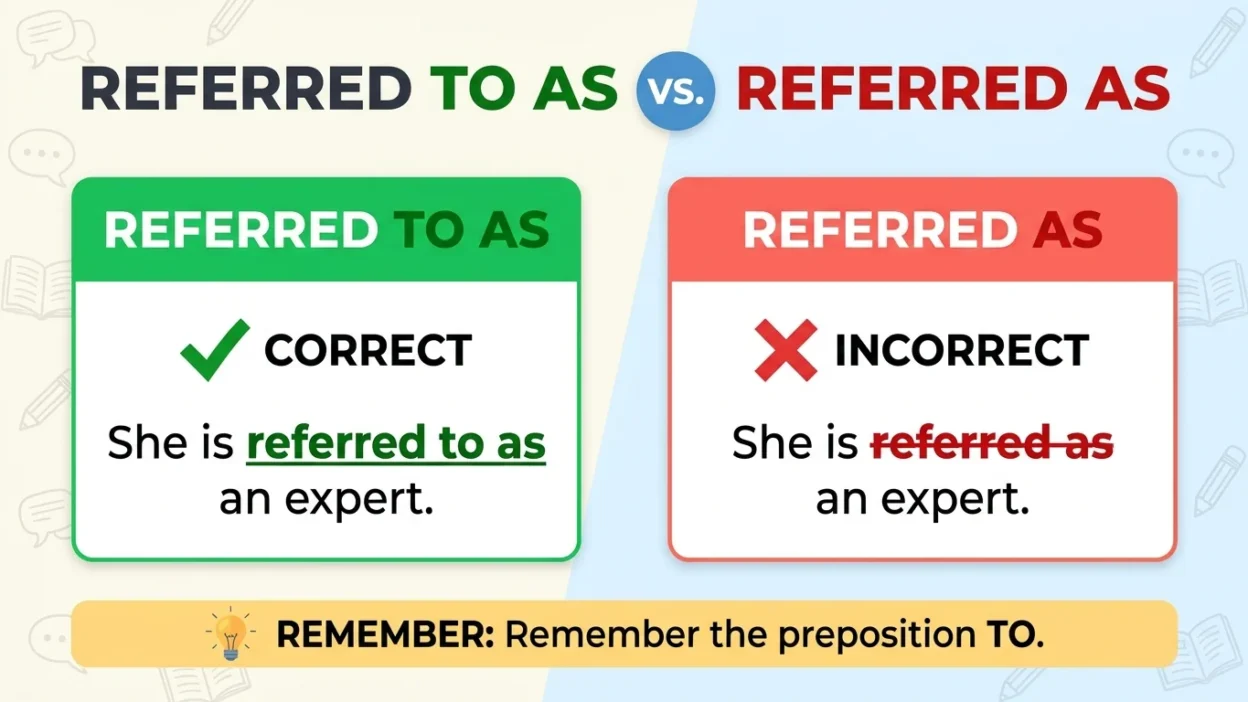
Is it referred to as or referred as? If you have ever been unsure which expression to use, you are not alone. These phrases look almost identical, but only one is the standard construction when you mean that someone or something is called by a particular name or description.
The correct expression is generally referred to as. For example, you should write, “He is referred to as an expert,” rather than “He is referred as an expert.” The confusion often occurs because English learners assume that the verb refer can be followed directly by as. However, the standard expression requires the preposition to before as. Understanding this small grammatical difference will help you write more naturally, avoid common mistakes, and use the verb refer correctly in different contexts.
Quick Answer: Referred To As or Referred As?
Referred to as is the standard and grammatically correct expression when identifying what someone or something is called. For example, “The city is referred to as the cultural capital.” The expression referred as is generally incorrect when used with this meaning. However, refer has other constructions, such as refer to someone as something, that follow different sentence patterns.
What Does Referred To As Mean?
Referred to as means called, known as, described as, or identified by a particular name or title.
It is the passive form of the expression refer to someone or something as something.
For example:
- People refer to him as a hero.
- He is referred to as a hero.
Both sentences communicate the same basic idea. The first is active, while the second is passive.
The expression is commonly used in conversations, academic writing, professional documents, and everyday English.
Examples of Referred To As
- William Shakespeare is often referred to as the greatest English playwright.
- This condition is referred to as a medical emergency.
- The region is commonly referred to as the northern territory.
- She is affectionately referred to as Grandma by her grandchildren.
- The process is referred to as natural selection.
- He is frequently referred to as an expert in his field.
- The building is referred to as a historical landmark.
- This type of writing is referred to as creative nonfiction.
In each example, referred to as introduces a name, title, category, or description.
What Does Referred As Mean?
Referred as is generally an incorrect construction when you want to say that someone or something is called by a particular name or description.
The problem is that the verb refer requires the preposition to in this particular expression.
For example:
Incorrect: She is referred as a talented artist.
Correct: She is referred to as a talented artist.
Incorrect: The disease is referred as a rare condition.
Correct: The disease is referred to as a rare condition.
However, this does not mean that the word as can never follow refer in a sentence. The correct construction is refer to someone as something.
For example:
- People refer to her as a talented artist.
- The researchers refer to the condition as a rare disorder.
Notice that to is still present, even when the sentence is in the active voice.
What Is the Difference Between Referred To As and Referred As?
The main difference is grammatical correctness.
| Expression | Correctness | Explanation |
|---|---|---|
| Referred to as | Correct | Standard expression for identifying a name or description |
| Referred as | Generally incorrect | Missing the required preposition in this construction |
Examples:
- Correct: He is referred to as a leader.
- Incorrect: He is referred as a leader.
- Correct: The animal is referred to as a mammal.
- Incorrect: The animal is referred as a mammal.
The word to is an essential part of the standard expression.
Why Do We Say Referred To As?
The verb refer commonly takes the preposition to when introducing the person or thing being discussed, mentioned, or identified.
When you want to explain what someone or something is called, the structure is:
Refer + to + person or thing + as + name or description
For example:
- We refer to him as our leader.
- They refer to the building as a museum.
- People refer to this period as the Renaissance.
In the passive voice, the structure changes:
Person or thing + be + referred to as + name or description
Examples:
- He is referred to as our leader.
- The building is referred to as a museum.
- This period is referred to as the Renaissance.
The preposition to remains necessary in both constructions.
Referred To As in Active and Passive Voice
Understanding active and passive voice makes the expression easier to use.
1. Active Voice
In active voice, the subject performs the action of referring to someone or something.
Structure:
Subject + refer + to + object + as + description
Examples:
- People refer to her as a genius.
- The locals refer to the mountain as the Sleeping Giant.
- Historians refer to this period as the Middle Ages.
- My friends refer to him as the family comedian.
2. Passive Voice
In passive voice, the person or thing receiving the description becomes the subject.
Structure:
Subject + be + referred to as + description
Examples:
- She is referred to as a genius.
- The mountain is referred to as the Sleeping Giant.
- This period is referred to as the Middle Ages.
- He is referred to as the family comedian.
Both structures are correct. Choose the one that best fits your sentence.
How to Use Referred To As in Different Tenses
The expression can be used with different forms of the verb be.
| Tense or construction | Example |
|---|---|
| Present simple | He is referred to as a specialist. |
| Past simple | She was referred to as a pioneer. |
| Present perfect | He has been referred to as a visionary. |
| Past perfect | She had been referred to as a leading expert. |
| Future | The place will be referred to as a protected area. |
| Modal | It may be referred to as a natural phenomenon. |
The form of be changes according to the tense, but referred to as remains intact.
Referred To As vs Called vs Known As
These expressions are related, but they are not always identical in tone or usage.
| Expression | Meaning | Example |
|---|---|---|
| Referred to as | Described or identified by a particular name or title | He is referred to as a pioneer. |
| Called | Given or known by a particular name | He is called a pioneer. |
| Known as | Recognized by a particular name or description | He is known as a pioneer. |
| Described as | Characterized in a particular way | He is described as a pioneer. |
| Regarded as | Considered to have a particular status or quality | He is regarded as a pioneer. |
Referred to as is particularly useful in formal, academic, and explanatory writing. Called is usually simpler and more conversational.
Common Mistakes When Using Referred To As
1. Leaving Out To
Incorrect: She is referred as a leader.
Correct: She is referred to as a leader.
The preposition to is required in this construction.
2. Confusing Referred To As With Referred To
These expressions have different meanings.
- Referred to: Mentioned or directed someone to a person, place, or source.
- Referred to as: Called or described by a particular name.
Examples:
- The doctor referred me to a specialist.
- The doctor is referred to as a leading specialist.
3. Using the Wrong Form of Be
Incorrect: He were referred to as an expert.
Correct: He was referred to as an expert.
Use the appropriate form of be according to the subject and tense.
4. Confusing Refer and Referred
Refer is the base form, while referred is the past tense and past participle.
Examples:
- Present: People refer to him as a leader.
- Past: People referred to him as a leader.
- Passive: He was referred to as a leader.
5. Assuming Referred To As and Known As Always Have the Same Tone
Both can introduce a name or description, but referred to as can sound more formal or analytical. Known as often emphasizes how a person or thing is recognized by others.
Memory Trick: How to Remember Referred To As
Remember this simple rule:
Refer to someone as something.
The word to is part of the standard expression.
Examples:
- Refer to her as a teacher.
- Refer to the place as a landmark.
- Refer to the event as a celebration.
When changing the sentence into passive voice, keep to:
- She is referred to as a teacher.
- The place is referred to as a landmark.
- The event is referred to as a celebration.
If you remember refer to someone as something, you will be much less likely to write referred as incorrectly.
American vs British English
There is no meaningful difference between American and British English in this expression. Both varieties use referred to as.
| Feature | American English | British English |
|---|---|---|
| Standard expression | Referred to as | Referred to as |
| Referred as | Generally incorrect in this meaning | Generally incorrect in this meaning |
| Meaning | Called or described as | Called or described as |
| Usage | Formal and informal writing | Formal and informal writing |
The expression follows the same grammatical pattern in both varieties.
Related Words and Expressions
Here are some useful expressions related to referred to as.
- Called: Given or known by a particular name.
- Known as: Recognized by a particular name or description.
- Described as: Characterized in a particular way.
- Regarded as: Considered to have a particular quality or status.
- Considered to be: Thought to have a particular identity or quality.
- Labeled as: Given a particular label or classification.
- Identified as: Recognized as belonging to a particular group or category.
- Referred to: Mentioned or directed toward someone or something.
- Termed: Given a particular name or description.
- Designated as: Officially assigned a particular name, role, or status.
Frequently Asked Questions
1. Is it referred to as or referred as?
The standard expression is referred to as. Use it when explaining what someone or something is called. For example, “She is referred to as an expert.”
2. Why is referred as incorrect?
In the meaning of being called or described by a particular name, the verb refer requires the preposition to. Therefore, the standard construction is refer to someone as something.
3. Can I say he is referred to as a genius?
Yes. This is grammatically correct. It means that people call or describe him as a genius.
4. Is referred to as formal or informal?
It is suitable for both formal and informal English. It is particularly common in academic writing, journalism, professional communication, and explanatory texts.
5. What is the difference between referred to and referred to as?
Referred to generally means mentioned or directed toward someone or something. Referred to as means called or described by a particular name or title.
6. Can referred to as be used in the past tense?
Yes. For example, “She was referred to as a pioneer.” You can also use it with other tenses, such as “She has been referred to as a pioneer.”
7. Is referred to as the same as known as?
They are often similar in meaning. Both can introduce a name or description. However, known as emphasizes recognition, while referred to as emphasizes the name or description people use.
8. Can I use referred to as in academic writing?
Yes. It is commonly used in academic writing to introduce technical terms, classifications, historical labels, and descriptions. For example, “This process is referred to as photosynthesis.”
Remember This
- Referred to as is the standard expression.
- Referred as is generally incorrect when meaning called or described as.
- The correct active structure is refer to someone as something.
- The correct passive structure is someone is referred to as something.
- The preposition to remains necessary in both structures.
- The expression is used in American and British English.
- Similar expressions include called, known as, and described as.
Conclusion
The difference between referred to as and referred as is straightforward. When you want to explain what someone or something is called, the correct expression is referred to as. The preposition to is an essential part of this grammatical construction and should not be omitted.
Remember the active structure, refer to someone as something, and its passive form, someone is referred to as something. Once you understand this pattern, you can use the expression confidently in conversations, professional communication, and academic writing.

Charles Kevin is a passionate language writer and researcher at SimileHive, creating clear, engaging content about similes, idioms, metaphors, and figurative language to help readers improve English communication confidently every day.