Have you ever heard someone dismiss an argument by saying, “That’s complete hogwash”? The word hogwash is an informal English term used to describe something that is foolish, ridiculous, false, or completely nonsensical. People commonly use it when they strongly disagree with a statement, reject an excuse, or believe that an explanation has no truth or value.
Although the word may sound unusual, it is widely understood in everyday English. It can make a response sound humorous, blunt, or dismissive, depending on the situation. For example, if someone makes an unbelievable claim without providing evidence, you might respond, “That’s hogwash!” Understanding this word will help you recognize it in conversations, books, articles, and informal discussions. You will also learn when it is appropriate to use hogwash and which alternatives can express a similar idea.
Quick Answer: What Does Hogwash Mean?
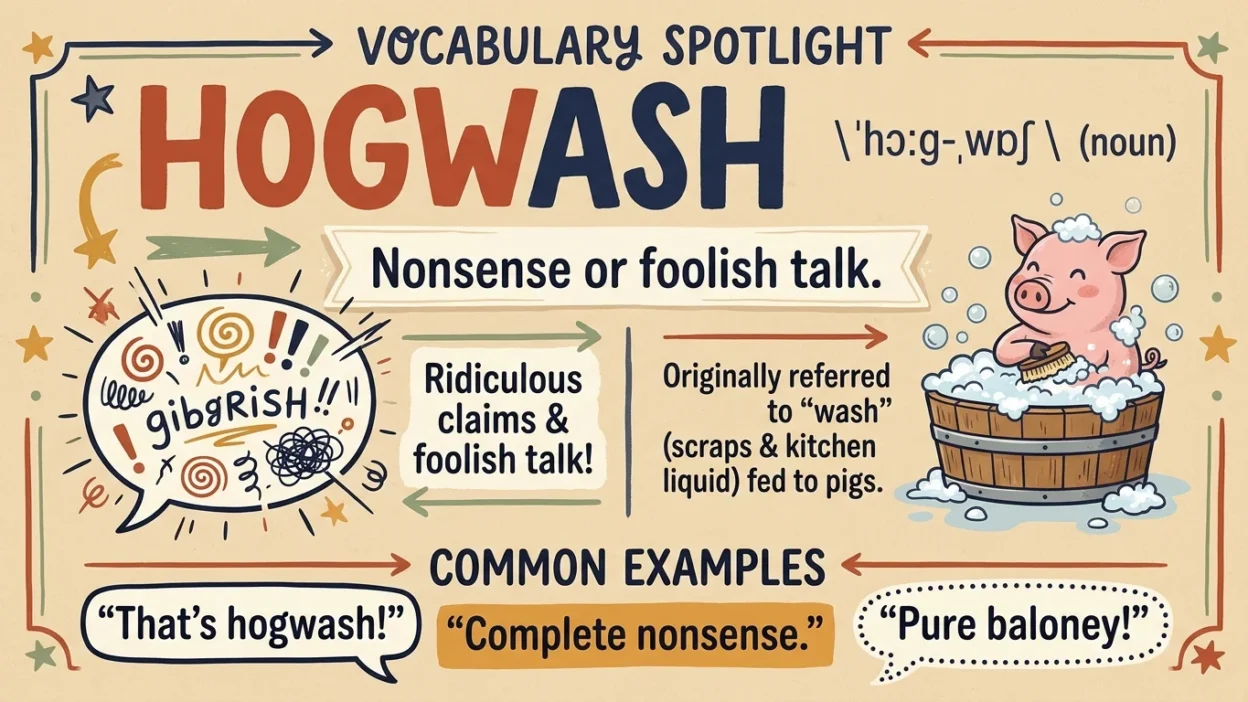
Hogwash means nonsense, foolish talk, or something considered completely false or ridiculous. It is an informal and usually dismissive word used to express disbelief or disagreement with an idea, statement, excuse, or explanation. For example, “His claim that he never makes mistakes is complete hogwash.”
What Does Hogwash Mean?
Hogwash is a noun that refers to something regarded as nonsense, foolishness, or an untrue statement.
It is often used when someone believes that another person’s words are unreasonable, misleading, exaggerated, or without a sound basis.
For example:
- That’s nothing but hogwash.
- I don’t believe his explanation. It’s complete hogwash.
- She dismissed the rumor as hogwash.
- The politician’s promises sounded like hogwash to many voters.
The word generally expresses a strong negative opinion. However, it can sometimes be used humorously among friends.
Is Hogwash a Real Word?
Yes. Hogwash is a recognized English word found in dictionaries and used in everyday conversation and informal writing.
It is not usually considered offensive, but it can sound dismissive or insulting when directed at someone’s ideas.
For example:
- Friendly or humorous: “Oh, that’s hogwash! You know I always share my snacks.”
- Strongly dismissive: “The entire explanation is hogwash.”
The tone depends on the context and the speaker’s intention.
What Is the Origin of Hogwash?
The word hogwash originally referred to liquid food or scraps given to pigs.
The word combines hog, meaning a pig, and wash, referring to a mixture of food waste or liquid. Over time, it developed a figurative meaning associated with nonsense or worthless talk.
Today, people rarely use the word to refer to actual pig food. Its common meaning is something foolish, ridiculous, or untrue.
How to Use Hogwash in a Sentence
You can use hogwash in different situations when you want to reject or criticize something you consider unreasonable or false.
1. To Reject a False Statement
Use hogwash when you believe someone is making a claim that is untrue.
Examples:
- His statement about the incident is complete hogwash.
- Don’t believe everything you hear. Some of it is hogwash.
- The claim that money can solve every problem is hogwash.
- She said the accusation was nothing but hogwash.
2. To Dismiss a Ridiculous Excuse
You can use the word when you do not believe someone’s explanation or excuse.
Examples:
- His excuse for being late was pure hogwash.
- I have heard enough of your hogwash.
- She knew his explanation was hogwash.
- That sounds like a lot of hogwash to me.
3. To Express Strong Disagreement
Use hogwash when you strongly disagree with an opinion or argument.
Examples:
- That’s complete hogwash, and you know it.
- I think the whole argument is hogwash.
- Calling that a fair decision is absolute hogwash.
- He dismissed the suggestion as political hogwash.
4. To Criticize Misleading Information
The word can also describe information that someone considers unreliable or deceptive.
Examples:
- The article was full of hogwash.
- She warned her friends not to believe the online hogwash.
- Much of what he said was nothing but hogwash.
- The speaker challenged the audience to question such hogwash.
15 Examples of Hogwash in Sentences
Here are 15 practical examples showing how hogwash is used in everyday English.
- His claim that he can predict the future is complete hogwash.
- I don’t believe that excuse because it sounds like hogwash.
- She dismissed the rumor as nothing but hogwash.
- The article contains more hogwash than useful information.
- Don’t waste your time listening to such hogwash.
- He told me that hard work is unnecessary, but I think that’s hogwash.
- The manager rejected the employee’s explanation as hogwash.
- Some people consider those promises political hogwash.
- I have never heard such complete hogwash in my life.
- His argument was filled with assumptions and hogwash.
- She laughed and said that the story was absolute hogwash.
- The advertisement made several claims that sounded like hogwash.
- They refused to accept the accusation, calling it pure hogwash.
- Stop talking hogwash and tell me what really happened.
- The professor encouraged students to question unsupported claims rather than accept hogwash.
Hogwash vs Nonsense vs Baloney vs Bunk
Several English words have meanings similar to hogwash, but they can differ in tone and usage.
| Word | Meaning | Tone |
|---|---|---|
| Hogwash | Foolish, false, or ridiculous talk | Informal and dismissive |
| Nonsense | Something unreasonable or without meaning | Neutral to dismissive |
| Baloney | Something untrue or ridiculous | Informal and humorous |
| Bunk | False or meaningless talk | Informal and dismissive |
| Rubbish | Something worthless, foolish, or untrue | Informal, especially British English |
| Drivel | Foolish or meaningless talk | Strongly critical |
| Twaddle | Silly or foolish talk | Informal and often humorous |
| Claptrap | Pretentious or meaningless talk | Dismissive |
Example comparison:
- That’s hogwash.
- That’s nonsense.
- That’s complete baloney.
- That’s a load of rubbish.
All four sentences express disagreement or disbelief, although their tone may differ.
Is Hogwash Formal or Informal?
Hogwash is generally an informal word. It is suitable for casual conversations, informal writing, opinion pieces, and situations where a strong but conversational expression is appropriate.
However, it may not be the best choice for academic papers, professional reports, legal documents, or diplomatic communication.
In formal writing, consider alternatives such as:
- Unsupported claim
- False statement
- Misleading information
- Unsubstantiated argument
- Inaccurate assertion
- Unfounded allegation
For example:
Informal: The entire explanation is hogwash.
More formal: The explanation is unsupported by reliable evidence.
Is Hogwash Offensive?
Hogwash is not generally considered a vulgar or profane word. However, it can sound rude or disrespectful because it dismisses someone’s statement as nonsense.
For example:
- Mild or humorous: “Come on, that’s hogwash!”
- Strong or confrontational: “Everything you said is complete hogwash.”
If you want to disagree politely, you could say:
- I don’t think that is accurate.
- I have some doubts about that claim.
- I don’t believe the evidence supports that conclusion.
- I see things differently.
The best expression depends on your relationship with the other person and the situation.
Common Mistakes When Using Hogwash
1. Thinking Hogwash Means Ordinary Disagreement
Hogwash is stronger than simply saying you disagree. It suggests that you consider something foolish, false, or ridiculous.
2. Using It as a Verb
Hogwash is primarily a noun in its modern common use.
Incorrect: He hogwashed the explanation.
Correct: He dismissed the explanation as hogwash.
3. Assuming It Always Refers to Lies
The word can describe nonsense, foolish opinions, exaggerated claims, or statements considered unreasonable. It does not always mean deliberate dishonesty.
4. Using It in Every Formal Situation
Although the word is widely understood, it can sound too casual or dismissive in professional and academic contexts.
5. Confusing Its Literal and Figurative Meanings
Historically, hogwash referred to food or liquid waste given to pigs. In modern everyday English, it usually means nonsense or foolish talk.
Memory Trick: How to Remember Hogwash
Think of the original meaning of the word: a mixture of food scraps and liquid given to pigs.
Over time, the word developed a figurative meaning associated with something worthless or nonsensical.
Remember:
Hogwash = Nonsense + Foolish Talk + Ridiculous Claims
For example:
“His explanation is complete hogwash.”
This means the speaker considers the explanation foolish, unreasonable, or untrue.
American vs British English
Hogwash is understood in both American and British English. It does not have a different spelling or meaning in the two varieties.
| Feature | American English | British English |
|---|---|---|
| Spelling | Hogwash | Hogwash |
| Meaning | Nonsense or foolish talk | Nonsense or foolish talk |
| Usage | Informal | Informal |
| Tone | Dismissive or humorous | Dismissive or humorous |
| Alternative | Baloney | Rubbish |
Although the word is used in both varieties, other expressions may be more common in particular regions. For example, rubbish is especially familiar in British English.
Related Words and Expressions
Here are some useful words and phrases that can help you express a similar idea.
- Nonsense: Something that is unreasonable, meaningless, or untrue.
- Baloney: Informal language for something considered false or ridiculous.
- Bunk: Foolish or misleading talk.
- Rubbish: Something considered worthless, foolish, or untrue.
- Drivel: Senseless or foolish talk.
- Twaddle: Silly or meaningless speech.
- Claptrap: Nonsensical or pretentious talk.
- Poppycock: A humorous or old fashioned word for nonsense.
- Hot air: Empty talk without meaningful action or substance.
- A load of bull: A blunt and informal expression for something considered false or ridiculous.
Frequently Asked Questions
1. What does hogwash mean in simple words?
Hogwash means nonsense, foolish talk, or something that is considered completely ridiculous or untrue. It is commonly used to reject an argument, excuse, or statement.
2. Is hogwash a bad word?
No. Hogwash is not generally a swear word or vulgar expression. However, it can sound rude or dismissive when used to criticize someone’s ideas.
3. Is hogwash slang?
It is an informal English word, but it is also a recognized dictionary word. It is commonly used in everyday conversations and informal writing.
4. What is another word for hogwash?
Common alternatives include nonsense, baloney, bunk, rubbish, drivel, twaddle, and claptrap. The best alternative depends on the intended tone and context.
5. Can hogwash mean lies?
Yes, it can describe statements that the speaker believes are false or misleading. However, it is broader than lies because it can also refer to foolish or unreasonable ideas that are not necessarily deliberate attempts to deceive.
6. Is hogwash American or British?
The word is used in both American and British English. Its spelling and general meaning remain the same.
7. What is the plural of hogwash?
Hogwash is generally an uncountable noun, so it does not normally have a plural form. People usually say “some hogwash” or “a lot of hogwash” rather than “hogwashes.”
8. How do you use hogwash in a sentence?
You can use it as a noun to describe something you consider foolish or untrue. For example: “I don’t believe his explanation. It’s complete hogwash.”
Remember This
- Hogwash means nonsense, foolish talk, or something considered ridiculous.
- It is a noun.
- It is generally informal and dismissive.
- It can describe false claims, unreasonable opinions, and unbelievable excuses.
- It is not normally considered a swear word.
- It is understood in both American and British English.
- Similar expressions include nonsense, baloney, bunk, and rubbish.
Conclusion
Hogwash is a useful informal English word for expressing disbelief or rejecting something you consider foolish, unreasonable, or untrue. It is commonly used in everyday conversations to criticize an excuse, opinion, argument, or claim that seems to lack credibility. Depending on the context, it can sound humorous, blunt, or strongly dismissive.
Although hogwash is appropriate in many casual situations, it is better to choose more neutral expressions in formal or professional writing. Words such as unsupported claim, inaccurate statement, and unsubstantiated argument can communicate disagreement more diplomatically. Understanding its meaning, tone, and usage will help you use this colorful English expression naturally and confidently.

Lucas Luke is a passionate language writer and content creator at SimileHive, specializing in similes, idioms, metaphors, and figurative language. He enjoys making complex English expressions simple, engaging, and easy to understand for students, writers, and language enthusiasts through well-researched, practical content.