Are you sometimes confused about whether to write are or our? These two words look and sound similar, but they have completely different meanings and grammatical functions. One is a verb used to describe a state or action, while the other is a possessive word that shows ownership or a relationship.
Understanding the difference between are and our is important for writing clear and grammatically correct English. The confusion is especially common because both words are pronounced similarly in many English accents. However, you cannot use them interchangeably. For example, “They are happy” is correct, while “They our happy” is incorrect. Similarly, “This is our house” is correct, but “This is are house” is wrong. Learning a few simple rules and examples will help you choose the right word every time.
Quick Answer: Are or Our?
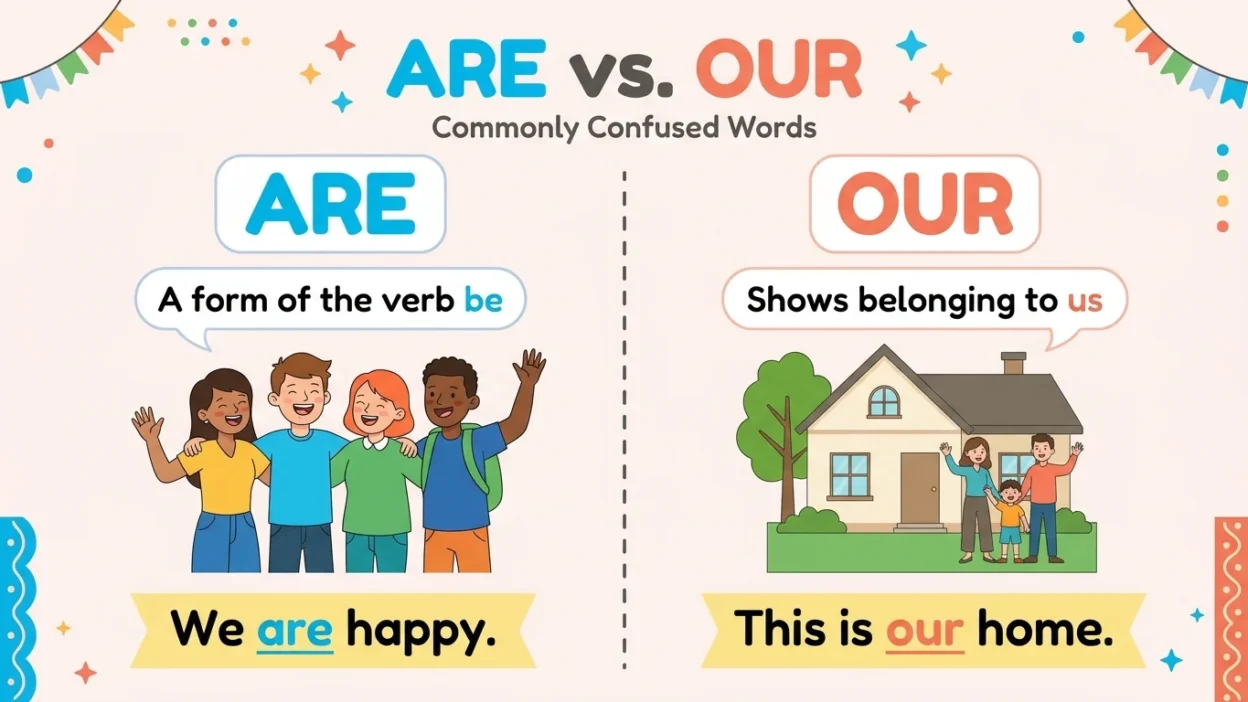
Are is a form of the verb be, used with plural subjects and the pronouns you, we, and they. Our is a possessive determiner that shows something belongs to or is associated with us. For example, “We are friends” and “This is our home.” The two words have different grammatical roles and cannot replace each other.
What Does Are Mean?
Are is a form of the verb be. It is commonly used with the pronouns you, we, and they, as well as plural nouns.
It helps describe a person’s condition, identity, location, or characteristics. It can also be used to form questions, continuous verb tenses, and passive sentences.
Examples of Are in Sentences
- They are my closest friends.
- We are ready for the meeting.
- You are very kind.
- The students are studying English.
- My parents are at home.
- These books are expensive.
- Are you feeling better today?
- The children are playing outside.
- We are learning something new.
- The flowers are beautiful.
In these examples, are connects the subject with information about it or helps form a verb phrase.
What Does Our Mean?
Our is a possessive determiner. It shows that something belongs to, is connected with, or is associated with the speaker and at least one other person.
It is the possessive form of the pronoun we.
For example:
- We have a house. It is our house.
- We have a teacher. She is our teacher.
- We have a country. It is our country.
Unlike are, the word our usually comes before a noun or a noun phrase.
Examples of Our in Sentences
- This is our classroom.
- Our parents are very supportive.
- We love our country.
- Our teacher explained the lesson.
- They visited our house yesterday.
- Our team won the competition.
- We should respect our elders.
- Our dog loves playing in the garden.
- This is our final decision.
- Our friendship has lasted for years.
In each example, our indicates a relationship or connection between the speaker’s group and something else.
What Is the Difference Between Are and Our?
The main difference is their grammatical function.
Are is a verb, while our is a possessive determiner.
| Feature | Are | Our |
|---|---|---|
| Part of speech | Verb | Possessive determiner |
| Main function | Describes a state or helps form a verb phrase | Shows ownership or association |
| Related word | Be | We |
| Common placement | After a subject | Before a noun |
| Example | We are happy. | This is our house. |
| Meaning | A state of being | Belonging to us |
Remember that are tells us something about a subject, whereas our tells us that something belongs to or is connected with us.
When Should You Use Are?
Use are when you need a form of the verb be.
Here are some common situations.
1. With We, You, and They
Use are with these personal pronouns in the present tense.
Examples:
- We are students.
- You are my best friend.
- They are waiting for us.
- We are happy with the results.
2. With Plural Nouns
Use are when the subject refers to more than one person, animal, or thing.
Examples:
- The boys are playing football.
- The flowers are fresh.
- My friends are helpful.
- The houses are beautiful.
3. To Describe Feelings or Conditions
Use are to describe how someone feels or the condition of something.
Examples:
- You are tired.
- They are excited.
- We are ready.
- The roads are wet.
4. To Describe Location
Use are to explain where people or things are.
Examples:
- We are at school.
- The children are in the garden.
- Your keys are on the table.
- They are outside.
5. To Form Questions
Place are before the subject when forming many present tense questions.
Examples:
- Are you ready?
- Are they coming?
- Are we late?
- Are the children asleep?
When Should You Use Our?
Use our when you want to show that something belongs to or is associated with you and at least one other person.
Here are some common situations.
1. To Show Ownership
Use our to indicate that something belongs to your group.
Examples:
- This is our car.
- Our house is quite large.
- We sold our old furniture.
- Our garden needs some attention.
2. To Talk About Family and Relationships
Use our when describing family members or relationships shared by a group.
Examples:
- Our mother is a teacher.
- Our brother lives abroad.
- Our friendship is important to us.
- Our family enjoys travelling together.
3. To Describe Shared Responsibilities
Use our when discussing duties or responsibilities that belong to a group.
Examples:
- It is our responsibility to help.
- Our job is to complete the project.
- We must do our best.
- Our duty is to protect the environment.
4. To Describe Shared Experiences
Use our when referring to something experienced or achieved by a group.
Examples:
- Our journey was unforgettable.
- Our first meeting was wonderful.
- We celebrated our victory.
- Our memories will last forever.
5. To Describe Groups and Organizations
Use our to refer to a group, team, company, or organization that includes the speaker.
Examples:
- Our team is working hard.
- Our company provides excellent services.
- Our school organizes sports events.
- Our community deserves better facilities.
Are vs Our: Sentence Comparison
The following examples show how the two words work differently.
| With Are | With Our |
|---|---|
| We are happy. | We love our happiness and peace. |
| They are students. | They are our students. |
| You are welcome. | You are our guest. |
| We are ready. | Our preparations are complete. |
| The children are playing. | Our children are playing. |
| They are friends. | They are our friends. |
Notice that both words can appear in the same sentence.
For example:
They are our friends.
Here, are is the verb, and our shows the relationship between the speaker’s group and the friends.
Are and Our in the Same Sentence
You can use both words together when a sentence requires a verb and a possessive determiner.
Examples:
- We are proud of our achievements.
- They are visiting our school tomorrow.
- Our parents are very supportive.
- We are grateful for our opportunities.
- These are our favorite books.
- Our teachers are very helpful.
- Are these our seats?
- We are protecting our environment.
- Our friends are waiting outside.
- They are responsible for our safety.
These examples are useful because they show that the two words have separate grammatical jobs.
Common Mistakes When Using Are and Our
1. Writing Our Instead of Are
Incorrect: We our happy.
Correct: We are happy.
Use are because the sentence needs a verb.
2. Writing Are Instead of Our
Incorrect: This is are house.
Correct: This is our house.
Use our because the sentence shows ownership.
3. Confusing Their and Our
Their refers to something belonging to or associated with them, while our refers to something belonging to or associated with us.
Examples:
- This is our classroom.
- That is their classroom.
4. Forgetting That Our Needs a Noun
Incorrect: This book is our.
Correct: This book is ours.
Remember that our normally comes before a noun, while ours can stand alone.
5. Using Are With a Singular Subject
Incorrect: She are my sister.
Correct: She is my sister.
Use is with he, she, and it in ordinary present tense sentences.
Are vs Our: A Simple Memory Trick
You can remember the difference with two simple associations:
Are = Action or state
It is a verb that helps describe what someone or something is.
Example: We are happy.
Our = Ownership
It shows that something belongs to or is associated with us.
Example: This is our house.
Whenever you are unsure, ask yourself:
- Does the sentence need a verb? Use are if the subject agrees.
- Does the sentence show something belonging to us? Use our.
This simple test can help you avoid most spelling and grammar mistakes involving these words.
Are vs Our vs Ours
Although are, our, and ours look similar, they have different grammatical functions.
| Word | Part of speech | Meaning | Example |
|---|---|---|---|
| Are | Verb | A form of be | We are ready. |
| Our | Possessive determiner | Belonging to us | This is our room. |
| Ours | Possessive pronoun | Something belonging to us | This room is ours. |
The important distinction is that our comes before a noun, while ours replaces a noun or noun phrase.
Examples:
- This is our car.
- This car is ours.
- We are driving our car.
Frequently Asked Questions
1. What is the difference between are and our?
Are is a form of the verb be, used to describe a state or form verb phrases. Our is a possessive determiner that shows ownership or association. For example, “We are happy” and “This is our home.”
2. Is are a verb or a noun?
Are is a verb. It is one of the present tense forms of the verb be. It is commonly used with you, we, and they, as well as plural nouns.
3. Is our a possessive pronoun?
In traditional grammar, our is a possessive adjective. In modern grammar, it is more precisely called a possessive determiner because it comes before a noun. Ours is the possessive pronoun.
4. Can are and our be used in the same sentence?
Yes. They can appear together when the sentence needs both a verb and a possessive determiner. For example, “They are our neighbors.”
5. Why do are and our sound similar?
They sound similar because their pronunciation is close in many English accents. However, their exact pronunciation can vary by region. Their meanings and grammatical functions remain different.
6. Is it are family or our family?
Use our family when referring to the family you belong to. For example, “Our family is very close.” Use are in a sentence such as “We are a happy family.”
7. Is it are friends or our friends?
Both can be correct, depending on the sentence. “They are friends” describes their relationship. “They are our friends” explains that they are friends of the speaker’s group.
8. What is the difference between our and ours?
Our comes before a noun, as in “our house.” Ours stands alone, as in “The house is ours.” Both indicate possession or association with the speaker’s group.
Remember This
- Are is a verb and a form of be.
- Our is a possessive determiner.
- Use are with you, we, and they and plural subjects.
- Use our before a noun to show ownership or association.
- Are and our can appear together in the same sentence.
- Ours is different from our because it can stand alone.
- Never use are and our interchangeably.
Conclusion
The difference between are and our is easy to understand once you recognize their grammatical roles. Are is a verb used to describe a state, condition, or situation, while our shows that something belongs to or is connected with the speaker and other people. Although they sound similar, they serve different purposes in English.
To use them correctly, remember that are usually follows a subject, while our normally comes before a noun. With regular practice and attention to sentence structure, you can easily distinguish between these two words and use them confidently in everyday speaking and writing.

Lucas Luke is a passionate language writer and content creator at SimileHive, specializing in similes, idioms, metaphors, and figurative language. He enjoys making complex English expressions simple, engaging, and easy to understand for students, writers, and language enthusiasts through well-researched, practical content.