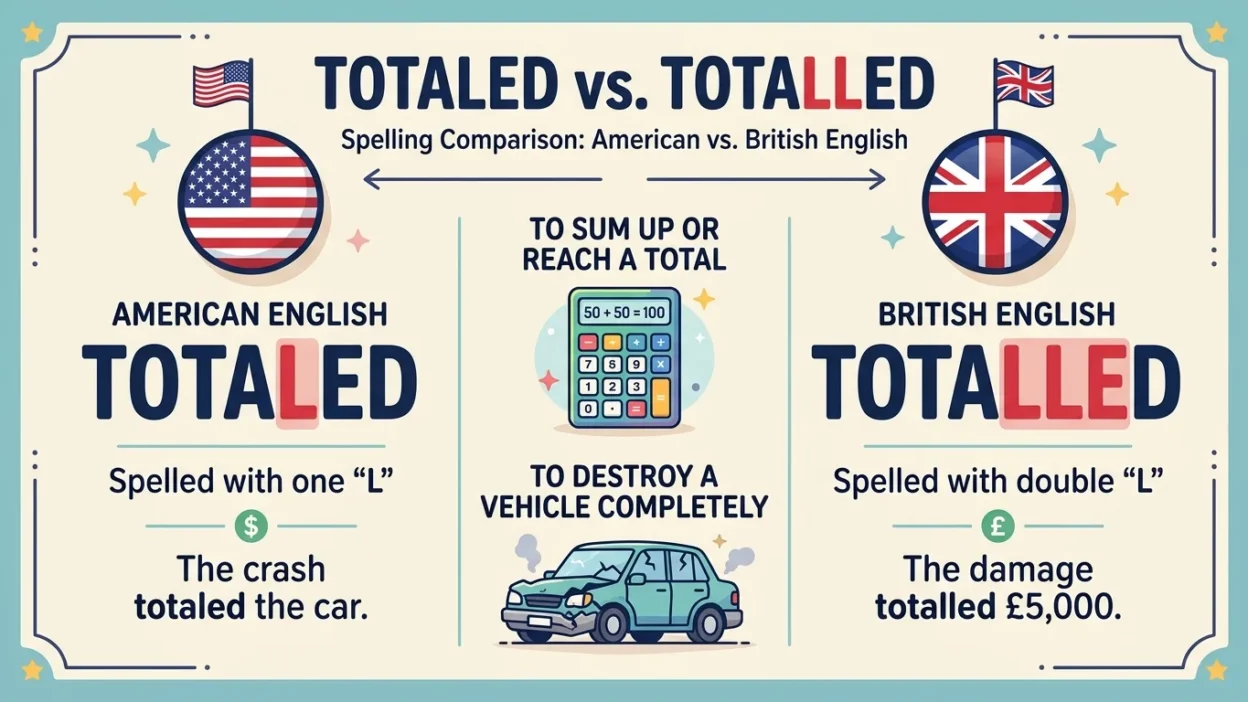
Have you ever wondered whether to write totaled or totalled? Both spellings are correct, and they have the same meaning. The difference is mainly a matter of regional spelling preferences. American English generally uses totaled, while British English, Australian English, and other varieties that follow British spelling conventions usually use totalled.
The confusion often arises because English has different rules for forming the past tense of verbs ending in a consonant followed by a vowel and a consonant. In some cases, the final consonant is doubled before adding ed. In others, it is not. Understanding this spelling difference will help you choose the right form for your audience and avoid inconsistencies in your writing.
Quick Answer: Totaled or Totalled?
Totaled and totalled are both correct past tense and past participle forms of the verb total. Use totaled in American English and totalled in British English. Both mean added up to a particular amount or, when referring to a vehicle, damaged so badly that it is considered a total loss.
What Does Totaled Mean?
Totaled is the American English spelling of the past tense and past participle of total.
It can have two common meanings:
- To add numbers or amounts together to calculate a sum.
- To damage something, especially a vehicle, so severely that repairing it is not considered worthwhile or economical.
Examples of Totaled
- The expenses totaled $500.
- Her medical bills totaled more than $2,000.
- The team totaled 15 points in the first round.
- The mechanic totaled the cost of all the repairs.
- His car was totaled in the accident.
- The storm totaled several buildings.
- Our monthly expenses totaled less than expected.
- The damaged vehicle was declared totaled by the insurance company.
What Does Totalled Mean?
Totalled is the British English spelling of the past tense and past participle of total.
It has exactly the same meanings as totaled. The only difference is the spelling.
Examples of Totalled
- The expenses totalled £500.
- Their combined earnings totalled £60,000.
- The final scores totalled 100 points.
- The repair costs totalled more than the value of the vehicle.
- Her car was totalled in a serious accident.
- The fire totalled three houses.
- The company’s losses totalled millions of pounds.
- The insurance company declared the vehicle totalled.
What Is the Difference Between Totaled and Totalled?
The difference is regional spelling, not meaning or pronunciation.
| Word | English variety | Meaning |
|---|---|---|
| Totaled | American English | Added up or damaged beyond economical repair |
| Totalled | British English | Added up or damaged beyond economical repair |
Both forms are grammatically correct. Choose the spelling that matches the English variety you are using.
Why Is Totaled Spelled With One L in American English?
American English generally does not double the final consonant in certain verbs when adding ed if the final syllable is unstressed.
The verb total has its main stress on the first syllable: TOtal. Because the final syllable is unstressed, American English generally keeps one l when forming the past tense.
Therefore:
- Total becomes totaled.
- Cancel becomes canceled.
- Travel becomes traveled.
- Label becomes labeled.
These are common American English spellings.
Why Is Totalled Spelled With Two Ls in British English?
British English commonly doubles the final l when adding a suffix such as ed or ing, even when the final syllable is unstressed.
Therefore:
- Total becomes totalled.
- Cancel becomes cancelled.
- Travel becomes travelled.
- Label becomes labelled.
This is a common British English spelling convention.
Totaled vs Totalled: Which Should You Use?
Your choice depends on your intended audience and the spelling style of your writing.
Use totaled when writing for:
- American readers.
- American newspapers and publications.
- Websites that follow American English.
- Schools and businesses that use American spelling.
Use totalled when writing for:
- British readers.
- Australian readers.
- Publications that follow British English spelling.
- Schools and businesses that use British spelling.
The most important rule is consistency. Avoid switching between American and British spelling conventions in the same piece of writing without a good reason.
Common Mistakes to Avoid
1. Thinking One Spelling Is Incorrect
Both totaled and totalled are correct. Neither is a misspelling when used according to its regional convention.
2. Using Both Spellings in the Same Article
Writing totaled in one paragraph and totalled in another can make your work inconsistent. Choose one spelling style and follow it throughout.
3. Confusing Totalled With Total
Total is the base form, while totalled is its British English past tense and past participle.
For example:
- Present: The expenses total £300.
- Past: The expenses totalled £300.
4. Assuming the Words Have Different Pronunciations
The two spellings are pronounced the same way. The extra l in totalled does not change the pronunciation.
Memory Trick: How to Remember the Difference
Remember this simple rule:
- American English: One L in totaled.
- British English: Two Ls in totalled.
You can also remember that British English commonly doubles the final l in words such as cancelled, travelled, and labelled. American English generally uses canceled, traveled, and labeled.
Related Words: Totaling vs Totalling
The same regional spelling difference appears when adding ing to total.
| American English | British English |
|---|---|
| Totaled | Totalled |
| Totaling | Totalling |
| Canceled | Cancelled |
| Canceling | Cancelling |
| Traveled | Travelled |
| Traveling | Travelling |
For example:
- American English: The expenses are totaling $800.
- British English: The expenses are totalling £800.
Frequently Asked Questions
1. Is totaled or totalled correct?
Both are correct. Totaled is the standard American English spelling, while totalled is commonly used in British English and other varieties that follow British spelling conventions.
2. Is totalled British or American?
Totalled is the British English spelling. It is also used in Australian English and other varieties influenced by British spelling conventions.
3. Is totaled American English?
Yes. Totaled is the standard American English spelling of the past tense and past participle of total.
4. Is it totaled or totalled when referring to a car?
Both spellings are correct. American writers generally say a car was totaled, while British writers generally say it was totalled. Both mean the vehicle was damaged so badly that it was considered a total loss.
5. Do totaled and totalled have the same pronunciation?
Yes. Both words have the same pronunciation. The difference is purely a spelling convention.
6. Is it totaling or totalling?
Both are correct. Totaling is the American English spelling, while totalling is the British English spelling.
7. Should I use totaled or totalled in formal writing?
Use the spelling appropriate for your audience. Choose totaled for American English publications and totalled for British English publications. Both are acceptable in formal writing when used consistently.
Remember This
- Totaled is the preferred American English spelling.
- Totalled is the preferred British English spelling.
- Both words have the same meaning and pronunciation.
- Both can refer to calculating a sum or severely damaging a vehicle.
- Use one spelling convention consistently throughout your writing.
Conclusion
The difference between totaled and totalled is simple: American English uses one l, while British English uses two. Both spellings are correct, and neither changes the meaning or pronunciation of the word.
If you are writing for an American audience, choose totaled. If your readers follow British English conventions, use totalled. Keeping your spelling consistent will make your writing clearer and more professional.

Lucas Luke is a passionate language writer and content creator at SimileHive, specializing in similes, idioms, metaphors, and figurative language. He enjoys making complex English expressions simple, engaging, and easy to understand for students, writers, and language enthusiasts through well-researched, practical content.