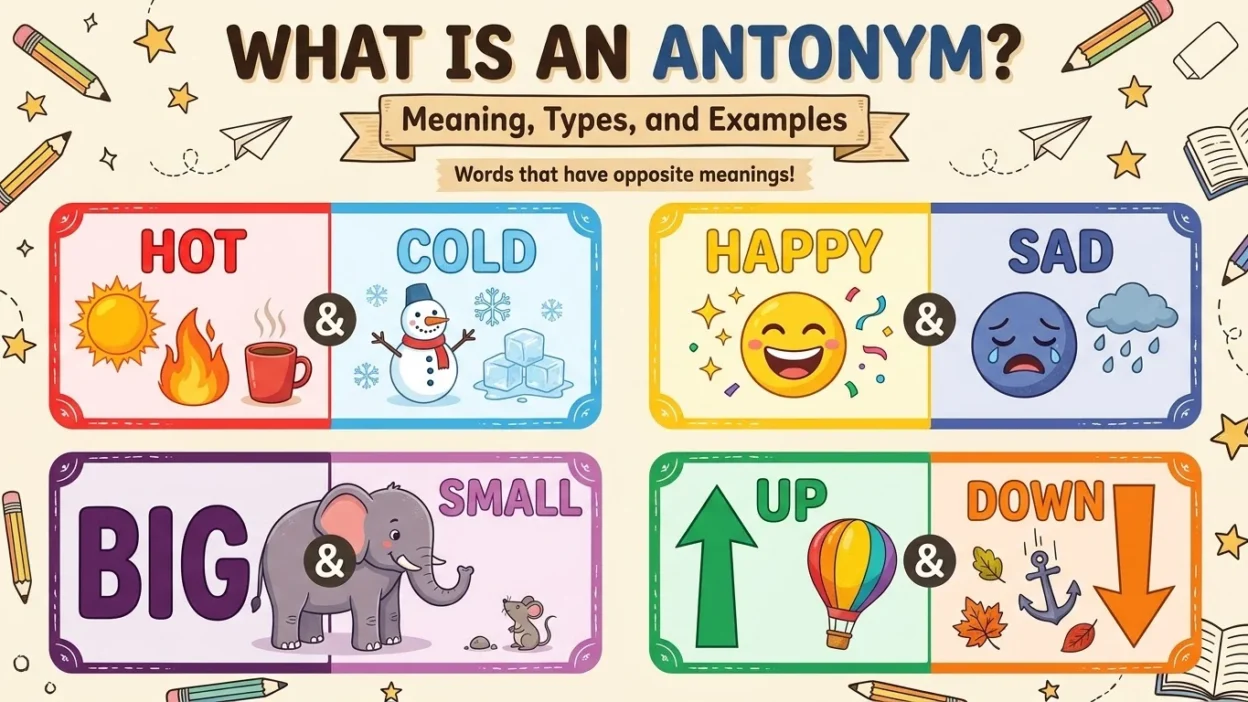
Have you ever wondered what the opposite of a word is called? In English, a word that has the opposite or contrasting meaning of another word is known as an antonym. For example, hot is an antonym of cold, happy is an antonym of sad, and strong is an antonym of weak. Antonyms help us express differences, describe contrasting situations, and communicate ideas more clearly.
Understanding antonyms is an important part of building a strong vocabulary. They are useful in everyday conversations, academic writing, reading comprehension, and language learning. However, not all antonyms work in exactly the same way. Some express completely opposite conditions, while others describe different positions on a scale or relationships between two things. This guide explains what antonyms are, explores their main types, and provides practical examples to help you use them correctly.
Quick Answer
An antonym is a word that has the opposite or contrasting meaning of another word. For example, good and bad, up and down, and accept and reject are antonym pairs. Antonyms help express differences and make communication more precise. The opposite of a word is not always exact because some words have several meanings.
What Does Antonym Mean?
An antonym is a word that expresses a meaning opposite or contrasting to another word.
The term comes from Greek elements:
- Anti: Meaning against or opposite.
- Onym: Meaning name or word.
Together, these elements form the term antonym, which refers to a word with an opposite meaning.
Here are some simple examples:
| Word | Antonym |
|---|---|
| Hot | Cold |
| Happy | Sad |
| Big | Small |
| Rich | Poor |
| Fast | Slow |
| Early | Late |
| Love | Hate |
| Open | Closed |
| Success | Failure |
| Beautiful | Ugly |
In each pair, the two words express contrasting meanings.
For example:
- The water is hot.
- The water is cold.
The words hot and cold describe opposite ends of a temperature scale.
What Are the Different Types of Antonyms?
Antonyms are commonly divided into three main types: complementary antonyms, gradable antonyms, and relational antonyms.
Understanding these categories helps you recognize how opposite meanings work in English.
1. Complementary Antonyms
Complementary antonyms describe two conditions that exclude each other within a particular context. If one condition is true, the other is false.
Examples:
- Alive and dead
- True and false
- Present and absent
- Pass and fail
- On and off
Example sentences:
- The patient is alive, not dead.
- The statement is either true or false.
- The student was present yesterday, but absent today.
- The machine is either on or off.
These pairs generally do not allow a middle position in their basic meanings, although some may have special uses in particular contexts.
2. Gradable Antonyms
Gradable antonyms describe opposite ends of a scale. They allow degrees or intermediate levels between them.
Examples:
- Hot and cold
- Big and small
- Happy and sad
- Tall and short
- Easy and difficult
- Rich and poor
Example sentences:
- The weather is hot today, but it may become cold tonight.
- This house is big, while the other one is small.
- The examination was easy for some students and difficult for others.
- She felt happy in the morning but sad in the evening.
These words allow intermediate descriptions. For example, something can be warm rather than hot or cold.
3. Relational Antonyms
Relational antonyms describe two words that express opposite perspectives of the same relationship.
Examples:
- Buy and sell
- Give and receive
- Parent and child
- Teacher and student
- Employer and employee
- Above and below
Example sentences:
- Sara bought a book from Ali.
- Ali sold a book to Sara.
- The teacher explained the lesson to the student.
- The student learned the lesson from the teacher.
These words describe related roles or actions viewed from different perspectives.
50 Common Antonyms in English
Here is a useful list of 50 common antonym pairs to help expand your vocabulary.
| Word | Antonym |
|---|---|
| Above | Below |
| Accept | Reject |
| Add | Subtract |
| Alive | Dead |
| Ancient | Modern |
| Arrive | Depart |
| Beautiful | Ugly |
| Begin | End |
| Best | Worst |
| Borrow | Lend |
| Brave | Cowardly |
| Bright | Dim |
| Build | Destroy |
| Buy | Sell |
| Careful | Careless |
| Cheap | Expensive |
| Clean | Dirty |
| Clever | Foolish |
| Close | Open |
| Create | Destroy |
| Dark | Light |
| Deep | Shallow |
| Difficult | Easy |
| Early | Late |
| Empty | Full |
| Expand | Contract |
| Fail | Succeed |
| Friend | Enemy |
| Generous | Selfish |
| Gentle | Harsh |
| Happy | Sad |
| Hard | Soft |
| Heavy | Light |
| Honest | Dishonest |
| Increase | Decrease |
| Include | Exclude |
| Inside | Outside |
| Knowledge | Ignorance |
| Laugh | Cry |
| Maximum | Minimum |
| Near | Far |
| Optimistic | Pessimistic |
| Permanent | Temporary |
| Polite | Rude |
| Private | Public |
| Remember | Forget |
| Strong | Weak |
| Victory | Defeat |
| Visible | Invisible |
| Wisdom | Foolishness |
Some words have several possible antonyms depending on their meaning and context. For example, light can be the opposite of heavy when describing weight or dark when describing brightness.
What Is the Difference Between an Antonym and a Synonym?
An antonym and a synonym are two different types of vocabulary relationships.
A synonym is a word with the same or a similar meaning as another word.
An antonym is a word with an opposite or contrasting meaning.
| Feature | Antonym | Synonym |
|---|---|---|
| Meaning | Opposite or contrasting meaning | Same or similar meaning |
| Purpose | Shows contrast | Shows similarity |
| Example 1 | Happy and sad | Happy and joyful |
| Example 2 | Big and small | Big and large |
| Example 3 | Fast and slow | Fast and quick |
| Example 4 | Begin and end | Begin and start |
For example:
- Happy and joyful are synonyms.
- Happy and sad are antonyms.
Understanding this difference can help you choose more accurate words when speaking or writing.
How to Find the Antonym of a Word
Finding an antonym is not always as simple as choosing the first opposite word that comes to mind. You need to consider the meaning and context of the original word.
Here are some useful steps.
1. Understand the Meaning of the Word
First, identify what the word means in the sentence.
For example:
The room is bright.
Here, bright describes the amount of light in the room. Its antonym is dark.
However, in the sentence “She is a bright student,” bright means intelligent. Possible antonyms include unintelligent or slow to understand, depending on the intended meaning.
2. Consider the Context
A word may have different antonyms depending on how it is used.
For example:
- Light means not heavy. Its antonym is heavy.
- Light means illuminated. Its antonym is dark.
The sentence determines which opposite is appropriate.
3. Check a Dictionary
If you are unsure, consult a reliable dictionary to check the word’s meaning and possible opposites.
4. Use the Antonym in a Sentence
Try using the opposite word in the original sentence to see whether it expresses the intended contrast.
Example:
- The bag is heavy.
- The bag is light.
Both sentences are grammatically correct and express contrasting meanings.
Can a Word Have More Than One Antonym?
Yes. Some words have several antonyms because they have multiple meanings.
For example, the word hard can have different opposites:
- Hard surface: Soft surface.
- Hard examination: Easy examination.
- Hard task: Easy task.
- Hard material: Soft material.
Similarly, the word light can have different antonyms:
- Light bag: Heavy bag.
- Light room: Dark room.
- Light meal: Heavy meal.
Therefore, you should always consider the context before selecting an antonym.
What Is the Difference Between an Antonym and an Opposite?
The words antonym and opposite are closely related, but they are not used in exactly the same way.
An antonym is a linguistic term for a word that contrasts in meaning with another word.
Opposite is a broader everyday term that can describe contrasting words, ideas, directions, positions, or situations.
Examples:
- Hot and cold are antonyms.
- North and south are opposite directions.
- Love and hate are contrasting emotions.
In everyday English, people often use opposite when they mean antonym.
Can You Form Antonyms by Adding Prefixes?
Yes. Some antonyms are formed by adding a prefix to a word. This changes the word’s meaning to express a negative or opposite idea.
Common negative prefixes include:
| Prefix | Example | Antonym |
|---|---|---|
| Un | Happy | Unhappy |
| In | Correct | Incorrect |
| Im | Possible | Impossible |
| Dis | Agree | Disagree |
| Ir | Regular | Irregular |
| Il | Legal | Illegal |
| Non | Fiction | Nonfiction |
| Mis | Understand | Misunderstand |
However, not every word has a natural antonym formed by adding a prefix.
For example, the opposite of happy is unhappy, but the opposite of hot is not unhot. It is cold.
Common Mistakes When Using Antonyms
1. Assuming Every Word Has Only One Antonym
Some words have multiple meanings and therefore have several possible opposites.
For example, light can mean not heavy or bright. Its antonym depends on the context.
2. Confusing Antonyms With Synonyms
Antonyms express opposite or contrasting meanings, while synonyms express similar meanings.
For example:
- Beautiful and attractive are synonyms.
- Beautiful and ugly are antonyms.
3. Choosing an Antonym Without Considering Context
A word may have different opposites in different situations.
For example, hard can mean difficult or firm. Easy is an antonym of hard when it means difficult, while soft is an antonym when it describes texture.
4. Assuming Every Antonym Is a Perfect Opposite
Some antonyms describe opposite ends of a scale rather than two completely exclusive conditions.
For example, hot and cold allow intermediate temperatures such as warm and cool.
5. Creating Unnatural Words With Prefixes
Adding un, in, or dis to a word does not always create a correct antonym.
For example, the natural opposite of good is bad, not ungood in ordinary English.
Memory Trick
Remember this simple distinction:
Antonym = Opposite meaning.
Synonym = Similar meaning.
Think of these examples:
- Hot and cold are antonyms.
- Hot and warm are related words with similar meanings.
- Happy and sad are antonyms.
- Happy and joyful are synonyms.
Whenever you see the word antonym, think of two words that express contrasting meanings.
American vs British English
The word antonym has the same spelling, meaning, and grammatical use in American and British English.
There is no significant regional difference in how the term is used.
| Feature | American English | British English |
|---|---|---|
| Spelling | Antonym | Antonym |
| Meaning | Opposite or contrasting word | Opposite or contrasting word |
| Pronunciation | /ˈæn.tə.nɪm/ | /ˈæn.tə.nɪm/ |
| Plural | Antonyms | Antonyms |
| Related term | Synonym | Synonym |
Both varieties use antonym in grammar lessons, dictionaries, vocabulary exercises, and everyday language discussions.
Related Words and Expressions
Here are some useful vocabulary terms related to antonyms.
- Synonym: A word with the same or a similar meaning as another word.
- Homonym: A word that shares its spelling or pronunciation with another word but has a different meaning.
- Homophone: A word that sounds the same as another word but has a different meaning or spelling.
- Homograph: A word that is spelled the same as another word but has a different meaning, and sometimes a different pronunciation.
- Contronym: A word that can have two opposite meanings depending on its use.
- Prefix: A group of letters added to the beginning of a word to change its meaning.
- Vocabulary: The words a person knows or uses.
- Word pair: Two words considered together because of their relationship in meaning or use.
Frequently Asked Questions
1. What is an antonym in simple words?
An antonym is a word that has an opposite or contrasting meaning to another word. For example, hot is an antonym of cold, and happy is an antonym of sad.
2. What are five examples of antonyms?
Five common antonym pairs are:
- Hot and cold
- Big and small
- Happy and sad
- Fast and slow
- Strong and weak
3. What is the opposite of an antonym?
A synonym is often considered the opposite of an antonym in vocabulary exercises. However, the two terms describe different relationships between words rather than strict opposites themselves.
4. What are the three main types of antonyms?
The three commonly taught types are complementary antonyms, gradable antonyms, and relational antonyms. They describe different kinds of relationships between contrasting words.
5. Can a word have two antonyms?
Yes. A word can have multiple antonyms when it has more than one meaning. For example, light can be the opposite of heavy or dark, depending on the context.
6. Is beautiful and ugly an antonym pair?
Yes. Beautiful and ugly are commonly used as antonyms because they express contrasting judgments about appearance.
7. What is the plural of antonym?
The plural form is antonyms.
Example: The students learned several antonyms during their vocabulary lesson.
8. Why are antonyms important in English?
Antonyms help learners understand word meanings, express contrasts, improve vocabulary, and make communication more precise. They are also useful for reading comprehension and writing.
Remember This
- An antonym is a word with an opposite or contrasting meaning.
- Hot and cold are antonyms.
- Happy and sad are antonyms.
- Synonyms have similar meanings.
- Complementary antonyms describe mutually exclusive conditions.
- Gradable antonyms describe opposite ends of a scale.
- Relational antonyms describe opposite perspectives of a relationship.
- A word can have several antonyms depending on its meaning.
- Context is important when choosing the correct antonym.
Conclusion
An antonym is a word that expresses the opposite or a contrasting meaning of another word. Common examples include hot and cold, happy and sad, strong and weak, and success and failure. Antonyms are an important part of English vocabulary because they help us describe differences, compare situations, and communicate ideas more effectively.
Learning antonyms can also improve your reading, writing, and speaking skills. Start by learning common word pairs, then explore how their meanings change according to context. With regular practice, you will find it easier to recognize antonyms and use them naturally in everyday English.

Adam Aaron is a language enthusiast and content writer at SimileHive, creating clear, engaging guides on similes, idioms, metaphors, and figurative language to help readers improve English confidently every day.