
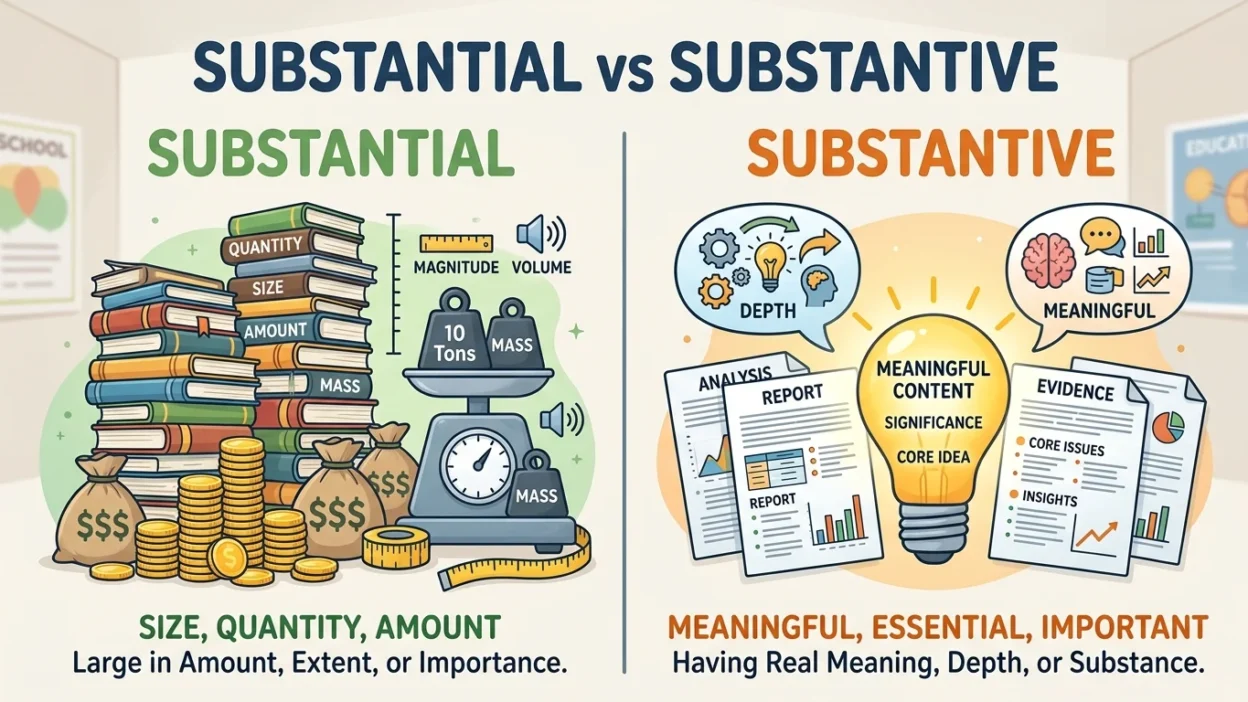
“Substantial” and “substantive” look and sound very similar, but they are not always interchangeable. Both words can describe something important, meaningful, or significant, which is why English learners often confuse them. However, they focus on different ideas.
Substantial usually means large in amount, size, degree, or importance. For example, “The company made a substantial profit” means the profit was large or significant. Substantive usually means related to the real or essential substance of something, especially its main ideas, content, or important details. For example, “The meeting produced a substantive discussion” means the discussion dealt with important and meaningful issues.
Understanding the difference becomes much easier when you remember that substantial often focuses on size, amount, or degree, while substantive focuses on substance, content, or essential meaning. This article explains the difference with simple definitions, examples, common mistakes, comparison tables, and useful memory tricks.
Quick Answer
Substantial means large, considerable, or important in amount, size, or degree. Substantive means related to the essential substance, content, or important details of something. A substantial change may be large, while a substantive change affects the actual content or substance.
Why Do People Confuse Substantial and Substantive?
These words come from the same Latin root connected with the idea of substance. They also have similar spellings and can both describe something important.
The main difference is what they emphasize.
Substantial often answers:
How much? How large? How significant?
Substantive often answers:
What is it really about? Does it contain meaningful or essential content?
Compare these sentences:
The project requires a substantial amount of money.
This means the amount of money is large.
The report contains substantive information.
This means the report contains meaningful or important information.
What Does Substantial Mean?
Substantial is an adjective that usually means large, considerable, significant, or important.
It can describe an amount, size, change, improvement, difference, increase, meal, building, contribution, or other thing that is considerable in some way.
Examples of Substantial
- The company made a substantial profit this year.
- She made a substantial contribution to the project.
- The house suffered substantial damage.
- We need a substantial amount of money to complete the work.
- There has been a substantial increase in prices.
- He received a substantial raise.
- The new policy resulted in a substantial improvement.
- They made a substantial investment in the business.
- The meal was substantial and filling.
- The two proposals have a substantial difference in cost.
- The storm caused substantial damage to the roads.
- She has a substantial amount of experience.
In these examples, substantial generally suggests something considerable in amount, size, degree, or importance.
What Does Substantive Mean?
Substantive is an adjective that usually means related to the essential substance, content, or important details of something.
It is especially common in formal, academic, legal, business, and professional writing.
For example:
The two sides had a substantive discussion.
This means they discussed real and important issues rather than only making small talk or dealing with minor details.
Examples of Substantive
- We need a substantive discussion about the problem.
- The report contains substantive information.
- The committee made several substantive changes to the proposal.
- The meeting did not produce any substantive results.
- She raised several substantive questions.
- The article offers a substantive analysis of the issue.
- The agreement includes substantive provisions.
- They had a substantive conversation about the future.
- The review provided substantive feedback.
- The researchers made a substantive contribution to the field.
- The two proposals differ in several substantive ways.
- We need substantive evidence before making a decision.
Here, substantive focuses on the actual content, substance, or meaningful nature of something.
Substantial vs Substantive: Comparison Table
| Word | Main Meaning | Main Focus | Example |
|---|---|---|---|
| Substantial | Large, considerable, significant | Amount, size, degree, importance | We made a substantial investment. |
| Substantive | Related to essential content or substance | Meaning, content, important details | We had a substantive discussion. |
A simple way to remember the difference is:
Substantial = considerable
Substantive = meaningful or related to substance
Substantial vs Substantive in Common Situations
| Expression | Meaning |
|---|---|
| Substantial amount | A large amount |
| Substantial increase | A large increase |
| Substantial damage | A large or serious amount of damage |
| Substantial contribution | A significant contribution |
| Substantive discussion | A meaningful discussion |
| Substantive change | A change to the actual content or substance |
| Substantive issue | An important issue involving the actual subject |
| Substantive information | Meaningful or important information |
| Substantive evidence | Evidence relevant to the actual substance of a matter |
| Substantive analysis | Detailed analysis of the essential issues |
When Should You Use Substantial?
Use substantial when you want to emphasize that something is considerable, large, serious, or significant.
Common combinations
Substantial amount
The project requires a substantial amount of funding.
Substantial increase
The company reported a substantial increase in sales.
Substantial damage
The building suffered substantial damage.
Substantial improvement
Her writing has shown substantial improvement.
Substantial difference
There is a substantial difference between the two prices.
Substantial experience
He has substantial experience in the field.
When Should You Use Substantive?
Use substantive when you want to emphasize actual content, meaningful ideas, essential issues, or important details.
Common combinations
Substantive discussion
The meeting finally became a substantive discussion.
Substantive change
The new version contains several substantive changes.
Substantive issue
The court must consider the substantive issue.
Substantive information
The report provides substantive information about the problem.
Substantive analysis
The article offers substantive analysis of the subject.
Substantive evidence
The researchers found substantive evidence supporting the theory.
Can They Ever Be Interchangeable?
Sometimes they can overlap, especially when both are being used to mean important or significant.
For example:
The agreement requires a substantial change.
This emphasizes that the change is considerable.
The agreement requires a substantive change.
This emphasizes that the change affects the actual content or substance.
The two sentences can describe the same change, but they highlight different aspects of it.
A change can also be both substantial and substantive.
The company made a substantial and substantive change to its business model.
Here, the change is significant in size or degree and also affects the actual substance of the business model.
Common Mistakes
Mistake 1: Using substantial when you mean meaningful content
Incorrect or less precise:
We had a substantial discussion about the problem.
This could mean the discussion was large or considerable, but it is not the clearest choice.
Better:
We had a substantive discussion about the problem.
Mistake 2: Using substantive for a large amount
Less natural:
The company spent a substantive amount of money.
Better:
The company spent a substantial amount of money.
Mistake 3: Assuming substantive always means large
Substantive does not necessarily mean large.
A short discussion can be substantive if it deals with important issues.
We had a short but substantive conversation.
The conversation was not long, but it had meaningful content.
Mistake 4: Thinking substantial and substantive are always interchangeable
They overlap in some contexts, but their emphasis is different.
Substantial focuses more on quantity, size, degree, or significance.
Substantive focuses more on content, substance, and essential matters.
A Simple Memory Trick
Think about the word substance.
Substantive contains the idea of substance.
So:
Substantive = substance and meaningful content
For substantial, think:
Substantial = substantial size or amount
Remember:
Substantial asks “How much?”
Substantive asks “What is the real substance?”
Substantial vs Substantive in American and British English
Both substantial and substantive are standard in American and British English.
There is no major spelling difference between the two varieties.
The distinction in meaning is also broadly the same.
For example:
The company made a substantial investment.
and
The committee had a substantive discussion.
Both expressions are natural in American and British English.
The exact frequency of particular expressions can vary by profession and context, especially in legal, academic, and government writing, but the basic distinction remains the same.
Similar Words
Words Similar to Substantial
Depending on the context, you can use:
• considerable
• significant
• large
• sizeable
• major
• important
• extensive
• considerable in amount
Example:
The company made a substantial investment.
Similar:
The company made a considerable investment.
Words Similar to Substantive
Depending on the context, you can use:
• meaningful
• significant
• important
• essential
• material
• content based
• substantial in content
Example:
We need a substantive discussion.
Similar:
We need a meaningful discussion.
Be careful, though. These words are not perfect replacements in every sentence.
Substantial vs Substantive: Final Verdict
The easiest distinction is this:
Substantial means large, considerable, or significant in amount, size, degree, or importance.
Substantive means related to the actual substance, content, or essential issues of something.
Compare:
She received a substantial raise.
The raise was large.
They had a substantive discussion.
The discussion dealt with meaningful and important issues.
If you are talking about an amount, increase, decrease, cost, damage, improvement, or size, substantial is often the better choice.
If you are talking about discussion, information, analysis, issues, evidence, content, or changes to the actual substance of something, substantive is often more precise.
Frequently Asked Questions
Is substantial the same as substantive?
No. They overlap in some contexts, but they usually emphasize different things. Substantial generally means large or considerable, while substantive usually refers to meaningful content or the essential substance of something.
Is it a substantial change or a substantive change?
Both can be correct, but they mean slightly different things. A substantial change is considerable or significant in degree. A substantive change affects the actual content or substance.
Is it a substantial discussion or substantive discussion?
Substantive discussion is usually the better choice when you mean a discussion involving meaningful or important issues.
What is a substantial amount?
A substantial amount is a large or considerable amount.
The project requires a substantial amount of money.
What does substantive mean in simple English?
Substantive means dealing with the real, important, or essential content of something.
The meeting included a substantive discussion of the problem.
Can something be both substantial and substantive?
Yes. Something can be both considerable in size or importance and meaningful in content.
The report represents a substantial and substantive contribution to the field.
Which word is more formal?
Both can sound formal depending on the context. Substantive is especially common in academic, legal, professional, and institutional writing.
Remember This
Substantial = large or considerable.
Substantive = meaningful or related to substance.
Think:
Substantial amount
Substantive discussion
Substantial increase
Substantive change
Substantial damage
Substantive information
If you remember those combinations, choosing between the two words becomes much easier.
Conclusion
Substantial and substantive are closely related words, but they serve different purposes. Substantial generally describes something considerable in amount, size, degree, or importance. It is commonly used with words such as amount, increase, damage, investment, improvement, and difference.
Substantive focuses more on actual content, substance, and important issues. It is especially useful with words such as discussion, information, analysis, evidence, issue, and change.
When you are unsure, ask yourself whether you are describing something as large or considerable or if you are describing it as meaningful and concerned with the actual substance. That simple question will help you choose the right word.

Charles Kevin is a passionate language writer and researcher at SimileHive, creating clear, engaging content about similes, idioms, metaphors, and figurative language to help readers improve English communication confidently every day.