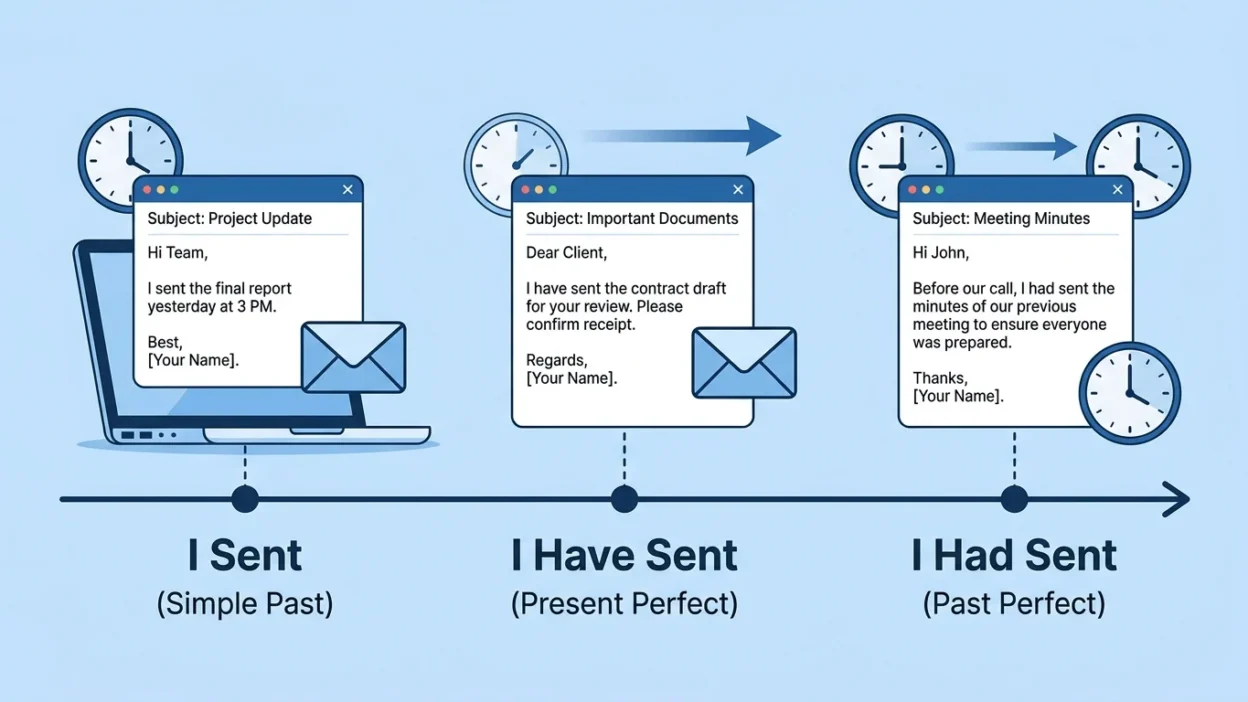
When talking about emails, “I sent,” “I have sent,” and “I had sent” are all grammatically correct, but they describe different time relationships. The main difference is not the action itself. All three expressions describe sending an email, but they place that action at different points in time. I sent an email usually describes a completed action in the past. I have sent an email connects a past action to the present. I had sent an email describes an action that happened before another past event.
Choosing the right expression depends on what you want to emphasize. If you simply want to say that you sent an email yesterday, use “I sent an email.” If you want to tell someone that the email has already been sent and that fact matters now, use “I have sent an email.” If you are talking about two events in the past and the email was sent first, use “I had sent an email.” Understanding this timeline makes the difference much easier to remember.
Quick Answer
I sent an email describes a completed past action, often with a specific past time. I have sent an email connects the past action to the present and often emphasizes the current result. I had sent an email shows that the email was sent before another past event.
Why Do People Confuse “I Sent,” “I Have Sent,” and “I Had Sent”?
The three expressions all describe the same basic action: sending an email.
The difference is when the action happened and how it relates to another time.
Compare:
- I sent an email. → Simple past
- I have sent an email. → Present perfect
- I had sent an email. → Past perfect
The easiest way to understand them is to think about a timeline.
I sent
Past action → finished in the past
I have sent
Past action → connected to now
I had sent
Earlier past action → happened before another past event
“I Sent” an Email
I sent an email uses the simple past tense.
Use it when the action happened and was completed in the past. You can use it when the exact time is stated or understood.
Examples
- I sent an email yesterday.
- I sent the email this morning.
- I sent you an email last night.
- I sent the report by email two hours ago.
The simple past commonly appears with finished time expressions such as:
- yesterday
- last night
- last week
- this morning, when the morning is finished
- two hours ago
- on Monday
- in 2025
Example
I sent the email yesterday.
Here, yesterday clearly places the action in the past.
“I Have Sent” an Email
I have sent an email uses the present perfect tense.
Use it when a past action has a connection to the present. With emails, this expression often tells someone that the email has already been sent and that the information is relevant now.
Examples
- I have sent the email.
- I have sent you the documents.
- I have sent the information you requested.
- I have sent the application by email.
For example:
Don’t worry. I have sent the email.
The important point is the current result: the email is now sent.
You would not normally combine the present perfect with a finished past time expression such as yesterday.
❌ I have sent the email yesterday.
✅ I sent the email yesterday.
“I Had Sent” an Email
I had sent an email uses the past perfect tense.
Use it when you are talking about an action that happened before another action or event in the past.
For example:
I had sent the email before she called me.
There are two past events:
- I sent the email.
- She called me.
The email was sent first, so had sent shows the earlier event.
More Examples
- I had sent the email before the meeting started.
- She had sent me an email before I arrived.
- I had already sent the documents when he asked for them.
- We had sent the report before the deadline changed.
I Sent vs I Have Sent vs I Had Sent
| Expression | Tense | Main Use | Example |
|---|---|---|---|
| I sent an email | Simple past | Completed past action | I sent an email yesterday. |
| I have sent an email | Present perfect | Past action connected to now | I have sent the email. |
| I had sent an email | Past perfect | Action completed before another past event | I had sent the email before she called. |
When Should You Use Each One?
Use “I sent” for a finished past action
Choose I sent when you are simply reporting something that happened in the past.
I sent the email yesterday.
I sent the email after lunch.
I sent the message last night.
The action is finished, and you are placing it in the past.
Use “I have sent” when the result matters now
Choose I have sent when you want to emphasize that the email is now sent.
I have sent the email, so you should receive it soon.
I have sent the documents you requested.
I have sent the information to your manager.
The exact time is usually not important.
Use “I had sent” when another past event is involved
Choose I had sent when the email was sent before another event in the past.
I had sent the email before he called.
She had sent the documents before the meeting began.
We had already sent the report when the client requested changes.
12+ Examples With “I Sent”
- I sent an email yesterday.
- I sent the email this morning.
- I sent you an email last night.
- I sent the documents on Monday.
- I sent the report two hours ago.
- I sent an email to my manager.
- I sent the application yesterday afternoon.
- I sent the information last week.
- I sent the file before leaving work.
- I sent you the details yesterday.
- I sent a follow-up email after the meeting.
- I sent the wrong attachment by mistake.
12+ Examples With “I Have Sent”
- I have sent the email.
- I have sent you the documents.
- I have sent the information you requested.
- I have sent the application.
- I have sent the report to your manager.
- I have sent a follow-up email.
- I have sent the file to the client.
- I have sent you the details.
- I have sent the revised document.
- I have sent the invitation.
- I have sent everything you need.
- I have sent the email already.
Notice that already works naturally with the present perfect:
I have already sent the email.
12+ Examples With “I Had Sent”
- I had sent the email before she called.
- I had sent the report before the meeting started.
- I had sent the documents when he asked for them.
- I had already sent the application before the deadline changed.
- I had sent you an email before I left.
- I had sent the information before the manager arrived.
- I had sent the file when the computer stopped working.
- I had already sent the message when she replied.
- I had sent the invoice before the customer contacted us.
- I had sent the attachment before noticing the mistake.
- I had sent several emails before receiving a response.
- I had sent the confirmation before the appointment was canceled.
Common Mistakes
Mistake 1: Using “I have sent” with “yesterday”
❌ I have sent the email yesterday.
✅ I sent the email yesterday.
Yesterday is a finished past time, so the simple past is normally used.
Mistake 2: Using “I had sent” without a past reference
❌ I had sent the email.
This sentence can be grammatically possible in a larger context, but by itself, I sent the email or I have sent the email is usually more natural.
The past perfect normally needs a past reference point.
Better:
I had sent the email before she called.
Mistake 3: Using “I sent” when the current result is important
If someone asks whether the email has been sent, you can say:
Yes, I have sent it.
This emphasizes the present result.
However, I sent it can also be perfectly natural, especially when the context already establishes the time.
Mistake 4: Confusing “sent” and “have sent”
Remember that sent is the past form of send.
- Present: I send emails.
- Simple past: I sent an email.
- Present perfect: I have sent an email.
- Past perfect: I had sent an email.
A Simple Timeline
Imagine these three situations:
Situation 1: Simple Past
Yesterday → I sent the email.
The action happened in the past.
Situation 2: Present Perfect
Past → I have sent the email → Now
The action happened in the past, but the result matters now.
Situation 3: Past Perfect
I had sent the email → She called me
Both events are in the past, but sending the email happened first.
Which One Should You Use in an Email or Work Message?
If you are telling a colleague that you have completed an action, “I have sent the email” is often a natural choice when the current status is what matters.
For example:
I have sent the email to the client.
If you are reporting when you sent it, use the simple past:
I sent the email to the client yesterday.
If you are describing something that happened before another past event, use the past perfect:
I had sent the email before the client called.
The correct choice depends on the context rather than on whether the sentence is formal or informal.
Similar Expressions
You may also see these common expressions:
I sent the email.
A straightforward statement about a completed past action.
I have sent the email.
Emphasizes that the email has now been sent.
I already sent the email.
A natural way to say that the action was completed earlier.
I have already sent the email.
Emphasizes the completed action and its present relevance.
I had already sent the email.
Shows that the email was sent before another past event.
I will send the email.
Describes a future action.
I am sending the email.
Usually describes an action happening now or around the current time.
Final Verdict
All three forms are correct, but they are used differently.
I sent an email = a completed action in the past.
I have sent an email = a past action connected to the present, often emphasizing that the email is now sent.
I had sent an email = an action that happened before another past event.
A useful rule is:
Specific finished past time → I sent
Present result → I have sent
Earlier than another past event → I had sent
Frequently Asked Questions
Is “I sent the email” correct?
Yes. I sent the email is the simple past tense and is correct when describing a completed action in the past.
Is “I have sent the email” correct?
Yes. I have sent the email is the present perfect and commonly emphasizes that the email has now been sent.
Is “I had sent the email” correct?
Yes. I had sent the email is the past perfect. It is normally used when the email was sent before another past action or event.
Should I say “I sent” or “I have sent”?
Use I sent when referring to a completed past action, especially with a finished time such as yesterday. Use I have sent when the current result is important.
Can I say “I have sent the email yesterday”?
No, this is not normally correct in standard English. Say:
I sent the email yesterday.
The present perfect generally does not combine with a finished past time such as yesterday.
When should I use “I had sent”?
Use I had sent when you need to show that one past action happened before another past event.
I had sent the email before she called.
Is “I have already sent the email” correct?
Yes. I have already sent the email is a natural way to tell someone that the email has been sent and the result is relevant now.
Remember This
I sent → past
I have sent → past + present connection
I had sent → earlier past
Think of the timeline:
I sent it yesterday.
I have sent it already.
I had sent it before she called.
Once you identify the time relationship, the correct tense becomes much easier to choose.
Conclusion
I sent, I have sent, and I had sent all describe the action of sending an email, but each form gives the action a different time relationship. Use I sent for a completed past action, especially when you mention a finished time. Use I have sent when the completed action has a connection to the present. Use I had sent when the action happened before another event in the past.
For everyday email and workplace communication, the choice is usually straightforward. If you are simply reporting what happened yesterday, say “I sent the email yesterday.” If you are confirming that the email is now taken care of, say “I have sent the email.” If you are telling a story about two past events, say “I had sent the email before she called.”

Charles Kevin is a passionate language writer and researcher at SimileHive, creating clear, engaging content about similes, idioms, metaphors, and figurative language to help readers improve English communication confidently every day.