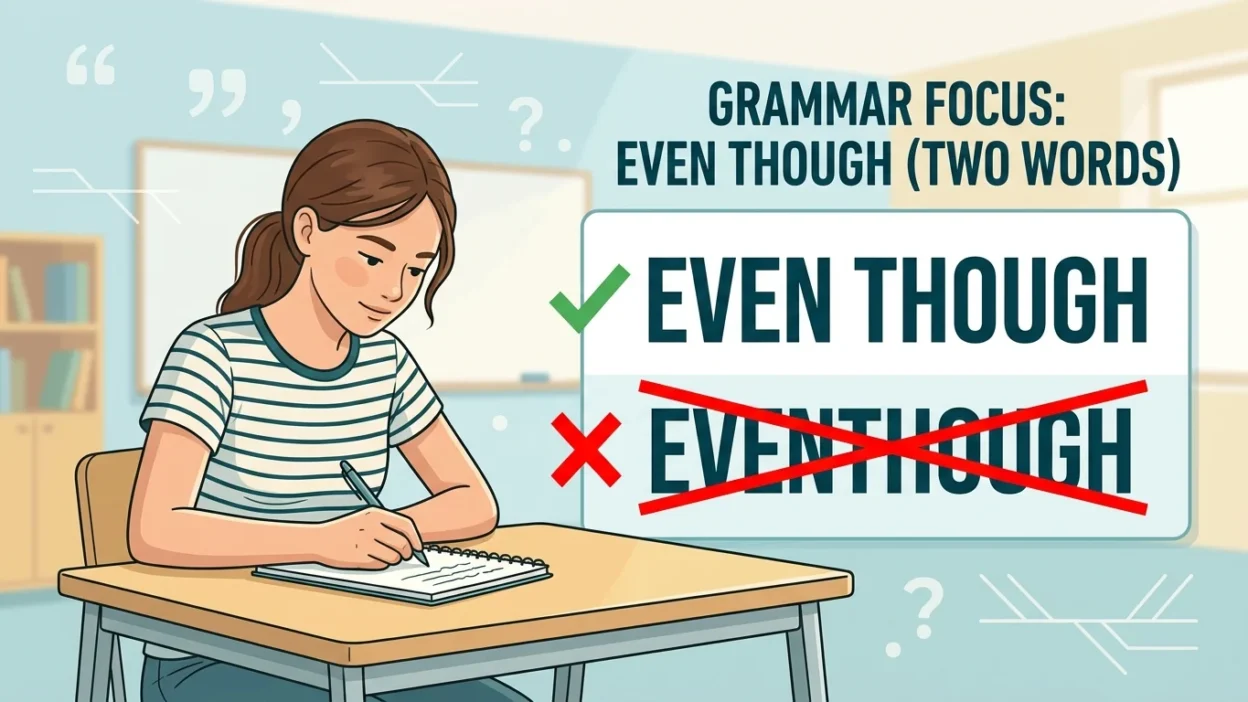
“Even though” is the correct spelling. “Eventhough” is incorrect in standard English because the two words must be written separately. Even though is a conjunction used to introduce a contrast or unexpected fact. For example, “Even though it was raining, we went outside.” Here, the rain might normally stop people from going outside, but they went anyway.
Many English learners confuse these forms because even though is pronounced as a connected phrase in normal speech. When spoken quickly, the words can sound almost like one word. However, in writing, always keep them separate: even though. It can appear at the beginning or in the middle of a sentence and is commonly followed by a subject and verb. Learning this simple spelling rule will help you avoid one of the most common mistakes with this expression.
Quick Answer
Even though is the correct form, and eventhough is incorrect. The expression means although or despite the fact that and introduces a contrast. For example, “Even though I was tired, I finished my work.” Always write even though as two separate words.
Why Do People Confuse “Even Though” and “Eventhough”?
People often write eventhough because the phrase sounds connected when spoken.
However, even though consists of two separate words:
- even = adds emphasis
- though = introduces a contrast
Together, even though means something similar to although.
For example:
Even though I was tired, I went to work.
This means:
Although I was tired, I went to work.
The important point is that even though is always written as two words.
First Word: Even
Even has several meanings in English, but in even though, it adds emphasis to the contrast.
Compare:
Though it was raining, we went outside.
Even though it was raining, we went outside.
The second sentence emphasizes the contrast more strongly.
The weather made going outside less expected, but the people went outside anyway.
Second Word: Though
Though can be used as a conjunction meaning although or despite the fact that.
For example:
Though he was tired, he continued working.
Adding even makes the contrast stronger:
Even though he was tired, he continued working.
So, the phrase even though is used to introduce a fact that makes the result seem surprising or unexpected.
Even Though vs Eventhough
| Form | Correct? | Meaning | Example |
|---|---|---|---|
| even though | Yes | Although; despite the fact that | Even though it was cold, we went outside. |
| eventhough | No | Incorrect spelling | ❌ Eventhough it was cold… |
| even though | Yes | Used to show contrast | Even though I was tired, I worked. |
The key rule is simple:
Even though = two words
Eventhough = incorrect
When Should You Use “Even Though”?
Use even though when you want to introduce a contrasting fact.
The basic structure is:
Even though + subject + verb, main clause
For example:
Even though I was tired, I finished my homework.
You can also put the main clause first:
I finished my homework even though I was tired.
Both sentences are correct.
At the Beginning of a Sentence
Even though it was raining, we went for a walk.
In the Middle of a Sentence
We went for a walk even though it was raining.
The meaning remains essentially the same.
15 Examples of “Even Though”
- Even though I was tired, I finished my homework.
- Even though it was raining, we went outside.
- She smiled even though she was nervous.
- Even though he studied hard, he failed the test.
- We went for a walk even though it was cold.
- Even though I was busy, I helped my friend.
- They continued playing even though it was getting dark.
- Even though she was sick, she went to work.
- He bought the car even though it was expensive.
- Even though I warned him, he made the same mistake.
- She kept running even though her legs were tired.
- Even though the restaurant was crowded, we found a table.
- I enjoyed the movie even though it was very long.
- Even though he was afraid, he opened the door.
- We arrived on time even though there was heavy traffic.
Even Though vs Although
Even though and although have very similar meanings.
Both can introduce a contrast.
Although it was raining, we went outside.
Even though it was raining, we went outside.
The main difference is emphasis. Even though often gives stronger emphasis to the contrast.
Comparison
| Expression | Meaning | Example |
|---|---|---|
| although | Despite the fact that | Although he was tired, he worked. |
| even though | Despite the fact that, with stronger emphasis | Even though he was tired, he worked. |
In many everyday sentences, either one can work naturally.
Even Though vs Though
Though and even though can both introduce contrast.
Though I was tired, I went to work.
Even though I was tired, I went to work.
Even though generally places more emphasis on the surprising contrast.
There is also an important difference in position. Though can sometimes appear at the end of a sentence in informal English:
The movie was good, though.
You cannot normally use even though in exactly the same way:
❌ The movie was good, even though.
Even Though vs Despite
These expressions are similar, but their grammar is different.
Even though is normally followed by a clause containing a subject and verb.
Even though I was tired, I worked.
Despite is normally followed by a noun, pronoun, or -ing form.
Despite being tired, I worked.
Do not write:
❌ Despite I was tired, I worked.
Instead:
✅ Even though I was tired, I worked.
Or:
✅ Despite being tired, I worked.
Common Mistakes
1. Writing “eventhough”
❌ Eventhough I was tired, I went to work.
✅ Even though I was tired, I went to work.
Always separate the two words.
2. Using “even though” incorrectly with a noun
❌ Even though the rain, we went outside.
✅ Even though it was raining, we went outside.
Or:
✅ Despite the rain, we went outside.
3. Confusing “even though” with “despite”
❌ Despite I was tired, I continued working.
✅ Even though I was tired, I continued working.
✅ Despite being tired, I continued working.
4. Using “even though” when there is no contrast
The phrase should normally introduce a contrasting or unexpected fact.
For example:
Even though I was hungry, I ate dinner.
This does not create a very strong contrast because being hungry naturally leads to eating dinner.
A clearer example is:
Even though I was not hungry, I ate dinner.
Here, the contrast is more obvious.
Memory Trick
Think of even though as two separate building blocks:
EVEN + THOUGH
Never combine them into one word.
You can also remember:
Even though = although
If you can replace the phrase with although, you probably have the correct expression.
For example:
Even though it was raining, we went outside.
→
Although it was raining, we went outside.
American vs British English
There is no major spelling difference between American and British English for this expression.
Both varieties use:
even though
The incorrect form eventhough should not be used in standard English simply because the phrase may sound like one unit when spoken.
The same spelling rule applies in formal and informal writing.
Similar Words and Expressions
Here are some expressions related to even though:
- although = despite the fact that
- though = although
- despite = without being prevented by something
- in spite of = despite
- while = can introduce a contrast in some contexts
- nevertheless = despite that
- however = introduces a contrast between ideas
For example:
Even though he was tired, he worked.
Although he was tired, he worked.
Despite being tired, he worked.
In spite of being tired, he worked.
These sentences express closely related ideas, but their grammatical structures are different.
Final Verdict
The correct form is even though.
❌ eventhough
✅ even though
Use even though to introduce a contrasting or unexpected fact.
For example:
Even though it was raining, we went outside.
It is written as two separate words in standard English.
Frequently Asked Questions
Is “eventhough” one word?
No. Eventhough is not the standard spelling. The correct form is even though, written as two words.
Is “even though” correct?
Yes. Even though is a standard English conjunction used to introduce a contrast.
What does “even though” mean?
Even though means although or despite the fact that. It introduces a fact that contrasts with the main idea.
Can “even though” start a sentence?
Yes.
Even though I was tired, I finished my work.
It can also appear later in a sentence:
I finished my work even though I was tired.
Is “even though” the same as “although”?
They have very similar meanings. Even though often gives slightly stronger emphasis to the contrast.
Can I say “even though” and “despite” in the same way?
Not exactly. Even though is normally followed by a clause, while despite is normally followed by a noun, pronoun, or -ing form.
Is “even though” formal or informal?
Even though is suitable for both everyday and formal English. It is a standard expression used in many types of writing and speech.
What is the opposite of “even though”?
There is no exact opposite. Depending on the context, expressions such as because, since, or as may express a reason rather than a contrast.
Remember This
Even though = correct
Eventhough = incorrect
Use even though when you want to show contrast:
Even though I was tired, I kept working.
The simplest memory rule is:
Keep “even” and “though” separate.
Conclusion
The difference between even though and eventhough is simple: even though is correct, while eventhough is an incorrect spelling. The phrase contains two separate words and is used to introduce a contrast or an unexpected fact. It is similar in meaning to although and despite the fact that.
When writing, always use even though as two words. Whether you are writing an email, school assignment, article, or everyday message, this form is clear and grammatically standard. If you remember that even though means roughly although, you will have an easy way to recognize and use it correctly.

Lucas Luke is a passionate language writer and content creator at SimileHive, specializing in similes, idioms, metaphors, and figurative language. He enjoys making complex English expressions simple, engaging, and easy to understand for students, writers, and language enthusiasts through well-researched, practical content.