
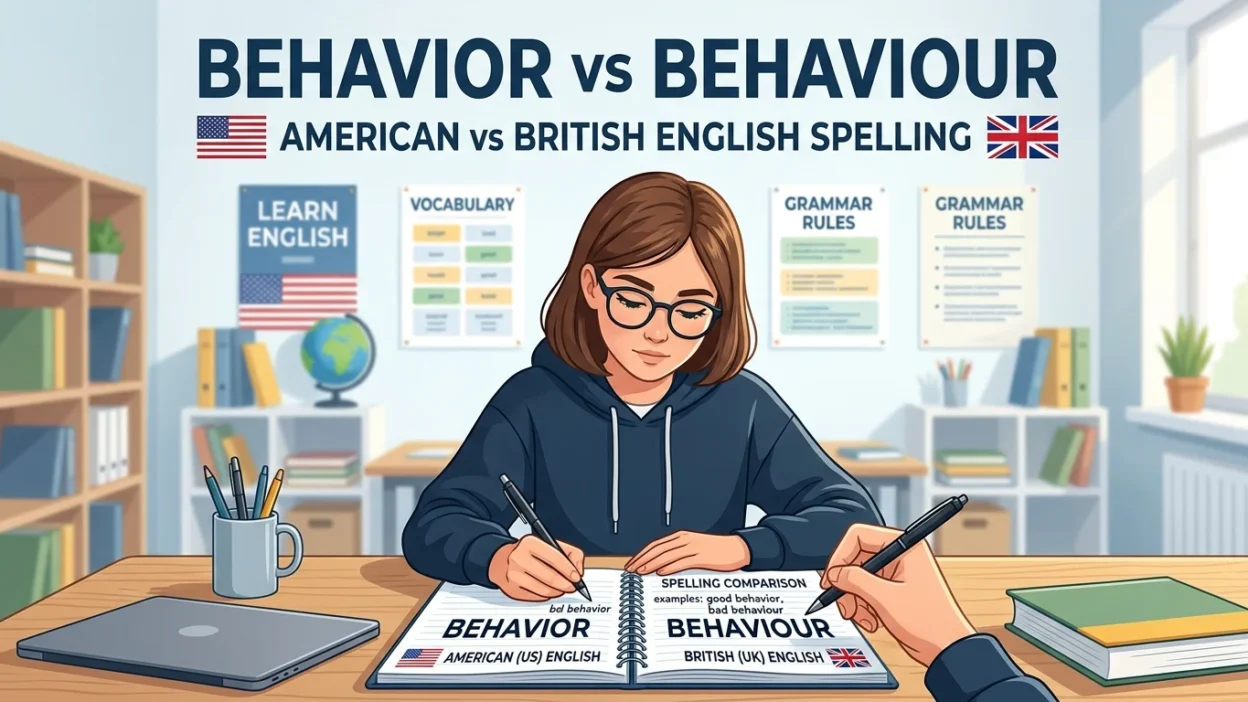
Behavior and behaviour have the same meaning. The only difference is the spelling used in different varieties of English. Behavior is the standard spelling in American English, while behaviour is the standard spelling in British English and many other varieties of English. Both forms refer to the way a person, animal, group, or organization acts or responds in a particular situation.
The difference is easy to remember once you know the spelling pattern. American English often removes the u from words such as behavior, color, favor, honor, and labor. British English generally keeps the u, giving us behaviour, colour, favour, honour, and labour. If you are writing for an American audience, use behavior. If you are following British English, use behaviour.
Quick Answer
Behavior is the American English spelling, while behaviour is the British English spelling. Both words mean the same thing: the way someone or something acts or responds. Neither spelling is more correct in general. Choose behavior for American English and behaviour for British English.
Why Do People Confuse “Behavior” and “Behaviour”?
The two words have exactly the same meaning and pronunciation in standard English. The only major difference is the spelling.
The confusion usually happens because English has different spelling conventions in different countries.
Compare:
- American English: behavior
- British English: behaviour
The same pattern appears in several other words:
- color → colour
- favor → favour
- honor → honour
- labor → labour
- neighbor → neighbour
So, if you know that British English often keeps the u, it becomes easier to remember behaviour.
First Word: Behavior
Behavior is the standard American English spelling.
It means the way a person, animal, group, or organization acts.
For example:
His behavior was very polite.
The teacher discussed the child’s behavior with his parents.
Scientists studied the behavior of the animals.
In American English, always use behavior in standard writing.
Second Word: Behaviour
Behaviour is the standard British English spelling.
It has exactly the same meaning as behavior.
For example:
His behaviour was very polite.
The teacher discussed the child’s behaviour with his parents.
Scientists studied the behaviour of the animals.
British spelling is also commonly used in other varieties of English influenced by British conventions.
Behavior vs Behaviour
| Word | Variety of English | Meaning | Example |
|---|---|---|---|
| behavior | American English | The way someone or something acts | His behavior was unusual. |
| behaviour | British English | The way someone or something acts | His behaviour was unusual. |
There is no difference in meaning between the two forms.
When Should You Use “Behavior”?
Use behavior when writing in American English.
For example:
- The student’s behavior improved.
- Her behavior surprised everyone.
- The study examined human behavior.
- His behavior was unacceptable.
- Animal behavior can be difficult to predict.
If your school, workplace, publication, or audience follows American English, behavior is the appropriate spelling.
When Should You Use “Behaviour”?
Use behaviour when writing in British English.
For example:
- The student’s behaviour improved.
- Her behaviour surprised everyone.
- The study examined human behaviour.
- His behaviour was unacceptable.
- Animal behaviour can be difficult to predict.
If your writing follows British English spelling conventions, use behaviour consistently.
15 Examples of “Behavior”
- His behavior was polite and respectful.
- The teacher praised her good behavior.
- The study examines human behavior.
- The child’s behavior changed suddenly.
- We need to understand this behavior.
- His strange behavior worried his family.
- The company has strict rules about employee behavior.
- The research focuses on animal behavior.
- Her behavior during the meeting was professional.
- The psychologist studied the patient’s behavior.
- Good behavior should be encouraged.
- The dog’s behavior changed after the move.
- Social media can influence people’s behavior.
- The teacher spoke to him about his behavior.
- The experiment measured changes in behavior.
15 Examples of “Behaviour”
- His behaviour was polite and respectful.
- The teacher praised her good behaviour.
- The study examines human behaviour.
- The child’s behaviour changed suddenly.
- We need to understand this behaviour.
- His strange behaviour worried his family.
- The company has strict rules about employee behaviour.
- The research focuses on animal behaviour.
- Her behaviour during the meeting was professional.
- The psychologist studied the patient’s behaviour.
- Good behaviour should be encouraged.
- The dog’s behaviour changed after the move.
- Social media can influence people’s behaviour.
- The teacher spoke to him about his behaviour.
- The experiment measured changes in behaviour.
Notice that the sentences have the same meaning. Only the spelling changes.
Behavior vs Behaviour in Different Types of Writing
Your choice should usually depend on the variety of English you are following.
American English
Use:
behavior
For example:
The research examines human behavior.
British English
Use:
behaviour
For example:
The research examines human behaviour.
Academic Writing
Both spellings are acceptable, but consistency matters.
If your paper follows American English:
human behavior
If it follows British English:
human behaviour
Do not switch between the two forms without a reason.
Professional Writing
The same rule applies to business emails, reports, websites, and other professional documents.
Choose the spelling that matches your intended variety of English.
American vs British English
| American English | British English |
|---|---|
| behavior | behaviour |
| color | colour |
| favor | favour |
| honor | honour |
| labor | labour |
| neighbor | neighbour |
The extra u is a common feature of several British English spellings.
However, not every English spelling difference follows exactly the same pattern, so it is best to learn common word pairs individually.
Behavior vs Behaviour: Is One More Correct?
Neither spelling is universally more correct.
Behavior is correct in American English.
Behaviour is correct in British English.
The important thing is to match your spelling to the variety of English you are using.
For example, an American English article might say:
Children’s behavior can change as they grow.
A British English article might say:
Children’s behaviour can change as they grow.
Both sentences are correct.
Common Mistakes
1. Mixing the two spellings
A common mistake is to use both forms in the same piece of writing.
For example:
The child’s behavior changed, but his behaviour remained difficult.
Unless you are intentionally discussing the spelling difference, this is inconsistent.
Choose one spelling and use it throughout.
2. Thinking “behaviour” is always more formal
The extra u does not make the word more formal.
Behavior and behaviour are simply different regional spellings.
3. Thinking “behavior” is incorrect in British English
Behavior is standard American English, but British English generally uses behaviour.
The issue is regional spelling, not grammar.
4. Forgetting the “u” in British English
If you are writing consistently in British English, remember:
behaviour
not:
behavior
Memory Trick
A simple way to remember the difference is:
American English → behavior
British English → behaviour
Think of the British u as the extra letter:
behavior → American
behaviour → British
You can connect it with other familiar pairs:
color → colour
favor → favour
behavior → behaviour
Similar Words
Depending on the context, words related to behavior/behaviour include:
- conduct
- actions
- manners
- attitude
- habits
- actions
- performance
- demeanor
- way of acting
These words are related but are not always exact synonyms.
For example, conduct often refers to the way someone behaves, especially in a formal or ethical context.
His conduct was professional.
Manners usually refers to how someone behaves toward other people.
She has excellent manners.
Attitude often refers to a person’s feelings or way of thinking rather than their actions alone.
His attitude toward the project changed.
Final Verdict
Behavior and behaviour mean exactly the same thing.
Use:
behavior → American English
behaviour → British English
Neither spelling is inherently more correct. The important thing is to use the spelling that matches the variety of English you are writing in and to remain consistent throughout your text.
Frequently Asked Questions
Is “behavior” or “behaviour” correct?
Both are correct. Behavior is the American English spelling, while behaviour is the British English spelling.
Is “behaviour” British or American?
Behaviour is the standard British English spelling. American English normally uses behavior.
Is “behavior” American or British?
Behavior is the standard American English spelling. British English normally uses behaviour.
Do behavior and behaviour have the same meaning?
Yes. They have the same meaning and generally the same pronunciation. The difference is spelling.
Why does British English spell behaviour with a “u”?
British English traditionally retains the u in words such as behaviour, colour, favour, honour, and labour, while American English commonly uses simplified spellings without the u.
Should I use behavior or behaviour in academic writing?
Use the spelling required by your institution, publication, style guide, or intended audience. If no specific requirement exists, choose either American or British English and use it consistently.
Is “behaviour” more formal than “behavior”?
No. Neither is more formal. They are regional spelling variants of the same word.
What is the plural of behavior or behaviour?
Behavior and behaviour are generally uncountable nouns when referring to the way someone or something acts, so you normally do not add s.
For example:
His behavior was unusual.
However, in specialized contexts, behaviors can be used to refer to different types or patterns of behavior.
Remember This
Behavior = American English
Behaviour = British English
They have the same meaning.
The only difference is the spelling:
American: behavior
British: behaviour
If you are writing for an American audience, choose behavior. If you are following British English, choose behaviour.
Conclusion
The difference between behavior and behaviour is a regional spelling difference rather than a difference in meaning. Both words describe the way a person, animal, group, or organization acts or responds. Behavior is standard in American English, while behaviour is standard in British English.
The best choice depends on the variety of English you are using. If your writing follows American English, use behavior throughout. If it follows British English, use behaviour. The most important rule is consistency. Once you know that British English generally keeps the u and American English often removes it, this spelling difference becomes easy to remember.

Lucas Luke is a passionate language writer and content creator at SimileHive, specializing in similes, idioms, metaphors, and figurative language. He enjoys making complex English expressions simple, engaging, and easy to understand for students, writers, and language enthusiasts through well-researched, practical content.