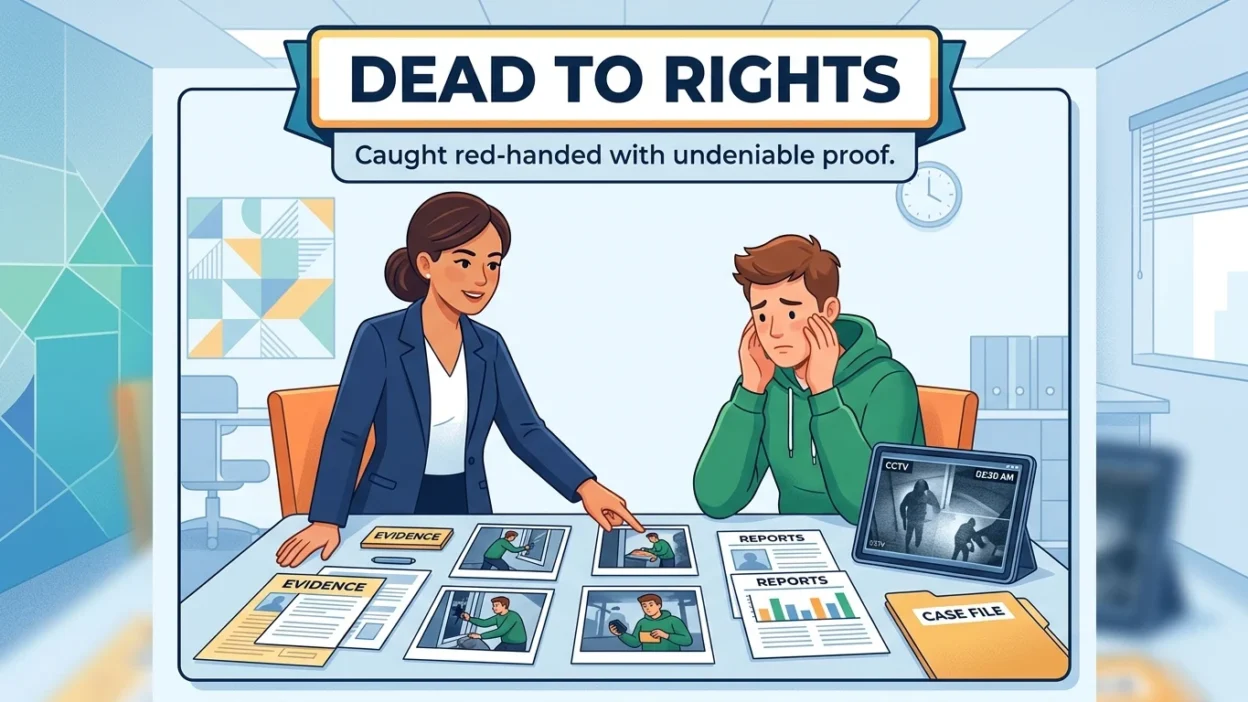
“Dead to rights” is an English idiom meaning caught in a situation where there is clear proof of guilt or wrongdoing and there is little or no chance of denying it. If someone is caught “dead to rights,” the evidence against them is strong and they have been caught in the act or in a way that clearly proves what they did. For example, “The police caught him dead to rights with the stolen money” means the evidence clearly connected him to the crime.
The expression is often used in conversations about crime, accusations, investigations, or situations where someone has been caught doing something wrong. However, it can also be used more casually. Someone might say, “You caught me dead to rights” after being caught doing something they were trying to hide. The phrase is usually informal and emphasizes that the evidence is so clear that there is little room for an explanation or denial.
Quick Answer
“Dead to rights” means caught with clear and convincing evidence of wrongdoing, leaving little opportunity to deny or escape blame. For example, “The security camera caught him dead to rights” means the camera provided clear evidence that showed what he had done.
Why Do People Say “Dead to Rights”?
The expression is an idiom, so its meaning is not meant to be understood literally.
Dead does not mean physically dead in this expression, and rights does not refer to legal rights in the usual sense.
Instead, dead to rights describes someone who has been caught in a position where the evidence against them is extremely strong.
For example:
The detective caught the suspect dead to rights.
This means the detective had clear evidence showing the suspect’s involvement.
The phrase can also be used jokingly:
You caught me dead to rights eating the last cookie.
Here, the speaker admits that they were clearly caught doing something they probably should not have done.
What Does “Dead to Rights” Mean?
Dead to rights can mean:
- caught in the act
- caught with clear evidence
- caught beyond reasonable denial
- clearly proven guilty of wrongdoing
- caught in an undeniable situation
- caught with strong evidence against you
The phrase often suggests that the person cannot reasonably talk their way out of the situation.
Where Does “Dead to Rights” Come From?
The exact origin of “dead to rights” is uncertain, but the expression has a long history in English.
One explanation connects dead with the older sense of something being complete, certain, or exact, while to rights has historically been associated with being in the correct or proper condition.
The phrase eventually developed the modern sense of catching someone in circumstances where the evidence is decisive.
Today, dead to rights is commonly understood as meaning caught with undeniable evidence or caught in the act.
How Do You Use “Dead to Rights”?
The expression is commonly used after verbs such as:
- catch
- have
- get
- prove
Common patterns include:
catch someone dead to rights
have someone dead to rights
be caught dead to rights
For example:
The police caught him dead to rights.
We had him dead to rights.
She was caught dead to rights.
The expression can be used with different pronouns:
| Person | Example |
|---|---|
| I | They caught me dead to rights. |
| You | They caught you dead to rights. |
| He | They caught him dead to rights. |
| She | They caught her dead to rights. |
| We | They caught us dead to rights. |
| They | They caught them dead to rights. |
Dead to Rights vs Caught in the Act
These expressions are closely related, but they are not exactly the same.
Caught in the act means someone was discovered while actually doing something.
The teacher caught him in the act of cheating.
Dead to rights emphasizes that there is clear evidence against the person, whether or not they were literally caught at the exact moment of the wrongdoing.
The security footage caught him dead to rights.
The footage provides strong evidence against him.
So:
Caught in the act → discovered while doing something.
Dead to rights → caught with evidence that clearly establishes wrongdoing.
Dead to Rights vs Caught Red-Handed
Caught red-handed means discovered while doing something wrong, especially something that the person was trying to hide.
The thief was caught red-handed.
Dead to rights emphasizes the strength of the evidence or the person’s inability to deny what happened.
The thief was caught dead to rights.
Both expressions can describe a situation where someone has been clearly caught, but dead to rights often focuses more on the evidence.
15 Examples of “Dead to Rights”
- The security camera caught him dead to rights.
- The police had the suspect dead to rights.
- She caught me dead to rights eating the last piece of cake.
- The evidence had him dead to rights.
- The video caught them dead to rights.
- He was caught dead to rights with the missing documents.
- The detective had the suspect dead to rights.
- My mother caught me dead to rights sneaking out of the house.
- The photographs caught him dead to rights.
- The witness’s testimony left him dead to rights.
- The recording caught the employee dead to rights.
- They had the evidence needed to catch him dead to rights.
- The manager caught the worker dead to rights changing the records.
- The video footage had the driver dead to rights.
- I tried to deny it, but my friend had me dead to rights.
“Dead to Rights” in Casual Conversation
The idiom does not have to be used only for serious crimes or legal situations.
It can be used humorously when someone has obvious evidence that another person did something.
For example:
You said you didn’t eat the cake, but I saw the crumbs on your shirt. I’ve got you dead to rights!
This means the evidence clearly shows that the person ate the cake.
Another example:
You said you weren’t using my computer, but your account is still open. I’ve got you dead to rights.
Here, the expression is being used playfully rather than as a serious legal statement.
Can “Dead to Rights” Be Used in a Positive Situation?
Usually, no.
The phrase normally relates to:
- wrongdoing
- guilt
- deception
- breaking a rule
- being caught
- undeniable evidence
It can be used humorously in harmless situations, but its basic meaning still involves being caught or exposed.
For example:
You caught me dead to rights hiding the birthday present.
This is not a serious wrongdoing, but the person has clearly been caught.
Common Mistakes
1. Taking “dead” literally
The phrase does not mean that someone is physically dead.
He was dead to rights.
does not mean:
He was dead.
It means that he was caught in a situation where the evidence against him was clear.
2. Using “dead in rights”
The established expression is:
✅ dead to rights
Not:
❌ dead in rights
3. Assuming it always means a criminal conviction
Being caught dead to rights means there is strong or undeniable evidence of wrongdoing. It does not literally mean that a court has convicted someone.
For example:
The video caught him dead to rights.
This describes the evidence, not necessarily the outcome of a legal case.
4. Using it for ordinary mistakes
The phrase is usually strongest when there is some wrongdoing, deception, or attempt to hide something.
For a simple mistake, words such as caught, discovered, or found out may be more natural.
Is “Dead to Rights” Formal or Informal?
“Dead to rights” is generally informal.
It is common in:
- everyday conversation
- crime stories
- movies and television
- journalism
- informal writing
- fictional dialogue
In formal writing, especially when precision matters, it is often better to say:
- clear evidence
- compelling evidence
- caught in the act
- conclusively established
- strong evidence of wrongdoing
For example:
Informal:
The evidence had him dead to rights.
More formal:
The evidence clearly established his involvement.
Memory Trick
Think:
Dead to rights = no way to deny it.
Imagine someone saying:
“I didn’t do it!”
Then a video recording, photograph, or other evidence immediately proves what happened.
You can think:
Caught dead to rights.
A simple memory sentence is:
“The evidence is so clear that denial is almost impossible.”
Dead to Rights vs Dead Right
Be careful not to confuse dead to rights with dead right.
Dead right
Dead right means completely or absolutely correct.
You are dead right about that.
Dead to rights
Dead to rights means caught with clear evidence of wrongdoing.
The police caught him dead to rights.
These expressions have completely different meanings.
American vs British English
“Dead to rights” is understood in both American and British English.
The expression is particularly familiar in informal speech, crime-related contexts, and popular media. There is no major spelling difference between American and British English.
For example:
They caught him dead to rights.
The same form can be used in both varieties of English.
Similar Expressions
Several expressions have meanings similar to dead to rights.
Caught in the act
Discovered while doing something wrong.
The teacher caught him in the act.
Caught red-handed
Discovered while doing something wrong, especially while trying to hide it.
The thief was caught red-handed.
The evidence is clear
A direct way to say that the evidence strongly supports a conclusion.
The evidence is clear.
Have someone cornered
Put someone in a situation where escape or denial is difficult.
The detective had him cornered.
Have someone nailed
An informal expression meaning to have strong evidence against someone.
They had him nailed.
These expressions overlap, but they are not identical in every context.
Final Verdict
“Dead to rights” means caught in a situation where there is clear, strong evidence of wrongdoing and little opportunity for denial.
For example:
The security camera caught him dead to rights.
This means the camera provided clear evidence that showed what he had done.
The phrase is generally informal and is often used in crime-related situations, but it can also be used humorously for harmless situations where someone has clearly been caught.
Frequently Asked Questions
What does “dead to rights” mean?
Dead to rights means caught with clear or convincing evidence of wrongdoing, leaving little opportunity to deny what happened.
What is an example of “dead to rights”?
The security camera caught the thief dead to rights.
This means the camera provided clear evidence showing what the thief did.
Is “dead to rights” an idiom?
Yes. Dead to rights is an English idiom meaning that someone has been caught with strong or undeniable evidence against them.
Does “dead to rights” mean guilty?
It means that someone has been caught in circumstances where the evidence strongly indicates wrongdoing. It does not literally mean that a court has legally determined the person guilty.
Is “dead to rights” formal?
No. It is generally an informal expression. In formal writing, phrases such as clear evidence or strong evidence of wrongdoing may be more appropriate.
What is another way to say “dead to rights”?
Depending on the context, you can say caught in the act, caught red-handed, caught with clear evidence, or clearly exposed.
What is the difference between “dead to rights” and “caught red-handed”?
Caught red-handed usually means someone was discovered while actually doing something wrong. Dead to rights emphasizes that the evidence against someone is clear and difficult to deny.
What is the difference between “dead right” and “dead to rights”?
Dead right means completely correct. Dead to rights means caught with clear evidence of wrongdoing.
Remember This
Dead to rights = caught with undeniable or very strong evidence.
Think:
The evidence is clear, and there is little room for denial.
For example:
The video caught him dead to rights.
Do not confuse it with dead right, which means completely correct.
Conclusion
The idiom “dead to rights” describes a situation in which someone has been caught with clear evidence of wrongdoing. It often suggests that the person has little opportunity to deny what happened or provide a convincing explanation. Although the phrase is frequently associated with crime and investigations, it can also be used humorously in everyday situations.
The expression is generally informal and is common in conversation, stories, and popular media. If you remember “dead to rights = caught with clear evidence,” you can easily understand its meaning. Just remember that dead to rights and dead right are different expressions: one is about being caught, while the other means being completely correct.

Lucas Luke is a passionate language writer and content creator at SimileHive, specializing in similes, idioms, metaphors, and figurative language. He enjoys making complex English expressions simple, engaging, and easy to understand for students, writers, and language enthusiasts through well-researched, practical content.