
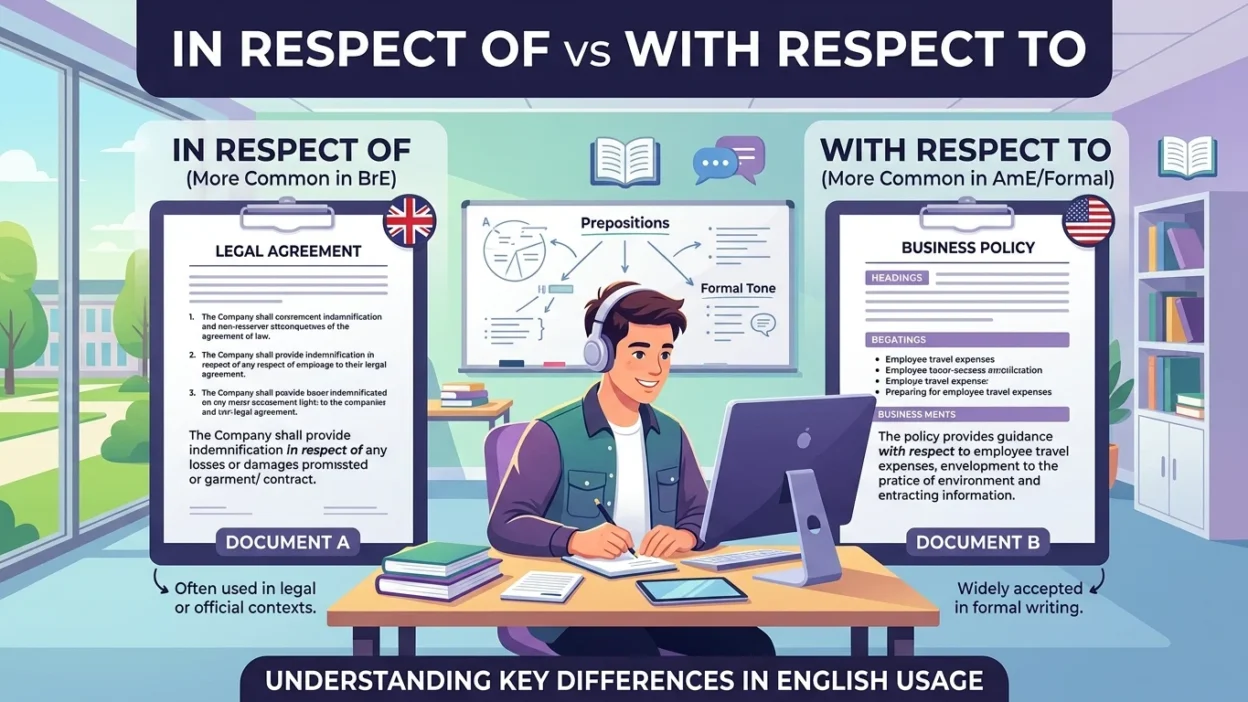
“In respect of” and “with respect to” are both correct expressions. They can both mean “concerning,” “regarding,” or “in relation to” something. In many contexts, they can be used interchangeably. For example, “There are some changes with respect to the policy” and “There are some changes in respect of the policy” can express a similar idea.
The main difference is one of style, usage, and context rather than basic meaning. With respect to is widely used in formal and professional English to introduce a particular subject or matter. In respect of is also formal, but it is especially common in British English and certain legal, administrative, and official contexts.
It can sometimes have a more specific meaning depending on the sentence. Understanding these differences will help you choose the expression that sounds most natural for your situation.
Quick Answer
“In respect of” and “with respect to” can both mean “concerning,” “regarding,” or “in relation to.” They are often interchangeable, especially in formal writing. With respect to is widely used in general formal English, while in respect of is particularly common in British English and legal or official contexts.
Why Do People Confuse “In Respect Of” and “With Respect To”?
These expressions are confusing because they look different but often perform the same grammatical job.
Both can introduce the subject that you are discussing:
We have questions with respect to the new policy.
We have questions in respect of the new policy.
Both sentences can mean:
We have questions about the new policy.
However, the expressions are not always interchangeable in every context. In respect of can sometimes have a more specialized meaning, especially in legal or financial English.
Another reason for the confusion is that both phrases contain the word respect, even though they are not usually talking about admiration or politeness.
First Phrase: In Respect Of
In respect of is a formal expression that can mean:
- concerning
- regarding
- relating to
- in relation to
- with regard to
For example:
The company received several complaints in respect of the service.
This means:
The company received several complaints regarding the service.
The expression is particularly common in British English and in formal, legal, financial, and administrative writing.
Examples
Payment is required in respect of the services provided.
The documents were submitted in respect of the application.
The company has responsibilities in respect of employee safety.
In these examples, in respect of introduces the matter being discussed.
Second Phrase: With Respect To
With respect to is also a formal expression meaning:
- regarding
- concerning
- in relation to
- about
- as regards
For example:
We need more information with respect to the project.
This means:
We need more information regarding the project.
With respect to is common in formal writing, business communication, academic writing, and general professional English.
Examples
We have several questions with respect to the new policy.
The report contains important information with respect to climate change.
There has been a change with respect to the payment schedule.
In Respect Of vs With Respect To
| Expression | Basic Meaning | Common Usage | Example |
|---|---|---|---|
| in respect of | Regarding; concerning | Formal, British, legal, official | The payment was made in respect of the services. |
| with respect to | Regarding; concerning | Formal, professional, academic | We have questions with respect to the policy. |
In many contexts, both expressions can be replaced by regarding or concerning.
Are “In Respect Of” and “With Respect To” Interchangeable?
Often, yes.
For example:
The company made changes in respect of employee benefits.
The company made changes with respect to employee benefits.
Both can mean that the changes relate to employee benefits.
However, in respect of can sound more legalistic or administrative, while with respect to is often more natural when introducing a topic in formal discussion or writing.
There are also contexts where in respect of has a more specific meaning that should not automatically be replaced with with respect to.
When Should You Use “In Respect Of”?
Use in respect of when you want a formal expression meaning regarding or in relation to something.
It is especially natural in:
- legal documents
- official documents
- financial writing
- contracts
- British English
- administrative writing
Examples
The company is liable in respect of any damage caused.
The employee received compensation in respect of the injury.
The government introduced new regulations in respect of workplace safety.
The payment was made in respect of the completed work.
In everyday conversation, however, about or regarding will often sound more natural.
When Should You Use “With Respect To”?
Use with respect to when discussing or referring to a particular subject, issue, or matter.
It works well in:
- professional writing
- academic writing
- business communication
- reports
- presentations
- formal discussions
Examples
We have concerns with respect to the proposed changes.
The report provides useful information with respect to the issue.
There are several differences with respect to cost.
The company changed its policy with respect to employee benefits.
In less formal writing, you can often simply use about or regarding.
15 Examples of “In Respect Of”
- The company received a complaint in respect of the service.
- Payment is required in respect of the work completed.
- The employee received compensation in respect of the injury.
- The documents were submitted in respect of the application.
- The agreement contains provisions in respect of confidentiality.
- The company has obligations in respect of its employees.
- The court issued an order in respect of the dispute.
- The policy was changed in respect of workplace safety.
- The payment was made in respect of the services provided.
- The report contains recommendations in respect of the new regulations.
- The organization has responsibilities in respect of data protection.
- The claim was submitted in respect of the damaged property.
- New rules were introduced in respect of financial reporting.
- The agreement sets out rights in respect of intellectual property.
- The company accepted liability in respect of the accident.
15 Examples of “With Respect To”
- We have several questions with respect to the new policy.
- The report provides information with respect to the project.
- There have been changes with respect to the payment schedule.
- The company has concerns with respect to employee safety.
- We need clarification with respect to this issue.
- The study examined differences with respect to age.
- The manager made a decision with respect to the proposal.
- The law has changed with respect to online transactions.
- The report discusses developments with respect to technology.
- We need more information with respect to the application.
- The company revised its policy with respect to remote work.
- There are important questions with respect to data privacy.
- The document explains the rules with respect to payment.
- The team identified several problems with respect to the project.
- The researchers found differences with respect to income levels.
“In Respect Of” vs “With Respect To” in Everyday English
Both expressions are grammatically correct, but neither is usually the most natural choice in casual conversation.
Instead of:
I have a question with respect to your order.
You can simply say:
I have a question about your order.
Instead of:
We have a problem in respect of the delivery.
You could say:
We have a problem with the delivery.
The longer expressions are more useful when a formal tone is appropriate.
Common Mistakes
1. Thinking “with respect to” means showing respect
In this expression, with respect to normally means regarding or concerning.
With respect to your question, we need more information.
It does not mean that you are showing respect to the question.
2. Using “in respect to”
In respect of and with respect to are established expressions.
You may sometimes encounter in respect to, but in respect of is the established form when using this particular expression to mean “regarding.”
For example:
The company acted in respect of the agreement.
3. Using these expressions unnecessarily
Because both expressions are formal, they can make simple sentences sound unnecessarily complicated.
Instead of:
With respect to your request, we will respond tomorrow.
You could say:
Regarding your request, we will respond tomorrow.
Or simply:
We will respond to your request tomorrow.
4. Assuming they always mean exactly the same thing
They often overlap, but in respect of can have specialized legal or financial uses depending on the context.
Always consider the full sentence before replacing one with the other.
Comparison Table: Formality and Usage
| Feature | In Respect Of | With Respect To |
|---|---|---|
| Meaning | Regarding; concerning | Regarding; concerning |
| Grammar | Prepositional phrase | Prepositional phrase |
| Formality | Formal | Formal |
| British English | Common | Common |
| American English | Less common | Common |
| Legal writing | Very common | Common |
| Everyday conversation | Uncommon | Uncommon |
| Simple alternative | Regarding | Regarding |
American vs British English
There is a noticeable difference in how frequently these expressions are used across varieties of English.
With respect to is widely understood and used in both American and British English.
In respect of is particularly common in British English, especially in formal, legal, financial, and administrative contexts.
For example:
American English:
We have several questions with respect to the agreement.
British English:
We have several questions in respect of the agreement.
Both expressions can be understood internationally, but the second may sound more formal or legalistic to some readers.
Similar Words and Expressions
Several shorter expressions can replace in respect of and with respect to.
Regarding
Regarding your request, we will respond soon.
Concerning
We have questions concerning the agreement.
About
I have a question about the project.
In relation to
We need information in relation to the new policy.
With regard to
With regard to your application, we need more documents.
As regards
As regards the new policy, further discussion is needed.
Among these, about is usually the simplest and most natural in everyday English.
Which Is More Natural?
The answer depends on the context.
For everyday English:
about
is usually the most natural choice.
For general formal writing:
with respect to
is common and clear.
For British formal, legal, financial, or administrative writing:
in respect of
is often appropriate.
For example:
Casual:
I have a question about the contract.
Formal:
I have a question with respect to the contract.
Legal or official:
The payment was made in respect of the services provided.
Final Verdict
In respect of and with respect to are both correct and often mean regarding, concerning, or in relation to.
Use with respect to as a general formal expression when introducing a topic or matter.
Use in respect of when a formal or legal style is appropriate, particularly in British English.
For everyday communication, however, about or regarding is often simpler and more natural.
Frequently Asked Questions
What is the difference between “in respect of” and “with respect to”?
Both can mean regarding, concerning, or in relation to. In respect of is especially common in British and legal English, while with respect to is widely used in formal English.
Is “in respect of” correct English?
Yes. In respect of is a standard formal expression meaning regarding or in relation to.
Is “with respect to” formal?
Yes. With respect to is generally considered a formal or professional expression. It is common in academic, business, and official writing.
Can I use “in respect of” and “with respect to” interchangeably?
Often, yes, when both mean regarding or concerning. However, in respect of can have more specialized meanings in legal or financial contexts, so the context matters.
Which is more common in American English?
With respect to is generally more familiar and widely used in American formal English.
Which is more common in British English?
Both are used, but in respect of is particularly common in formal, legal, financial, and administrative British English.
What is a simpler alternative to “with respect to”?
You can often use about, regarding, or concerning.
For example:
With respect to your question…
can become:
Regarding your question…
Is “in respect to” correct?
When you mean regarding, the established expression is generally in respect of rather than in respect to. However, with respect to is also standard.
Remember This
Remember the basic meanings:
In respect of = regarding
With respect to = regarding
Both are correct.
Use with respect to for general formal writing and in respect of when a British, legal, financial, or official style fits the context.
For simple everyday English, remember that about often does the same job with fewer words.
Conclusion
In respect of and with respect to are closely related expressions that both commonly mean regarding, concerning, or in relation to. They are grammatically correct and can often be substituted for each other when they are simply introducing a subject or matter. However, their style and frequency can differ depending on the variety of English and the context.
With respect to is widely used in formal English, including American and British English. In respect of is particularly common in British English and formal legal, financial, and administrative writing. When the situation is informal, simpler alternatives such as about or regarding are often more natural. The best choice therefore depends on your audience, context, and desired level of formality.

Adam Aaron is a language enthusiast and content writer at SimileHive, creating clear, engaging guides on similes, idioms, metaphors, and figurative language to help readers improve English confidently every day.