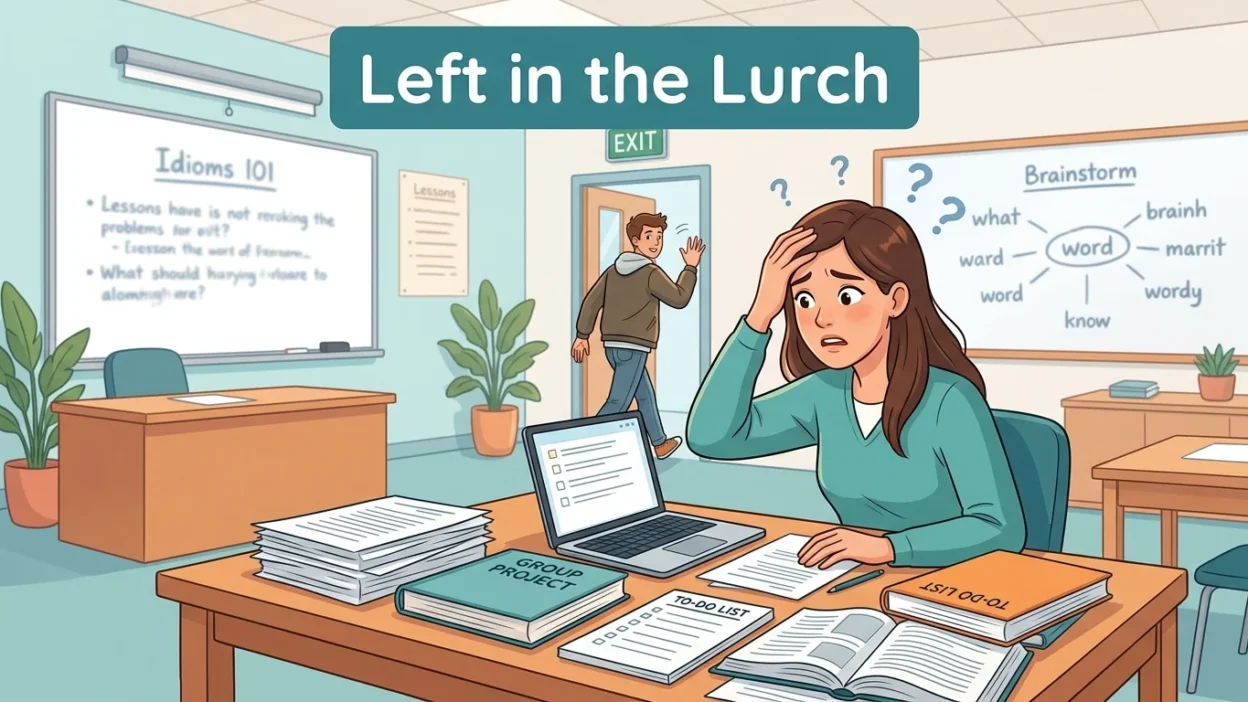
“Left in the lurch” means to be abandoned or left in a difficult situation without the help, support, or assistance you expected. The expression is an idiom often used when someone suddenly stops helping you, fails to keep a promise, or leaves you to deal with a problem alone.
For example, “My coworker quit without warning and left me in the lurch” means the coworker left the speaker with a difficult situation to handle alone.
The phrase is commonly used in everyday English, especially when someone feels let down at an important moment. You might be left in the lurch when a friend cancels at the last minute, a business partner fails to do their part, or someone who promised to help suddenly disappears.
The expression does not mean that someone is literally left in a physical place called “the lurch.” It describes being caught in a difficult or uncertain situation without the support you need.
Quick Answer
“Left in the lurch” means abandoned or left in a difficult situation without the help you expected. It is often used when someone fails to support you at an important moment. For example, “She left me in the lurch” means she left me to deal with a problem by myself.
Why Do People Say “Left in the Lurch”?
“Left in the lurch” is an idiom, so its meaning is not completely literal.
The word lurch can mean a sudden movement or an unstable position. In the idiom, however, the lurch refers figuratively to a difficult, uncertain, or uncomfortable situation.
When someone is left in the lurch, they are suddenly without the support they were relying on.
For example:
My business partner quit without notice and left me in the lurch.
This means the speaker expected the business partner to remain and help, but instead had to deal with the consequences alone.
What Does “Left in the Lurch” Mean?
Left in the lurch means:
- abandoned in a difficult situation
- left without help
- left without support
- left to deal with a problem alone
- let down at an important moment
- left in a difficult or uncertain position
The expression often suggests that the person who was expected to help failed to do so.
For example:
My friend promised to drive me home but never came. She left me in the lurch.
The speaker was depending on the friend but was unexpectedly left without assistance.
Where Does “Left in the Lurch” Come From?
The origin of “left in the lurch” is not completely certain. The word lurch has been used in English in several senses over time, including ideas related to sudden movement, imbalance, and an awkward or difficult position.
The idiom became established in English with the figurative meaning of being left in a difficult situation without help or support.
Today, the expression is widely understood without requiring knowledge of its historical origin.
How Do You Use “Left in the Lurch”?
The most common structure is:
leave + someone + in the lurch
or:
be left in the lurch
Examples:
- He left me in the lurch.
- She left us in the lurch.
- They left their employees in the lurch.
- I was left in the lurch.
- We were left in the lurch.
The phrase can be used with different pronouns:
| Person | Example |
|---|---|
| I | I was left in the lurch. |
| You | You were left in the lurch. |
| He | He was left in the lurch. |
| She | She was left in the lurch. |
| We | We were left in the lurch. |
| They | They were left in the lurch. |
“Left in the Lurch” vs “Leave in the Lurch”
The two forms are related but have different grammatical uses.
Leave someone in the lurch
This describes the action of abandoning someone in a difficult situation.
Don’t leave me in the lurch.
Left in the lurch
This describes the person who experienced the abandonment.
I was left in the lurch.
For example:
My colleague left me in the lurch.
The colleague performed the action.
I was left in the lurch.
The speaker experienced the situation.
15 Examples of “Left in the Lurch”
- My coworker quit without notice and left me in the lurch.
- She canceled at the last minute and left us in the lurch.
- His business partner disappeared and left him in the lurch.
- The contractor failed to finish the work and left the homeowners in the lurch.
- My friend promised to help but left me in the lurch.
- The manager resigned suddenly and left the team in the lurch.
- They canceled the event and left everyone in the lurch.
- The driver never arrived, leaving us in the lurch.
- He stopped answering my calls and left me in the lurch.
- The company closed unexpectedly and left its employees in the lurch.
- Our supplier failed to deliver the materials and left us in the lurch.
- She backed out of the project and left her teammates in the lurch.
- The babysitter canceled just before dinner and left the parents in the lurch.
- He promised to handle the paperwork but left me in the lurch.
- The team captain got injured before the game and left the team in the lurch.
Examples With “Left in the Lurch” in Everyday Situations
At work
My colleague didn’t show up for the presentation, so I was left in the lurch.
The speaker had to handle the presentation without the expected help.
In a friendship
My friend promised to pick me up but never came, leaving me in the lurch.
The friend failed to provide the promised assistance.
In business
Our supplier canceled the order at the last minute and left us in the lurch.
The business was suddenly placed in a difficult situation.
In a project
The designer left the project halfway through and left the rest of us in the lurch.
The remaining team members had to deal with the unfinished work.
“Left in the Lurch” vs “Left High and Dry”
These idioms are very similar.
Left in the lurch means someone is left in a difficult situation without expected help.
My partner quit and left me in the lurch.
Left high and dry means someone is abandoned without help or resources, often in a particularly difficult situation.
The company closed and left its workers high and dry.
Both expressions can describe abandonment, but left in the lurch often emphasizes being left to deal with a problem or responsibility.
“Left in the Lurch” vs “Abandoned”
Abandoned is a direct and general word.
He abandoned his team.
Left in the lurch is more idiomatic and emphasizes the difficult situation created by the person’s departure or failure to help.
He left his team in the lurch.
The second sentence suggests that the team was left with a problem to handle.
Common Mistakes
1. Saying “left on the lurch”
❌ He left me on the lurch.
✅ He left me in the lurch.
The correct preposition is in.
2. Saying “left at the lurch”
❌ She left us at the lurch.
✅ She left us in the lurch.
3. Taking the phrase literally
Lurch does not refer to a specific physical place in this expression.
He left me in the lurch.
means:
He left me in a difficult situation without help.
4. Using it for every kind of departure
Simply leaving someone does not necessarily mean leaving them in the lurch.
The expression usually suggests that the person was depending on help or support and was placed in difficulty when that support disappeared.
Is “Left in the Lurch” Formal or Informal?
“Left in the lurch” is a common idiomatic expression that works well in everyday conversation and general writing.
It can also appear in professional writing when the tone is not highly formal.
For very formal writing, you may prefer:
- left without support
- left without assistance
- placed in a difficult position
- left without the expected help
- abandoned without adequate support
For example:
Informal:
The supplier left us in the lurch.
More formal:
The supplier’s failure to deliver left us without the support we had expected.
Similar Expressions
Here are some expressions with related meanings:
Left high and dry
Abandoned without help or resources.
Left out in the cold
Excluded or ignored.
Hung out to dry
Left to face criticism, blame, or consequences alone.
Let someone down
Fail to do something someone was depending on.
Leave someone stranded
Leave someone without a way to continue or get somewhere.
Leave someone in a difficult position
A more direct and formal expression.
These expressions overlap, but their meanings are not always exactly the same.
Memory Trick
Think:
Left in the lurch = left with a problem and no help.
Imagine someone expecting a friend, coworker, or partner to help with an important task. That person suddenly disappears, and now you have to handle everything alone.
You have been:
left in the lurch
A simple memory sentence is:
Someone leaves, and you are left with the problem.
Final Verdict
“Left in the lurch” means being abandoned or left in a difficult situation without the help or support you expected.
For example:
My coworker quit without warning and left me in the lurch.
This means the coworker left unexpectedly, and the speaker was left to deal with the resulting problem alone.
The expression is usually used when someone had a reasonable expectation of help, support, or cooperation.
Frequently Asked Questions
What does “left in the lurch” mean?
Left in the lurch means being abandoned or left in a difficult situation without the help or support you expected.
What is an example of “left in the lurch”?
My colleague didn’t come to work and left me in the lurch.
This means the colleague’s absence left the speaker with a difficult situation to handle alone.
Is “left in the lurch” an idiom?
Yes. Left in the lurch is an English idiom meaning to be left without expected help or support in a difficult situation.
What does “leave someone in the lurch” mean?
It means to abandon someone when they need or expect your help, leaving them to deal with a difficult situation alone.
What is another way to say “left in the lurch”?
Depending on the context, you can say left without help, abandoned, let down, left high and dry, or left in a difficult position.
Is “left in the lurch” formal?
It is a common idiom and is suitable for everyday conversation and many forms of general writing. More formal writing may use a direct phrase such as left without support.
Can I say “I was left in the lurch”?
Yes. This is a natural and common way to use the expression.
I was left in the lurch when my coworker suddenly quit.
What is the difference between “left in the lurch” and “left high and dry”?
Both can mean being abandoned without help. Left in the lurch often emphasizes being left with a difficult problem or responsibility, while left high and dry emphasizes being abandoned without the resources or assistance needed.
Remember This
Left in the lurch = left in a difficult situation without help.
If someone was supposed to help you but suddenly failed to do so, you can say:
They left me in the lurch.
The key idea is unexpectedly being left to deal with a problem alone.
Conclusion
The idiom “left in the lurch” describes a situation where someone is abandoned or left without the help they were expecting. It is often used when a friend, coworker, partner, company, or other person suddenly fails to provide promised support, leaving someone with a difficult problem to handle.
The expression is useful in both everyday conversations and general writing. If you remember “left in the lurch = left with a problem and no help,” you can easily understand and use the idiom. For example, if a coworker suddenly quits before an important project is finished, you might say that they left you in the lurch.

Charles Kevin is a passionate language writer and researcher at SimileHive, creating clear, engaging content about similes, idioms, metaphors, and figurative language to help readers improve English communication confidently every day.