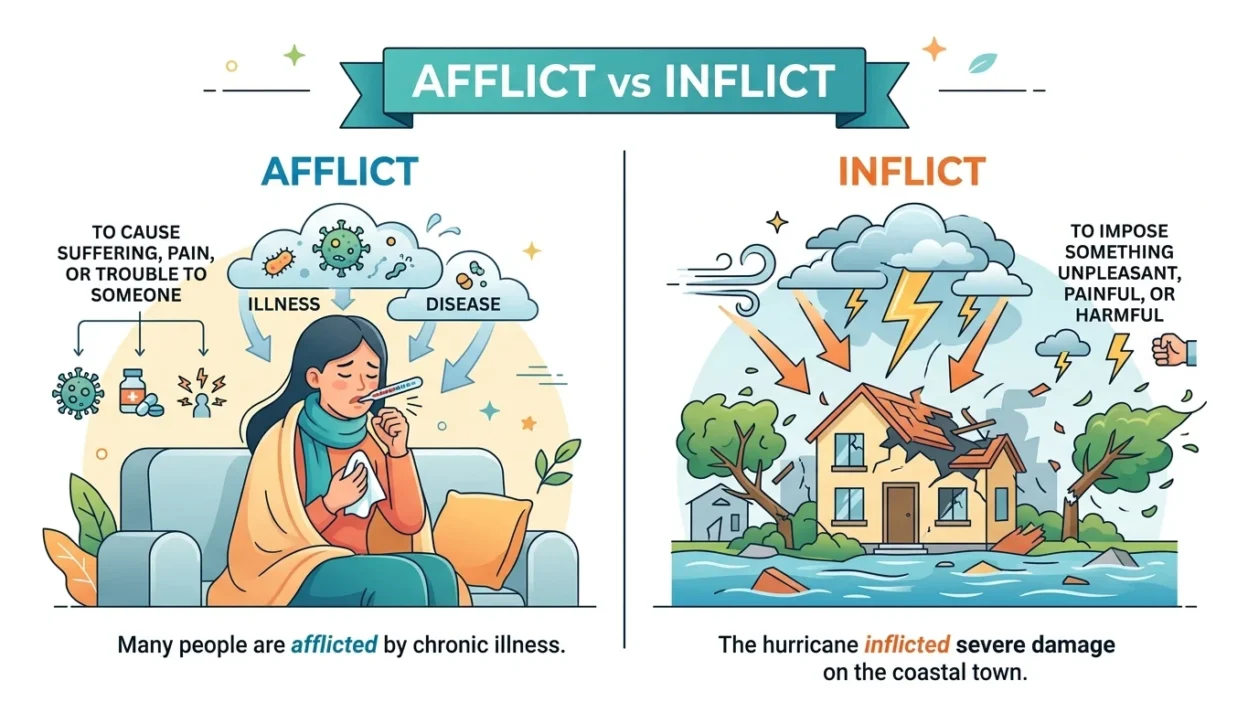
Afflict and inflict are often confused because they sound similar and both relate to suffering, pain, or something unpleasant. However, they are used differently. Afflict usually means to cause someone or something to suffer from a problem, illness, or difficult condition. Inflict means to deliberately or directly cause pain, damage, punishment, or harm to someone or something.
The easiest way to remember the difference is to look at what comes after each verb. We commonly say that a person or condition afflicts someone or something: “The disease afflicted thousands of people.” With inflict, someone or something causes harm: “The injury inflicted severe pain.” Understanding who or what causes the suffering and who experiences it will help you choose the correct word.
Quick Answer
Afflict means to cause someone or something to suffer from a serious problem, illness, or difficult condition. Inflict means to cause pain, damage, punishment, or harm, often deliberately. For example, “The disease afflicted him” means he suffered from the disease, while “The attack inflicted serious damage” means the attack caused the damage.
Why Do People Confuse “Afflict” and “Inflict”?
The two words look and sound similar:
- afflict
- inflict
Both are verbs connected with something unpleasant, which makes them easy to mix up.
However, they focus on different relationships.
With afflict, the emphasis is usually on the person, group, or thing experiencing a problem.
The disease afflicted many people.
With inflict, the emphasis is on the harm, pain, damage, or punishment being caused.
The disease inflicted serious damage on the community.
A useful way to think about them is:
Afflict → someone suffers from something.
Inflict → someone or something causes harm to someone or something.
First Word: Afflict
Afflict means to cause suffering, distress, or serious problems to someone or something.
It is commonly used with:
- diseases
- illnesses
- poverty
- problems
- disasters
- hardships
- suffering
- emotional difficulties
Examples
The disease afflicted thousands of people.
Poverty afflicts many communities.
He was afflicted by a serious illness.
The person or group affected by the problem is the focus.
Common Pattern
Something + afflicts + person/group
For example:
The disease afflicted the population.
Here:
- The disease = source of suffering
- the population = people experiencing the suffering
Second Word: Inflict
Inflict means to cause something unpleasant, such as pain, injury, damage, suffering, or punishment.
It often suggests that someone or something causes the unpleasant result.
Examples
The accident inflicted serious injuries.
The army inflicted heavy losses on its opponent.
The punishment inflicted considerable suffering.
The focus is on the harm or damage that is being caused.
Common Pattern
Someone or something + inflicts + harm/damage/pain + on someone or something
For example:
The attack inflicted severe damage on the building.
Here:
- The attack = cause
- severe damage = harm caused
- the building = thing affected
Afflict vs Inflict: The Key Difference
| Word | Basic Meaning | Common Focus | Example |
|---|---|---|---|
| afflict | Cause suffering or problems | The person or thing suffering | The disease afflicted many people. |
| inflict | Cause pain, harm, damage, or punishment | The harm being caused | The attack inflicted serious damage. |
The simplest distinction is:
Afflict someone with a problem.
Inflict something harmful on someone.
When Should You Use “Afflict”?
Use afflict when talking about a problem, disease, condition, or hardship that affects and causes suffering to someone or something.
Common collocations with “afflict”
- afflict people
- afflict a community
- afflict a country
- afflict a population
- afflict someone with an illness
- afflict a person with pain
- afflict a region with problems
Examples
The disease afflicted the entire village.
The region was afflicted by drought.
He was afflicted with a rare condition.
Poverty continues to afflict many families.
When Should You Use “Inflict”?
Use inflict when someone or something causes pain, injury, damage, punishment, or suffering.
Common collocations with “inflict”
- inflict damage
- inflict pain
- inflict injury
- inflict harm
- inflict punishment
- inflict suffering
- inflict losses
- inflict a wound
Examples
The storm inflicted serious damage on the town.
The accident inflicted severe injuries.
The attacker inflicted pain on his victim.
The team inflicted a heavy defeat on its opponent.
15 Examples of “Afflict”
- The disease afflicted thousands of people.
- Poverty continues to afflict many families.
- The region was afflicted by a severe drought.
- The illness afflicted him for many years.
- The problem afflicts communities around the world.
- Several villages were afflicted by flooding.
- The condition afflicts both children and adults.
- The country was afflicted by a long period of economic hardship.
- The disease has afflicted the population for decades.
- Many people are afflicted with chronic pain.
- The community was afflicted by food shortages.
- Fear continued to afflict the residents.
- The disease afflicted people of all ages.
- The region has been afflicted by repeated storms.
- His family was afflicted by financial difficulties.
15 Examples of “Inflict”
- The storm inflicted serious damage on the town.
- The accident inflicted severe injuries.
- The attack inflicted heavy losses.
- The fire inflicted extensive damage on the building.
- The injury inflicted considerable pain.
- The punishment was designed to inflict suffering.
- The hurricane inflicted millions of dollars in damage.
- The accident inflicted permanent injuries on several people.
- The fighting inflicted enormous damage on the city.
- The weapon was capable of inflicting serious injuries.
- The attack inflicted heavy casualties.
- The storm inflicted widespread damage.
- The blow inflicted a painful wound.
- The conflict inflicted significant losses on both sides.
- The disease can inflict serious complications in severe cases.
Afflict vs Inflict in Passive Sentences
Both words can appear in passive constructions, which can sometimes make the distinction harder to see.
Afflicted
He was afflicted with a serious illness.
Here, he is experiencing the condition.
Inflicted
He was inflicted with a serious illness.
This is generally not the natural construction. Instead, you would normally say:
He was afflicted with a serious illness.
Or:
The illness inflicted serious suffering on him.
This difference is important because afflicted with is a common expression, while inflicted with is generally not the normal choice when describing someone who has a disease or condition.
Common Mistakes
1. Using “inflict” for a disease that affects someone
❌ He was inflicted with a disease.
✅ He was afflicted with a disease.
A disease afflicts a person.
2. Using “afflict” with damage
❌ The storm afflicted serious damage on the city.
✅ The storm inflicted serious damage on the city.
Damage is something that can be inflicted.
3. Confusing “afflicted with” and “inflicted with”
Use:
✅ afflicted with an illness
Not normally:
❌ inflicted with an illness
For example:
She was afflicted with a serious illness.
4. Forgetting the object of “inflict”
Inflict commonly takes the harm itself as its direct object:
The storm inflicted damage.
The attack inflicted injuries.
The injury inflicted pain.
Memory Trick
Use this simple rule:
Afflict = affect with suffering
Inflict = impose harm
Think:
A disease afflicts a person.
An attack inflicts damage.
Another useful memory trick is:
Afflict → Affected person
Inflict → Impose harm
This is not a grammatical rule, but it can help you remember the difference.
Afflict vs Inflict vs Affect
There is another word that is often confused with afflict and inflict: affect.
Affect
Usually means to influence or have an effect on someone or something.
The weather affected our plans.
Afflict
Means to cause suffering or serious problems.
The disease afflicted the population.
Inflict
Means to cause pain, harm, damage, or punishment.
The storm inflicted serious damage.
| Word | Main Meaning | Example |
|---|---|---|
| affect | Influence | The news affected her mood. |
| afflict | Cause suffering | The disease afflicted him. |
| inflict | Cause harm or damage | The accident inflicted serious injuries. |
American vs British English
Afflict and inflict have essentially the same meanings in American and British English.
There is no major regional spelling difference that changes how these verbs are normally used.
For example, both varieties can use:
The disease afflicted thousands of people.
And:
The storm inflicted serious damage.
The important issue is choosing the correct verb based on meaning, not choosing between American and British spelling.
Similar Words
Afflict
Similar words include:
- trouble
- burden
- distress
- plague
- torment
- affect
The exact synonym depends on the context.
Inflict
Similar words include:
- cause
- impose
- deliver
- administer
- deal
- subject
Again, the best alternative depends on what is being caused.
For example:
The disease afflicted the population.
Could become:
The disease affected the population.
But:
The attack inflicted serious damage.
Could become:
The attack caused serious damage.
Final Verdict
Afflict and inflict are both related to suffering and harm, but they are not interchangeable.
Use afflict when a person, group, or thing is suffering from a problem, disease, hardship, or difficult condition.
The disease afflicted many people.
Use inflict when someone or something causes pain, damage, injury, punishment, or suffering.
The storm inflicted serious damage.
The easiest rule to remember is:
Afflict someone with a problem.
Inflict something harmful on someone.
Frequently Asked Questions
What is the difference between afflict and inflict?
Afflict means to cause suffering or problems to someone or something. Inflict means to cause pain, harm, damage, injury, or punishment.
Is it “afflicted with” or “inflicted with” a disease?
The normal expression is afflicted with a disease.
He was afflicted with a serious illness.
Is it “inflict damage” or “afflict damage”?
The correct expression is inflict damage.
The storm inflicted serious damage on the building.
Can a disease inflict pain?
Yes. Inflict can describe something causing pain or harm.
The disease inflicted considerable pain on the patient.
However, when simply describing the condition affecting someone, afflict is also natural:
The disease afflicted many people.
What is an easy way to remember afflict and inflict?
Remember:
Afflict = affect with suffering.
Inflict = impose harm.
Is “afflict” a synonym for “affect”?
They can overlap in some contexts, but they are not identical. Affect usually means to influence, while afflict specifically suggests causing suffering or serious problems.
Can you inflict suffering?
Yes.
The conflict inflicted great suffering on the population.
Is “inflicted with” correct?
Inflicted with is generally not the normal expression when talking about having a disease or condition. Use afflicted with instead.
Remember This
Afflict = cause suffering or problems.
Inflict = cause harm, pain, damage, or punishment.
Think of these two examples:
The disease afflicted the community.
The storm inflicted serious damage.
If you are talking about the person or group suffering, think afflict.
If you are talking about the harm being caused, think inflict.
Conclusion
The difference between afflict and inflict becomes much easier once you focus on what each verb describes. Afflict is commonly used for diseases, hardships, conditions, and problems that cause suffering to a person, group, or place. Inflict is used when pain, damage, injury, punishment, or other harm is caused.
A quick way to remember the distinction is to associate afflict with the person or group experiencing a problem and inflict with the harm being imposed. For example, “The disease afflicted thousands of people” focuses on those suffering from the disease, while “The storm inflicted serious damage” focuses on the damage caused by the storm.

Adam Aaron is a language enthusiast and content writer at SimileHive, creating clear, engaging guides on similes, idioms, metaphors, and figurative language to help readers improve English confidently every day.