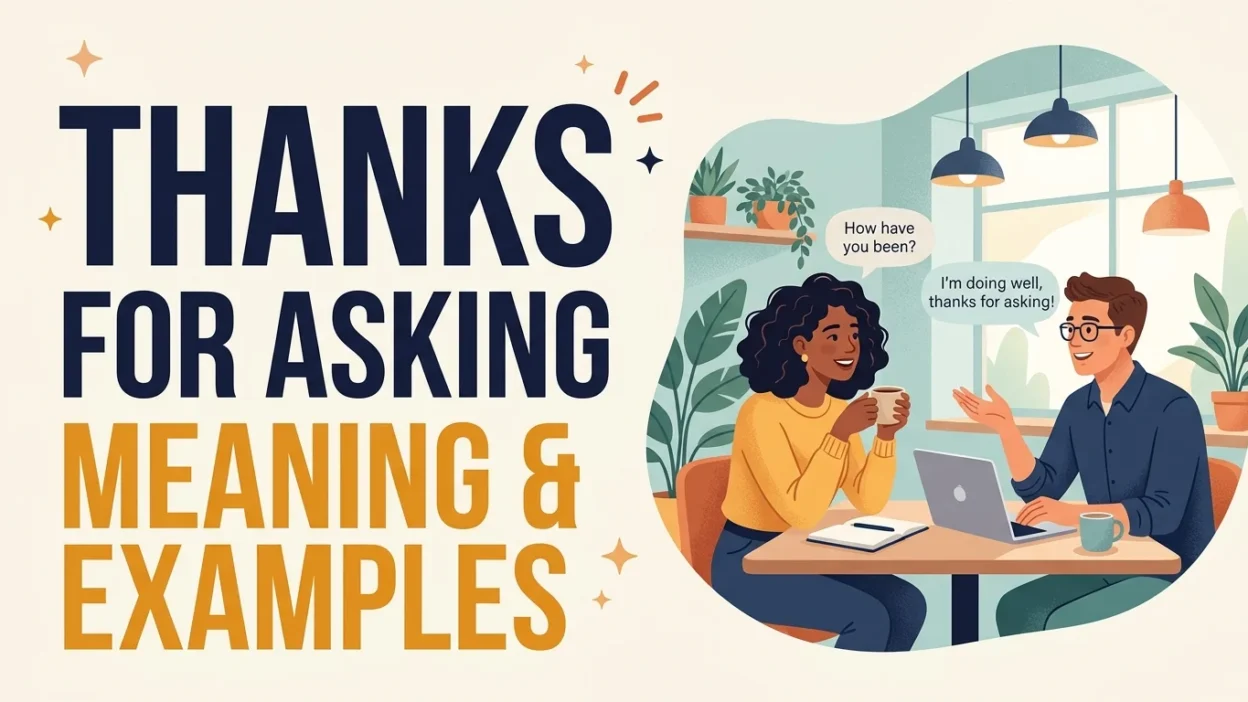
“Thanks for asking” is a polite and friendly expression used to show appreciation when someone asks you a question, checks on you, or shows interest in your life, feelings, or situation. It can be used in everyday conversations, professional emails, text messages, and social interactions. For example, if someone asks, “How are you feeling today?” you can reply, “Thanks for asking. I’m feeling much better.”
The phrase can express genuine gratitude, warmth, or simple politeness, depending on the situation and tone of voice. Sometimes, it is followed by an answer, such as “Thanks for asking. Everything is going well.” In other cases, it can introduce personal information or help keep a conversation going. Understanding when and how to use “thanks for asking” will help you sound natural and courteous in English. This guide explains its meaning, common uses, example sentences, suitable replies, and differences from similar expressions.
Quick Answer: What Does “Thanks for Asking” Mean?
“Thanks for asking” means “I appreciate that you asked me.” It is a polite expression used when someone shows interest in your well-being, opinions, experiences, or circumstances. It is often followed by an answer to the person’s question, such as “Thanks for asking. I’m doing well.”
What Does “Thanks for Asking” Mean?
The phrase “thanks for asking” expresses appreciation for someone’s question or concern. It acknowledges that the person took the time to ask about something that matters to you.
The exact meaning depends on the context.
1. Showing appreciation
When someone asks about your day, health, or family, the phrase shows that you appreciate their interest.
Example: “Thanks for asking. My family is doing well.”
2. Acknowledging someone’s concern
If someone checks on you during a difficult time, the phrase can express gratitude for their kindness.
Example: “Thanks for asking. I’m slowly feeling better.”
3. Responding politely to a question
You can also use it in ordinary conversations when someone asks about your preferences, plans, or opinions.
Example: “Thanks for asking. I’d prefer to meet on Friday.”
4. Expressing sarcasm in certain contexts
Depending on the tone, “thanks for asking” can sometimes sound sarcastic, especially if someone feels ignored or believes the other person should have asked earlier.
Example: “I’m exhausted, thanks for asking.”
In this situation, the speaker may be implying that the other person has not shown enough concern. However, the phrase is usually friendly when said sincerely.
How to Use “Thanks for Asking” in a Sentence
The expression is commonly used at the beginning of a response. It can stand alone, but it often sounds more natural when followed by an answer.
Examples:
- “Thanks for asking. I’m doing great.”
- “Thanks for asking about my health.”
- “Thanks for asking. I’ll be happy to help.”
- “Thanks for asking how my interview went.”
- “Thanks for asking. I haven’t made a decision yet.”
You can also use the slightly more formal version, “Thank you for asking.”
15 Examples of “Thanks for Asking” in Sentences
- “Thanks for asking. I’m feeling much better today.”
- “Thanks for asking about my family.”
- “Thanks for asking. Everything is going well at work.”
- “Thanks for asking how I spent my weekend.”
- “Thanks for asking. I would love to join you.”
- “Thanks for asking about my opinion on the project.”
- “Thanks for asking. The exam went better than I expected.”
- “Thanks for asking how my mother is doing.”
- “Thanks for asking. I’m still considering my options.”
- “Thanks for asking about the meeting.”
- “Thanks for asking. I haven’t received the results yet.”
- “Thanks for asking how I feel about the decision.”
- “Thanks for asking. I really appreciate your concern.”
- “Thanks for asking about my new job.”
- “Thanks for asking. I hope things are going well for you, too.”
“Thanks for Asking” vs. “Thank You for Asking”
Both expressions are correct and have the same basic meaning. The main difference is tone.
| Expression | Meaning and tone | Best use |
|---|---|---|
| Thanks for asking | Friendly and conversational | Everyday conversations, texts, and casual emails |
| Thank you for asking | Slightly more formal or deliberate | Professional conversations, formal emails, and polite replies |
Examples:
- Casual: “Thanks for asking. I’m doing well.”
- More formal: “Thank you for asking about my progress. I appreciate your interest.”
Neither expression is automatically more sincere than the other. The situation and your tone help communicate how much appreciation you feel.
“Thanks for Asking” vs. “Thanks for Checking In”
These expressions are similar, but they are not always interchangeable.
| Expression | Meaning |
|---|---|
| Thanks for asking | Appreciates a question someone asked |
| Thanks for checking in | Appreciates someone contacting you to see how you are doing |
| Thanks for your concern | Appreciates someone’s worry or care about your situation |
| Thanks for asking about me | Specifically appreciates someone’s interest in you |
For example, if a friend messages you after you have been sick, you might say, “Thanks for checking in. I’m feeling better now.”
If someone asks how you are doing during a conversation, “Thanks for asking” is a natural response.
How to Reply to “Thanks for Asking”
If someone says “thanks for asking” to you, the best response depends on the conversation.
Here are some natural replies:
- “Of course!”
- “You’re welcome.”
- “Anytime!”
- “I’m glad I asked.”
- “No problem. I hope everything goes well.”
- “Of course. I wanted to make sure you’re okay.”
- “You’re welcome. Let me know if you need anything.”
In casual conversations, “Of course!” and “Anytime!” sound warm and natural. In a professional setting, “You’re welcome” or “I’m glad to hear that” may be more suitable, depending on what the person said afterward.
Common Mistakes to Avoid
1. Confusing “thanks for asking” with “thanks for telling me”
“Thanks for asking” appreciates a question. “Thanks for telling me” appreciates information someone shared.
2. Using the phrase without answering the question
You can say “Thanks for asking” by itself, but if someone asks how you are, adding a short answer usually makes the conversation flow better.
Better: “Thanks for asking. I’m doing well.”
3. Assuming it always sounds sincere
The phrase can sound sarcastic when delivered with an irritated tone. Consider your wording and tone when using it.
4. Forgetting the word “for”
The standard expression is “Thanks for asking,” not “Thanks asking.”
Is “Thanks for Asking” Grammatically Correct?
Yes. “Thanks for asking” is grammatically correct and widely used in spoken and written English.
Here, “thanks” expresses gratitude, while “for asking” explains what the gratitude is for. The word “asking” is a gerund, meaning a verb form ending in -ing that functions like a noun.
Other expressions with the same structure include:
- Thanks for helping.
- Thanks for calling.
- Thanks for waiting.
- Thanks for inviting me.
- Thanks for letting me know.
Is “Thanks for Asking” Formal or Informal?
“Thanks for asking” works in both casual and professional situations. It is generally friendly and polite rather than highly formal.
For casual use, you might say, “Thanks for asking! I’m great.”
For a professional email, you could write, “Thank you for asking about the project’s progress. We are on schedule.”
If you need a more formal tone, “Thank you for your interest” or “Thank you for your concern” may be appropriate, depending on the context.
Frequently Asked Questions
1. What does “thanks for asking” mean?
It means you appreciate someone taking the time to ask you a question or show interest in your situation.
2. Is “thanks for asking” polite?
Yes. It is a polite and friendly expression commonly used in everyday and professional communication.
3. Can I say “thanks for asking” when someone asks how I am?
Yes. A natural response is, “Thanks for asking. I’m doing well.”
4. Is “thanks for asking” sarcastic?
Not usually. It is generally sincere, but it can sound sarcastic if the speaker uses an annoyed tone or intends criticism.
5. What is another way to say “thanks for asking”?
You can say “Thank you for asking,” “I appreciate you asking,” “Thanks for checking in,” or “Thank you for your concern.” Choose the expression that fits the situation.
6. Should I say “thanks for asking” or “thank you for asking”?
Both are correct. “Thanks for asking” is more conversational, while “thank you for asking” can sound slightly more formal.
7. How do you respond when someone says “thanks for asking”?
You can reply with “You’re welcome,” “Of course,” “Anytime,” or “No problem.” A warm response may also include an offer of help.
Remember This
“Thanks for asking” is a natural way to express appreciation when someone asks about you, your opinions, or your circumstances. It is suitable for most everyday conversations and many professional situations.
Use “thank you for asking” when you prefer a slightly more formal tone, and consider “thanks for checking in” when someone has contacted you specifically to see how you are doing.
Conclusion
The phrase “thanks for asking” is a simple but useful expression in English. It shows appreciation for someone’s question, interest, or concern. Whether you are talking with a friend, replying to a colleague, or answering a question about your well-being, it helps you sound polite and approachable.
To use it naturally, follow the phrase with a relevant answer whenever appropriate. For example, “Thanks for asking. I’m doing well” is clear, friendly, and grammatically correct. Learning expressions like this can make your everyday English conversations smoother and more confident.

Charles Kevin is a passionate language writer and researcher at SimileHive, creating clear, engaging content about similes, idioms, metaphors, and figurative language to help readers improve English communication confidently every day.