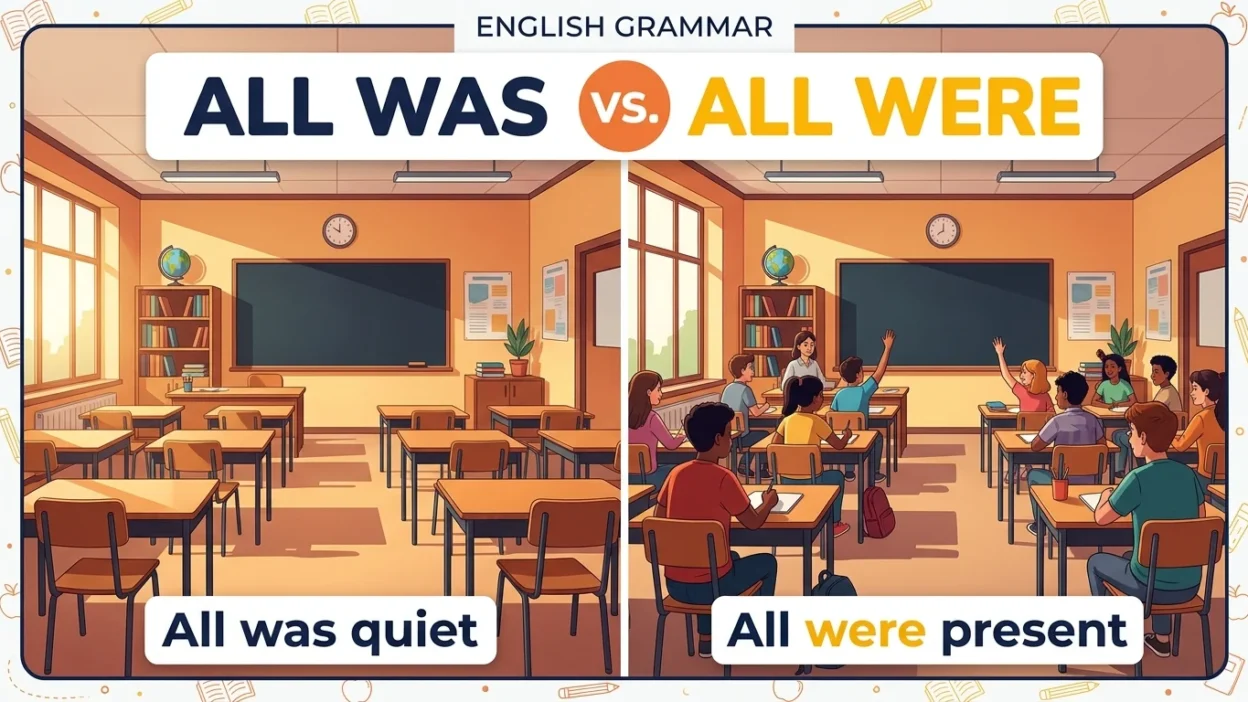
Choosing between “all was” and “all were” can be confusing because the word all can refer to one thing, several things, or an entire situation. The correct choice depends on what all refers to in your sentence. For example, “All was quiet in the house” is correct because all refers to the overall situation. However, “All were invited to the party” is correct because all refers to multiple people.
Both expressions are grammatically correct, but they are not interchangeable in every context. Understanding whether all functions as a singular or plural pronoun will help you choose the right verb. This guide explains the difference between “all was” and “all were,” provides simple grammar rules and examples, and covers common mistakes so you can use both expressions confidently in everyday English and formal writing.
Quick Answer: Should You Use “All Was” or “All Were”?
Both “all was” and “all were” are correct, depending on the meaning of all. Use “all was” when all refers to an uncountable thing or a whole situation, as in “All was silent.” Use “all were” when all refers to multiple people or countable things, as in “All were present.”
What Is the Difference Between “All Was” and “All Were”?
The main difference is subject-verb agreement. The verb must agree with what all represents in the sentence.
- All was: Usually refers to an uncountable noun, a general condition, or an entire situation.
- All were: Usually refers to multiple people or countable things.
Consider these examples:
- “All was peaceful after the storm.” Here, all refers to the overall situation.
- “All were happy with the results.” Here, all refers to multiple people.
The word all does not always take the same verb. You need to consider its meaning and the noun or idea it represents.
When Should You Use “All Was”?
Use “all was” when all refers to a singular, uncountable idea or an entire situation. In this construction, all is understood as one whole rather than several separate items.
1. When Referring to an Entire Situation
Use “all was” when describing the overall condition of a place, event, or experience.
Examples:
- All was quiet in the village.
- All was peaceful after the argument.
- All was well until the power went out.
- All was silent in the classroom.
- All was calm before the storm.
In these examples, all refers to the general state of things.
2. When Referring to Everything as a Whole
“All was” can also refer to everything collectively, especially in literary or somewhat formal writing.
Examples:
- All was lost after the final battle.
- All was forgotten with time.
- All was ready for the celebration.
- All was well in the end.
- All was darkness around them.
Some of these sentences have a literary tone. In everyday English, speakers may prefer alternatives such as “Everything was ready” or “Everything was lost.”
3. When “All” Refers to an Uncountable Noun
When all refers to an uncountable noun, a singular verb is normally appropriate.
Examples:
- All the water was gone.
- All the information was accurate.
- All the money was spent.
- All the food was eaten.
- All the equipment was delivered.
Notice that in these examples, the noun after all determines the verb. Water, information, money, food, and equipment are uncountable nouns in these meanings, so they take was in the past tense.
When Should You Use “All Were”?
Use “all were” when all refers to multiple people or countable things. The plural verb were agrees with the plural meaning.
1. When Referring to Multiple People
Examples:
- All were invited to the wedding.
- All were present at the meeting.
- All were happy with the decision.
- All were waiting outside.
- All were ready to leave.
Here, all means all the people in a particular group.
2. When Referring to Multiple Countable Things
Examples:
- All the books were on the table.
- All the windows were open.
- All the students were prepared.
- All the answers were correct.
- All the tickets were sold.
Because books, windows, students, answers, and tickets are plural countable nouns, the correct verb is were.
3. When Referring to Multiple Events or Items
Examples:
- All the events were successful.
- All the reports were submitted.
- All the problems were resolved.
- All the documents were signed.
- All the options were available.
In each sentence, all refers to several distinct things, so were is appropriate.
“All Was” vs. “All Were”: Comparison Table
| Feature | All Was | All Were |
|---|---|---|
| Verb | Singular past form | Plural past form |
| Typical meaning | A whole situation or uncountable amount | Multiple people or countable things |
| Example | All was quiet. | All were quiet. |
| With uncountable nouns | All the milk was gone. | Not standard for this meaning |
| With plural countable nouns | Not standard for this meaning | All the chairs were broken. |
| Common alternative | Everything was | Everyone was or all of them were, depending on meaning |
Remember that the noun or idea being referred to is more important than the word all by itself.
Is “All Was” or “All Were” Correct in Everyday English?
Both can be correct, but the natural choice depends on the sentence.
Consider these examples:
“All was well.”
This is a common expression meaning that everything was fine. Here, all refers to the overall situation.
“All were well.”
This can be correct when all refers to several people or living things who were in good health or doing well, though the meaning and context matter. For example, “After the accident, all were well.”
“All the children were well.”
This is a clear and natural way to say that every child was healthy.
“All the work was completed.”
This is correct because work is uncountable in this meaning.
What About “All of Us Was” vs. “All of Us Were”?
When all is followed by a plural pronoun such as us, them, or you, the verb is generally plural when it refers to the people in the group.
Correct examples:
- All of us were tired.
- All of them were invited.
- All of you were helpful.
- All of us were ready to leave.
In standard English, “All of us was tired” is not correct when us refers to multiple people.
Compare this with “All of the food was eaten,” where all refers to an uncountable noun and takes a singular verb.
What About “All I Was” vs. “All I Were”?
This is a different grammatical construction.
“All I was” is correct when you are describing what you were or the role you had.
Example: “All I was trying to do was help.”
Here, I was trying uses the past continuous tense, and all means “the only thing.”
“All I were” is generally incorrect in ordinary statements. However, were can appear in hypothetical or subjunctive constructions, such as “If I were all that you needed, I would stay.” This is a different grammatical structure and is not a simple alternative to “all I was.”
12 Examples of “All Was” and “All Were”
- All was quiet after midnight.
- All were present for the announcement.
- All the water was used during the experiment.
- All the players were ready for the match.
- All was well until the weather changed.
- All the flowers were beautiful.
- All the money was returned to its owner.
- All the guests were welcomed warmly.
- All was silent as the lights went out.
- All the files were saved successfully.
- All the food was fresh.
- All were pleased with the final decision.
These examples demonstrate how the verb changes according to what all refers to.
Common Mistakes to Avoid
1. Using “Was” With a Plural Noun
Incorrect: All the students was present.
Correct: All the students were present.
The noun students is plural, so use were.
2. Using “Were” With an Uncountable Noun
Incorrect: All the information were correct.
Correct: All the information was correct.
Information is uncountable in standard English, so it takes a singular verb.
3. Assuming “All” Is Always Plural
The word all can refer to a whole amount, a general situation, or several individual things. Its verb depends on the meaning.
Correct: All was quiet.
Correct: All were quiet.
The first describes a general atmosphere; the second can describe several people or things.
4. Confusing “All Was” With “Everything Was”
“Everything was” is often more natural in everyday conversation when you mean all things collectively.
For example:
- Natural: Everything was ready.
- Also possible, with a more literary tone: All was ready.
Easy Memory Trick
Use this simple rule:
- Was = one whole or an uncountable amount.
- Were = multiple people or countable things.
Think of these examples:
- All the milk was gone.
- All the bottles were empty.
- All was peaceful.
- All were present.
When you are unsure, identify the noun or idea that all refers to. That will usually help you select the correct verb.
American vs. British English
The basic rules for “all was” and “all were” are the same in standard American and British English. Both varieties use singular agreement with uncountable nouns and plural agreement with plural countable nouns.
| Context | American English | British English |
|---|---|---|
| Uncountable noun | All the furniture was delivered. | All the furniture was delivered. |
| Plural noun | All the students were ready. | All the students were ready. |
| General situation | All was well. | All was well. |
Regional and stylistic differences may affect how natural a particular sentence sounds, but the core agreement rule remains the same.
Frequently Asked Questions
1. Is “all was” grammatically correct?
Yes. “All was” is correct when all refers to a whole situation or an uncountable amount. For example, “All was quiet” and “All the water was gone” are correct.
2. Is “all were” grammatically correct?
Yes. “All were” is correct when all refers to multiple people or countable things. For example, “All were invited” and “All the books were missing” are correct.
3. Should I say “all was good” or “all were good”?
Both can be correct in different contexts. “All was good” refers to the overall situation, although “Everything was good” is often more natural. “All were good” refers to multiple people or things, such as “All the answers were good.”
4. Is “all was well” correct?
Yes. “All was well” is a standard expression meaning that everything was fine or that the overall situation was satisfactory.
5. Should I say “all of them was” or “all of them were”?
Use “all of them were” when them refers to multiple people or things. For example, “All of them were invited.”
6. Is “all the people was” correct?
No, not in standard English. Because people is plural, say “All the people were there.”
7. What is the easiest way to choose between “all was” and “all were”?
Look at what all represents. Use was for a whole situation or an uncountable noun, and use were for multiple people or plural countable nouns.
Remember This
“All was” and “all were” are both correct, but they serve different purposes. Use “all was” for a whole situation or an uncountable amount, as in “All was quiet.” Use “all were” for multiple people or countable things, as in “All were present.”
The most reliable way to choose is to identify what all refers to and make the verb agree with that meaning.
Conclusion
The difference between “all was” and “all were” comes down to subject-verb agreement. When all refers to an uncountable amount or a situation considered as a whole, was is generally appropriate. When it refers to several people or countable things, were is usually the correct choice.
With practice, the distinction becomes easier to recognize. Remember examples such as “All was well,” “All the information was correct,” and “All the students were ready.” These patterns will help you choose the right expression in conversations, school assignments, and professional writing.

Charles Kevin is a passionate language writer and researcher at SimileHive, creating clear, engaging content about similes, idioms, metaphors, and figurative language to help readers improve English communication confidently every day.