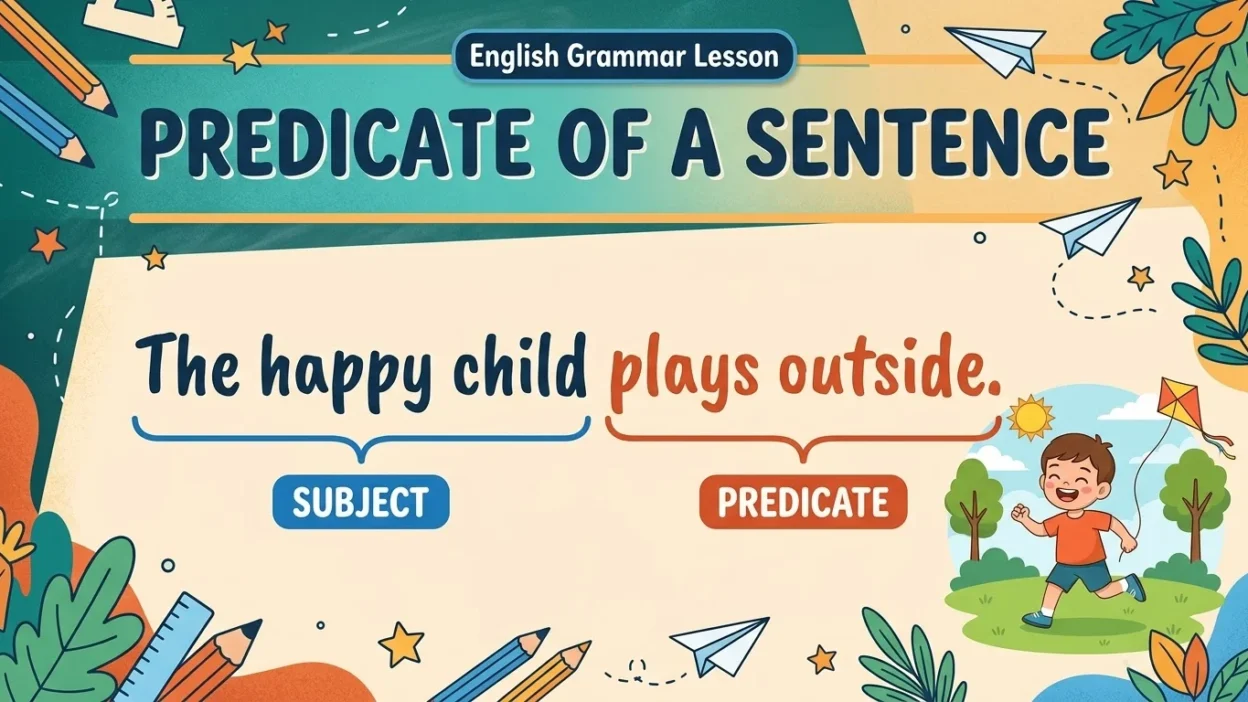
The predicate of a sentence is the part that tells us something about the subject. It usually contains a verb and may include other words that explain what the subject does, what happens to it, or what it is like. For example, in the sentence “The little girl is reading a book,” the subject is “The little girl,” and the predicate is “is reading a book.” The predicate tells us what the girl is doing.
Understanding predicates is an important part of learning English grammar because every complete sentence needs a subject and a predicate, although the subject may sometimes be understood rather than stated directly.
Predicates can be short, such as “runs,” or longer, such as “runs quickly through the park every morning.” In this guide, you will learn the definition of a predicate, its main types, how to identify it, and how to distinguish it from the subject and the object of a sentence.
Quick Answer: What Is the Predicate of a Sentence?
The predicate is the part of a sentence that says something about the subject. It includes the verb and may contain objects, complements, and other details. For example, in “The dog barked loudly,” the subject is “The dog,” and the predicate is “barked loudly.”
What Is a Predicate in Grammar?
In English grammar, a predicate tells us what the subject does, what happens to the subject, or what the subject is or is like.
A simple sentence often has two main parts:
- Subject: The person, animal, thing, or idea the sentence is about.
- Predicate: What the sentence says about the subject.
Consider this example:
Sentence: The baby is sleeping peacefully.
- Subject: The baby
- Predicate: is sleeping peacefully
- Verb: is sleeping
The predicate includes the verb phrase “is sleeping” and the adverb “peacefully,” which describes how the baby is sleeping.
Here are a few more examples:
| Sentence | Subject | Predicate |
|---|---|---|
| Birds fly. | Birds | fly |
| Sarah likes music. | Sarah | likes music |
| The children are playing outside. | The children | are playing outside |
| My father works in a hospital. | My father | works in a hospital |
| The sky looks beautiful today. | The sky | looks beautiful today |
Notice that the predicate can consist of a single verb or a group of words.
What Are the Main Types of Predicates?
Predicates are commonly classified into two main types: the simple predicate and the complete predicate. Some grammar lessons also discuss the compound predicate.
1. Simple Predicate
The simple predicate is the main verb or verb phrase that tells what the subject does or what happens to it. It does not include the other details that may accompany the verb.
Examples:
- The boy runs quickly.
- She is reading a novel.
- They have finished their homework.
- My brother will travel tomorrow.
- The baby was crying loudly.
In these sentences, the simple predicates are runs, is reading, have finished, will travel, and was crying.
A simple predicate can contain more than one word when the verb phrase includes helping verbs.
2. Complete Predicate
The complete predicate includes the verb and all the words that tell us more about the subject.
Examples:
- The boy runs quickly through the park.
- She is reading a novel in her bedroom.
- They have finished their homework before dinner.
- My brother will travel to London tomorrow.
- The baby was crying loudly during the night.
The complete predicate gives the full information expressed about the subject.
Compare these two examples:
Sentence: The cat slept on the sofa.
- Simple predicate: slept
- Complete predicate: slept on the sofa
The word slept is the main verb. The phrase on the sofa adds information about where the cat slept.
3. Compound Predicate
A compound predicate occurs when one subject has two or more verbs or verb phrases that share the same subject.
Examples:
- Emma opened the door and walked inside.
- The dog barked and ran toward the gate.
- He washed the dishes, dried them, and put them away.
- My sister sings beautifully and plays the piano.
- The children laughed and danced at the party.
In the sentence “Emma opened the door and walked inside,” the compound predicate is “opened the door and walked inside.” Both actions are performed by Emma.
How to Identify the Predicate of a Sentence
You can usually find the predicate by following a few simple steps.
<box gap={3}> <row align=start gap={3}> <box background=”surface-secondary” radius=”lg” size=”44px” align=center justify=center> <icon name=”search” size=”xl” /> </box> <box flex=”1″ gap={1}> **Step 1: Find the subject.**
  Ask who or what the sentence is about.

  Example: “The old man walked slowly.”

  The sentence is about **the old man**.
</box>
</row> <row align=start gap={3}> <box background=”surface-secondary” radius=”lg” size=”44px” align=center justify=center> <icon name=”scan-text” size=”xl” /> </box> <box flex=”1″ gap={1}> **Step 2: Find the verb.**
  Look for the action or state of being.

  In the example, the verb is **walked**.
</box>
</row> <row align=start gap={3}> <box background=”surface-secondary” radius=”lg” size=”44px” align=center justify=center> <icon name=”check-circle” size=”xl” /> </box> <box flex=”1″ gap={1}> **Step 3: Include the words that complete the predicate.**
  The complete predicate is **walked slowly**.
</box>
</row> </box>
Remember that the predicate is not always everything that follows the subject. In some sentences, word order changes, and the subject may come after the verb.
For example, in “Here comes the bus,” the subject is “the bus,” and the predicate is “Here comes.” In traditional school grammar, the complete predicate may be described as “Here comes” because the subject follows the verb, though some analyses treat “here” as an introductory adverbial and identify “comes” as the verb.
15 Examples of Predicates in Sentences
Here are 15 examples with the subjects and predicates identified.
| Sentence | Subject | Predicate |
|---|---|---|
| The sun shines brightly. | The sun | shines brightly |
| My mother cooks dinner. | My mother | cooks dinner |
| The students listened carefully. | The students | listened carefully |
| A bird sat on the branch. | A bird | sat on the branch |
| He is very kind. | He | is very kind |
| The baby is sleeping. | The baby | is sleeping |
| Our team won the match. | Our team | won the match |
| The flowers smell sweet. | The flowers | smell sweet |
| The teacher explained the lesson. | The teacher | explained the lesson |
| My friends arrived late. | My friends | arrived late |
| The train stopped suddenly. | The train | stopped suddenly |
| She has completed the assignment. | She | has completed the assignment |
| The children played in the garden. | The children | played in the garden |
| My brother likes chocolate cake. | My brother | likes chocolate cake |
| The sky became dark. | The sky | became dark |
These examples show that predicates can describe actions, conditions, feelings, and characteristics.
What Is the Difference Between a Predicate and a Subject?
The subject and predicate perform different jobs in a sentence.
| Feature | Subject | Predicate |
|---|---|---|
| Function | Tells who or what the sentence is about | Tells something about the subject |
| Usually contains | A noun, pronoun, or noun phrase | A verb and related words |
| Example | The little bird | sang sweetly |
| Full sentence | The little bird sang sweetly. | The little bird sang sweetly. |
The subject is “The little bird,” while the predicate is “sang sweetly.”
A useful way to remember the difference is that the subject is the topic, and the predicate tells us something about that topic.
What Is the Difference Between a Predicate and an Object?
A predicate is a major part of a sentence, while an object is a word or phrase that receives an action or completes the meaning of certain verbs.
Consider this sentence:
Mia kicked the ball.
- Subject: Mia
- Predicate: kicked the ball
- Verb: kicked
- Object: the ball
The predicate includes both the verb and the object. Therefore, an object can be part of the predicate, but the two terms do not mean the same thing.
Another example:
The chef prepared a delicious meal.
The predicate is “prepared a delicious meal,” while the object is “a delicious meal.”
What Is a Predicate Nominative and a Predicate Adjective?
Some predicates contain words that describe or identify the subject after a linking verb, such as is, was, seems, or became.
Predicate Nominative
A predicate nominative is a noun or pronoun that identifies the subject after a linking verb.
Example: “Maria is a doctor.”
- Subject: Maria
- Verb: is
- Predicate nominative: a doctor
- Complete predicate: is a doctor
The phrase “a doctor” identifies Maria.
Predicate Adjective
A predicate adjective is an adjective that describes the subject after a linking verb.
Example: “The soup smells delicious.”
- Subject: The soup
- Verb: smells
- Predicate adjective: delicious
- Complete predicate: smells delicious
The word “delicious” describes the soup.
More examples:
- The sky became dark.
- The children seem excited.
- My father is patient.
- The flowers look fresh.
In each example, the adjective describes the subject rather than receiving an action.
Can a Sentence Have More Than One Predicate?
Yes. A sentence can have a compound predicate, in which one subject performs multiple actions.
Examples:
- The girl sang and danced.
- The teacher explained the topic and answered questions.
- The dog ran across the yard and jumped over the fence.
A sentence can also contain more than one clause, and each clause may have its own subject and predicate.
Example: “I finished my homework, and my brother watched television.”
- First clause: Subject “I”; predicate “finished my homework”
- Second clause: Subject “my brother”; predicate “watched television”
This is a compound sentence with two independent clauses.
Common Mistakes to Avoid
1. Confusing the Predicate With the Verb Alone
The verb is the central part of the predicate, but the complete predicate can include other words.
Sentence: “The girl sang beautifully.”
- Verb: sang
- Complete predicate: sang beautifully
2. Including the Subject in the Predicate
In basic sentence analysis, the subject and complete predicate are separate parts.
Incorrect identification:
- Subject: The dog barked
- Predicate: barked loudly
Correct identification:
- Subject: The dog
- Predicate: barked loudly
3. Forgetting Helping Verbs
Helping verbs form part of the verb phrase and should be included in the simple predicate.
Example: “They have been waiting.”
The simple predicate is “have been waiting,” not just “waiting.”
4. Assuming the Predicate Always Follows the Subject
Word order can vary.
Example: “Never have I seen such a beautiful sunset.”
The subject is “I,” and the predicate is “have seen such a beautiful sunset.” The word “never” is an introductory adverb.
5. Confusing Predicate Adjectives With Objects
In “The cake tastes sweet,” sweet describes the cake. It is a predicate adjective, not an object.
Frequently Asked Questions
1. What is the predicate of a sentence in simple words?
The predicate is the part of a sentence that tells what the subject does or what the subject is like. In “The boy is laughing,” the predicate is “is laughing.”
2. What are the two main types of predicates?
The two main types commonly taught in school grammar are the simple predicate and the complete predicate. A compound predicate is another useful category.
3. Can a predicate be one word?
Yes. In “Birds fly,” the predicate is the single word “fly.”
4. Does every sentence have a predicate?
A complete clause normally has a predicate. In commands such as “Sit down,” the subject “you” is understood, and “sit down” is the predicate.
5. What is a complete predicate?
A complete predicate includes the verb and all the words that tell what the subject does or what it is like. In “The cat slept on the sofa,” the complete predicate is “slept on the sofa.”
6. What is a compound predicate?
A compound predicate contains two or more verbs or verb phrases that share the same subject. For example, “Liam opened the window and turned on the fan.”
7. What is the difference between a predicate and a verb?
A verb expresses an action, occurrence, or state. A predicate includes the verb and may also include objects, complements, and modifiers.
Remember This
The predicate tells us something about the subject. It contains a verb and may include additional information.
For example, in “The young athlete ran quickly across the field,” the subject is “The young athlete,” and the complete predicate is “ran quickly across the field.”
To identify the predicate, find the subject first, locate the verb, and then include the words that complete the information about the subject.
Conclusion
The predicate is one of the essential parts of English grammar because it tells us what the subject does, what happens to it, or what it is like. Learning to identify simple, complete, and compound predicates makes it easier to understand sentence structure and write clear sentences. Predicates can be short or long, depending on how much information a sentence provides.
With regular practice, you can quickly distinguish predicates from subjects, verbs, and objects. Start with simple examples such as “Birds fly,” then move on to longer sentences such as “The birds are flying over the lake.” Understanding this grammar concept will strengthen your reading, writing, and overall English skills.

Adam Aaron is a language enthusiast and content writer at SimileHive, creating clear, engaging guides on similes, idioms, metaphors, and figurative language to help readers improve English confidently every day.