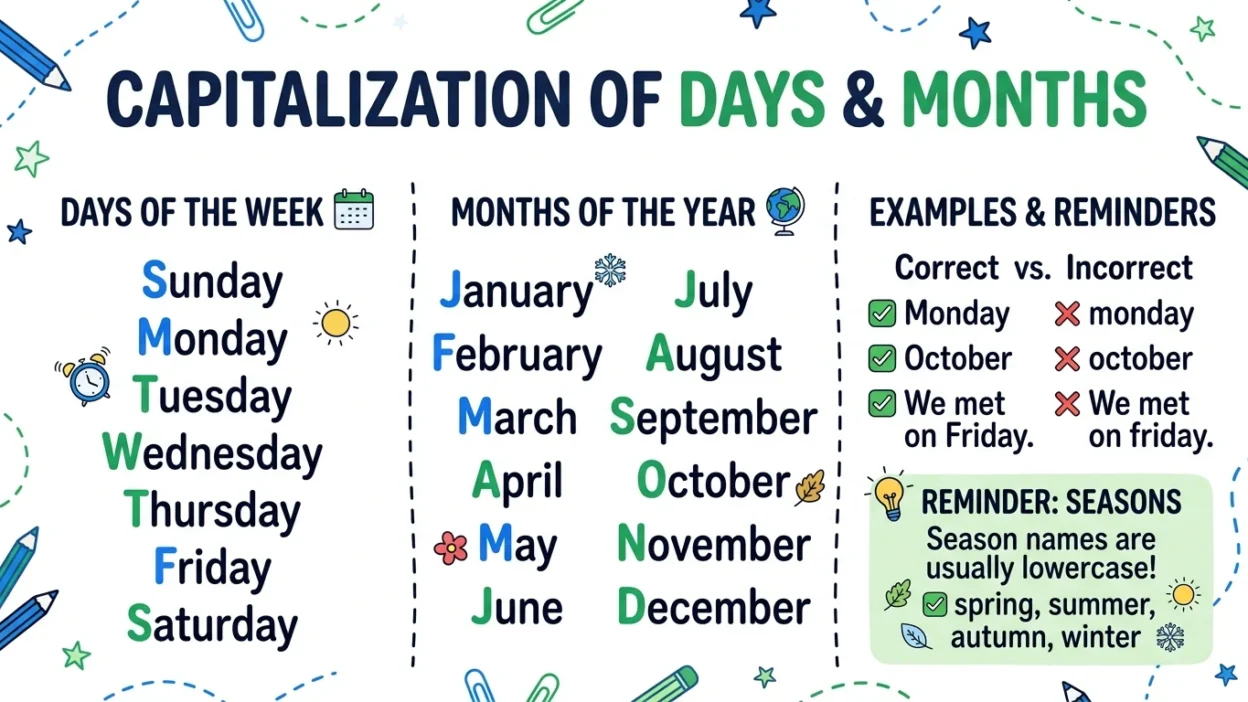
Knowing when to capitalize the days of the week and months of the year is an important part of English grammar. Words such as Monday, Friday, January, and December appear in everyday writing, including emails, school assignments, business documents, calendars, and social media posts. Although these words may seem ordinary, English has a specific rule for writing them correctly.
In English, the names of days and months always begin with a capital letter, regardless of where they appear in a sentence. For example, you should write “I will visit you on Monday” and “My birthday is in October.” Writing “monday” or “october” in standard English is incorrect, even when these words appear in the middle of a sentence.
In this guide, you will learn the capitalization rules for days and months, explore correct and incorrect examples, understand common mistakes, and discover how these rules apply to dates, abbreviations, and formal writing.
Quick Answer: Do You Capitalize Days and Months?
Yes. In English, the names of all seven days of the week and all twelve months of the year are proper nouns, so they must begin with a capital letter. Write Monday, Tuesday, January, and February, even when they appear in the middle or at the end of a sentence.
1. Capitalization of Days of the Week
The names of the seven days of the week are always capitalized in English.
| Day | Correct Spelling | Incorrect Spelling |
|---|---|---|
| Monday | Monday | monday |
| Tuesday | Tuesday | tuesday |
| Wednesday | Wednesday | wednesday |
| Thursday | Thursday | thursday |
| Friday | Friday | friday |
| Saturday | Saturday | saturday |
| Sunday | Sunday | sunday |
Examples of days in sentences
- I have an English class on Monday.
- We usually visit our grandparents on Sunday.
- The meeting is scheduled for Wednesday.
- She started her new job last Friday.
- Are you available on Saturday?
- My exams begin on Tuesday.
- The store closes early on Thursday.
Notice that the day remains capitalized even when it appears in the middle or at the end of a sentence.
Incorrect: We will meet on friday.
Correct: We will meet on Friday.
2. Capitalization of Months of the Year
All twelve months must also begin with a capital letter.
| Month | Correct Spelling | Incorrect Spelling |
|---|---|---|
| January | January | january |
| February | February | february |
| March | March | march |
| April | April | april |
| May | May | may |
| June | June | june |
| July | July | july |
| August | August | august |
| September | September | september |
| October | October | october |
| November | November | november |
| December | December | december |
Examples of months in sentences
- My birthday is in January.
- We are planning a trip for March.
- The school year begins in April.
- She moved to Canada in June.
- The weather becomes cooler in October.
- Many people celebrate New Year’s Day in January.
- Our final exams will take place in December.
Incorrect: My birthday is in august.
Correct: My birthday is in August.
3. Why Are Days and Months Capitalized?
Days and months are capitalized because their names are treated as proper nouns in English.
A proper noun identifies a particular person, place, organization, or named thing. For example:
- Common noun: a day
- Proper noun: Monday
- Common noun: a month
- Proper noun: January
The words day and month are general terms and are not normally capitalized unless they begin a sentence or appear in a title that follows a capitalization style. The specific names Monday and January, however, always begin with capital letters in standard English.
Examples:
- Monday is my busiest day.
- January is the first month of the year.
- I enjoy this month because the weather is pleasant.
4. Capitalization of Dates
When writing a complete date, capitalize the day and month names.
Examples:
- Monday, January 12, 2026
- Friday, March 20, 2026
- Sunday, July 5, 2026
- Tuesday, December 15, 2026
Both the day and the month retain their capital letters.
Correct and incorrect date formats
| Incorrect | Correct |
|---|---|
| monday, january 12 | Monday, January 12 |
| friday, march 20 | Friday, March 20 |
| sunday, july 5 | Sunday, July 5 |
| tuesday, december 15 | Tuesday, December 15 |
The punctuation and order of a date can vary by region and style, but the capitalization of the day and month names does not.
5. Do You Capitalize Days and Months in the Middle of a Sentence?
Yes. Days and months are capitalized even when they appear in the middle or at the end of a sentence.
Examples:
- My appointment is on Monday.
- We are traveling in December.
- I received the invitation last Friday.
- The course begins in September.
- She will return on Thursday.
The capitalization rule does not depend on the word’s position in the sentence.
6. What About Abbreviations of Days and Months?
Abbreviations of day and month names generally use capital letters, too.
| Full Name | Common Abbreviation |
|---|---|
| Monday | Mon. |
| Tuesday | Tue. or Tues. |
| Wednesday | Wed. |
| Thursday | Thu. or Thurs. |
| Friday | Fri. |
| Saturday | Sat. |
| Sunday | Sun. |
| January | Jan. |
| February | Feb. |
| March | Mar. |
| April | Apr. |
| August | Aug. |
| September | Sep. or Sept. |
| October | Oct. |
| November | Nov. |
| December | Dec. |
May, June, and July are often written in full because their names are already short.
Abbreviations vary by style guide and context. Some styles omit periods, especially in calendars and tables. For example, both Mon. and Mon may be used depending on the style.
Examples:
- The meeting is on Mon.
- The conference begins in Oct.
- Our appointment is scheduled for Fri., Jan. 16.
7. Common Capitalization Mistakes
Here are some mistakes to avoid when writing days and months.
Mistake 1: Using lowercase letters
Incorrect: I will call you on tuesday.
Correct: I will call you on Tuesday.
Mistake 2: Capitalizing only the first word of a date
Incorrect: We met on Friday, june 12.
Correct: We met on Friday, June 12.
Mistake 3: Assuming a word should be lowercase in the middle of a sentence
Incorrect: My vacation begins in august.
Correct: My vacation begins in August.
Mistake 4: Capitalizing general time words unnecessarily
Incorrect: I will see you next Week.
Correct: I will see you next week.
The word week is a common noun, so it is normally lowercase unless it begins a sentence or is part of a title.
Mistake 5: Confusing seasons with months
Incorrect: Spring begins in March, and Summer follows in June.
Correct: Spring begins in March, and summer follows in June.
In ordinary prose, seasons such as spring, summer, autumn, and winter are generally lowercase. Specific style guides or special names may use different capitalization.
8. Days and Months vs. Seasons and General Time Words
Not every word connected to time requires a capital letter.
| Word Type | Examples | Capitalization |
|---|---|---|
| Days of the week | Monday, Friday | Always capitalized |
| Months of the year | January, August | Always capitalized |
| Seasons | spring, summer, winter | Usually lowercase |
| General time words | day, week, month, year | Usually lowercase |
| Holidays | Christmas, Easter | Capitalized |
| Parts of the day | morning, afternoon, evening | Usually lowercase |
Examples:
- We will meet on Monday in the spring.
- Her birthday is in July.
- I exercise every morning.
- We celebrate Christmas in December.
9. American vs. British English
The capitalization rules for days and months are the same in American and British English.
Both varieties capitalize names such as Monday, Thursday, January, and November.
Examples:
- American English: The meeting is on Monday, October 12.
- British English: The meeting is on Monday 12 October.
The main difference in these examples is the date format and punctuation, not capitalization.
10. Practice Quiz: Test Your Knowledge
Choose the correctly capitalized sentence in each question.
Question 1: Which sentence is correct?
{@body const [a1,setA1] = DIL.useState(“”)}
<radio-group value={a1} onChange={setA1} direction=”col”>
<radio value=”a”>I will visit you on monday.</radio>
<radio value=”b”>I will visit you on Monday.</radio>
<radio value=”c”>I will visit you on MONDAY.</radio>
</radio-group>
{#if a1 !== “”}
<text color={a1 === “b” ? “success” : “danger”}>{a1 === “b” ? “Correct! Monday is capitalized normally.” : “Not quite. The correct answer is: I will visit you on Monday.”}</text>
{/if}
Question 2: Which sentence is correct?
{@body const [a2,setA2] = DIL.useState(“”)}
<radio-group value={a2} onChange={setA2} direction=”col”>
<radio value=”a”>My birthday is in october.</radio>
<radio value=”b”>My birthday is in October.</radio>
<radio value=”c”>My birthday is in OCTOBER.</radio>
</radio-group>
{#if a2 !== “”}
<text color={a2 === “b” ? “success” : “danger”}>{a2 === “b” ? “Correct! October begins with a capital letter.” : “Not quite. The correct answer is: My birthday is in October.”}</text>
{/if}
Question 3: Which word normally stays lowercase?
{@body const [a3,setA3] = DIL.useState(“”)}
<radio-group value={a3} onChange={setA3} direction=”col”>
<radio value=”a”>Tuesday</radio>
<radio value=”b”>December</radio>
<radio value=”c”>winter</radio>
</radio-group>
{#if a3 !== “”}
<text color={a3 === “c” ? “success” : “danger”}>{a3 === “c” ? “Correct! Season names are usually lowercase in ordinary prose.” : “Not quite. The correct answer is winter.”}</text>
{/if}
Frequently Asked Questions
1. Are days of the week always capitalized in English?
Yes. The names of all seven days, including Monday, Tuesday, Wednesday, Thursday, Friday, Saturday, and Sunday, begin with capital letters.
2. Are months of the year proper nouns?
Yes. Month names are proper nouns in English, so they must be capitalized wherever they appear in a sentence.
3. Should I capitalize Monday in the middle of a sentence?
Yes. For example, “My appointment is on Monday” is correct. The word remains capitalized even though it is not the first word in the sentence.
4. Do you capitalize seasons like summer and winter?
Usually not. In ordinary English writing, season names such as spring, summer, autumn, and winter are lowercase. Capitalize them only when another rule or a specific name requires it.
5. Should days and months be capitalized in emails?
Yes. The same capitalization rules apply to emails, text messages, essays, reports, and formal letters.
6. Are day and month abbreviations capitalized?
Yes. Common abbreviations such as Mon., Fri., Jan., and Dec. begin with capital letters. Whether an abbreviation uses a period depends on the style and context.
7. Do American and British English follow the same rules?
Yes. Both American and British English capitalize days and months. Date order and punctuation may differ, but capitalization remains the same.
Remember This
The easiest rule to remember is that all day names and month names are capitalized in English.
Write Monday, not monday, and January, not january. However, general time words such as day, week, month, and year, along with season names such as summer and winter, are usually lowercase in ordinary sentences.
Conclusion
Capitalization of days and months is a simple but essential English grammar rule. If you are writing an email, preparing an assignment, creating a calendar, or recording a date, always capitalize names such as Monday, Friday, January, and December. Their position in a sentence does not change this rule.
To improve your writing, remember the difference between proper names and general time words. Days and months begin with capital letters, while words such as week, year, and summer usually remain lowercase. Following these rules will help you write more clearly and confidently.

Lucas Luke is a passionate language writer and content creator at SimileHive, specializing in similes, idioms, metaphors, and figurative language. He enjoys making complex English expressions simple, engaging, and easy to understand for students, writers, and language enthusiasts through well-researched, practical content.