Choosing between is and are is one of the most important parts of learning English grammar. Both words are forms of the verb be, but they are used with different subjects. Knowing when to use is or are will help you write correct sentences, speak more naturally, and avoid common grammatical mistakes.
The main difference is simple: use is with singular subjects and are with plural subjects. For example, “She is happy” is correct because she is singular, while “They are happy” is correct because they is plural. However, some sentences can be confusing, especially when they contain compound subjects, collective nouns, indefinite pronouns, or phrases that come between the subject and the verb.
Questions such as “Is everyone ready?” and “Are the students ready?” also show why understanding the subject is essential. This guide explains the difference between is and are with clear rules, comparison tables, practical examples, common mistakes, and frequently asked questions.
Quick Answer
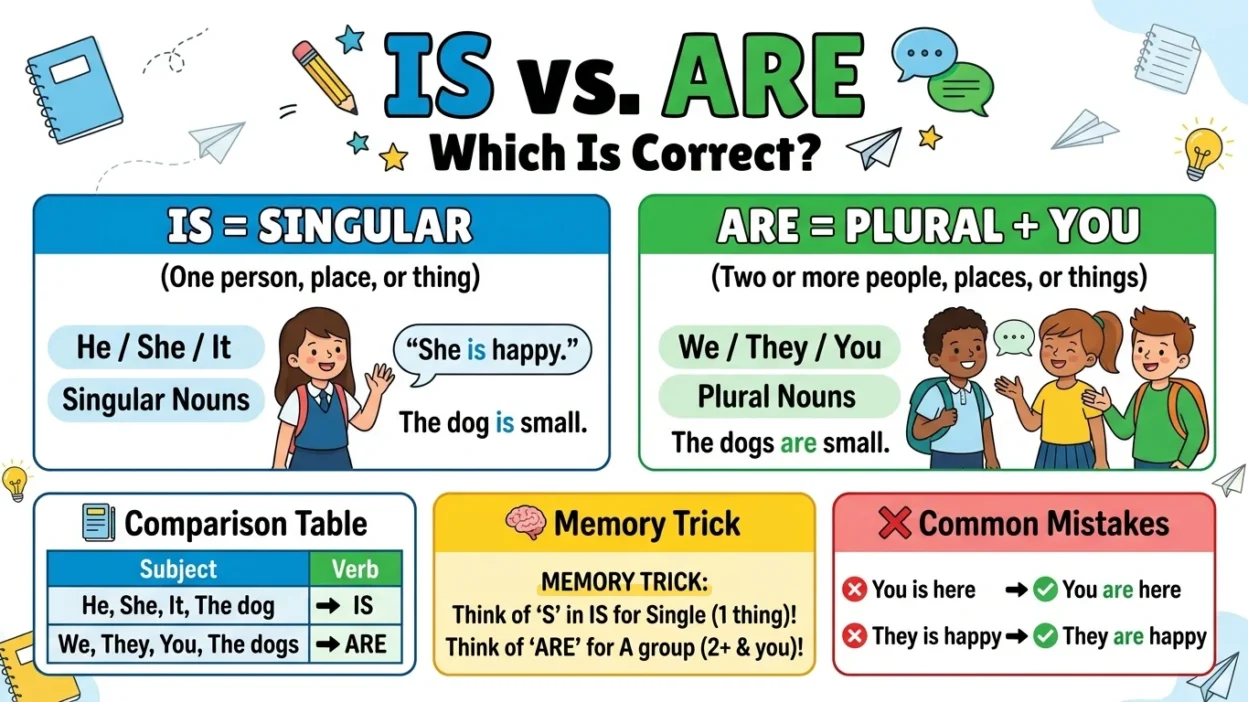
Is is used with singular subjects, such as he, she, it, and singular nouns. Are is used with plural subjects and the pronouns you, we, and they. For example, “The student is ready” and “The students are ready.” The correct choice depends on the subject, not simply on the nearest noun.
Why Do People Confuse Is and Are?
People often confuse is and are because English verbs must agree with their subjects. This rule is called subject-verb agreement.
The difficulty increases when a sentence contains several nouns, long subject phrases, or words that do not follow the usual singular and plural patterns.
Consider these examples:
- The boy is playing football.
- The boys are playing football.
- The box of books is heavy.
- The books in the box are heavy.
In the third sentence, box is the subject, so the singular verb is is correct. In the fourth sentence, books is the subject, so the plural verb are is required.
The key is to identify the actual subject before choosing the verb.
First Word: Is
Is is the present-tense form of the verb be used with third-person singular subjects.
When Should You Use Is?
Use is with the following subjects:
- He
- She
- It
- A singular noun
- An uncountable noun
- An indefinite pronoun that takes a singular verb
Examples:
- He is my brother.
- She is a teacher.
- It is raining.
- The cat is sleeping.
- Water is essential for life.
- Everyone is welcome.
Is With Singular Nouns
A singular noun refers to one person, place, thing, or idea.
Examples:
- The student is studying.
- My phone is new.
- The building is tall.
- This book is interesting.
Even if a sentence contains other nouns, use is when the main subject is singular.
Example: The color of the flowers is beautiful.
The subject is color, not flowers.
Is With Uncountable Nouns
Uncountable nouns generally take singular verbs.
Examples:
- The information is useful.
- The furniture is expensive.
- The advice is helpful.
- The news is surprising.
Although some of these nouns refer to many things or pieces of information, they are grammatically singular in standard English.
Second Word: Are
Are is the present-tense form of the verb be used with plural subjects and the pronoun you.
When Should You Use Are?
Use are with the following subjects:
- You
- We
- They
- Plural nouns
- Two or more subjects joined by and
Examples:
- You are very kind.
- We are ready.
- They are students.
- The children are playing.
- John and Mary are friends.
Are With Plural Nouns
Plural nouns refer to more than one person, place, thing, or idea.
Examples:
- The students are attentive.
- My friends are waiting.
- The cars are expensive.
- These questions are difficult.
Are With You
One common source of confusion is the pronoun you.
In English, you always takes are in the present tense, whether it refers to one person or several people.
Examples:
- You are my best friend.
- You are responsible for this task.
- You are all invited to the party.
Do not write “You is” in standard English.
Is vs. Are: Comparison Table
| Feature | Is | Are |
|---|---|---|
| Main use | Singular subjects | Plural subjects |
| Pronouns | He, she, it | You, we, they |
| Singular noun | The girl is happy. | Not normally used |
| Plural noun | Not normally used | The girls are happy. |
| Uncountable noun | The milk is fresh. | Not normally used |
| Subject joined by and | Usually not used | Tom and Ali are here. |
| Example question | Is she ready? | Are they ready? |
Remember that you takes are even when referring to one person.
When to Use Is or Are
The easiest way to choose between is and are is to identify the subject and determine whether it is grammatically singular or plural.
1. Use Is With One Person or Thing
Examples:
- The teacher is in the classroom.
- My sister is a doctor.
- The computer is working.
- The answer is correct.
2. Use Are With More Than One Person or Thing
Examples:
- The teachers are in the classroom.
- My sisters are doctors.
- The computers are working.
- The answers are correct.
3. Use Are With You, We, and They
Examples:
- You are helpful.
- We are prepared.
- They are excited.
4. Use Is With Everyone, Someone, and Nobody
These indefinite pronouns are grammatically singular.
Examples:
- Everyone is present.
- Someone is at the door.
- Nobody is perfect.
- Each is responsible for their work.
5. Use Are With Two Subjects Joined by And
When two singular subjects are joined by and, they generally form a plural subject.
Examples:
- My mother and father are at home.
- Tea and coffee are available.
- Honesty and kindness are important qualities.
However, when two words refer to one combined item or concept, a singular verb may be appropriate.
Example: Fish and chips is my favorite meal.
Here, fish and chips is treated as one dish.
Is vs. Are: 15 Examples in Sentences
Study these examples to see how the correct verb changes according to the subject.
- The boy is intelligent.
- The boys are intelligent.
- She is my friend.
- They are my friends.
- The dog is hungry.
- The dogs are hungry.
- My phone is charging.
- My phones are charging.
- Everyone is ready.
- Both students are ready.
- The weather is pleasant.
- The flowers are beautiful.
- You are responsible for your actions.
- The quality of these products is excellent.
- The quality of these products and their prices are important considerations.
In the last example, the subject contains two coordinated elements: the quality of these products and their prices. Together, they take the plural verb are.
Common Mistakes With Is and Are
Mistake 1: Using Is With a Plural Subject
Incorrect: The students is ready.
Correct: The students are ready.
Why? Students is plural.
Mistake 2: Using Are With a Singular Subject
Incorrect: My brother are at home.
Correct: My brother is at home.
Why? Brother is singular.
Mistake 3: Writing You Is
Incorrect: You is very helpful.
Correct: You are very helpful.
Why? The pronoun you takes are in the present tense.
Mistake 4: Choosing the Verb Based on the Nearest Noun
Incorrect: The list of names are on the table.
Correct: The list of names is on the table.
Why? The subject is list, not names.
Mistake 5: Using Are With Everyone
Incorrect: Everyone are happy.
Correct: Everyone is happy.
Why? Everyone is grammatically singular.
Mistake 6: Forgetting Subject-Verb Agreement in Questions
Incorrect: Are your sister at home?
Correct: Is your sister at home?
Why? Your sister is a singular subject.
Memory Trick: How to Remember Is vs. Are
Use this simple pattern:
IS = singular; ARE = plural, plus YOU.
Remember these examples:
- He is
- She is
- It is
- The boy is
- They are
- We are
- You are
- The boys are
A useful test is to replace the subject with a pronoun.
Example: The teacher is kind.
Replace the teacher with she: She is kind.
Example: The teachers are kind.
Replace the teachers with they: They are kind.
This technique helps you identify the correct verb, even when a sentence contains extra words.
Is vs. Are in American and British English
The basic rules for is and are are the same in American and British English. However, collective nouns can sometimes differ.
In American English, collective nouns such as team, family, and committee commonly take singular verbs when the group is treated as one unit.
Example: The team is winning.
In British English, a plural verb may also be used when the members of the group are considered individually.
Example: The team are arguing among themselves.
Both varieties use is and are according to standard subject-verb agreement rules, but collective nouns can allow different choices depending on meaning and regional convention.
Similar Words: Am, Was, Were, and Be
Understanding is and are becomes easier when you compare them with other forms of the verb be.
| Verb | Main use | Example |
|---|---|---|
| Am | With I in the present tense | I am ready. |
| Is | With singular third-person subjects | She is ready. |
| Are | With you, we, they, and plural subjects | They are ready. |
| Was | With I, he, she, it, and singular subjects in the past | He was tired. |
| Were | With you, we, they, and plural subjects in the past | They were tired. |
| Be | Base form | Be careful. |
| Been | Past participle | She has been helpful. |
| Being | Present participle or gerund | He is being polite. |
These verbs belong to the same verb family, but their use depends on tense, subject, and sentence structure.
Final Verdict: Is or Are?
Use is with singular third-person subjects, such as he, she, it, and singular nouns. Use are with plural subjects and the pronouns you, we, and they.
The most important rule is to match the verb to the grammatical subject, not to a nearby noun. For example, “The box of pencils is on the desk” is correct because box is the subject.
If you remember that everyone takes is, you takes are, and two subjects joined by and generally take are, you will avoid many common mistakes.
Frequently Asked Questions
1. What is the main difference between is and are?
Is is used with singular third-person subjects, while are is used with plural subjects and the pronouns you, we, and they.
Examples: “The child is happy” and “The children are happy.”
2. Is everyone or are everyone correct?
Everyone is is correct.
Example: Everyone is invited to the meeting.
Although everyone refers to many people, it is grammatically singular.
3. Is it correct to say you is?
No. In standard English, use you are, whether you are speaking to one person or several people.
Correct: You are a good student.
4. Is the family is or are correct?
Both can be correct, depending on the variety of English and the intended meaning.
- The family is moving to another city. (The family is treated as one unit.)
- The family are discussing their individual plans. (Common in British English when emphasizing members.)
5. Should I use is or are with a list of items?
It depends on the subject’s structure.
- The list of items is on the desk.
- The items on the list are expensive.
Use the verb that agrees with the main subject.
6. Is there or are there correct?
Both are correct in different situations.
- There is a book on the table.
- There are three books on the table.
The verb agrees with the noun that follows it in these constructions.
7. Is it is or are it?
Use it is in standard English.
Example: It is a beautiful day.
The pronoun it is singular, so it takes is.
8. Can a singular noun ever take are?
In standard present-tense subject-verb agreement, an ordinary singular noun normally takes is. However, are is used with the singular pronoun you. Collective nouns can also take plural agreement in some varieties of English when the group is viewed as individual members.
Remember This
- He is, not he are.
- They are, not they is.
- Everyone is, not everyone are.
- You are, even when speaking to one person.
- The box of toys is, because box is the subject.
- The toys are, because toys is plural.
Conclusion
The difference between is and are comes down to subject verb agreement. Use is with singular third person subjects and are with plural subjects, as well as you, we, and they. Once you learn these basic patterns, you can apply them to statements, questions, descriptions, and everyday conversations.
The best way to improve is to practise identifying the subject before choosing the verb. Pay special attention to indefinite pronouns, phrases containing extra nouns, and collective nouns. With regular practice, choosing between is and are will become much easier.

Lucas Luke is a passionate language writer and content creator at SimileHive, specializing in similes, idioms, metaphors, and figurative language. He enjoys making complex English expressions simple, engaging, and easy to understand for students, writers, and language enthusiasts through well-researched, practical content.