Should you write OK or okay? Both spellings are correct in modern English, and they generally have the same meaning. The difference is mainly in spelling, style, and context. Okay is a standard written form, while OK is a shorter form that is especially common in text messages, informal writing, signs, and everyday communication.
You can use either spelling to express agreement, approval, acceptance, or an acceptable condition. For example, “Okay, I will call you later” and “OK, I will call you later” are both correct. However, some situations call for a particular style. In formal documents, consistency matters more than choosing one spelling over the other, although okay may feel more conversational and OK more concise.
Understanding how these forms work will help you choose the right one in emails, academic writing, professional communication, and casual conversations.
Quick Answer
OK and okay are both correct spellings with essentially the same meaning. Both can express agreement, acceptance, or that something is satisfactory. Okay is a fully spelled-out form, while OK is a shorter alternative. Use whichever form suits your context, and follow any style guide or organizational preference when writing professionally.
Why Do People Confuse OK and Okay?
People often wonder whether OK is an abbreviation, whether okay is the only correct spelling, or whether one form is more formal than the other.
The confusion exists because both forms are widely used, and their meanings overlap almost completely.
Consider these examples:
- OK, I understand.
- Okay, I understand.
- Your answer is OK.
- Your answer is okay.
All four sentences are acceptable. The choice usually depends on personal preference, tone, and the style of the surrounding text.
Another source of confusion is capitalization. You may encounter OK, ok, and okay. These forms are used differently across contexts, but OK and okay are particularly well-established written forms.
First Word: OK
OK is a common spelling used to express agreement, approval, acceptance, or an acceptable condition.
It is especially useful when you want to communicate something briefly.
What Does OK Mean?
Depending on the context, OK can mean:
- Yes or agreed.
- Acceptable or satisfactory.
- All right or fine.
- Permission or approval.
- In good enough condition.
Examples:
- OK, I will meet you at six.
- Your application is OK.
- Is everything OK?
- The plan sounds OK to me.
- Are you OK after the accident?
In each example, OK communicates agreement, acceptability, or a person’s condition.
When Should You Use OK?
Use OK when you want a short, direct, and familiar expression.
It is common in:
- Text messages and instant messaging.
- Informal emails.
- Signs and notices.
- Everyday conversations.
- Brief responses and acknowledgments.
Examples:
- OK, see you tomorrow.
- The meeting time is OK for me.
- Everything is OK now.
- OK, let’s begin.
OK can also appear in professional writing. It is not inherently incorrect or unprofessional, although a more specific word may communicate your meaning more clearly in formal contexts.
Second Word: Okay
Okay is the fully spelled-out form of OK. It has the same basic meaning and can function as an interjection, adjective, adverb, or verb.
What Does Okay Mean?
Okay can express agreement, indicate that something is satisfactory, or reassure someone that everything is fine.
Examples:
- Okay, I will help you.
- The food was okay, but not excellent.
- Are you okay?
- I hope everything will be okay.
- She okayed the proposal.
The last example shows okay being used as a verb. The past-tense spelling is okayed.
When Should You Use Okay?
Use okay when you prefer the full spelling or want a conversational tone that reads smoothly in ordinary prose.
Examples:
- Okay, I understand your point.
- The arrangements are okay with me.
- It is okay to ask questions.
- Everything will be okay in the end.
Okay is suitable for many kinds of writing, including personal messages, emails, dialogue, articles, and general prose.
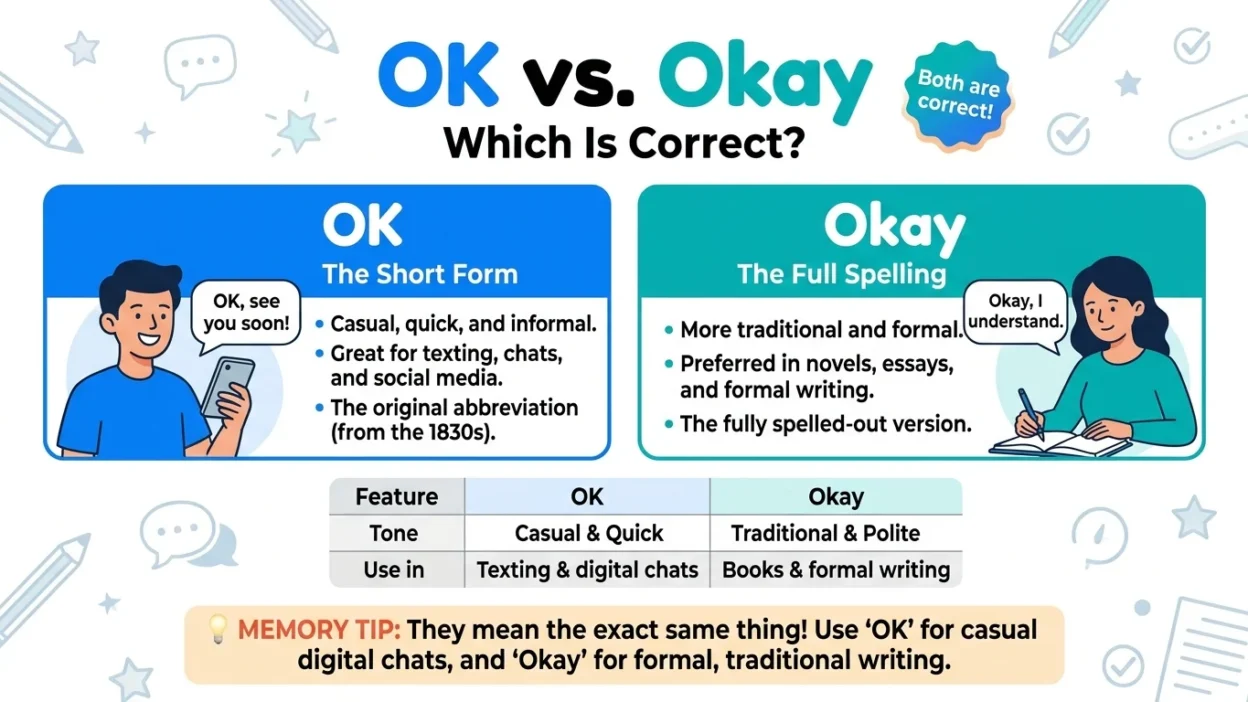
OK vs. Okay: Key Differences
| Feature | OK | Okay |
|---|---|---|
| Meaning | Agreement, approval, or satisfactory condition | The same |
| Spelling | Short form | Full spelling |
| Grammatical use | Interjection, adjective, adverb, or verb in appropriate contexts | Interjection, adjective, adverb, or verb in appropriate contexts |
| Tone | Concise and familiar | Conversational and fully spelled out |
| Text messages | Very common | Very common |
| Formal writing | Acceptable in many contexts | Acceptable in many contexts |
| Example | OK, I’ll be there. | Okay, I’ll be there. |
The main difference is the spelling, not the meaning. Neither form is universally more correct than the other.
When Should You Use OK or Okay?
Both forms are acceptable, but your choice may depend on the situation.
1. In Text Messages and Chats
Both spellings are common in informal digital communication.
Examples:
- OK, I’ll call you later.
- Okay, thanks!
- Are you OK?
- Okay, see you soon.
Choose the version that matches your usual writing style and the tone of the conversation.
2. In Professional Emails
Both forms can work in professional emails, depending on the message.
Examples:
- Okay, I will send the revised report today.
- The proposed schedule is OK with me.
However, in a formal email, more specific expressions may sound more polished.
Instead of:
- OK, I will do it.
You could write:
- Certainly, I will take care of it.
- Understood. I will proceed accordingly.
- That arrangement works for me.
These alternatives communicate your meaning more precisely when the situation requires a formal tone.
3. In Academic Writing
In academic writing, OK and okay may sound conversational. Whether they are appropriate depends on the discipline, the type of assignment, and the style guide.
Instead of writing:
- The results were okay.
Consider:
- The results were acceptable.
- The findings were satisfactory.
- The results met the required standard.
Choose a precise word that reflects your intended meaning.
4. When Expressing Agreement
Both spellings can communicate agreement or acceptance.
Examples:
- OK, let’s start the meeting.
- Okay, I agree with your suggestion.
- That is OK with me.
- That is okay with me.
There is no essential difference in meaning between these examples.
5. When Reassuring Someone
Both forms are used to reassure people or ask about their well-being.
Examples:
- Everything will be OK.
- Everything will be okay.
- Are you OK?
- Are you okay?
Both versions are natural and correct.
OK vs. Okay: Examples in Different Situations
| Situation | Example with OK | Example with Okay |
|---|---|---|
| Agreement | OK, let’s go. | Okay, let’s go. |
| Permission | Is it OK to leave early? | Is it okay to leave early? |
| Well-being | Are you OK? | Are you okay? |
| Acceptance | The plan is OK. | The plan is okay. |
| Reassurance | Everything will be OK. | Everything will be okay. |
| Approval | The manager said it was OK. | The manager said it was okay. |
Both columns use correct English. You can generally substitute one spelling for the other without changing the sentence’s meaning.
12 Examples of OK and Okay in Sentences
Here are practical examples that show how the two spellings are used.
- OK, I will meet you outside the library.
- Okay, please send me the details.
- Is it OK if I borrow your pen?
- Is it okay to ask for help?
- Everything will be OK after we solve the problem.
- I hope you are okay after your long journey.
- The new schedule is OK with everyone.
- The food was okay, but I preferred the dessert.
- OK, let’s discuss the next question.
- Okay, I understand what you mean.
- The teacher said it was OK to submit the assignment tomorrow.
- She okayed the final design before publication.
These examples show that OK and okay can be used in similar contexts, while the verb okay has its own spelling patterns.
Common Mistakes to Avoid
1. Assuming Okay Is the Only Correct Form
Incorrect belief: “OK is always wrong.”
Correction: Both OK and okay are established, correct spellings.
2. Assuming OK Is Only for Text Messages
OK is common in informal communication, but it also appears in professional writing, public notices, and many edited texts.
The appropriate choice depends on context and style.
3. Writing Ok in Formal Text Without a Style Reason
Although Ok appears in casual writing, OK and okay are safer, more widely established choices. If you use a particular style guide, follow its preference.
4. Confusing Okay With Okey
In standard English, the usual forms are OK and okay. Okey is not the standard spelling for the ordinary expression.
5. Overusing OK in Formal Writing
Although OK is correct, repeating it in formal documents may make your writing sound vague or conversational.
Instead of “The report is OK,” consider more precise wording such as:
- The report is satisfactory.
- The report meets the requirements.
- The report is acceptable.
Choose the expression that best describes the situation.
6. Forgetting the Verb Form
When okay is used as a verb, it follows ordinary English verb patterns.
Examples:
- Present: The manager okays the request.
- Past: The manager okayed the request.
- Present participle: The manager is okaying the request.
These spellings are standard. You may also encounter OK’d or OKing in some writing, but consistency is important.
Memory Trick: How to Remember OK vs. Okay
Remember this simple rule:
OK = short form. Okay = full spelling.
Both express the same basic idea.
- OK, I’ll be there.
- Okay, I’ll be there.
For professional or academic writing, think about what you really want to communicate. If you mean acceptable, approved, satisfactory, or understood, one of those words may be more precise than either OK or okay.
The best choice is the one that suits the context and remains consistent throughout your writing.
American vs. British English: Is There a Difference?
Both OK and okay are widely understood and used in American and British English. Neither spelling belongs exclusively to one variety.
| Feature | American English | British English |
|---|---|---|
| OK | Correct | Correct |
| Okay | Correct | Correct |
| Everyday use | Both are common | Both are common |
| Formal writing | Follow the relevant style guide | Follow the relevant style guide |
Differences are more likely to reflect a publisher’s or organization’s preferred style than a strict regional grammar rule.
Similar Words and Alternatives to OK and Okay
Depending on your intended meaning, several alternatives may be more suitable.
| Word or phrase | Meaning | Example |
|---|---|---|
| All right | Acceptable or satisfactory | Everything is all right. |
| Fine | Acceptable or in good condition | The plan is fine with me. |
| Acceptable | Meeting an expected standard | The results are acceptable. |
| Certainly | Expressing agreement or willingness | Certainly, I can help. |
| Understood | Showing that a message has been understood | Understood. I will proceed. |
| Approved | Officially accepted or authorized | The proposal has been approved. |
| No problem | Informal reassurance or agreement | No problem, I’ll help you. |
| Satisfactory | Good enough to meet requirements | The work was satisfactory. |
Choose an alternative according to the message you want to communicate. For example, approved suggests authorization, while okay may express only general acceptance.
Final Verdict: OK or Okay?
Both OK and okay are correct and widely accepted in modern English. They generally mean the same thing and can express agreement, approval, acceptance, or a satisfactory condition.
Use OK when you want a short, concise form. Use okay when you prefer the fully spelled-out version. In formal documents, follow the relevant style guide and consider whether a more precise expression, such as acceptable, approved, or understood, would communicate your meaning better.
The important point is not to treat one spelling as right and the other as wrong. Choose the form that fits your context and use it consistently.
Frequently Asked Questions
1. Is OK or okay correct?
Both are correct. OK is a shorter spelling, while okay is the full spelling. They generally have the same meaning.
2. Is okay more formal than OK?
Not necessarily. Okay is fully spelled out, while OK is more concise. Neither is automatically more formal in every context. Follow the style guide or organization’s preference when one exists.
3. Should I write OK or okay in an email?
Both are acceptable in many emails. For a casual message, either works. For a formal email, consider using a more precise expression such as certainly, understood, or that arrangement is acceptable.
4. Is OK an abbreviation?
OK is commonly treated as an initialism or conventional short form of okay. Its exact historical origin has been widely discussed, but in modern English, both spellings are established.
5. Is it okay or is it OK?
Both are correct.
Examples:
- Is it okay to call you later?
- Is it OK to call you later?
The choice is stylistic rather than grammatical.
6. Is Ok with a lowercase k correct?
You may encounter Ok, especially in casual digital writing, but OK and okay are safer standard choices. Use the form preferred by your style guide and remain consistent.
7. What is the plural or past tense of OK?
When used as a verb, okay can form okays, okayed, and okaying.
Examples:
- She okays the requests.
- He okayed the changes.
- They are okaying the final version.
8. Is okay appropriate for academic writing?
It depends on the context. In informal discussion or dialogue, okay may be appropriate. In formal academic prose, more precise alternatives such as acceptable, satisfactory, or adequate are often better.
Remember This
- OK and okay are both correct.
- Both forms have essentially the same meaning.
- OK is the shorter form.
- Okay is the fully spelled-out form.
- Neither spelling is universally more formal.
- Follow the relevant style guide in professional or academic writing.
- Use a more precise alternative when OK or okay does not express your meaning clearly.
Conclusion
The difference between OK and okay is mainly a matter of spelling and style, not meaning. Both forms are widely accepted in English and can express agreement, approval, acceptance, or reassurance. You can generally use either form in everyday conversations, messages, and many types of writing.
When writing professionally, choose the spelling that matches your organization’s preferred style and remain consistent. If you need to communicate a specific judgment or decision, consider alternatives such as acceptable, approved, or understood. Knowing when to use these expressions will make your English clearer and more precise.

Adam Aaron is a language enthusiast and content writer at SimileHive, creating clear, engaging guides on similes, idioms, metaphors, and figurative language to help readers improve English confidently every day.