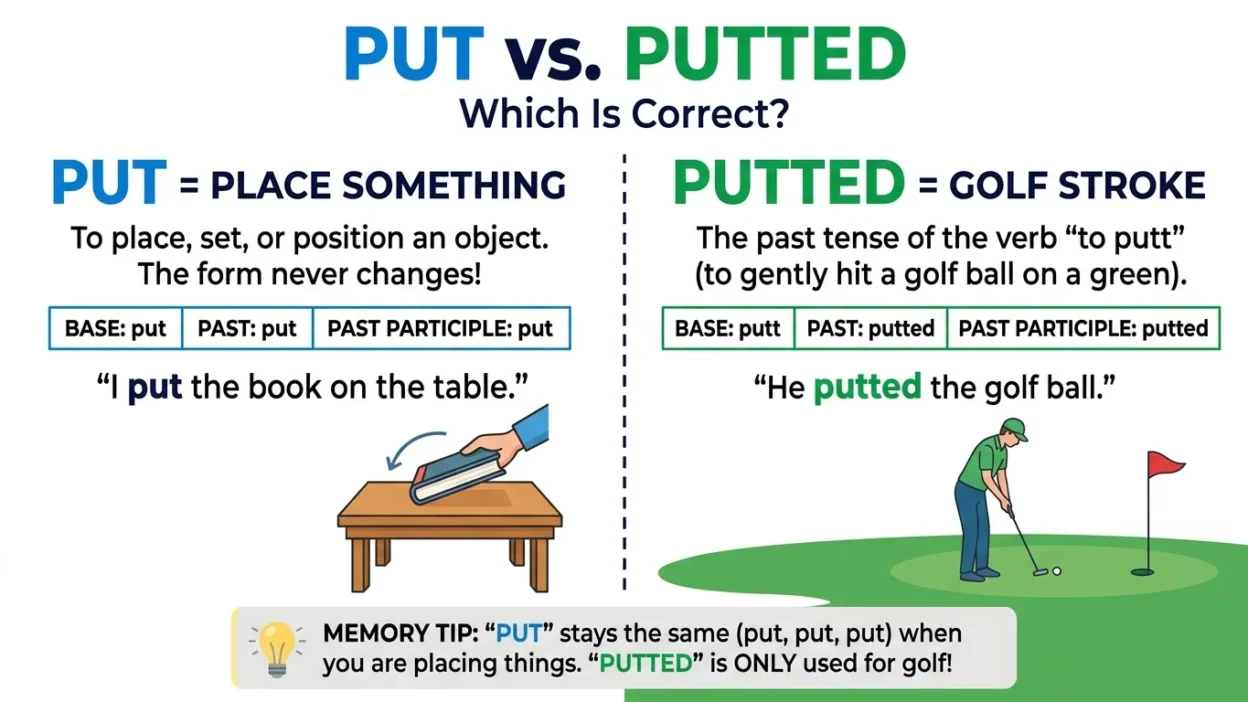
Is it putted or put? If you have ever wondered which word to use when talking about something you placed somewhere in the past, the answer is simple: put is the correct past tense of put, while putted is generally incorrect when you mean placed or moved something to a position. The verb put is an irregular verb, which means it does not form its past tense by adding -ed.
For example, you should say, “I put the book on the table yesterday,” not “I putted the book on the table yesterday.” The same form, put, is used in the present tense, past tense, and past participle. However, putted does exist as a specialized form of the verb putt, which is used in golf.
Understanding this difference will help you avoid common grammar mistakes and use the correct verb form in everyday conversations, school assignments, professional writing, and exams.
Quick Answer
Put is correct; putted is incorrect when you mean placing something somewhere. The verb put has the same form in the present tense, simple past tense, and past participle: put, put, put. For example, “I put my keys on the desk yesterday.” However, putted is the past tense of putt, a golf term meaning to make a short stroke toward the hole.
Why Do People Confuse Putted and Put?
People often confuse these words because many English verbs form their past tense by adding -ed.
For example:
- Walk → walked
- Talk → talked
- Jump → jumped
- Clean → cleaned
Following this pattern, some learners assume that put becomes putted. However, English also contains irregular verbs that do not follow this rule.
Examples:
- Put → put
- Cut → cut
- Hit → hit
- Set → set
- Let → let
These verbs retain the same form in the present tense and simple past tense.
The confusion also occurs because putted is a legitimate word in golf, but it has a different meaning.
First Word: Put
Put is the correct verb when you mean to place, position, or move something somewhere.
It is an irregular verb, so its form does not change in the simple past tense or past participle.
What Does Put Mean?
The verb put commonly means to move something to a particular place or position.
Examples:
- Please put your bag on the chair.
- I put my phone in my pocket.
- She put the flowers in a vase.
- He put the keys on the kitchen counter.
In these sentences, put describes the action of placing something.
What Is the Past Tense of Put?
The simple past tense of put is put.
Examples:
- Present: I put my books on the shelf every evening.
- Past: I put my books on the shelf yesterday.
- Past participle: I have put my books on the shelf.
Notice that the spelling remains the same in all three forms.
What Is the Past Participle of Put?
The past participle of put is also put. It is used with auxiliary verbs such as have, has, and had.
Examples:
- I have put the documents in the folder.
- She has put the children to bed.
- They had put everything in its proper place before leaving.
These sentences demonstrate that put does not change its spelling when used with a helping verb.
Second Word: Putted
Putted is a real English word, but it is generally not the correct past tense of put when the meaning is “to place something somewhere.”
Instead, putted is the past tense and past participle of putt, a verb used mainly in golf.
What Does Putted Mean?
In golf, to putt means to strike a golf ball gently, usually on the putting green, to move it toward the hole.
Examples:
- She putted the ball toward the hole.
- He putted carefully on the final green.
- The golfer putted from a short distance and scored.
In these examples, putted is grammatically correct because the base verb is putt, not put.
Can You Use Putted to Mean Placed?
In standard English, no. When you mean that you placed something somewhere, use put.
Incorrect: I putted my wallet on the table.
Correct: I put my wallet on the table.
Incorrect: She putted the clothes in the cupboard.
Correct: She put the clothes in the cupboard.
Remember that put and putt are different verbs with different meanings.
Put vs. Putted: Comparison Table
| Feature | Put | Putted |
|---|---|---|
| Base verb | Put | Putt |
| Meaning | Place or position something | Strike a golf ball with a short stroke |
| Simple past tense | Put | Putted |
| Past participle | Put | Putted |
| Example | I put the book on the desk. | He putted the ball toward the hole. |
| Correct for ordinary placement? | Yes | No |
The essential distinction is the base verb. Put refers to placing something, while putt refers to a type of golf stroke.
When Should You Use Put or Putted?
Use the word that matches the intended meaning.
When to Use Put
Use put when talking about placing, positioning, or moving something into a particular location.
Examples:
- I put my shoes near the door.
- She put the milk in the refrigerator.
- They put their books on the desk.
- He put the baby in the crib.
- We put the chairs around the table.
These examples use put correctly in the past tense or present tense, depending on context.
When to Use Putted
Use putted when describing the action of putting a golf ball toward the hole.
Examples:
- He putted the ball into the hole.
- She putted from the edge of the green.
- The golfer putted twice on the final hole.
In ordinary writing about placing objects, put is the correct choice.
Put vs. Putted: Examples in Sentences
The following examples show the difference between the two words.
| Incorrect or correct usage | Explanation |
|---|---|
| Incorrect: I putted my bag on the floor. | Use put for placing a bag. |
| Correct: I put my bag on the floor. | Put is the simple past tense. |
| Incorrect: She putted the book in her backpack. | The sentence describes placing a book. |
| Correct: She put the book in her backpack. | Put is the correct verb. |
| Correct: He putted the golf ball toward the hole. | Putted is the past tense of putt. |
| Correct: She has put the keys on the desk. | Put is the past participle. |
12 Examples of Put in Sentences
Here are more examples of the correct use of put.
- I put my phone on the desk yesterday.
- She put the groceries in the kitchen.
- He put his jacket on the chair.
- They put their luggage in the car.
- We put the books back on the shelf.
- My mother put the food in the refrigerator.
- The teacher put the papers on the table.
- I have put your name on the list.
- She has put the children to bed.
- They had put the furniture in the correct rooms.
- Please put your shoes outside.
- He will put the letter in the envelope.
Notice that put stays the same even when the time changes. Words such as yesterday, have, had, and will help establish the tense.
Common Mistakes to Avoid
1. Adding -ed to Put
Incorrect: I putted the keys on the table.
Correct: I put the keys on the table.
Why? Put is an irregular verb whose past tense does not take -ed.
2. Using Putted With the Wrong Meaning
Incorrect: She putted her phone in her bag.
Correct: She put her phone in her bag.
Use putted only when the intended verb is putt, usually in golf.
3. Changing Put in the Past Participle
Incorrect: I have putted the files in the folder.
Correct: I have put the files in the folder.
The past participle of put is also put.
4. Assuming All Verbs Follow the Same Past-Tense Rule
Many verbs form their past tense with -ed, but irregular verbs follow different patterns.
Examples:
- Put → put
- Cut → cut
- Hit → hit
- Buy → bought
- Bring → brought
Learn irregular verbs individually instead of applying the -ed rule to every verb.
5. Confusing Put With Putt
Remember:
- Put: Place something somewhere.
- Putt: Strike a golf ball with a short stroke.
The two verbs sound similar, but their meanings are different.
Memory Trick: How to Remember Put vs. Putted
Use this simple rule:
Put → Put → Put
- Present: I put the book here.
- Past: I put the book here yesterday.
- Past participle: I have put the book here.
Remember the golf exception:
Putt → Putted
Think of a golfer putting a ball toward the hole. The extra t in putt helps distinguish the golf verb from the ordinary verb put.
If you are describing an object being placed somewhere, use put. If you are describing a golf stroke, putted may be correct.
American vs. British English: Is There a Difference?
There is no significant difference between American and British English in the past-tense forms of these verbs.
| Verb | American English | British English |
|---|---|---|
| Put (past tense) | Put | Put |
| Put (past participle) | Put | Put |
| Putt (past tense) | Putted | Putted |
| Putt (past participle) | Putted | Putted |
Both varieties use put when referring to placing something and putted when referring to the past tense of the golf verb putt.
Similar Words: Put, Set, Place, and Lay
Several English verbs describe positioning something, but they are not always interchangeable.
| Word | Meaning | Example |
|---|---|---|
| Put | Move something to a position | I put the cup on the table. |
| Set | Place something in a particular position | She set the vase on the shelf. |
| Place | Put something somewhere, often carefully | He placed the documents in a folder. |
| Lay | Put something down in a flat position | She laid the blanket on the bed. |
These verbs may have different past-tense forms:
- Put → put
- Set → set
- Place → placed
- Lay → laid
Learning these patterns can help you avoid errors when describing actions in the past.
Final Verdict: Put or Putted?
Put is the correct past tense and past participle of the verb put. Use it when you mean to place, position, or move something somewhere.
For example:
- Correct: I put my keys on the table yesterday.
- Correct: I have put the documents in the folder.
- Incorrect: I putted my keys on the table yesterday.
However, putted is correct when it is the past tense or past participle of putt, the golf verb.
The simplest rule is to remember that put stays the same in the present, past, and past participle forms. Do not add -ed unless you are using the separate verb putt.
Frequently Asked Questions
1. Is it putted or put?
Put is correct when you mean to place something somewhere. For example, “I put my bag on the chair yesterday.” Putted is the past tense of the golf verb putt.
2. Is putted ever a correct word?
Yes. Putted is correct when describing a golf stroke.
Example: “He putted the ball toward the hole.”
It is not the standard past tense of put meaning “to place.”
3. What is the past tense of put?
The past tense of put is put.
Example: “I put the letter in the envelope yesterday.”
4. What is the past participle of put?
The past participle is also put.
Example: “She has put the documents on the desk.”
5. Is it I put or I putted yesterday?
The correct sentence is “I put it yesterday.” Use put because the verb has the same spelling in the present and simple past tenses.
6. Is putted grammatically incorrect?
Not always. It is correct as the past tense of putt, the golf verb. It is generally incorrect when used as the past tense of put meaning “to place.”
7. What are the three forms of put?
The three principal forms are:
- Base form: put
- Simple past: put
- Past participle: put
Example: “I put it there yesterday, and I have put it there before.”
8. Why does put not become putted?
Put is an irregular verb. Irregular verbs do not always form the past tense by adding -ed. In this case, all three principal forms remain the same: put, put, put.
Remember This
- Put means to place or position something.
- Put is the present tense, simple past tense, and past participle.
- Putted is the past tense of putt, the golf verb.
- Do not write “I putted the book on the table.”
- Write “I put the book on the table.”
- Learn irregular verbs individually instead of adding -ed automatically.
Conclusion
The difference between put and putted depends on the verb’s meaning. When you describe placing something somewhere, put is correct in the present tense, past tense, and past participle. This is because put is an irregular verb that does not change its form.
The word putted is also correct, but it belongs to the separate verb putt, which is commonly used in golf. Remembering this distinction will help you write more accurately and avoid a common English grammar mistake.

Charles Kevin is a passionate language writer and researcher at SimileHive, creating clear, engaging content about similes, idioms, metaphors, and figurative language to help readers improve English communication confidently every day.