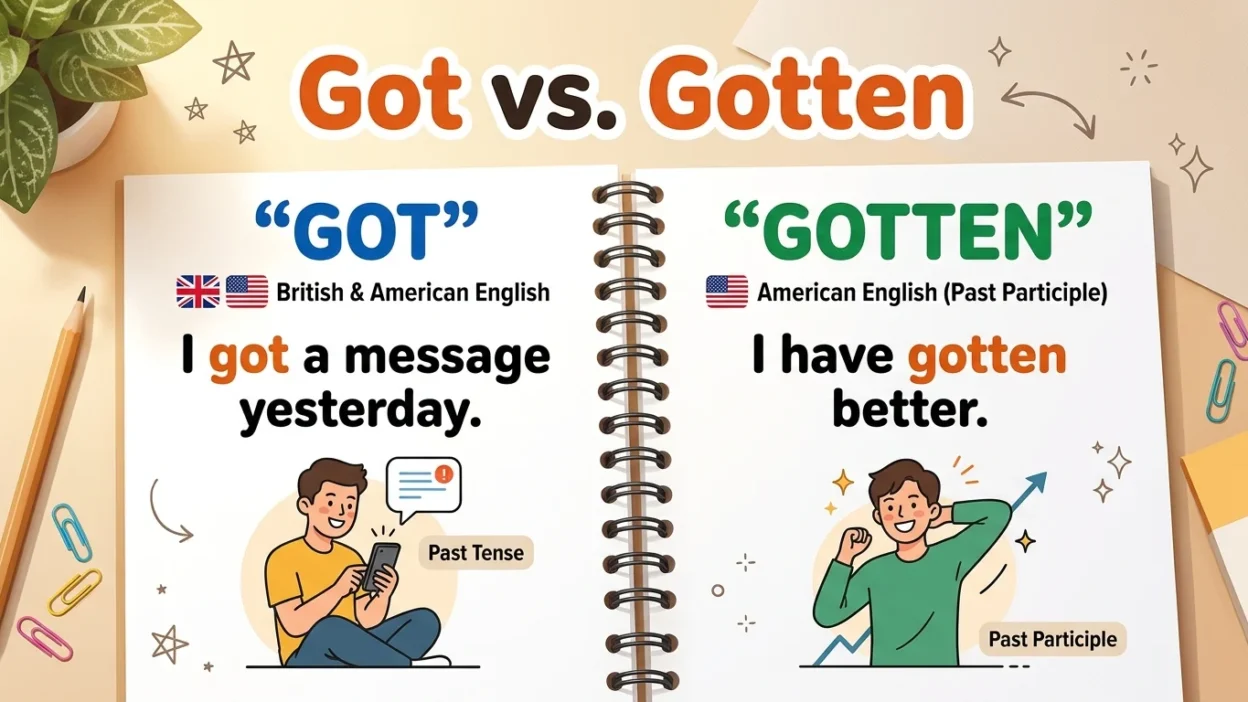
Have you ever wondered whether to write “got” or “gotten”? Both words are correct, but they are used differently depending on the type of English you speak and the meaning you want to express. Got is common in both American and British English, while gotten is used mainly in American English as the past participle of get.
Understanding the difference between gotten and got can help you write more naturally, avoid common grammar mistakes, and choose the right word for different situations. For example, Americans often say, “I have gotten better at English,” while British speakers usually say, “I have got better at English.” However, the distinction is not always that simple because the two varieties of English also use these words differently in expressions such as “have got” and “have got to.”
Quick Answer: Gotten vs. Got
Gotten is the past participle of get in American English and often emphasizes a change, development, or process of obtaining something. Got is the simple past form in both American and British English and is also the usual past participle in British English. In American English, got is especially common in expressions such as “have got” for possession and “have got to” for obligation.
Why Do People Confuse Gotten and Got?
People confuse gotten and got because both words come from the verb get. Their correct use also depends on whether someone is speaking American or British English.
The main difference is grammatical:
- Got: Used as the simple past form of get in both American and British English.
- Gotten: Used mainly as the past participle of get in American English.
- Have got: Commonly expresses possession or obligation in American English and is also widely used in British English.
- Have gotten: Often describes a change or the process of obtaining something in American English.
For example:
- I got a new job last week.
- I have gotten better at writing.
- I have got two brothers.
- I have got to finish this assignment.
Each sentence uses a form of get, but the grammar and meaning differ.
What Does Got Mean?
Got is the simple past form of get. It describes something that happened in the past, such as receiving, obtaining, finding, or becoming something.
Examples of Got
- I got your message yesterday.
- She got a new phone for her birthday.
- We got home late last night.
- He got angry when he heard the news.
- They got tickets for the concert.
- I got an excellent grade on my exam.
- The weather got colder after sunset.
- She got the answer right.
- We got lost on the way to the hotel.
- He got a promotion at work.
In these examples, got refers to a past event or change. It is correct in both American and British English.
Is Got Also a Past Participle?
Yes. Got is the past participle of get in British English and is also used as a past participle in certain American English expressions.
Examples:
- British English: I have got much better at cooking.
- American English: I have got two sisters.
- American English: We have got to leave now.
Remember that have got can express possession, while have got to expresses necessity or obligation.
What Does Gotten Mean?
Gotten is the past participle of get in American English. It commonly appears with have, has, or had to describe a change, a result, or the process of acquiring something.
Examples of Gotten
- I have gotten much better at English.
- She has gotten a new job.
- We have gotten used to the cold weather.
- He has gotten taller since last year.
- They have gotten permission to enter.
- The situation has gotten worse.
- I had gotten the information before the meeting.
- She has gotten more confident over time.
- We have gotten several emails today.
- The children have gotten tired after playing outside.
These examples are natural in American English. In British English, speakers generally use got instead of gotten in these past-participle constructions, although usage can vary.
Got vs. Gotten: Key Differences
| Feature | Got | Gotten |
|---|---|---|
| Main use | Simple past of get | Past participle of get in American English |
| American English | Very common | Very common in perfect tenses |
| British English | Used as simple past and past participle | Generally uncommon |
| Example | I got a gift yesterday. | I have gotten a gift recently. |
| Change or development | The weather got colder. | The weather has gotten colder. |
| Possession | I have got a car. | Not normally used to express possession |
| Obligation | I have got to go. | Not used in this expression |
When Should You Use Got?
Use got when describing a completed past action. You can also use it in expressions involving possession or obligation.
1. Use Got for a Past Event
When something happened at a specific time in the past, use got.
- I got home at six o’clock.
- She got a letter yesterday.
- We got the results last Friday.
2. Use Got to Express Possession
In the expression have got, the word got can mean that someone possesses something.
- I have got a bicycle.
- She has got blue eyes.
- They have got a beautiful house.
In American English, “I have a bicycle” is also very common.
3. Use Got in the Expression Have Got To
The expression have got to means must or need to.
- I have got to finish my homework.
- She has got to leave early.
- We have got to be careful.
This expression is informal and common in both American and British English.
When Should You Use Gotten?
Use gotten mainly in American English when forming perfect tenses with have, has, or had.
1. To Describe a Change
Use gotten when something has changed or developed over time.
- My English has gotten better.
- The traffic has gotten worse.
- He has gotten more patient.
2. To Describe Becoming Something
Gotten can describe a change in condition, mood, or situation.
- She has gotten sick.
- The room has gotten warmer.
- I have gotten tired of waiting.
3. To Describe Obtaining Something
Use gotten when emphasizing the process or result of acquiring something.
- I have gotten a new passport.
- We have gotten permission to use the room.
- She has gotten several offers.
In British English, got is generally preferred in comparable sentences: “My English has got better” or “I have got a new passport.”
Got vs. Gotten in American and British English
The most important distinction is regional usage. American English regularly uses gotten as a past participle, while British English usually uses got.
| Meaning | American English | British English |
|---|---|---|
| Past event | I got home late. | I got home late. |
| Improvement | My English has gotten better. | My English has got better. |
| Change in weather | It has gotten colder. | It has got colder. |
| Possession | I’ve got a car. | I’ve got a car. |
| Obligation | I’ve got to go. | I’ve got to go. |
Both varieties are correct within their usual patterns. If you are writing for an American audience, gotten is often appropriate in perfect-tense sentences about changes or acquisition. If you are writing for a British audience, got is generally the safer choice.
Common Mistakes With Got and Gotten
Mistake 1: Using Gotten as the Simple Past
Incorrect: I gotten a new phone yesterday.
Correct: I got a new phone yesterday.
Why? Use got as the simple past form of get. Gotten normally needs a helping verb such as have, has, or had.
Mistake 2: Using Gotten in British English Without Considering Audience
American English: The situation has gotten worse.
British English: The situation has got worse.
Both forms can be understood, but got is the conventional British English choice.
Mistake 3: Confusing Got With Have Got
“I got a car” usually describes receiving or obtaining a car in the past. “I have got a car” usually means that you own or possess one.
- I got a car last month. (Past event)
- I have got a car. (Possession)
Mistake 4: Writing Have Gotten To When You Mean Obligation
Awkward: I have gotten to leave now.
Natural: I have got to leave now.
Use have got to to mean must or need to. Do not substitute gotten in this expression.
A Simple Memory Trick
Remember this rule:
- Got = past event: I got a gift yesterday.
- Gotten = American English past participle: I have gotten a gift.
- Have got = possession: I have got a gift.
- Have got to = obligation: I have got to leave.
Think of gotten as the form that often appears after have when an American English speaker describes a change or the process of getting something.
Got vs. Gotten: More Example Sentences
Here are additional examples to help you understand how each form works.
- I got a call from my manager this morning.
- She has gotten much better at driving.
- We got caught in the rain yesterday.
- He has gotten used to his new school.
- They got the keys from the landlord.
- The days have gotten shorter.
- I got an invitation to the wedding.
- She has gotten three job offers.
- We have got enough food for everyone.
- You have got to see this movie.
- The baby got sleepy after lunch.
- The project has gotten more complicated.
Notice that got works for simple past actions, while gotten often appears in American English with a helping verb to describe a change or an acquisition.
Similar Words and Verb Forms
The verb get has several forms, and knowing them makes the distinction easier.
| Verb form | Word | Example |
|---|---|---|
| Base form | Get | I get emails every day. |
| Third-person singular | Gets | She gets good grades. |
| Simple past | Got | He got a present. |
| Past participle (American English) | Gotten | He has gotten a present. |
| Past participle (British English) | Got | He has got a present. |
| Present participle | Getting | She is getting ready. |
Note that the past participle got in “He has got a present” can be interpreted differently depending on context. It may refer to possession or, in British English, to an event of receiving something.
Frequently Asked Questions
1. Is Gotten Grammatically Correct?
Yes. Gotten is grammatically correct and widely used in American English as the past participle of get. For example, “I have gotten better at writing” is standard American English.
2. Is Gotten American or British English?
Gotten is primarily associated with American English. British English generally uses got as the past participle of get, although there are exceptions and regional variations.
3. Is It I Have Got or I Have Gotten?
Both are correct, but their meanings can differ. “I have got a car” usually means that you possess a car. “I have gotten a car” in American English usually means that you have acquired one.
4. Is Gotten the Past Tense of Get?
No. The simple past of get is got. Gotten is the past participle in American English.
Correct: “I got a new job yesterday.”
Correct: “I have gotten a new job.”
5. Do Americans Say Got or Gotten?
Americans use both. They say “I got it yesterday” for a past event and often say “I have gotten better” to describe a change. They also use got in expressions such as “I’ve got a car.”
6. Do British People Use Gotten?
British speakers generally use got instead of gotten. However, gotten does occur in some British contexts, including fixed expressions and certain regional or historical uses.
7. Is It Has Gotten Worse or Has Got Worse?
Both are grammatical. “Has gotten worse” is the usual American English form, while “has got worse” is the usual British English form.
8. Can I Use Gotten in Formal Writing?
Yes. Gotten is acceptable in formal American English when used correctly. Choose the form that matches your audience, dialect, and the meaning of the sentence.
Remember This
- Got is the simple past form of get in both American and British English.
- Gotten is the usual past participle of get in American English.
- Have got commonly expresses possession.
- Have got to expresses obligation or necessity.
- British English generally prefers got where American English often uses gotten.
Conclusion
The difference between got and gotten mainly depends on grammar, meaning, and regional usage. Got is the simple past form of get in both American and British English. Gotten is the standard past participle in American English, especially when describing a change, development, or the process of obtaining something.
To choose the correct word, first ask whether you are describing a past event, expressing possession, showing a change, or stating an obligation. Use got for simple past actions, gotten for many American English perfect-tense constructions, have got for possession, and have got to for necessity. With these patterns in mind, you can use both forms naturally and confidently.

Lucas Luke is a passionate language writer and content creator at SimileHive, specializing in similes, idioms, metaphors, and figurative language. He enjoys making complex English expressions simple, engaging, and easy to understand for students, writers, and language enthusiasts through well-researched, practical content.