Is it “setup” or “set up”? Both forms are correct, but they serve different grammatical purposes. The difference depends on how you use the word in a sentence. Setup is usually a noun or an adjective, while set up is a verb phrase that describes the action of arranging, installing, or establishing something.
For example, you might write, “The computer setup is simple,” but “I need to set up my new computer.” Although the two expressions look almost identical, using the wrong form can make your writing less accurate.
Understanding this simple grammar rule will help you write clearer emails, instructions, academic assignments, and professional documents. Once you know whether you are naming an arrangement or describing an action, choosing between setup and set up becomes much easier.
Quick Answer: Setup vs. Set Up
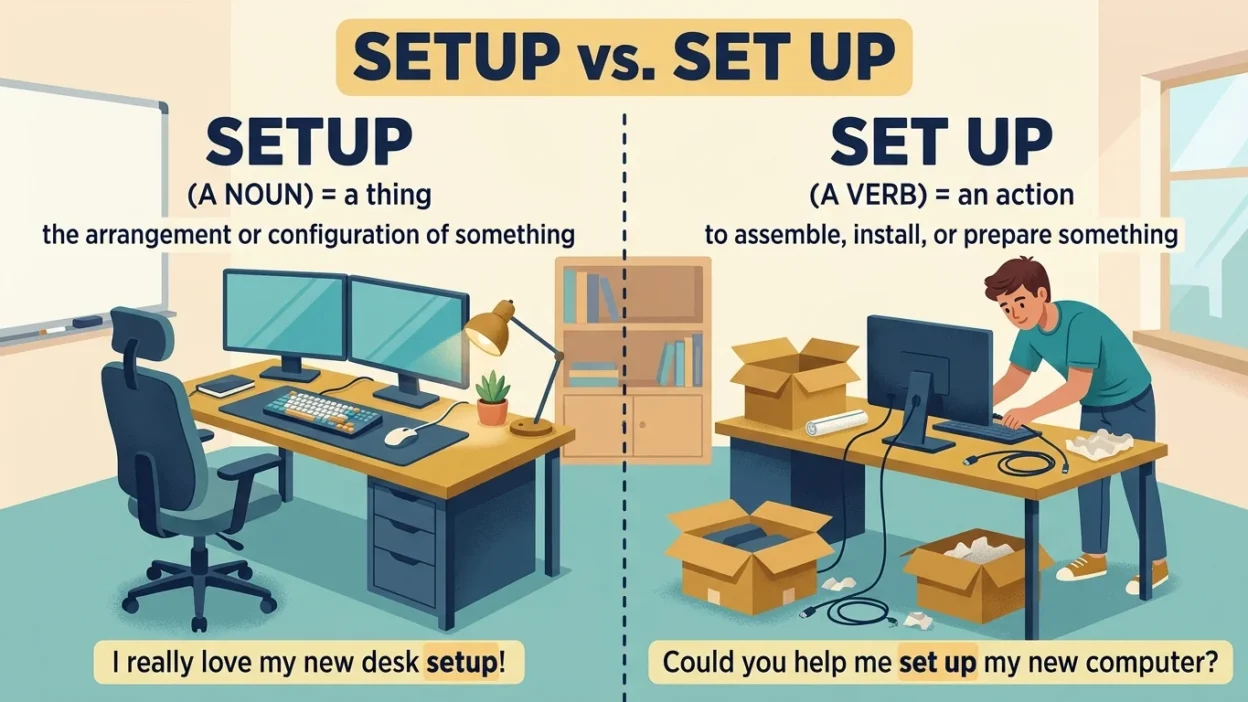
Setup is generally a noun meaning an arrangement, configuration, or collection of equipment. It can also be an adjective, as in setup instructions. Set up is a verb phrase meaning to arrange, install, organize, or establish something. Use setup when naming a thing or arrangement, and use set up when describing an action. For example, “The setup is ready” is correct, as is “Please set up the equipment.”
Why Do People Confuse Setup and Set Up?
People confuse setup and set up because they contain the same words and have closely related meanings. The main difference is grammatical: one usually names something, while the other describes an action.
Compare these examples:
- Noun: The office setup is comfortable.
- Verb: I need to set up my office.
- Adjective: Read the setup instructions first.
In the first sentence, setup names an arrangement. In the second, set up describes the action of arranging the office. In the third, setup modifies the noun instructions.
The easiest way to remember the difference is to ask yourself: Am I naming something, or am I describing an action?
What Does Setup Mean?
Setup is a noun that refers to the way something is arranged, organized, or configured. It can describe equipment, a workspace, a system, a plan, or a situation.
Examples of Setup as a Noun
- My computer setup includes two monitors.
- The conference room setup was perfect for the meeting.
- We need a better setup for our online classes.
- The gaming setup took several hours to organize.
- The sound setup was ready before the concert.
- Her home office setup is simple and comfortable.
- The laboratory setup requires special equipment.
- The new security setup protects the building.
- Our classroom setup encourages group discussion.
- The initial setup of the device was easy.
In each sentence, setup names an arrangement, configuration, or system.
Can Setup Be an Adjective?
Yes. Setup can also be used as an adjective before a noun, especially in phrases related to preparation or installation.
Examples:
- Please read the setup instructions.
- The setup process takes about ten minutes.
- We followed the setup guide carefully.
- The technician provided a setup checklist.
In these examples, setup describes the type of instructions, process, guide, or checklist.
What Does Set Up Mean?
Set up is a verb phrase that means to arrange, install, organize, prepare, or establish something. It describes an action that someone performs.
The phrase is made up of the verb set and the particle up. Its past-tense and past-participle forms are set up, not setuped.
Examples of Set Up as a Verb
- I need to set up my new laptop.
- She will set up a meeting with the manager.
- We set up the chairs before the guests arrived.
- They plan to set up a small business.
- He helped me set up my email account.
- The teacher will set up a group activity.
- Please set up the projector before the presentation.
- The company wants to set up a new office.
- We set up the equipment yesterday.
- Can you set up an appointment for Friday?
In these examples, set up describes an action: arranging, preparing, installing, or establishing something.
Setup vs. Set Up: Key Differences
| Feature | Setup | Set up |
|---|---|---|
| Part of speech | Usually a noun; sometimes an adjective | Verb phrase |
| Main meaning | An arrangement or configuration | To arrange, install, prepare, or establish |
| Example | The setup is complete. | Please set up the computer. |
| Past tense | Not applicable as a noun | Set up |
| Common phrases | Computer setup, setup guide | Set up an account, set up a meeting |
| Quick test | Can you replace it with “arrangement”? | Can you replace it with “arrange” or “install”? |
When Should You Use Setup?
Use setup when you are referring to an arrangement, configuration, or system rather than the action of creating it.
1. When Talking About Equipment
- My desk setup includes a laptop and two screens.
- The audio setup needs improvement.
- His gaming setup is expensive.
2. When Describing a System or Arrangement
- The seating setup allows everyone to see the stage.
- Our current office setup is suitable for remote work.
- The classroom setup makes group activities easier.
3. When Using It Before Another Noun
- Follow the setup instructions.
- The setup guide explains each step.
- We printed a setup checklist for new employees.
4. When Referring to an Initial Configuration
- The initial setup took only five minutes.
- The software setup was straightforward.
- The device has a simple setup.
A helpful test is to replace setup with arrangement or configuration. If the sentence still makes sense, the noun form is probably correct.
When Should You Use Set Up?
Use set up when you are describing the act of arranging, installing, preparing, or establishing something.
1. When Installing Technology
- I will set up my new phone tonight.
- Can you set up the printer?
- She helped me set up my online account.
2. When Arranging Meetings or Events
- We need to set up a meeting.
- They will set up the stage tomorrow.
- Please set up the chairs before the guests arrive.
3. When Establishing a Business or Organization
- They want to set up a company.
- The charity plans to set up a local office.
- She hopes to set up her own business.
4. When Creating a System or Process
- The administrator will set up a new account.
- We need to set up a payment system.
- The school will set up a new registration process.
If you can replace set up with arrange, install, prepare, or establish, the two-word verb phrase is likely the right choice.
Setup vs. Set Up in Different Sentences
The following pairs show how the meaning and grammar change.
| Sentence with Setup | Sentence with Set Up |
|---|---|
| The setup is easy. | I will set up the equipment. |
| My office setup is comfortable. | I need to set up my office. |
| The software setup was quick. | We will set up the software. |
| The meeting setup looks professional. | Let’s set up a meeting. |
| The camera setup is complete. | She will set up the camera. |
Notice that setup names the arrangement, while set up describes the action of creating or preparing it.
Is It Set Up, Set Up, or Setup?
These forms are sometimes confused because hyphens and spaces can change how a phrase is written.
- Setup: Usually a noun or adjective. Example: “The setup is complete.”
- Set up: A verb phrase. Example: “We need to set up the room.”
- Set-up: A hyphenated form sometimes used as a noun or adjective, particularly in British English or certain editorial styles. However, setup is the usual noun spelling in much contemporary American English.
For most everyday writing, use setup as a noun and set up as a verb. If you are following a particular style guide, check its preferred treatment of the hyphenated form.
Common Mistakes With Setup and Set Up
Mistake 1: Using Setup as a Verb
Incorrect: I need to setup my new computer.
Correct: I need to set up my new computer.
Why? The sentence describes an action, so use the verb phrase set up.
Mistake 2: Using Set Up as a Noun
Incorrect: The set up was easy.
Correct: The setup was easy.
Why? The sentence refers to an arrangement or configuration, so the one-word noun is appropriate.
Mistake 3: Writing Setuped
Incorrect: I setuped the printer yesterday.
Correct: I set up the printer yesterday.
Why? The verb set has the same form in the present and past tense. The correct past-tense phrase is set up.
Mistake 4: Confusing Setup Instructions With Instructions to Set Up
Correct: Read the setup instructions before installing the software.
Correct: Follow these instructions to set up the software.
The first sentence uses setup as an adjective. The second uses set up as a verb.
A Simple Memory Trick
Remember this easy rule:
- Setup = a thing.
- Set up = an action.
For example:
- The setup is ready. (Thing)
- Please set up the equipment. (Action)
You can also try replacing the word with arrangement or arrange:
- The arrangement is ready. → Setup
- Please arrange the equipment. → Set up
This quick test will help you choose the correct form in most situations.
American vs. British English
The distinction between setup and set up is broadly the same in American and British English: the one-word form is commonly used as a noun, while the two-word form is used as a verb.
However, some British publications and style guides use set-up as a hyphenated noun or adjective. American English generally favors setup for the noun and adjective.
| Usage | American English | British English |
|---|---|---|
| Noun | The setup is ready. | The setup or set-up is ready, depending on style |
| Verb | Set up the computer. | Set up the computer. |
| Adjective | Setup instructions | Setup or set-up instructions, depending on style |
When writing for an international audience, setup as a noun and set up as a verb are practical, widely understood choices.
Frequently Asked Questions
1. Is Setup One Word or Two?
Both forms are correct, but they have different grammatical roles. Setup is usually a noun or adjective, while set up is a verb phrase.
2. Is It Correct to Say “I Will Setup a Meeting”?
No. In standard usage, write “I will set up a meeting.” Because the sentence describes an action, the two-word verb phrase is required.
3. Is It “The Setup Is Complete” or “The Set Up Is Complete”?
“The setup is complete” is the usual form. Here, setup is a noun referring to the arrangement or configuration.
4. Is Setup a Noun or a Verb?
Setup is usually a noun and can also function as an adjective. The verb phrase is written as two words: set up.
5. What Is the Past Tense of Set Up?
The past tense is set up. For example, “We set up the equipment yesterday.” The word set does not change in the past tense.
6. Is Set-Up Correct in British English?
Yes, set-up is used as a noun or adjective in some British English writing styles. However, setup is also widely used. Follow your publication’s or institution’s preferred style.
7. Is It “Setup Process” or “Set Up Process”?
Setup process is generally the preferred form when setup modifies the noun process. You could also write “the process of setting up,” which is clear and natural.
8. How Can I Remember the Difference Between Setup and Set Up?
Think of setup as the thing you have and set up as the action you perform. “The setup looks good” names an arrangement; “set up the equipment” describes an action.
Remember This
- Setup is usually a noun meaning an arrangement or configuration.
- Setup can also be used as an adjective, as in setup instructions.
- Set up is a verb phrase meaning to arrange, install, prepare, or establish something.
- The past tense of the verb is set up, not setuped.
- For most writing, remember: one word for the thing, two words for the action.
Conclusion
The difference between setup and set up is simple once you understand their grammatical roles. Use setup when referring to an arrangement, configuration, or collection of equipment. Use set up when describing the action of installing, arranging, preparing, or establishing something.
For example, “The computer setup is complete” is correct because setup is a noun. “I need to set up my computer” is correct because set up is a verb phrase. Keep the one-word-versus-two-word rule in mind, and you will be able to use both expressions confidently in everyday and professional writing.

Charles Kevin is a passionate language writer and researcher at SimileHive, creating clear, engaging content about similes, idioms, metaphors, and figurative language to help readers improve English communication confidently every day.