Knowing whether to put a comma before “even” can be confusing because the word even serves several purposes in English sentences. It can emphasize a word, introduce a surprising detail, appear in phrases such as even though and even if, or form part of expressions such as even so. The correct punctuation depends on how the word functions in the sentence, not simply on the word itself.
In most cases, you do not need a comma before “even” when it is used as an ordinary adverb. For example, “She didn’t even notice the mistake” needs no comma. However, a comma may be appropriate when even begins a contrasting or supplementary phrase, or when the surrounding sentence structure requires one. Learning a few simple rules will help you punctuate sentences naturally and confidently.
Quick Answer: Do You Put a Comma Before Even?
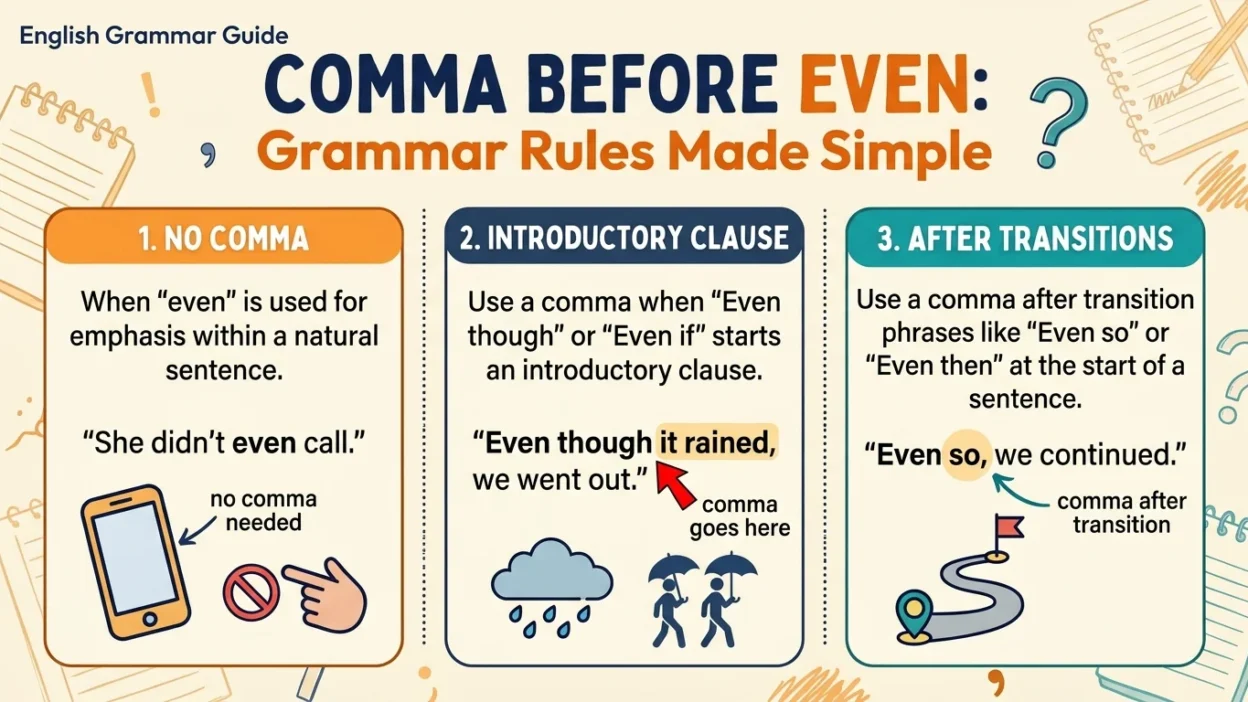
Usually, no comma is needed before “even.” When even emphasizes a word or phrase, write it directly into the sentence: “He didn’t even call me.” A comma may be necessary when even appears in a larger expression that introduces a contrast or a separate clause, but the punctuation depends on the complete construction. Phrases such as even though and even if generally do not require a comma immediately before even when they occur within a sentence.
Why Do People Get Confused About a Comma Before Even?
People often confuse the punctuation rules because even appears in different grammatical structures. It can emphasize a single word, introduce a dependent clause through even though, or connect an idea to a previous statement through even so.
Compare these examples:
- No comma: She didn’t even apologize.
- No comma before the phrase: I went outside even though it was raining.
- Comma after the introductory expression: Even so, we decided to continue.
- Comma before a contrasting phrase: He agreed to help, even with his busy schedule.
The key is to look at the whole sentence. Do not add a comma merely because you see the word even.
When Should You Not Use a Comma Before Even?
In ordinary sentences, even is an adverb that adds emphasis. It usually fits directly into the sentence without commas.
1. When Even Emphasizes a Word
Examples:
- She didn’t even look at me.
- I can’t even remember his name.
- He even brought snacks for everyone.
- They even invited their neighbors.
- The child can even read simple books.
No comma is needed because even is part of the sentence’s normal structure.
2. When Even Appears Before a Number or Quantity
Examples:
- Even two hours wasn’t enough.
- She didn’t spend even one dollar.
- Not even a single person complained.
- He couldn’t lift even five kilograms.
In these sentences, even emphasizes a number or quantity. A comma would be unnecessary.
3. When Even Appears in the Middle of a Sentence
Examples:
- The solution is even simpler than before.
- She is even more confident now.
- This problem is even harder than the last one.
- The movie was even better than I expected.
Again, no comma is needed around even when it functions as an ordinary adverb.
Do You Put a Comma Before “Even Though”?
Usually, no comma is placed immediately before “even though” when the phrase introduces a dependent clause after the main clause. However, a comma is normally used after the dependent clause when it comes first.
Even Though at the Beginning
When even though begins a sentence, the dependent clause usually takes a comma before the main clause.
Examples:
- Even though it was raining, we went for a walk.
- Even though she was tired, she finished her work.
- Even though he studied hard, he didn’t pass the exam.
The comma comes after the introductory dependent clause, not before even.
Even Though in the Middle
When the main clause comes first, a comma is generally unnecessary if the dependent clause follows naturally.
Examples:
- We went for a walk even though it was raining.
- She finished her work even though she was tired.
- He attended the meeting even though he felt unwell.
However, a comma may be used when the clause is parenthetical or when the writer wants to emphasize a pause.
Do You Put a Comma Before “Even If”?
The same general rule applies to even if. When it introduces a dependent clause after the main clause, you usually do not need a comma immediately before it.
Examples:
- I’ll help you even if I’m busy.
- She will attend the event even if it rains.
- He plans to continue even if the work becomes difficult.
When the dependent clause comes first, place a comma after it:
- Even if it rains, we’ll go.
- Even if you disagree, please listen.
- Even if she apologizes, he may remain upset.
The comma separates the introductory dependent clause from the main clause. It is not a special rule about the word even.
When Is a Comma Appropriate Before Even?
A comma can appear before even when the word begins a supplementary or contrasting phrase, or when another punctuation rule calls for a pause.
1. Before a Supplementary Phrase
A phrase beginning with even may be set off with a comma when it adds a parenthetical detail.
Examples:
- The plan worked, even under difficult conditions.
- She remained calm, even in an emergency.
- He completed the task, even without assistance.
The comma is influenced by the sentence’s structure and emphasis. In many contexts, these phrases can also be written without a comma if they are closely integrated into the sentence.
2. Before “Even If” for Contrast or Emphasis
A writer may use a comma before even if to emphasize a contrast or create a deliberate pause, especially in a long sentence.
Example:
- We will proceed with the project, even if the results are uncertain.
Here, the comma may help the reader process the sentence, but it is not always required. In a short, straightforward sentence, the comma is usually unnecessary:
- I’ll go even if it rains.
3. Before an Interrupting Phrase
If even begins an interrupting phrase, commas may mark the phrase’s boundaries.
Example:
- The proposal, even in its revised form, needs more work.
The commas surround the supplementary phrase even in its revised form. They do not belong to even itself.
Comma Before “Even So”
Even so is a transitional expression meaning nevertheless or despite that. When it appears at the beginning of a sentence, it is usually followed by a comma.
Examples:
- The weather was terrible. Even so, we enjoyed our trip.
- The task was difficult. Even so, she completed it.
- He was warned several times. Even so, he repeated the mistake.
When even so appears later in a sentence, punctuation depends on how it is used:
- The task was difficult; even so, she completed it.
- She knew the risks and continued even so.
Remember that the common punctuation pattern is “Even so,” with a comma after so when the expression introduces a sentence or independent clause.
Comma Before Even: Correct and Incorrect Examples
| Sentence | Correct? | Explanation |
|---|---|---|
| She didn’t even notice. | Correct | No comma is needed before ordinary adverb even. |
| We went even though it rained. | Correct | No comma is normally needed before even though after the main clause. |
| Even though it rained, we went. | Correct | The comma follows the introductory dependent clause. |
| Even so, we continued. | Correct | Use a comma after introductory even so. |
| He finished, even with little time. | Often correct | The comma can mark a supplementary or emphatic phrase. |
| I will go, even if it rains. | Sometimes appropriate | The comma may add emphasis or improve readability, but it is often unnecessary. |
| She didn’t, even notice. | Incorrect in ordinary usage | The comma wrongly separates the verb phrase from the adverb. |
Common Mistakes With Commas Before Even
Mistake 1: Adding a Comma Before Every Even
Incorrect: I didn’t, even see the message.
Correct: I didn’t even see the message.
Why? The word even is an ordinary adverb here and does not need a comma.
Mistake 2: Putting the Comma in the Wrong Place With Even Though
Incorrect: Even though, she was tired, she continued.
Correct: Even though she was tired, she continued.
Why? Do not separate even though from the clause it introduces. Place the comma after the introductory clause.
Mistake 3: Forgetting the Comma After Introductory Even So
Less clear: Even so we decided to continue.
Preferred: Even so, we decided to continue.
Why? The introductory transition even so is normally followed by a comma.
Mistake 4: Treating Every Comma Before Even If as Mandatory
Incorrect as a universal rule: A comma must always come before even if.
Better rule: A comma before even if depends on the sentence structure, length, and intended emphasis. Short, closely connected clauses usually do not require one.
A Simple Memory Trick
Remember these three patterns:
- Ordinary even: Usually no comma. “She didn’t even ask.”
- Even though / even if: If the dependent clause comes first, place a comma after it. “Even though it rained, we went out.”
- Even so: Usually use a comma after it when it introduces a sentence. “Even so, we continued.”
The most important point is that punctuation depends on the grammatical structure, not on the word even alone.
Frequently Asked Questions
1. Do You Always Need a Comma Before Even?
No. Most sentences do not need a comma before even. For example, “He didn’t even try” is correct without a comma.
2. Is There a Comma Before Even Though?
Usually not when even though follows the main clause: “We went out even though it was raining.” If the dependent clause comes first, use a comma after it: “Even though it was raining, we went out.”
3. Should I Put a Comma Before Even If?
Not usually in a short, closely connected sentence. For example, “I’ll help even if I’m busy” is correct. A comma may be used for emphasis or readability in longer sentences.
4. Do You Put a Comma After Even?
Not normally when even is an ordinary adverb: “She even smiled.” However, expressions such as even so are usually followed by a comma when used as introductory transitions.
5. Is “Even So” Followed by a Comma?
Yes, when even so introduces a sentence or independent clause, a comma is normally used: “Even so, we decided to continue.”
6. Can You Put a Comma Before Even at the End of a Sentence?
Yes, if the comma separates a supplementary or contrasting phrase from the main clause. For example, “The team succeeded, even under pressure.” The comma is optional in some contexts and depends on how closely the phrase connects to the sentence.
7. Is It “Not Even” or “Not, Even”?
The usual form is not even, without a comma: “He did not even answer the question.” A comma would normally interrupt the sentence incorrectly.
8. What Is the Easiest Way to Know Whether a Comma Is Needed Before Even?
Check how even functions. If it simply emphasizes a word or phrase, you usually do not need a comma. If it introduces a dependent clause or supplementary expression, follow the punctuation rules for that construction.
Remember This
- Do not add a comma before even just because the word appears in a sentence.
- Use no comma with ordinary adverbial even in most cases.
- With introductory even though and even if clauses, place a comma after the dependent clause.
- Use a comma after introductory even so.
- When a phrase beginning with even is supplementary, commas may be appropriate depending on the sentence structure.
Conclusion
The comma rule for even is straightforward once you focus on the complete sentence. When even simply adds emphasis, as in “She didn’t even call,” no comma is needed. When it appears in expressions such as even though or even if, the placement of the dependent clause determines where a comma may be required. When even so introduces a new sentence or independent clause, a comma normally follows it.
Instead of memorizing a single rule for the word even, learn how each construction works. This approach will help you punctuate sentences correctly and write more clearly in academic, professional, and everyday English.

Lucas Luke is a passionate language writer and content creator at SimileHive, specializing in similes, idioms, metaphors, and figurative language. He enjoys making complex English expressions simple, engaging, and easy to understand for students, writers, and language enthusiasts through well-researched, practical content.