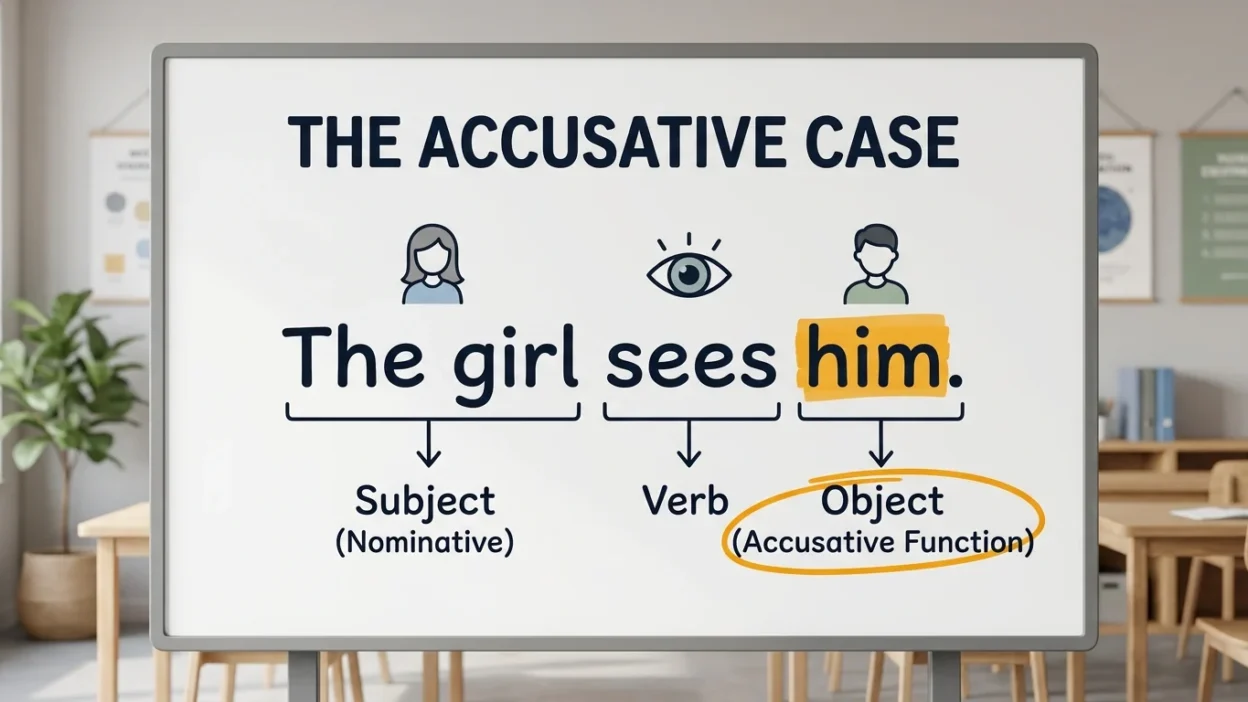
The accusative case is a grammatical case that commonly identifies the direct object of a verb the person or thing that receives an action. For example, in the sentence “She called him,” the pronoun “him” is in the accusative case because it receives the action of the verb “called.” Understanding the accusative case helps you recognize how nouns and pronouns function in a sentence.
The accusative case is especially important when learning languages such as German, Latin, Russian, and Greek, where nouns, pronouns, or adjectives may change their forms depending on their grammatical roles. In modern English, the accusative case is most visible in object pronouns such as me, him, her, us, and them. Learning its rules and examples makes sentence structure easier to understand.
Quick Answer: What Is the Accusative Case?
The accusative case is a grammatical case most commonly used to mark the direct object of a verb. The direct object receives the action expressed by the verb. In “Tom helped her,” the pronoun “her” is in the accusative case. In English, this case is mainly visible in object pronouns, while many other languages mark it through changes in noun endings, articles, or adjectives.
What Does the Accusative Case Mean?
The accusative case identifies a noun or pronoun that functions as the direct object of a verb. A direct object answers the question what? or whom? after an action verb.
Consider this sentence:
Maria invited John.
- Subject: Maria
- Verb: invited
- Direct object: John
Maria performs the action, and John receives it. In languages with a clearly marked accusative case, the form of the word for John may change to show that he is the object.
In English, the noun “John” does not change its form. However, pronouns do show a difference:
- She invited I. (Incorrect in standard English)
- She invited me. (Correct)
The pronoun “me” is the object form of “I.” This distinction is one of the clearest examples of the accusative case in English.
What Is the Accusative Case in English?
English has relatively little case marking compared with languages such as German or Latin. Most English nouns have the same form whether they function as subjects or objects. Pronouns, however, preserve important case distinctions.
Compare these subject and object pronouns:
| Subject form | Object form |
|---|---|
| I | Me |
| He | Him |
| She | Her |
| We | Us |
| They | Them |
| Who | Whom |
Examples:
- I saw him.
- She called me.
- They invited us.
- We helped them.
- Whom did you meet?
In each example, the subject pronoun performs the action, while the object pronoun receives it.
The word “you” has the same form as both a subject and an object pronoun: “You helped me” and “I helped you.” The same is true of “it.”
Modern English grammar often uses the term objective case for the form of pronouns used as objects of verbs and prepositions. The objective case includes functions traditionally associated with the accusative and, historically, the dative case.
What Are the Main Uses of the Accusative Case?
The accusative case has several common functions, depending on the language. The following examples explain its most important uses.
1. To Mark the Direct Object
The most common function of the accusative case is to identify the direct object of a verb.
Examples:
- She read the book.
- He kicked the ball.
- I saw her.
- They invited us.
- The teacher praised him.
In English, “her,” “us,” and “him” are object pronouns. In languages with grammatical case endings, the direct object may have a special accusative form.
2. After Certain Prepositions
In some languages, particular prepositions require the accusative case. In English, pronouns also take their object forms after prepositions.
Examples:
- This gift is for me.
- She walked with him.
- The message came from her.
- They sat beside us.
- He stood behind them.
The English pronouns “me,” “him,” “her,” “us,” and “them” are objective forms. In languages such as German, the choice of case after a preposition depends on the preposition and sometimes on the meaning of the sentence.
3. To Express Movement Toward a Destination in Some Languages
Certain languages use the accusative case after particular prepositions to express movement toward a destination. German is a common example.
For instance:
- German: Ich gehe in den Park.
- English: “I am going into the park.”
The German phrase den Park uses the accusative form after in because the sentence describes movement into the park.
Compare it with:
- German: Ich bin in dem Park.
- English: “I am in the park.”
Here, dem Park is dative because the sentence describes a location rather than movement into it.
This movement versus location distinction applies to certain German two-way prepositions, not to every preposition or every language.
4. To Express Duration or Extent in Some Languages
Some languages use the accusative case to express duration, distance, or extent.
For example, Latin can use the accusative to indicate duration:
- Multos annos vixit.
- Meaning: “He lived for many years.”
The phrase multos annos is in the accusative case and expresses how long he lived.
The exact rules differ from language to language, so the accusative case should not be assumed to have the same functions everywhere.
Accusative Case Examples in English
Here are examples showing how object pronouns function in everyday English sentences.
| Sentence | Accusative/object form | Explanation |
|---|---|---|
| She called me. | Me | Receives the action of calling |
| I saw him. | Him | Receives the action of seeing |
| We invited her. | Her | Receives the action of inviting |
| They helped us. | Us | Receives the action of helping |
| He knows them. | Them | Receives the action of knowing |
| Whom did you choose? | Whom | Functions as the object of choose |
| The teacher praised you. | You | Object form of you |
| I found it. | It | Object form of it |
Remember that English nouns generally do not change their forms when they become direct objects. The case distinction is most noticeable in pronouns.
Accusative Case vs. Nominative Case
The nominative and accusative cases have different grammatical functions.
The nominative case commonly marks the subject of a sentence—the person or thing performing the action. The accusative case commonly marks the direct object the person or thing receiving the action.
Compare:
- She loves him.
- He loves her.
In the first sentence, “she” is the subject, and “him” is the object. In the second sentence, “he” is the subject, and “her” is the object.
| Feature | Nominative case | Accusative case |
|---|---|---|
| Main function | Usually marks the subject | Usually marks the direct object |
| English pronouns | I, he, she, we, they, who | Me, him, her, us, them, whom |
| Example | He called me. | He called me. |
| Question to ask | Who performs the action? | Whom or what does the action affect? |
These are the typical functions of the two cases. Some languages use the nominative and accusative in additional ways.
Accusative Case vs. Objective Case
The terms “accusative case” and “objective case” are related, but they are not always identical.
In modern English grammar, objective case is a common name for pronoun forms used as objects of verbs and prepositions. Traditional grammar sometimes uses “accusative” when discussing the direct-object function specifically.
For example:
- She saw him. — “Him” is a direct object.
- She spoke to him. — “Him” is the object of a preposition.
English uses the same pronoun form in both sentences. In languages with richer case systems, direct objects and objects of prepositions may take different cases depending on the construction.
Accusative Case in German
German is a useful language for understanding how the accusative case works because articles and some pronouns change according to grammatical case.
Consider these examples:
| German sentence | English meaning | Accusative form |
|---|---|---|
| Ich sehe den Mann. | I see the man. | den Mann |
| Sie kauft einen Apfel. | She buys an apple. | einen Apfel |
| Er hat einen Hund. | He has a dog. | einen Hund |
| Wir besuchen die Frau. | We visit the woman. | die Frau |
In German, the masculine singular article often changes from der in the nominative to den in the accusative. The indefinite masculine article changes from ein to einen.
For example:
- Nominative: Der Mann kommt. — “The man is coming.”
- Accusative: Ich sehe den Mann. — “I see the man.”
The noun Mann remains the same, but its article changes to show its grammatical role.
Accusative Case in Latin
Latin uses noun endings to indicate grammatical case. The accusative case commonly marks direct objects and can also appear in other constructions.
For example:
- Puella poetam videt. — “The girl sees the poet.”
In this sentence:
- Puella means “the girl” and is nominative, the subject.
- Poetam means “the poet” and is accusative, the direct object.
- Videt means “sees.”
The ending of poetam helps identify it as the object of the verb.
Latin also uses the accusative in certain expressions of direction and duration. Its precise use depends on the grammatical construction.
How to Identify the Accusative Case
You can often identify the accusative case by following these steps.
- Find the verb. Identify the action or state expressed in the sentence.
- Find the subject. Ask who or what performs the action.
- Look for the direct object. Ask “whom?” or “what?” after the verb.
- Check the word form. In English, look especially at object pronouns. In languages with case endings, check the noun, article, adjective, or pronoun form.
- Consider the language’s rules. Some languages also use the accusative after certain prepositions or in other constructions.
Example: “The boy kicked the ball.”
- Verb: kicked
- Subject: the boy
- Question: The boy kicked what?
- Answer: the ball
- Function: direct object
In English, “the ball” does not change its form. In a language with a marked accusative case, its form may indicate that it is the direct object.
Common Mistakes About the Accusative Case
Mistake 1: Confusing Subject and Object Pronouns
Incorrect: Me saw her.
Correct: I saw her.
Explanation: “I” is the subject pronoun. “Me” is normally used as an object pronoun.
Mistake 2: Using a Subject Pronoun After a Verb
Incorrect: She called I.
Correct: She called me.
Explanation: The pronoun receives the action of the verb, so the object form “me” is appropriate.
Mistake 3: Assuming Every Language Uses the Accusative in the Same Way
The accusative case does not function identically in every language. It often marks direct objects, but some languages also use it after specific prepositions or to express duration, movement, or extent.
Mistake 4: Thinking English Nouns Always Change in the Accusative
English nouns such as “book,” “teacher,” and “student” usually retain the same form whether they are subjects or objects. Pronouns show the distinction more clearly: “she” becomes “her,” and “they” becomes “them.”
Mistake 5: Confusing the Accusative With the Genitive Case
The accusative commonly marks a direct object, while the genitive often expresses possession or a relationship between nouns.
- Accusative/object: She saw him.
- Possessive/genitive: This is his book.
The exact functions of the genitive vary across languages, but it should not be treated as interchangeable with the accusative.
Easy Memory Trick for the Accusative Case
Remember this simple rule:
Nominative = the doer; accusative = the receiver of the action.
For example:
The girl hugged the boy.
- “The girl” is the subject performing the action.
- “The boy” is the direct object receiving the action.
In English pronouns, remember the pairs:
- I → me
- He → him
- She → her
- We → us
- They → them
- Who → whom
This memory trick works well for understanding the basic subject-object distinction, although not every accusative construction involves a direct object.
Frequently Asked Questions
1. What is the accusative case in simple words?
The accusative case is a grammatical case that commonly identifies the direct object of a verb. In “She helped him,” the pronoun “him” receives the action of helping and is in the objective form in English.
2. What is an example of the accusative case?
An English example is “I saw her.” The pronoun “her” is the object of the verb “saw.” In German, Ich sehe den Mann means “I see the man,” and den Mann is in the accusative case.
3. What is the difference between nominative and accusative case?
The nominative case usually marks the subject, while the accusative case commonly marks the direct object. In “He called her,” “he” is nominative, and “her” is the object form associated with the accusative function.
4. Does English have an accusative case?
English has limited case marking. It does not usually change noun forms to mark the accusative, but it preserves distinctions in pronouns. For example, “I” is the subject form, while “me” is the object form.
5. Is “me” an accusative pronoun?
“Me” is an object pronoun in modern English. It performs the direct-object function in sentences such as “She saw me.” In traditional descriptions, this function is often associated with the accusative case; modern English grammar commonly calls it the objective case.
6. What question does the accusative case answer?
When it marks a direct object, the accusative case commonly answers “whom?” or “what?” For example, in “He opened the door,” the question “He opened what?” gives the answer “the door.”
7. Which languages use the accusative case?
Languages that use an accusative case include German, Latin, Russian, Greek, and many others. The forms and rules differ between languages, so learners should study the case system of the particular language they are learning.
8. Is the accusative case always used for direct objects?
No. Although marking the direct object is its best-known function, the accusative can also be used in certain prepositional constructions and expressions of duration, distance, or direction, depending on the language.
Conclusion
The accusative case is an important grammatical concept that helps explain how languages distinguish the direct object from the subject. It commonly identifies the person or thing that receives an action. In English, this distinction is especially visible in pronouns such as “me,” “him,” “her,” “us,” and “them,” while languages such as German and Latin also use changes in word forms to mark case.
To identify the accusative case, find the verb, identify the subject, and look for the direct object. Remember that the accusative case does not work exactly the same way in every language. Learning its basic function first will make it easier to understand more advanced grammar rules.

Lucas Luke is a passionate language writer and content creator at SimileHive, specializing in similes, idioms, metaphors, and figurative language. He enjoys making complex English expressions simple, engaging, and easy to understand for students, writers, and language enthusiasts through well-researched, practical content.