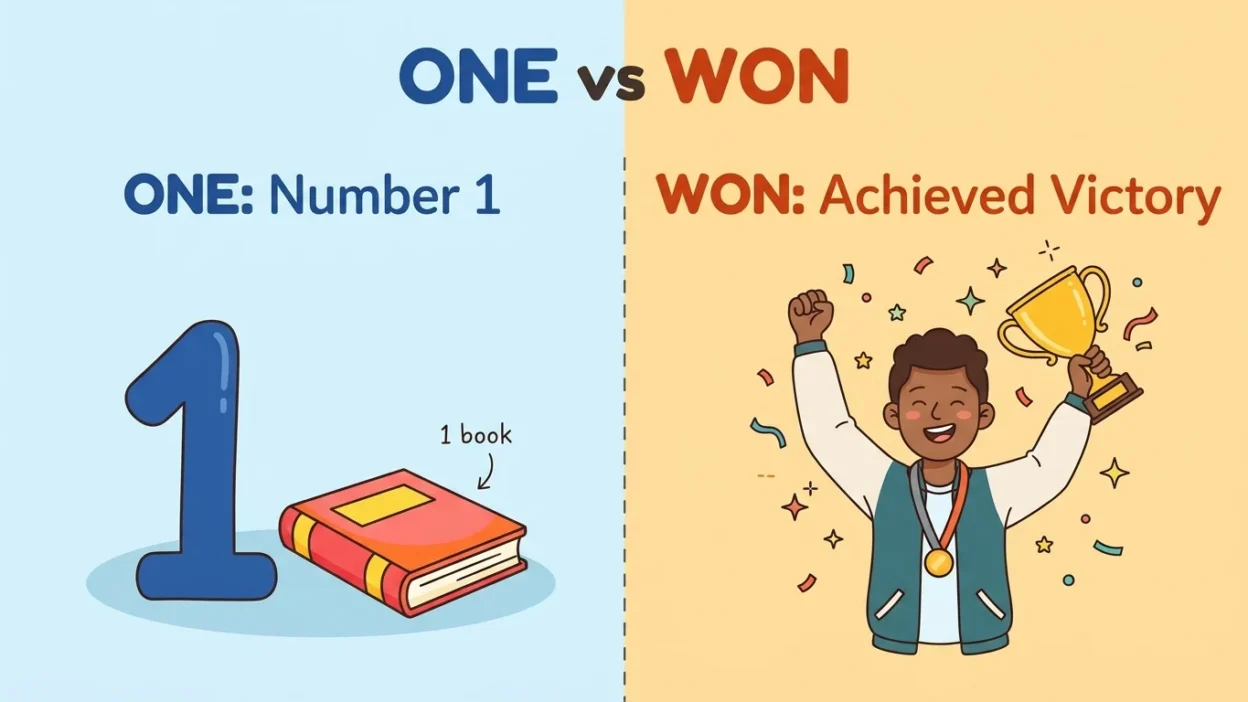
“One” and “won” sound exactly alike in standard English, but they have different meanings and grammatical uses. One is the number 1 and can also refer to a single person or thing. Won is the past tense and past participle of the verb win. Knowing the difference between one vs won will help you avoid spelling mistakes and write more clearly.
Although these words are pronounced the same way, you cannot use them interchangeably. For example, “I won the game” means that you were victorious, while “I have one ticket” means that you possess a single ticket. Understanding their meanings, sentence patterns, and examples makes it easier to choose the correct word every time.
Quick Answer: One vs Won
One refers to the number 1 or a single person or thing. Won is the past tense and past participle of win, meaning to achieve victory or success in a competition or contest. For example, “I have one brother” refers to the number of brothers, while “She won the race” means she finished first or achieved victory.
Why Do People Confuse One and Won?
People often confuse one and won because they are homophones. Homophones are words that sound alike but have different meanings and spellings.
Both words are pronounced /wʌn/ in standard English. Because their pronunciation is identical, listeners must use the context of a sentence to understand which word is intended.
For example:
- I have one question.
- Our team won the match.
In the first sentence, one indicates a quantity. In the second sentence, won describes a successful result.
The easiest way to avoid confusion is to remember that one is about number, while won is about winning.
What Does One Mean?
One is the number 1. It can function as a number, a determiner, a pronoun, or a noun, depending on how it is used in a sentence.
1. One as a Number
One identifies a quantity of exactly 1.
Examples:
- I bought one notebook.
- She has one sister.
- We need one more chair.
- He ordered one cup of coffee.
- There is one mistake in this paragraph.
2. One as a Pronoun
One can replace a noun when the person or thing is already understood from the context.
Examples:
- I like the red shirt, but the blue one is cheaper.
- This pen does not work. Can I borrow one?
- She lost her umbrella, so I gave her one.
- Which book do you prefer? The first one or the second one?
In these sentences, one replaces a noun that has already been mentioned or is understood.
3. One Referring to a Person
One can refer to a person in a general or formal statement.
Examples:
- One should always tell the truth.
- One must respect other people’s opinions.
- One cannot succeed without effort.
This use is more formal than using “you” or “people” in everyday conversation.
What Does Won Mean?
Won is the simple past tense and past participle of the verb win. It means to achieve victory, succeed in a competition, or receive a prize.
1. Won as the Simple Past Tense
Use won when describing a victory or success that happened in the past.
Examples:
- Our team won the final match.
- She won the spelling competition.
- He won a gold medal.
- They won the championship last year.
- My friend won a scholarship.
2. Won as a Past Participle
Won also appears with auxiliary verbs such as has, have, and had.
Examples:
- She has won three awards.
- We have won the game.
- He had won the competition before the injury.
- They have won several important matches.
Remember the verb forms:
| Verb form | Word |
|---|---|
| Base form | Win |
| Simple past | Won |
| Past participle | Won |
| Present participle | Winning |
The correct past form is won, not “winned.”
One vs Won: Key Differences
| Feature | One | Won |
|---|---|---|
| Meaning | The number 1 or a single person or thing | Achieved victory or success |
| Part of speech | Number, determiner, pronoun, or noun | Verb form |
| Base form | One has no verb base form | Win |
| Past tense | Not applicable | Won |
| Example | I need one ticket. | I won a ticket in a contest. |
| Memory clue | One means a single item | Won means victory |
The main difference is that one expresses a quantity or refers to a person or thing, while won describes the result of winning.
When Should You Use One?
Use one when you are referring to the number 1, a single item, or a person or thing that replaces a previously mentioned noun.
1. To Express a Quantity
Examples:
- I need one glass of water.
- She bought one dress.
- We have one hour left.
- He gave me one chance.
2. To Replace a Noun
Examples:
- I wanted a new phone, so I bought one.
- The black shoes are more expensive than the brown ones.
- This chair is broken. Please bring another one.
3. To Refer to a Single Choice
Examples:
- Choose one answer.
- Only one student can win the prize.
- I would like one of those sandwiches.
When Should You Use Won?
Use won when you want to describe winning a game, competition, award, prize, or other form of success.
1. To Describe a Victory
Examples:
- Our school won the cricket tournament.
- She won the race yesterday.
- The team won against its strongest opponent.
2. To Describe Receiving a Prize
Examples:
- He won a new laptop in the competition.
- My sister won a scholarship.
- They won a cash prize at the event.
3. To Describe Success or Achievement
Examples:
- Her honesty won everyone’s respect.
- The candidate won the election.
- The company won an important contract.
In these examples, won does not always refer to a sporting competition. It can also describe gaining support, respect, or success.
One vs Won in Sentences
The following examples show how the meaning changes depending on which word you use.
| Sentence with One | Sentence with Won |
|---|---|
| I have one brother. | I won the game. |
| She bought one ticket. | She won two tickets. |
| We need one more player. | Our team won the match. |
| He chose one answer. | He won the prize. |
| I read one book yesterday. | I won a book in a contest. |
| There is one winner. | She won the competition. |
Notice that one usually answers a question about quantity or identity, while won answers a question about an achievement or result.
Common Mistakes With One and Won
Mistake 1: Using Won to Express a Number
Incorrect: I have won brother.
Correct: I have one brother.
Explanation: One indicates the number of brothers. Won is a form of the verb win.
Mistake 2: Using One to Describe Victory
Incorrect: Our team one the match.
Correct: Our team won the match.
Explanation: Won is the past tense of win, so it describes the team’s victory.
Mistake 3: Writing Winned Instead of Won
Incorrect: She winned the race.
Correct: She won the race.
Explanation: Win is an irregular verb. Its simple past form is won, not winned.
Mistake 4: Confusing One and Once
One refers to the number 1 or a single item. Once usually means one time or at some point in the past.
Examples:
- I have one car.
- I visited London once.
These words have different meanings even though they are related.
Mistake 5: Choosing a Word Based Only on Pronunciation
Incorrect: I one the competition.
Correct: I won the competition.
Explanation: Both words sound alike, so you must consider the sentence’s meaning and grammar rather than pronunciation alone.
Easy Memory Trick for One vs Won
Use this simple rule to remember the difference:
One means a single item. Won means you won something.
Think of these examples:
- I have one goal.
- I won the game.
You can also connect won with its base verb, win:
Win → Won → Won
If you are talking about the number 1, use one. If you are talking about winning or achieving victory, use won.
Are One and Won Pronounced the Same?
Yes. One and won are homophones in standard English. Both are generally pronounced /wʌn/, which sounds like “wun.”
Their pronunciation is the same, but their meanings and spellings are different.
Examples:
- I have one apple.
- I won the prize.
Because these words sound identical, spelling depends on understanding the sentence. Reading the surrounding words usually makes the intended meaning clear.
One vs Won in American and British English
One and won have the same meanings, spellings, and standard pronunciations in American and British English.
| Feature | American English | British English |
|---|---|---|
| One | Number 1 or a single item | Number 1 or a single item |
| Won | Past tense of win | Past tense of win |
| Pronunciation | Usually /wʌn/ | Usually /wʌn/ |
| Example | I won the game. | I won the game. |
There is no regional spelling difference between these words. The correct choice depends on meaning and grammar, not on whether you are using American or British English.
Frequently Asked Questions
1. What is the difference between one and won?
One refers to the number 1 or a single person or thing. Won is the past tense and past participle of win. For example, “I have one sister” expresses quantity, while “I won the competition” describes victory.
2. Is one or won correct?
Both words are correct, but they are used differently. Use one for a number or single item, and use won when describing winning something. The correct choice depends on the meaning of the sentence.
3. Are one and won homophones?
Yes. One and won are homophones because they have the same pronunciation but different spellings and meanings. One refers to a number, while won describes an action or result related to winning.
4. Is it I one or I won?
Use “I won” when you mean that you achieved victory. For example, “I won the race.” The phrase “I one” is generally incorrect when you are describing winning.
5. What is the past tense of win?
The past tense of win is won. For example, “Our team won the match yesterday.” The past participle is also won, as in “Our team has won the match.”
6. Can one be used as a pronoun?
Yes. One can replace a noun when the meaning is clear. For example, in “I like the blue shirt better than the red one,” the word one replaces the noun shirt.
7. How do you remember one vs won?
Remember that one means a single item, while won means achieved victory. If you can replace the word with “the number 1,” use one. If you can replace it with “achieved victory,” use won.
8. Do one and won sound the same in British English?
Yes. In standard British English, one and won are pronounced alike. Their meanings and grammatical uses are also the same as in American English.
Conclusion
The difference between one and won is simple once you understand their meanings. One refers to the number 1, a single person or thing, or a noun replaced by a pronoun. Won is the past tense and past participle of win and describes achieving victory or success.
Although both words sound the same, they cannot replace each other in a sentence. Remember to use one when discussing quantity and won when discussing victory. With regular practice, you will be able to distinguish these homophones and use them correctly in everyday writing.
Final verdict: Use one for a single person or thing, and use won when someone has achieved victory.

Charles Kevin is a passionate language writer and researcher at SimileHive, creating clear, engaging content about similes, idioms, metaphors, and figurative language to help readers improve English communication confidently every day.