“Based on” and “based off of” are commonly used English expressions that describe how something is developed, created, or influenced by something else. For example, a movie can be based on a true story, or a character can be based off of a real person. Although both phrases are widely understood, they differ in formality, usage, and acceptance in standard written English.
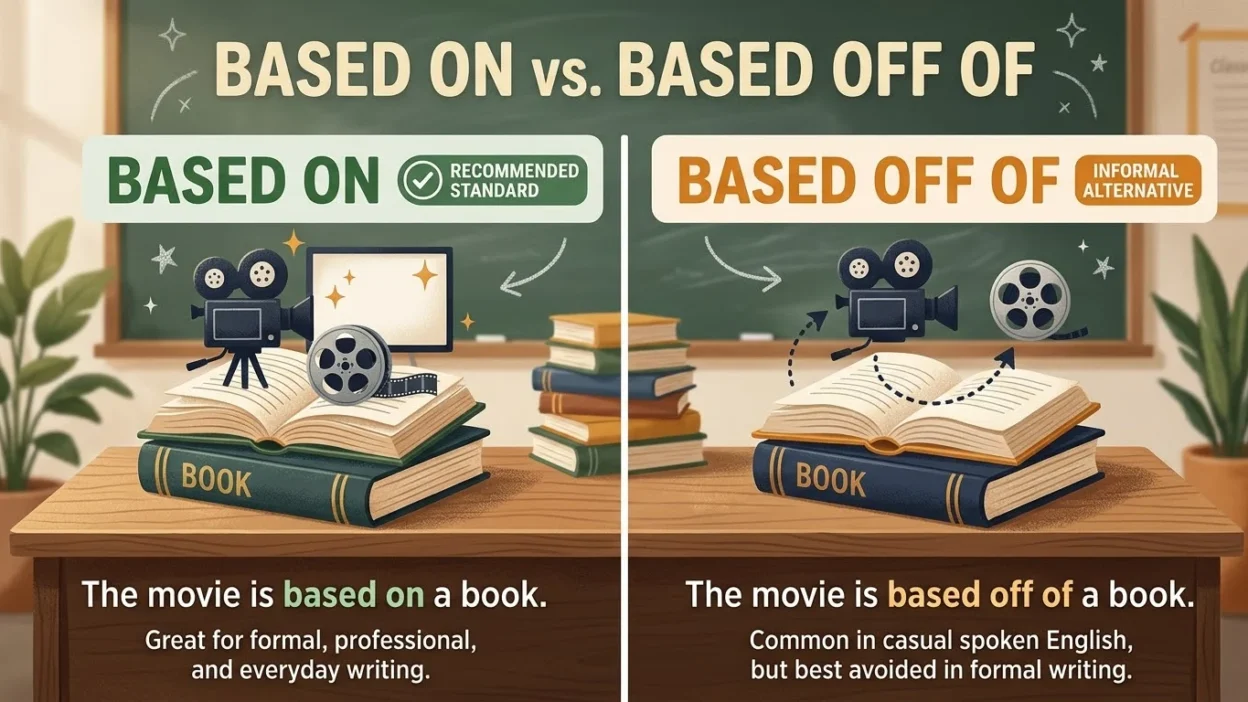
The main difference is that “based on” is the more traditional, widely accepted, and generally preferred expression, especially in formal writing. “Based off of” is common in informal American English, but some readers and editors consider it less conventional or unnecessarily wordy. Understanding when to use each phrase will help you write more naturally and clearly.
Quick Answer: Based On vs Based Off Of
“Based on” is the standard and safest choice for academic writing, professional communication, and formal contexts. It means that something is developed from, supported by, or influenced by a source. “Based off of” is also used, particularly in informal American English, with a similar meaning. However, it is often considered less formal. For most situations, choose “based on.”
What Does Based On Mean?
“Based on” means that something is founded on, developed from, or influenced by an idea, fact, event, source, or experience.
It is the conventional expression used in both formal and informal English.
Examples of Based On
- The movie is based on a true story.
- Her decision was based on careful research.
- The teacher created the test based on the lessons.
- This novel is based on historical events.
- The report is based on reliable evidence.
- Our plan is based on the available information.
- The character is based on a real person.
- The recommendation was based on customer feedback.
In each sentence, based on introduces the source, evidence, or idea that influenced something.
What Does Based Off Of Mean?
“Based off of” is an expression that means roughly the same thing as “based on.” It is frequently heard in informal American English, especially in conversations about movies, television, books, designs, characters, and creative work.
For example:
- The movie is based off of a popular novel.
- The character was based off of a real person.
- She designed the artwork based off of an old photograph.
- The game was based off of a famous legend.
These sentences are understandable, and the expression is used by many English speakers. However, some editors and style guides prefer “based on” because it is more established and concise.
In formal writing, “based off of” is usually best replaced with “based on.”
Based On vs Based Off Of: Key Differences
| Feature | Based on | Based off of |
|---|---|---|
| Meaning | Founded on or developed from something | Generally the same meaning |
| Standard usage | Widely established | Common, especially in informal American English |
| Formal writing | Preferred | Usually avoided |
| Informal conversation | Natural | Also common |
| Conciseness | Shorter | Longer |
| Example | The film is based on a book. | The film is based off of a book. |
Both expressions can communicate the same idea, but “based on” is the more reliable choice when you want your writing to sound polished and conventional.
Why Do People Say Based Off Of Instead of Based On?
People use “based off of” because English speakers often extend familiar expressions by analogy. The word “off” can suggest a source, starting point, or model, as in “copy off of” or “work off of.”
In informal speech, “based off of” has become a familiar expression, especially in American English. Speakers generally understand it as meaning that something was developed from an original source.
However, the conventional phrase is “based on.” The additional words “off of” are not necessary to communicate the meaning in most contexts.
For example:
- Preferred: The series is based on a book.
- Informal alternative: The series is based off of a book.
The first version is shorter and more widely accepted in edited writing.
When Should You Use Based On?
Use “based on” whenever you want a clear, conventional expression that works in almost any context.
1. In Academic Writing
Academic writing values clarity, precision, and conventional grammar.
Examples:
- The conclusion is based on the results of the experiment.
- The research paper is based on several published studies.
- The theory is based on observable evidence.
2. In Professional Communication
Use “based on” in reports, business emails, presentations, and workplace documents.
Examples:
- The decision was based on the latest sales figures.
- Our proposal is based on your requirements.
- The schedule was based on the team’s availability.
3. In Creative Work
“Based on” is also common when discussing movies, books, characters, and other creative projects.
Examples:
- The film is based on a bestselling novel.
- The character is based on a historical figure.
- The story is based on the writer’s childhood experiences.
4. In Everyday Conversation
You do not need to avoid “based on” in casual speech. It is natural in everyday English.
Examples:
- I chose the restaurant based on its reviews.
- We made our plans based on the weather.
- That opinion is based on personal experience.
When Is Based Off Of Acceptable?
“Based off of” is most common in informal American English. You may hear it in casual conversations, interviews, podcasts, social media posts, and discussions about creative projects.
Examples:
- The superhero was based off of a comic book character.
- This design is based off of an older model.
- The show is based off of a popular video game.
- His drawing was based off of a photograph.
- The story was based off of something that happened to her.
These examples reflect common informal usage. They do not mean that “based off of” is necessarily the best choice in every context.
If you are writing an essay, academic assignment, business report, or formal article, replacing “based off of” with “based on” is generally the better option.
Based On vs Based Off: Is There a Difference?
You may also encounter “based off” without the final word “of.” This form is used in informal English, particularly in American speech.
Examples:
- The film is based off a novel.
- The design is based off an older product.
Many speakers use “based off” and “based off of” interchangeably. However, neither is as conventional in formal writing as “based on.”
For standard written English, the clearest recommendation remains:
Use “based on” instead of “based off” or “based off of” unless you have a specific reason to preserve the informal wording.
Based On vs Based Off Of in American and British English
“Based on” is widely accepted in both American and British English. “Based off of” is especially associated with informal American usage, although it may also be understood or used elsewhere.
| Context | American English | British English |
|---|---|---|
| Formal writing | Based on | Based on |
| Academic writing | Based on | Based on |
| Casual conversation | Based on or based off of | Based on is the safer conventional choice |
| Film and book descriptions | Based on is standard | Based on is standard |
These are general usage tendencies, not absolute rules. Individual speakers may use different forms regardless of where they live.
Common Mistakes With Based On and Based Off Of
Mistake 1: Using Based Off Of in Formal Writing
Less conventional: The report is based off of recent research.
Preferred: The report is based on recent research.
Explanation: Based on is more established and appropriate for formal writing.
Mistake 2: Assuming Based Off Of Is Always Grammatically Impossible
The expression “based off of” is common in informal English and is generally understood. It is more accurate to describe it as less conventional or less preferred in formal writing than to claim that it is never used correctly.
Mistake 3: Using Both Expressions Together
Incorrect: The movie is based on off of a novel.
Correct: The movie is based on a novel.
Explanation: Choose one construction rather than combining them.
Mistake 4: Forgetting the Source After Based On
Unclear: The decision was based on.
Clear: The decision was based on customer feedback.
Explanation: When based on introduces the source of an idea or decision, include the relevant information unless the context makes it clear or the sentence is intentionally incomplete.
Mistake 5: Assuming Based On Always Means Completely Copied From
A project based on another source may be inspired by it, adapted from it, or supported by it. The phrase does not necessarily mean that the new work is an exact copy.
For example, a film based on a novel may change the characters, setting, or ending.
Easy Memory Trick for Based On vs Based Off Of
Remember this simple rule:
Based on is the standard choice. Based off of is a common informal alternative.
Think of these examples:
- Formal: The article is based on scientific research.
- Informal: The character is based off of someone I know.
When you are unsure which expression to use, choose “based on.” It is concise, widely accepted, and suitable for nearly every situation.
Frequently Asked Questions
1. Is based on or based off of correct?
Both expressions are used in English. However, “based on” is the more conventional and widely accepted choice, especially in formal writing. “Based off of” is common in informal American English and usually conveys a similar meaning.
2. Is based off of grammatically incorrect?
It is too strong to say that “based off of” is always grammatically incorrect. The expression is common in informal usage, but many editors consider it less conventional than “based on.” For formal writing, “based on” is generally recommended.
3. Is based on more professional than based off of?
Yes, in most formal contexts. “Based on” is concise and established, making it appropriate for academic papers, business reports, professional emails, and published articles.
4. Can I say a movie is based off of a book?
Yes. People commonly use this expression in casual conversation, particularly in American English. However, “The movie is based on a book” is the more conventional wording for formal descriptions and reviews.
5. What is the difference between based off and based off of?
In common informal usage, the two expressions generally have the same meaning. Both are alternatives to “based on.” However, “based on” remains the more established choice in standard written English.
6. Is based on used in both American and British English?
Yes. “Based on” is standard in both American and British English. “Based off of” is particularly common in informal American English, though usage can vary among speakers.
7. Can I use based off of in an academic essay?
It is better to use “based on” in an academic essay. Although readers will usually understand “based off of,” the more conventional expression sounds more polished and follows common formal writing preferences.
8. What is another way to say based on?
Depending on the context, you can use “founded on,” “derived from,” “inspired by,” “grounded in,” or “adapted from.” These expressions are not always interchangeable, so choose the one that accurately describes the relationship between the source and the new work.
Conclusion
The difference between “based on” and “based off of” mainly concerns conventional usage and formality. Both expressions are used to describe something developed from, influenced by, or connected to a source. However, “based on” is more established, concise, and suitable for formal writing.
“Based off of” is common in informal American English, so you may hear it frequently in conversations and entertainment discussions. Still, when writing essays, reports, professional emails, or articles, choosing “based on” is the simplest way to ensure that your wording is clear and conventional.
Final verdict: Use “based on” as your default choice. Reserve “based off of” for informal contexts where that wording feels natural.

Charles Kevin is a passionate language writer and researcher at SimileHive, creating clear, engaging content about similes, idioms, metaphors, and figurative language to help readers improve English communication confidently every day.