Have you ever wondered whether to write “suffice it to say” or “suffice to say”? Both expressions appear in English writing and conversation, but one is the established standard expression. Understanding the difference can help you write more naturally, avoid common grammar mistakes, and express your ideas clearly.
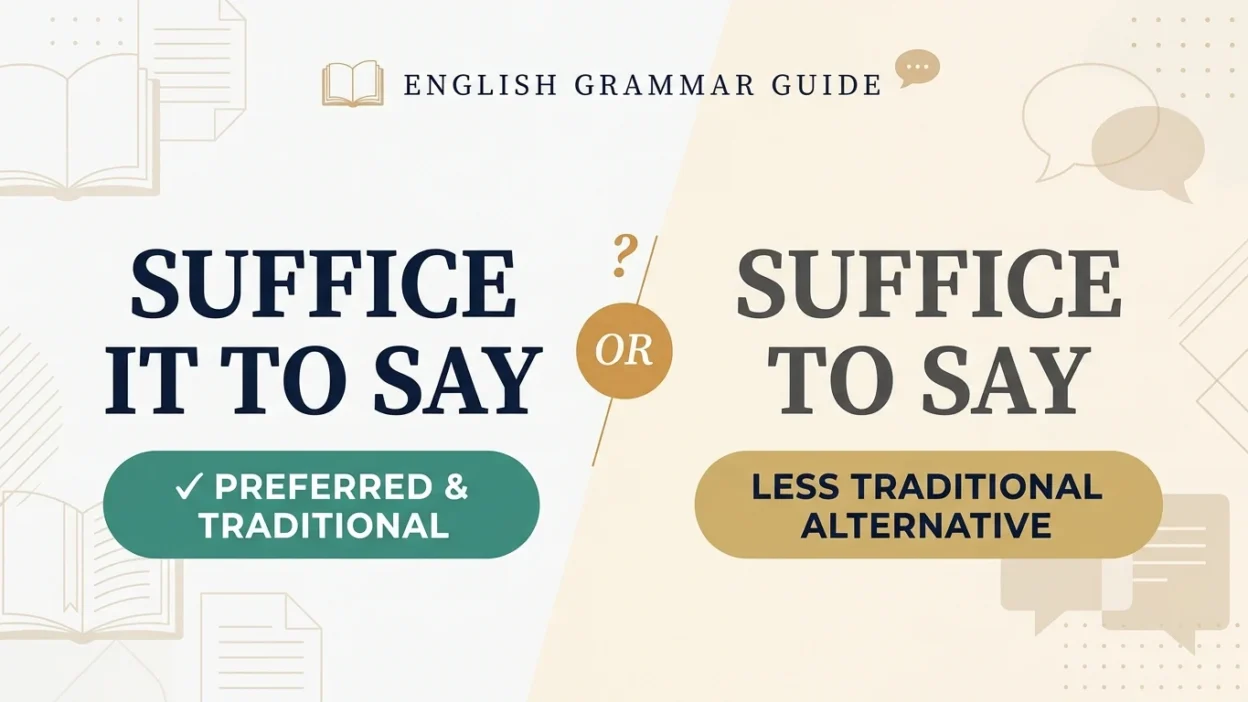
“Suffice it to say” is the traditional and widely accepted expression. It means that enough has been said to make a point clear without providing every detail. For example, “Suffice it to say, the meeting did not go as planned.” The shorter form, “suffice to say,” is also used, particularly in informal communication, but it is generally considered less traditional. If you are writing an academic essay, professional email, article, or formal report, “suffice it to say” is the safer choice. Learning how this expression works will help you use it confidently and understand its meaning in different contexts.
Quick Answer
“Suffice it to say” is the standard expression. It means that what follows is enough to communicate the main point without explaining every detail. “Suffice to say” is also used by some speakers and writers, but “suffice it to say” is the more established form and is generally preferable in formal writing.
Why Do People Confuse Suffice It to Say and Suffice to Say?
People often confuse these expressions because they communicate essentially the same idea. In everyday speech, the word “it” may sound unnecessary, so some speakers leave it out.
However, the traditional expression includes “it” as part of its established grammatical structure.
Consider these examples:
- Standard: Suffice it to say, I was disappointed with the result.
- Less traditional: Suffice to say, I was disappointed with the result.
The first version is the safest choice for standard written English. The second is understandable and appears in actual usage, but some readers may consider it incomplete or less polished.
The confusion also arises because English contains many fixed expressions whose wording does not always follow the patterns learners expect. In such cases, learning the established phrase is often easier than trying to reconstruct it from individual words.
What Does Suffice It to Say Mean?
“Suffice it to say” means that a brief statement is enough to communicate an important point. The speaker or writer uses it to avoid giving unnecessary details.
For example:
“Suffice it to say, we were not happy with the service.”
This means that the service was unsatisfactory, and the writer does not feel the need to explain every problem.
How Is Suffice It to Say Used?
The expression often introduces a summary, conclusion, or strong observation.
Examples:
- Suffice it to say, the trip was unforgettable.
- Suffice it to say, the negotiations were difficult.
- Suffice it to say, everyone was surprised by the announcement.
- Suffice it to say, the results were better than expected.
It can introduce either a positive or a negative statement. Its purpose is to signal that the following information is enough to make the point.
Is Suffice It to Say Formal?
Yes. “Suffice it to say” is suitable for formal and informal writing, although it can sound somewhat literary or old fashioned in casual conversation.
In everyday speech, alternatives such as “in short,” “to put it simply,” and “needless to say” may sound more natural, depending on the context.
What Does Suffice to Say Mean?
“Suffice to say” is a shortened version of the established expression “suffice it to say.” It is used to introduce a statement that summarizes a situation or communicates the main point without further explanation.
For example:
“Suffice to say, the event was a success.”
Most readers will understand the intended meaning. However, the shorter form is less traditional and may be viewed as an omission of “it” in contexts that favor standard formal usage.
Is Suffice to Say Grammatically Correct?
The phrase “suffice to say” is widely used and readily understood. Nevertheless, “suffice it to say” remains the conventional form recommended for careful formal writing.
If you are unsure which version to choose, use “suffice it to say.” It is the more established expression and avoids unnecessary questions about correctness.
Suffice It to Say vs. Suffice to Say: Comparison Table
| Feature | Suffice it to say | Suffice to say |
|---|---|---|
| Structure | Traditional full expression | Shortened expression |
| Meaning | Enough has been said to make the point | Essentially the same meaning |
| Standard usage | Established and widely accepted | Commonly used but less traditional |
| Formal writing | Recommended | Better avoided when a conventional form is preferred |
| Example | Suffice it to say, I was impressed. | Suffice to say, I was impressed. |
| Best choice for learners | Yes | Understandable, but less preferred |
When Should You Use Each Expression?
Choosing between the two forms depends on your audience, writing style, and preference for conventional usage.
When to Use Suffice It to Say
Use “suffice it to say” in formal writing, academic work, professional communication, and carefully edited content.
Examples:
- Suffice it to say, the proposal requires further consideration.
- Suffice it to say, the results exceeded our expectations.
- Suffice it to say, the experience changed my perspective.
- Suffice it to say, the company faced several challenges.
This form is particularly useful when you want to summarize a situation without explaining every detail.
When to Use Suffice to Say
You may encounter “suffice to say” in informal writing, online articles, conversations, and casual messages. Readers generally understand it, but it is not the preferred traditional form.
For example:
“Suffice to say, I will not be ordering from that restaurant again.”
For formal or edited writing, you can revise this to:
“Suffice it to say, I will not be ordering from that restaurant again.”
The meaning remains the same, but the second sentence uses the conventional expression.
12 Examples of Suffice It to Say in Sentences
Here are practical examples showing how to use the standard expression in different situations.
- Suffice it to say, the exam was more difficult than I expected.
- Suffice it to say, we had a wonderful time at the wedding.
- Suffice it to say, the customer was unhappy with the final result.
- Suffice it to say, the project took longer than planned.
- Suffice it to say, the manager was impressed with her performance.
- Suffice it to say, the weather ruined our outdoor plans.
- Suffice it to say, the new restaurant exceeded our expectations.
- Suffice it to say, the disagreement was difficult to resolve.
- Suffice it to say, the company needs a better strategy.
- Suffice it to say, I learned a valuable lesson from the experience.
- Suffice it to say, the audience responded enthusiastically.
- Suffice it to say, the decision was not an easy one.
In each example, the expression tells the reader that the following statement communicates the essential point without requiring a longer explanation.
Common Mistakes With Suffice It to Say
Mistake 1: Leaving Out It in Formal Writing
Less preferred: “Suffice to say, the event was successful.”
Recommended: “Suffice it to say, the event was successful.”
The second version follows the established expression.
Mistake 2: Using the Expression Without a Clear Point
Unclear: “Suffice it to say, and then we went home.”
Better: “Suffice it to say, the meeting ended earlier than expected.”
Use the expression to introduce a meaningful summary or observation, not simply as a filler phrase.
Mistake 3: Confusing It With Needless to Say
These expressions are related but not identical in tone.
“Suffice it to say” means that a brief statement is enough to make the point.
“Needless to say” suggests that something is obvious or should not need to be explained.
For example:
“Suffice it to say, the trip was exhausting.”
“Needless to say, everyone was tired after the trip.”
The first emphasizes summarizing the experience. The second emphasizes that the conclusion is unsurprising.
Mistake 4: Overusing the Expression
Although “suffice it to say” is useful, repeating it throughout the same article can make the writing feel monotonous.
Consider alternatives such as “in short,” “overall,” “to summarize,” and “the bottom line is” when they fit the context.
What Is an Easy Memory Trick for Suffice It to Say?
Use this simple memory trick:
Remember the little word “it.”
The conventional expression is “suffice it to say,” so include “it” whenever you want the safest standard form.
You can also remember the meaning as:
“Enough has been said.”
For example:
“Suffice it to say, the outcome was disappointing.”
The writer is telling the reader that the result was disappointing without listing every detail.
Suffice It to Say in American and British English
“Suffice it to say” is used in both American and British English. The conventional expression does not change between these varieties.
American English
Example: “Suffice it to say, the project was a learning experience.”
American writers may also use the shorter “suffice to say,” particularly in casual contexts.
British English
Example: “Suffice it to say, the decision was unpopular.”
British English also uses the traditional expression. The shorter form may appear in everyday writing, but “suffice it to say” remains the safer choice for formal work.
Which Version Should You Choose?
Whether you write in American or British English, use “suffice it to say” when you want the conventional form. There is no need to change it based on your audience’s variety of English.
Similar Words and Expressions
Several expressions communicate a similar idea and can make your writing more varied.
In short: Used to summarize information briefly.
Example: “In short, we need a better plan.”
To put it simply: Used to explain something in straightforward language.
Example: “To put it simply, the system is not working.”
In summary: Used to present the main points of a discussion.
Example: “In summary, the project met its goals.”
Needless to say: Used when something seems obvious or expected.
Example: “Needless to say, the team was delighted.”
All things considered: Used to give an overall judgment after considering different factors.
Example: “All things considered, it was a successful event.”
The bottom line is: Used to introduce the most important point.
Example: “The bottom line is that we need more time.”
These alternatives can make your writing clearer when “suffice it to say” feels too formal or repetitive.
Final Verdict
“Suffice it to say” is the preferred conventional expression. It means that enough has been said to communicate the essential point without providing every detail.
“Suffice to say” is a commonly encountered shortened version that most readers understand, but it is less traditional and may be considered less appropriate in formal writing.
For essays, professional emails, reports, and carefully edited articles, choose “suffice it to say.” If you want a simpler or more conversational alternative, consider “in short” or “to put it simply.”
Frequently Asked Questions
1. Is It Suffice It to Say or Suffice to Say?
“Suffice it to say” is the traditional and preferred expression. “Suffice to say” is also used, but it is less conventional. For formal writing, use “suffice it to say.”
2. What Does Suffice It to Say Mean?
“Suffice it to say” means that a short statement is enough to communicate the main point without providing every detail. For example, “Suffice it to say, the interview did not go well.”
3. Is Suffice to Say Incorrect?
“Suffice to say” is widely used and generally understood, but it is less traditional than “suffice it to say.” If you want to follow established formal usage, include “it.”
4. Do Americans Say Suffice It to Say?
Yes. “Suffice it to say” is used in American English and British English. The conventional wording is the same in both varieties.
5. Should There Be a Comma After Suffice It to Say?
A comma is commonly used when the expression introduces a statement at the beginning of a sentence.
Example: “Suffice it to say, we were delighted with the results.”
The comma separates the introductory expression from the main statement.
6. What Is Another Way to Say Suffice It to Say?
Alternatives include “in short,” “to put it simply,” “in summary,” and “the bottom line is.” Choose the alternative that best matches the tone and meaning of your sentence.
7. Can I Use Suffice It to Say in Academic Writing?
Yes, but use it sparingly. It is grammatically acceptable, although it can sound rhetorical or somewhat old fashioned. In academic writing, a direct summary of your point may sometimes be clearer.
Remember This
- Suffice it to say is the traditional, preferred form.
- Suffice to say is a commonly used shortened version.
- Both expressions communicate that a brief statement is enough.
- Use the full expression in formal and carefully edited writing.
- Consider alternatives such as “in short” when you want simpler wording.
The easiest rule is to remember the word “it” and use “suffice it to say” whenever you are unsure.
Conclusion
“Suffice it to say” and “suffice to say” have essentially the same intended meaning, but they differ in conventional usage. The longer expression is the established form and is the better choice for academic, professional, and formal writing. Although the shorter version appears in everyday English, using the full phrase helps you avoid questions about grammar and style.
Remember that “suffice it to say” introduces a brief statement that communicates the main point without explaining every detail. If the expression sounds too formal for your sentence, alternatives such as “in short,” “in summary,” or “to put it simply” can work just as well. Choosing the right phrase will help your writing sound clear, natural, and confident.

Charles Kevin is a passionate language writer and researcher at SimileHive, creating clear, engaging content about similes, idioms, metaphors, and figurative language to help readers improve English communication confidently every day.