The words “pending” and “impending” look similar, but they have different meanings. Both can describe something that has not happened yet, which is why English learners and even fluent speakers sometimes confuse them. Knowing the difference helps you choose the right word in emails, reports, academic writing, and everyday conversations.
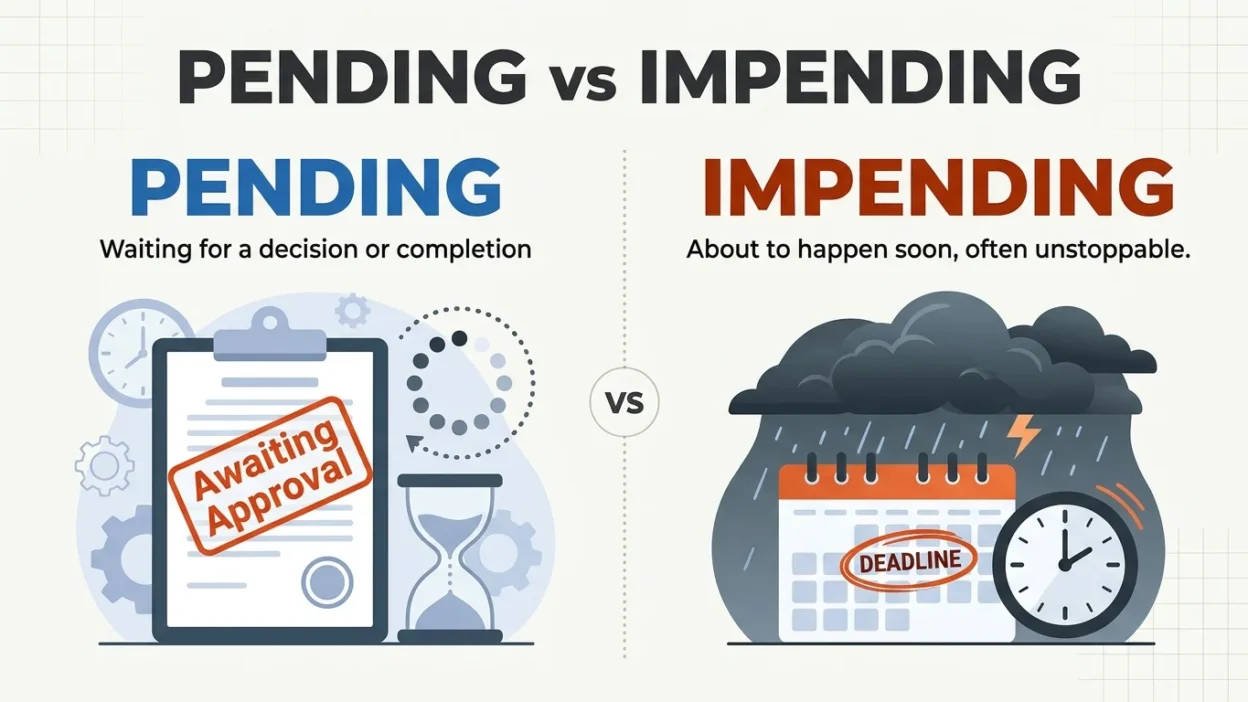
Pending usually describes something that is awaiting a decision, approval, completion, or action. For example, “Your application is pending approval” means that the application has not yet been approved. Impending, on the other hand, describes something that is about to happen, often something serious, unpleasant, or important. For example, “The impending storm forced residents to prepare.
” Although both words refer to situations connected with the future, pending emphasizes something unfinished or unresolved, while impending emphasizes something approaching. Understanding this distinction will make your writing clearer and more accurate.
Quick Answer
Pending means awaiting a decision, action, or completion. Impending means about to happen soon. For example, “The payment is pending” means the payment has not been completed, while “The impending deadline” means the deadline is approaching. Use pending for unresolved matters and impending for upcoming events.
Why Do People Confuse Pending and Impending?
People confuse these words because both relate to something that has not yet happened. However, they focus on different aspects of a situation.
Pending emphasizes the status of a matter that remains unfinished or undecided.
Impending emphasizes the approach of an event that is expected to happen soon.
Compare these examples:
- My job application is pending.
The application is still being processed or awaiting a decision. - My job interview is impending.
The interview is approaching, although this wording is less natural than “my upcoming job interview.”
The key is to ask whether you are describing an unresolved matter or an approaching event.
What Does Pending Mean?
Pending is an adjective that commonly describes something awaiting a decision, approval, action, or completion. It can also function as a preposition meaning “until” or “while awaiting,” particularly in formal or legal contexts.
Common Meanings of Pending
1. Awaiting approval or a decision
Example: “Your application is pending approval.”
This means the application has not yet received approval.
2. Awaiting completion
Example: “The transaction is still pending.”
The transaction has not yet been completed or finalized.
3. Awaiting a legal outcome
Example: “The case is pending before the court.”
The case has not yet been resolved.
4. Until something happens
Example: “The employee will remain on leave pending an investigation.”
Here, pending means that the arrangement will continue until the investigation takes place or reaches the relevant stage.
How to Use Pending in a Sentence
Pending is common in business, banking, employment, education, and legal communication.
Examples:
- My refund is pending.
- The request is pending approval.
- We are waiting for the pending payment.
- The court has not decided the pending case.
- Your admission status is still pending.
In these examples, pending describes something that remains incomplete, undecided, or awaiting action.
What Does Impending Mean?
Impending is an adjective that describes an event that is approaching and expected to happen soon. It is frequently used for important, serious, or unpleasant events, although it is not limited to negative situations.
Common Meanings of Impending
1. An event that is about to happen
Example: “The impending examination made the students nervous.”
The examination is approaching.
2. A coming danger or threat
Example: “Residents prepared for the impending storm.”
The storm is expected to arrive soon.
3. An approaching change or deadline
Example: “The impending deadline encouraged the team to work faster.”
The deadline is drawing near.
4. An expected major event
Example: “They were excited about the impending wedding.”
The wedding is approaching.
How to Use Impending in a Sentence
Impending often appears before nouns such as storm, danger, deadline, crisis, disaster, arrival, and change.
Examples:
- The impending storm could disrupt travel.
- She was worried about the impending deadline.
- Everyone prepared for the impending changes.
- The town received a warning about impending danger.
- The family was excited about the impending arrival of their baby.
The word highlights the fact that an event is approaching, not that a decision or process remains unfinished.
Pending vs Impending: Comparison Table
| Feature | Pending | Impending |
|---|---|---|
| Meaning | Awaiting action, approval, or resolution | About to happen soon |
| Main focus | An unfinished or unresolved matter | An approaching event |
| Common contexts | Applications, payments, cases, requests | Storms, deadlines, changes, danger |
| Example | The payment is pending. | An impending storm is approaching. |
| Typical question | Has it been completed or decided? | Is it about to happen? |
| Tone | Often neutral or administrative | Often urgent or anticipatory |
When Should You Use Pending or Impending?
Choose the word according to what you want to describe.
When to Use Pending
Use pending when something is waiting for an action, decision, approval, or completion.
Examples:
- My visa application is pending.
- The bank is reviewing the pending transaction.
- The manager has several pending requests.
- The court hearing is pending.
- The order remains pending confirmation.
A helpful clue is that pending often appears with words such as approval, payment, application, decision, request, transaction, and investigation.
When to Use Impending
Use impending when an event is expected to happen soon.
Examples:
- The impending storm forced the school to close early.
- We need to prepare for the impending deadline.
- The company is planning for an impending change in leadership.
- The community was warned about impending flooding.
- They were excited about the impending holiday.
A helpful clue is that impending often appears with words such as storm, danger, crisis, deadline, arrival, disaster, and change.
12 Examples of Pending and Impending in Sentences
These examples show how each word works in everyday and professional situations.
Examples Using Pending
- My bank transfer is still pending.
- The university has not announced the results of the pending applications.
- Your order is pending confirmation.
- The employee’s promotion is pending approval.
- The court will review the pending motion next week.
- We cannot complete the process until the pending documents arrive.
Examples Using Impending
- The weather service warned residents about the impending storm.
- The students studied hard because of the impending examination.
- The company prepared for the impending launch of its new product.
- Everyone was concerned about the impending economic crisis.
- The team worked late to meet the impending deadline.
- The family eagerly awaited the impending arrival of their guests.
Notice that pending describes an unresolved status, while impending describes an event that is approaching.
Common Mistakes With Pending and Impending
Mistake 1: Saying “The Impending Payment” When You Mean an Unfinished Transaction
Less appropriate: “My bank transfer is impending.”
Better: “My bank transfer is pending.”
Use pending when the transfer has not yet been completed. If you mean the transfer is scheduled to happen soon, “upcoming payment” may be more natural.
Mistake 2: Saying “The Pending Storm” When You Mean a Storm Is Approaching
Less appropriate: “The pending storm may arrive tonight.”
Better: “The impending storm may arrive tonight.”
Use impending to describe an approaching event. “An approaching storm” is another natural alternative.
Mistake 3: Assuming Impending Always Means Something Bad
Although impending often appears in phrases such as “impending danger” and “impending disaster,” it can also describe positive events.
Example: “They were excited about the impending arrival of their child.”
Mistake 4: Confusing Pending With Postponed
Pending does not necessarily mean postponed.
“The application is pending” means it has not yet been resolved or completed.
“The meeting was postponed” means it was moved to a later time.
These expressions describe different situations.
What Is an Easy Memory Trick for Pending vs Impending?
Remember these simple rules:
Pending = waiting.
Something is pending when it is waiting for a decision, approval, action, or completion.
Impending = approaching.
Something is impending when it is about to happen.
Think of these examples:
- Pending application: waiting for approval.
- Pending payment: waiting to be completed.
- Impending storm: a storm is approaching.
- Impending deadline: a deadline is drawing near.
If you can replace the word with “waiting” or “approaching,” you can usually identify the correct choice.
Pending vs Impending in American and British English
The distinction between pending and impending is essentially the same in American and British English. Both words are used in both varieties, and their core meanings do not change.
American English
Examples:
“The application is pending approval.”
“The impending storm may affect travel.”
British English
Examples:
“The application is pending approval.”
“The impending storm may affect travel.”
Both expressions are standard in each variety. Your choice should depend on the meaning of the sentence rather than the country in which you are writing.
Similar Words and Expressions
Several related words can help you express these ideas more precisely.
Awaiting: Waiting for something to happen or arrive.
Example: “We are awaiting a response.”
Unresolved: Not yet settled or decided.
Example: “The issue remains unresolved.”
Outstanding: Not yet paid, completed, or dealt with.
Example: “The company has several outstanding invoices.”
Upcoming: Scheduled or expected to happen in the near future.
Example: “We are preparing for the upcoming conference.”
Approaching: Getting closer in time or distance.
Example: “The approaching deadline is causing concern.”
Forthcoming: Expected to happen or become available soon.
Example: “The forthcoming announcement may clarify the situation.”
Imminent: About to happen very soon, often with a stronger sense of urgency than impending.
Example: “Officials warned of an imminent threat.”
These alternatives are useful because they let you distinguish between unfinished matters, scheduled events, and situations that are about to occur.
Final Verdict: Pending or Impending?
Use pending for something that is waiting for action or resolution. Use impending for something that is approaching and expected to happen soon.
For example, “My application is pending” means that a decision has not yet been made. “An impending deadline” means that the deadline is approaching.
Although both words refer to situations connected with the future, they are not interchangeable. When you focus on whether something is waiting or approaching, choosing the correct word becomes much easier.
Frequently Asked Questions
1. What Is the Main Difference Between Pending and Impending?
Pending means awaiting an action, decision, approval, or completion. Impending means about to happen soon. A pending application is awaiting a decision, while an impending storm is approaching.
2. Does Pending Mean Something Will Happen Soon?
Not necessarily. Pending means that something remains unresolved or incomplete. It may be completed soon, but the word itself does not specify when. For example, a pending application might take days or weeks to process.
3. Does Impending Always Mean Something Bad?
No. Impending often describes unpleasant events, such as storms or crises, but it can also describe positive or neutral events. For example, “the impending wedding” refers to a wedding that is approaching.
4. Is Pending the Same as In Progress?
Not exactly. Pending often means that something is awaiting a decision, action, or completion. In progress means that work or activity has already started and is continuing. A request can be pending while someone waits for approval, whereas a project in progress is actively being worked on.
5. Is Impending the Same as Imminent?
They have similar meanings, but imminent often suggests that something will happen very soon, sometimes with greater urgency. Impending also describes an approaching event but can be used more broadly. For example, both “impending danger” and “imminent danger” are possible.
6. Can I Use Pending for a Deadline?
Yes, but the meaning depends on the sentence. “The deadline is pending confirmation” means that confirmation is still awaited. If the deadline is approaching, “the impending deadline” or “the upcoming deadline” is more appropriate.
7. Which Word Should I Use in a Professional Email?
Use pending when discussing applications, payments, approvals, requests, or unresolved matters. Use impending when referring to an approaching event, deadline, or expected change. For example, write “Your request is pending approval” or “We are preparing for the impending system update.”
Remember This
- Pending means waiting for an action, decision, or completion.
- Impending means approaching or about to happen.
- A pending application is unresolved.
- An impending storm is approaching.
- Pending does not automatically mean postponed.
- Impending does not always describe something negative.
The easiest way to remember the difference is: pending means waiting, while impending means approaching.
Conclusion
Pending and impending may look similar, but they describe different situations. Pending focuses on something that has not yet been completed, approved, or resolved. Impending focuses on something that is approaching and expected to happen soon. Recognizing this difference will help you choose the right word in professional emails, academic writing, and everyday communication.
Whenever you are unsure, ask yourself whether the situation is waiting for action or whether an event is drawing near. Use pending for the first and impending for the second. With this simple distinction and a few practical examples, you can use both words accurately and confidently.

Lucas Luke is a passionate language writer and content creator at SimileHive, specializing in similes, idioms, metaphors, and figurative language. He enjoys making complex English expressions simple, engaging, and easy to understand for students, writers, and language enthusiasts through well-researched, practical content.