Have you ever received a gift that you did not need and wondered if you could give it to someone else? The English word “regift” describes exactly that situation. It is commonly used in everyday conversations, holiday discussions, and articles about gift giving. Understanding its meaning will help you use it naturally and avoid confusing it with similar words.
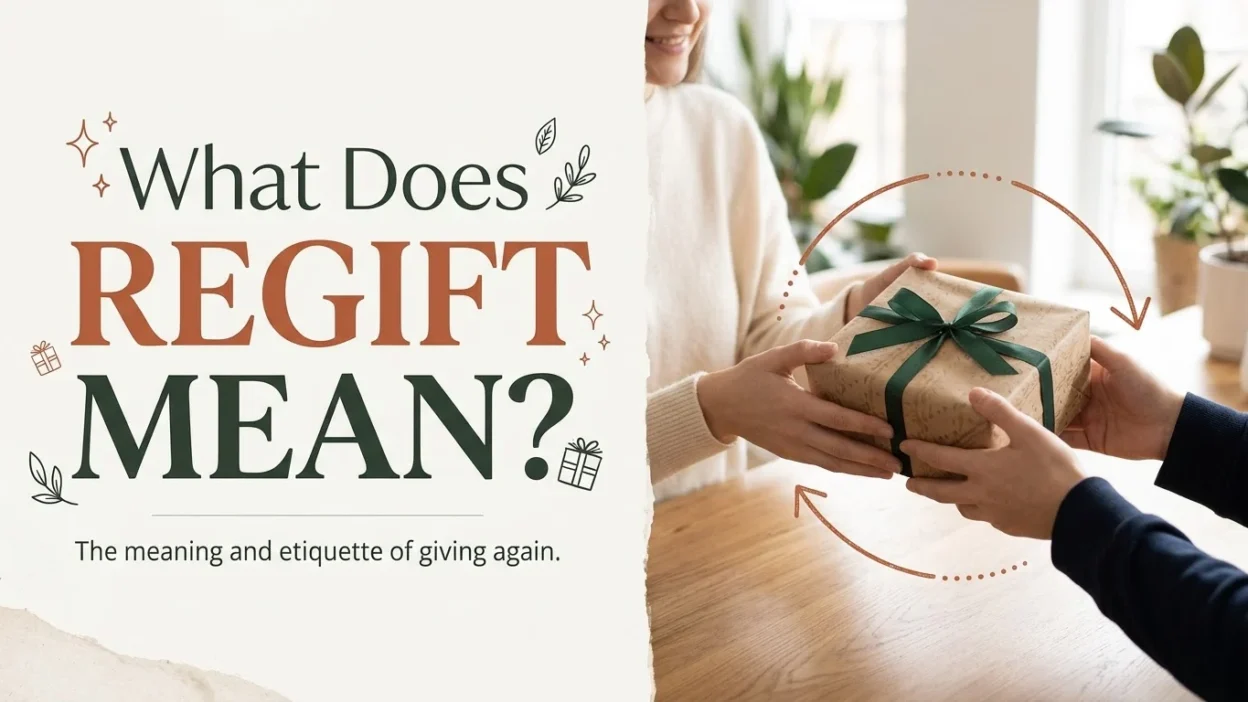
Regift means to give someone a gift that you originally received from another person. For example, if your friend gives you a candle that you never use and you later give it to your cousin as a birthday present, you have regifted the candle.
Regifting can be a practical way to pass along useful items, reduce waste, and save money. However, it can sometimes be considered impolite if the original giver discovers it or if the gift is inappropriate for the new recipient. The meaning is straightforward, but the social rules surrounding regifting depend on the situation, the relationship, and the thought behind the gift.
Quick Answer
Regift means to give a gift you received from someone to another person as a gift. For example, “She decided to regift the unused notebook to her sister.” The word is commonly used as a verb, and its related forms include “regifting,” “regifted,” and “regifts.”
Why Do People Use the Word Regift?
People use “regift” because it describes a specific action that would otherwise require a longer explanation.
Instead of saying, “I gave someone a present that I had previously received from another person,” you can simply say, “I regifted the present.”
The word is especially common when discussing birthdays, weddings, holidays, office parties, and other occasions involving presents.
Regifting may happen for several reasons:
- The original gift does not suit the recipient’s needs.
- The item is unused and could be useful to someone else.
- The person wants to avoid wasting a perfectly good item.
- The person already owns something similar.
- The gift would be more suitable for another person.
For example, someone might receive two identical books and decide to give one to a friend who enjoys reading.
What Does Regift Mean?
Regift is a verb that means to give away something you received as a gift by presenting it to someone else as a gift.
The word combines “re,” meaning again, with “gift.” It refers to giving an item as a present for a second time.
How to Use Regift in a Sentence
Regift can be used in different tenses, depending on when the action happens.
Present tense: “I sometimes regift items that I cannot use.”
Past tense: “He regifted the coffee maker to his brother.”
Future tense: “She might regift the unopened gift next year.”
Present continuous: “They are regifting the extra tickets to their friends.”
Noun form: “Regifting can be a practical way to reuse unwanted gifts.”
Although “regift” is often used casually, it is a recognized English word and can appear in many types of writing.
What Is Regifting?
Regifting is the act of giving a previously received gift to someone else as a present.
For example, imagine that you receive a decorative vase for your birthday. You already have several vases, so you decide to give the unused vase to a friend who is moving into a new home. If you present it to your friend as a gift, you are regifting it.
Regifting differs from ordinary secondhand selling or donating because the item is given to another person as a present.
Is Regifting Acceptable?
Regifting can be acceptable when the item is in excellent condition and genuinely suits the new recipient. It can also help prevent useful items from going to waste.
However, some people consider regifting impolite, especially when the original giver has put considerable thought into choosing the present.
A few simple guidelines can help:
- Choose an item that is appropriate for the new recipient.
- Make sure it is unused or in excellent condition.
- Remove any personal notes or packaging intended for the original recipient.
- Avoid regifting an item within the same social circle if doing so could cause embarrassment.
- Give the item thoughtfully rather than treating it as something you simply want to get rid of.
The important point is that a regift should still feel like a meaningful present.
Regift vs Gift: What Is the Difference?
| Feature | Gift | Regift |
|---|---|---|
| Meaning | To give or receive a present | To give someone a present you previously received |
| Previous ownership | Not necessarily relevant | The giver received the item as a gift first |
| Example | I gifted her a book. | I regifted the book I received last year. |
| Main idea | Giving a present | Giving a previously received present |
The main difference is the item’s history. A gift can be purchased specifically for someone, while a regift has already been given to someone before.
When Should You Use Regift?
Use “regift” when you want to explain that an item originally given to you as a present is being given to someone else as a present.
Examples in Everyday Conversation
- I decided to regift the unopened perfume to my cousin.
- She does not like the mug, so she might regift it.
- He regifted the book to someone who enjoys history.
- We agreed not to regift presents from our office party.
- My sister regifted an unused scarf to her friend.
Examples in Writing
- Regifting can help reduce unnecessary waste.
- Some people believe regifting is perfectly acceptable.
- The article explains how to regift presents politely.
- She felt uncomfortable about regifting a present from her best friend.
- The family discussed whether regifting was appropriate during the holidays.
These examples show how the word can be used in casual speech, articles, and more formal discussions.
12 Examples of Regift in Sentences
Here are additional examples to help you understand how the word works in different situations.
- I might regift this unused notebook to my younger brother.
- She regifted the chocolate box because she does not eat sweets.
- He plans to regift the extra gift card to a friend.
- They decided to regift the unopened kitchen appliance.
- My aunt told me never to regift a personal gift.
- I would rather donate the item than regift it.
- Regifting is common in some families during the holidays.
- She was worried that her friend would discover the regift.
- He carefully checked the packaging before regifting the item.
- You should only regift something that the new recipient will appreciate.
- The unused board game was regifted to another family.
- We laughed about accidentally regifting the same book to each other.
Common Mistakes With Regift
Mistake 1: Confusing Regift With Refund
Incorrect understanding: “I regifted the headphones, so I got my money back.”
Correct explanation: Regifting means giving a previously received present to someone else. A refund means getting money back after returning a purchase.
Mistake 2: Thinking Regift Means Give Any Gift
The word does not describe every act of giving a present.
For example, buying a new watch for your father is simply giving him a gift. Giving your father a watch that someone previously gave you would be regifting.
Mistake 3: Using the Wrong Verb Form
These are the correct forms:
Present: “I regift unwanted presents.”
Past: “I regifted the book.”
Continuous: “I am regifting the item.”
Noun: “Regifting is sometimes controversial.”
Mistake 4: Assuming Every Regift Is Rude
Regifting is not automatically rude. It depends on the item’s condition, its suitability for the new recipient, and the circumstances. A thoughtful regift can be appreciated just as much as a newly purchased present.
What Is an Easy Memory Trick for Regift?
Remember the word in two parts:
Re + gift = gift again.
The prefix “re” often means “again,” as in “rewrite,” which means to write again, and “reuse,” which means to use again.
Similarly, “regift” means to give a previously received gift to someone else.
For example:
“I received a book last year and gave it to my friend this year. I regifted the book.”
This simple connection makes the meaning easy to remember.
Regift in American and British English
“Regift” is understood in both American and British English. It is especially familiar in discussions about holidays, birthdays, and gift giving.
American English
Example: “She decided to regift the unopened candle.”
The word is commonly used in informal conversation and popular writing.
British English
Example: “He chose to regift the unused book to a friend.”
The word is understandable in British English as well, although individual preferences may vary.
There is no major difference in meaning between the two varieties.
Similar Words and Expressions
Learning related terms can help you describe different ways of passing items to other people.
Gift: Something given voluntarily to another person.
Example: “She gave me a lovely gift.”
Donate: To give something to a person or organization without expecting payment.
Example: “We donated the unused clothes to charity.”
Reuse: To use something again instead of throwing it away.
Example: “You can reuse the gift bag.”
Hand down: To pass an item to a younger person or another family member, often because it has lasting value.
Example: “She handed down her grandmother’s necklace.”
Recycle: To process waste materials so they can be used again.
Example: “The company recycles old packaging.”
Repurpose: To use something for a different purpose.
Example: “He repurposed the decorative box as a storage container.”
These words are related to the idea of giving items another use, but they do not have exactly the same meaning as regift.
Final Verdict: What Does Regift Mean?
Regift means to give a present you previously received to someone else as a gift. It is a recognized verb used in everyday English, particularly when discussing unwanted, duplicate, or unsuitable presents.
For example, if someone gives you a book and you later give that same book to a friend as a birthday present, you have regifted it.
Regifting can be practical and thoughtful when done carefully. The best approach is to choose something appropriate, ensure it is in good condition, and consider the feelings of both the original giver and the new recipient.
Frequently Asked Questions
1. What Does Regift Mean in Simple English?
Regift means giving a gift you received from someone to another person as a present. For example, if you receive an unused notebook and later give it to your friend, you have regifted it.
2. Is Regift a Real Word?
Yes. “Regift” is an established English word. It is commonly used as a verb to describe giving a previously received present to someone else.
3. Is Regifting Rude?
Not necessarily. Regifting can be acceptable if the item is in excellent condition and suits the new recipient. It may be considered rude if the gift is obviously unwanted, personally meaningful to the original giver, or passed along carelessly.
4. What Is the Past Tense of Regift?
The past tense is “regifted.” For example, “She regifted the unused candle to her sister.”
5. What Is the Difference Between Regift and Donate?
To regift means to give a previously received present to someone else as a gift. To donate means to give something to a person or organization, usually without expecting payment or a gift in return.
6. Can You Regift Something You Have Already Used?
You can, but it depends on the item and the circumstances. A used item may be suitable if it is in excellent condition and the recipient would appreciate it. However, many people expect gifts to be new or unused, so consider the recipient’s expectations.
7. What Is Another Word for Regift?
There is no perfect one word substitute in every context. You can say “give away a previously received gift” or “pass along a gift.” If the item is being donated rather than presented as a gift, “donate” may be more appropriate.
Remember This
- Regift means to give a previously received present to someone else.
- Regifted is the past tense.
- Regifting is the noun or continuous verb form.
- Regifting is different from donating, selling, or recycling an item.
- A thoughtful regift can be practical and considerate.
The easiest way to remember the meaning is to think of “regift” as giving a gift again.
Conclusion
The word “regift” describes a common situation in which someone gives a present they previously received to another person. It is useful in conversations about birthdays, holidays, unwanted presents, and ways to reduce waste. The word is simple to understand once you connect the prefix “re” with the idea of doing something again.
If regifting is appropriate depends on the situation and the people involved. Choosing an item that is in good condition and genuinely suitable for the new recipient can make regifting a thoughtful choice. By understanding the word’s meaning and using it correctly, you can communicate naturally and confidently in everyday English.

Lucas Luke is a passionate language writer and content creator at SimileHive, specializing in similes, idioms, metaphors, and figurative language. He enjoys making complex English expressions simple, engaging, and easy to understand for students, writers, and language enthusiasts through well-researched, practical content.