Is it “she and I” or “she and me”? Both expressions are correct English, but they are used in different parts of a sentence. The right choice depends on if the pronouns are acting as the subject or the object. This is an important grammar rule for students, English learners, and anyone who wants to speak and write naturally.
For example, you would say, “She and I went to school together,” because the two people are performing the action. However, you would say, “The teacher praised her and me,” because the two people are receiving the action. A simple trick can help you choose correctly every time: remove the other person from the sentence and see whether “I” or “me” sounds right on its own. Once you understand this rule, you can confidently use both expressions in everyday conversations, emails, essays, and professional writing.
Quick Answer
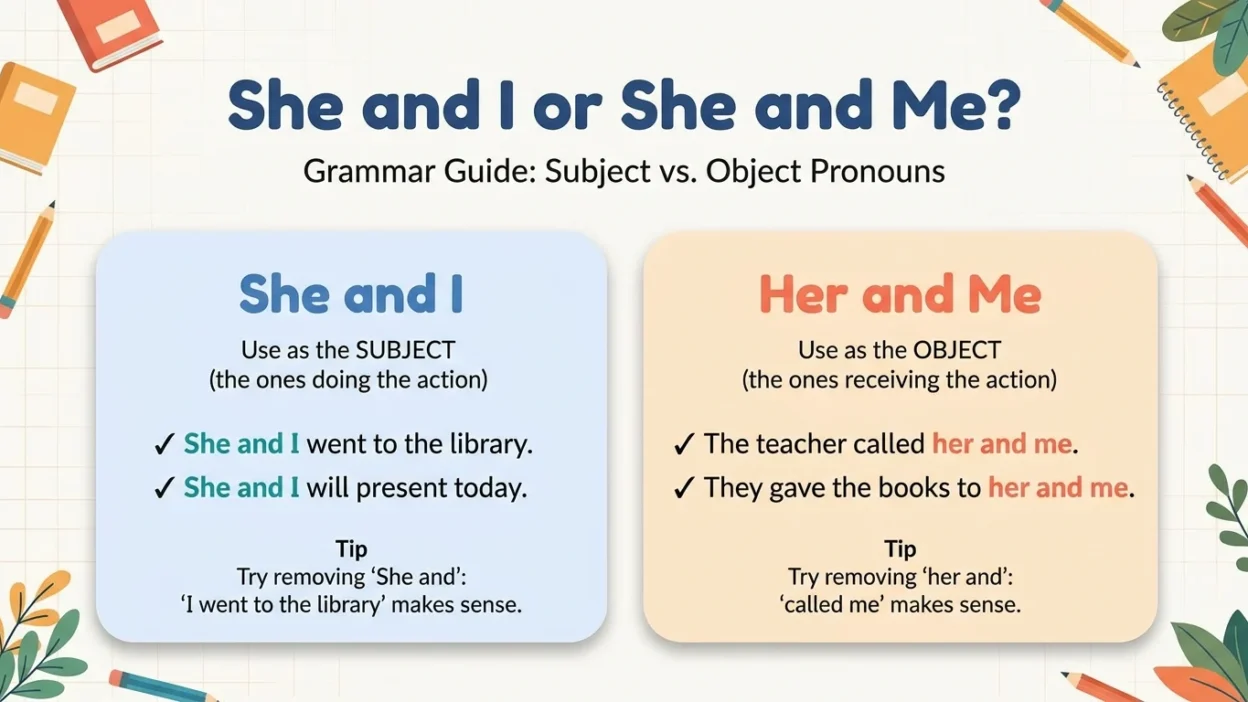
Use “she and I” when the pronouns are the subject of a sentence, as in “She and I are friends.” Use “she and me” when the pronouns are the object of a verb or preposition, as in “They invited her and me.” Both are correct, but the grammatical role determines which one to use.
Why Do People Confuse “She and I” and “She and Me”?
People often confuse these expressions because they try to choose the pronoun that sounds more formal or polite. Many people have learned that “she and I” sounds more proper, so they use it even when “she and me” is grammatically correct.
However, English pronouns change form depending on their role in a sentence.
- She is a subject pronoun.
- Her is an object pronoun.
- I is a subject pronoun.
- Me is an object pronoun.
The important point is that adding another person does not change the grammatical role of the pronoun.
For example:
- Correct: She and I finished the project.
- Correct: The manager thanked her and me.
- Incorrect: Her and me finished the project.
- Incorrect: The manager thanked she and I.
1. She and I: Meaning and Usage
Use “she and I” when both people are performing the action or are the subjects of the sentence.
The pronoun “I” is used because it is part of the subject. The pronoun “she” is also a subject pronoun.
Examples of She and I
- She and I work at the same company.
- She and I went shopping yesterday.
- She and I are learning English.
- She and I completed the assignment.
- She and I have been friends for years.
- She and I will attend the meeting tomorrow.
- She and I enjoyed the movie.
- She and I are responsible for the project.
In each example, “she and I” identifies the people performing the action or being described.
Is “She and I” Always Used at the Beginning?
No. It can appear in different positions as long as it functions as the subject.
For example:
- Yesterday, she and I visited our grandparents.
- After the meeting, she and I discussed the proposal.
- Although she and I disagree sometimes, we respect each other.
Remember: Use “she and I” when the pronouns are the subject of the sentence.
2. She and Me: Meaning and Usage
Use “she and me” when the pronouns function as the object of a verb or a preposition.
The pronoun “me” is an object pronoun, so it is appropriate when someone performs an action toward you or when a preposition introduces you as its object.
Examples of She and Me
- The teacher praised her and me.
- They invited her and me to dinner.
- The manager spoke to her and me.
- Our friends helped her and me.
- The gift was for her and me.
- The coach congratulated her and me.
- The decision surprised her and me.
- The children sat between her and me.
In these sentences, “her and me” is grammatically correct because both pronouns are objects.
Why Is “She and Me” Sometimes Correct?
Some people think “she and me” is always wrong because they have been taught to use “she and I” in formal speech. That is a misunderstanding.
Consider this sentence:
“They invited she and I to the party.”
It is incorrect because the pronouns are objects of the verb “invited.” The correct sentence is:
“They invited her and me to the party.”
Remember: Use “she and me” when the pronouns receive an action or follow a preposition.
She and I vs. She and Me: Comparison Table
| Expression | Grammatical role | Example |
|---|---|---|
| She and I | Subject | She and I went home. |
| She and me | Object | They called her and me. |
| Her and I | Incorrect when both are subjects | Her and I went home. |
| She and me | Incorrect when both are subjects | She and me went home. |
| Her and me | Object | The teacher helped her and me. |
When Should You Use Each Expression?
Use She and I When They Perform the Action
Ask yourself: Who is doing the action?
If the answer is “she and I,” use the subject pronouns.
Correct: She and I prepared the presentation.
Incorrect: She and me prepared the presentation.
You can check by removing “she and.” The sentence becomes “I prepared the presentation,” which is correct.
Use She and Me When They Receive the Action
Ask yourself: Who received the action?
Correct: The teacher called her and me.
Incorrect: The teacher called she and I.
Remove “her and” to test the sentence. You would say, “The teacher called me,” not “The teacher called I.”
Use Her and Me After a Preposition
Prepositions such as “to,” “for,” “with,” “between,” and “about” generally take object pronouns.
Examples:
- The invitation was sent to her and me.
- The surprise was planned for her and me.
- The teacher spoke with her and me.
- The secret stayed between her and me.
- They were talking about her and me.
12 Examples of She and I vs. She and Me
Here are examples that show the difference in everyday English.
- She and I: She and I are classmates.
- She and I: She and I traveled to London last year.
- She and I: She and I will organize the event.
- She and I: She and I have the same teacher.
- She and I: She and I enjoy reading novels.
- She and I: She and I were chosen for the team.
- She and me: The teacher gave her and me extra time.
- She and me: My parents invited her and me.
- She and me: The coach selected her and me.
- She and me: The prize was awarded to her and me.
- She and me: The teacher sat between her and me.
- She and me: They asked her and me to explain the problem.
Common Mistakes to Avoid
Mistake 1: Using “Me” as the Subject
Incorrect: Me and she went to the market.
Correct: She and I went to the market.
The pronouns are the subject, so use “she and I.” In standard English, it is also customary to mention the other person before yourself.
Mistake 2: Using “I” as the Object
Incorrect: The teacher helped she and I.
Correct: The teacher helped her and me.
The pronouns receive the action of “helped,” so object pronouns are required.
Mistake 3: Thinking “She and I” Is Always More Correct
Incorrect: The invitation was for she and I.
Correct: The invitation was for her and me.
The preposition “for” takes object pronouns. Formal writing follows this rule, too.
Mistake 4: Forgetting the Pronoun Test
If you are uncertain, temporarily remove the other person from the sentence.
- “She and I are ready.” Remove “she and”: “I am ready.”
- “They invited her and me.” Remove “her and”: “They invited me.”
Both remaining sentences are grammatically correct, which helps you identify the right pronouns.
Mistake 5: Using “Her and Me” as the Subject
Incorrect: Her and me are going to the library.
Correct: She and I are going to the library.
“Her” and “me” are object pronouns. Use “she” and “I” for the subject.
A Simple Memory Trick
Remember this rule:
I = Subject. Me = Object.
To check your sentence, remove the other person.
- If you would say “I went,” use “she and I.”
- If you would say “They invited me,” use “her and me.”
For example:
“She and I went to the park.” You would say, “I went to the park.”
“They saw her and me.” You would say, “They saw me.”
This quick test works in most everyday sentences.
American vs. British English
The grammatical rule for “she and I” and “she and me” is the same in American and British English.
Both varieties use subject pronouns for subjects and object pronouns for objects. For example, “She and I are friends” and “They invited her and me” are correct in both varieties.
In casual conversation, some speakers may use expressions that do not follow standard formal grammar. However, for schoolwork, professional writing, exams, and formal communication, follow the subject and object rule.
Similar Pronoun Pairs
The same rule applies to other pronouns used together.
He and I vs. Him and Me
- Correct: He and I work together.
- Correct: The manager thanked him and me.
She and I vs. Her and Me
- Correct: She and I are neighbors.
- Correct: The teacher called her and me.
You and I vs. You and Me
- Correct: You and I should talk.
- Correct: This gift is for you and me.
They and I vs. Them and Me
- Correct: They and I attended the event.
- Correct: The organizer invited them and me.
In each pair, choose subject pronouns for subjects and object pronouns for objects.
Final Verdict
Both “she and I” and “she and me” are correct English expressions. The difference is their grammatical function.
Use “she and I” when the pronouns are the subject, as in “She and I went to school.”
Use “she and me” when the pronouns are objects, as in “The teacher helped her and me.”
If you are unsure, remove the other person and check whether “I” or “me” fits the sentence. This simple trick will help you choose correctly.
Frequently Asked Questions
1. Is it “she and I” or “she and me”?
Both are correct, depending on the sentence. Use “she and I” as the subject and “she and me” when the phrase is the object. For example, “She and I went shopping,” but “They invited her and me.”
2. Is “she and me” grammatically correct?
Yes. “She and me” is correct when “me” is the object, but the standard object form of “she” is “her,” so the complete object phrase is usually “her and me.” For example, “They invited her and me.”
3. Is “she and I” always correct?
No. “She and I” is correct when the phrase is the subject, but not when it is the object of a verb or preposition. Say “She and I attended the meeting,” but “The manager spoke to her and me.”
4. Should I say “she and I went” or “she and me went”?
In standard English, say “she and I went.” The phrase is the subject of the sentence, and “I” is the correct subject pronoun. You can test it by saying “I went,” which is grammatically correct.
5. Is it “between she and I” or “between her and me”?
The correct expression is “between her and me.” The word “between” is a preposition, and prepositions take object pronouns. Therefore, “between she and I” is incorrect in standard English.
6. Why do people say “she and I” instead of “she and me”?
Some people have learned that “she and I” sounds more formal or polite. As a result, they sometimes use it where object pronouns are needed. However, “her and me” is the correct choice when the phrase is the object.
7. Is “you and I” or “you and me” correct?
Both can be correct. Use “you and I” as the subject, as in “You and I are friends.” Use “you and me” as the object, as in “They invited you and me.”
8. Is this rule important in formal writing?
Yes. In formal writing, academic work, and professional communication, subject and object pronouns should follow standard grammar. Using “she and I” and “her and me” correctly makes sentences clearer and grammatically accurate.
Remember This
Use “she and I” when you and another person perform the action. Use “her and me” when someone performs an action toward you both or when you follow a preposition. Remove the other person to check whether “I” or “me” is correct.
Conclusion
The difference between “she and I” and “she and me” is simple once you understand subject and object pronouns. “She and I” is used when the two people perform an action or serve as the subject. “Her and me” is used when the two people receive an action or follow a preposition.
Whenever you are unsure, try the one-person test. If “I” fits the sentence, use “she and I.” If “me” fits, use “her and me.” Practicing with everyday examples will help you use these expressions naturally and confidently in both spoken and written English.

Adam Aaron is a language enthusiast and content writer at SimileHive, creating clear, engaging guides on similes, idioms, metaphors, and figurative language to help readers improve English confidently every day.