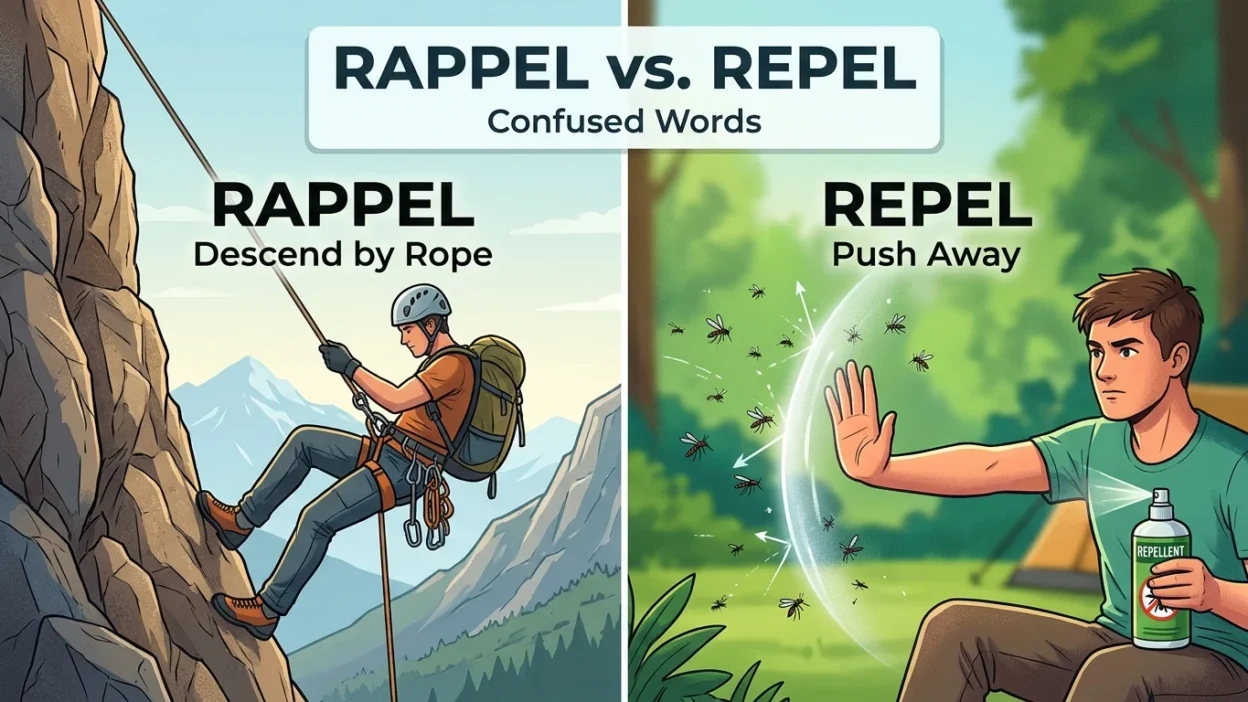
Are you confused about rappel vs. repel? These two words look and sound somewhat similar, but they have completely different meanings. Rappel is a verb that means to descend a steep surface, such as a cliff or building, using a rope. Repel means to drive something away, resist something, or prevent something from approaching. Understanding the difference will help you use both words correctly in everyday English, academic writing, and professional communication.
For example, a climber might rappel down a mountain, while a particular smell might repel insects. The words are easy to mix up because they share several letters, but their meanings and uses are distinct. In this guide, you will learn how to spell, pronounce, and use rappel and repel, with simple definitions, practical examples, common mistakes, and memory tricks to help you remember the difference.
Quick Answer
Rappel means to descend a steep surface using a rope and specialized equipment. Repel means to push away, drive back, resist, or keep something away. For example, “The climber rappelled down the cliff” is correct, while “This spray helps repel mosquitoes” uses the second word correctly.
Why Do People Confuse Rappel and Repel?
People confuse rappel and repel because they have similar spellings and share the letters r, p, e, and l. However, their meanings are unrelated in ordinary usage.
The main difference is the action each word describes:
- Rappel: Moving down a steep surface using a rope.
- Repel: Pushing something away or preventing it from coming closer.
Pronunciation also helps distinguish them. Rappel is commonly pronounced “ruh PEL,” while repel is pronounced “rih PEL.” The exact vowel sound can vary by accent.
1. Rappel: Meaning and Usage
Rappel is a verb that means to descend a cliff, wall, or other steep surface using a rope and appropriate equipment. It is commonly associated with rock climbing, mountaineering, rescue operations, and military training.
The technique involves controlling the descent along the rope. In British English, the related term abseil is commonly used for the same activity.
Examples of Rappel
- The climber prepared to rappel down the cliff.
- We learned how to rappel during our outdoor training.
- The rescue team rappelled from the helicopter.
- She carefully rappelled down the rock face.
- The instructor showed us how to rappel safely.
- The team used ropes to rappel into the canyon.
- He wore a helmet and harness before rappelling.
- The experienced climber rappelled down the steep wall.
Common Forms of Rappel
| Form | Example |
|---|---|
| Base form | rappel |
| Third person singular | rappels |
| Past tense | rappelled |
| Present participle | rappelling |
Remember: Rappel is associated with ropes, climbing, and descending steep surfaces.
2. Repel: Meaning and Usage
Repel is a verb that means to drive away, push back, resist, or prevent something from approaching. It can describe physical forces, insects, people, unwanted substances, or emotional reactions.
For example, a mosquito repellent helps repel mosquitoes, and a water resistant coating may repel water.
Examples of Repel
- This spray helps repel mosquitoes.
- The strong smell repels many insects.
- Some materials repel water.
- The magnets repel each other when like poles face one another.
- The soldiers managed to repel the attack.
- His rude behavior may repel potential customers.
- This fabric is designed to repel stains.
- The strong odor repelled everyone in the room.
Common Forms of Repel
| Form | Example |
|---|---|
| Base form | repel |
| Third person singular | repels |
| Past tense | repelled |
| Present participle | repelling |
Remember: Repel is associated with pushing away, resisting, or keeping something away.
Rappel vs. Repel: Comparison Table
| Feature | Rappel | Repel |
|---|---|---|
| Part of speech | Verb, and also a noun in climbing contexts | Verb |
| Main meaning | Descend using a rope | Push away or resist |
| Common context | Climbing, rescue, mountaineering | Insects, forces, attacks, substances |
| Past tense | Rappelled | Repelled |
| Example | They rappelled down the cliff. | The spray repels mosquitoes. |
When Should You Use Each Word?
Use Rappel When Talking About Rope Descents
Use rappel when someone descends a steep surface using a rope and suitable equipment.
Examples:
- The climber will rappel down the mountain.
- The rescue worker rappelled from the platform.
- We practiced rappelling during the training session.
If the action involves descending by rope, rappel is the appropriate word.
Use Repel When Talking About Driving Something Away
Use repel when something pushes away, resists, or keeps another thing from coming closer.
Examples:
- This lotion helps repel insects.
- The defenders repelled the attack.
- The coating repels water.
If the action involves resistance or keeping something away, choose repel.
12 Examples of Rappel and Repel in Sentences
Here are examples showing how the words work in different contexts.
- Rappel: The climbers rappelled down the cliff after reaching the summit.
- Rappel: She learned to rappel under the supervision of an instructor.
- Rappel: The rescue team rappelled into the rocky area.
- Rappel: He checked his equipment before rappelling.
- Rappel: The group practiced rappelling on a training wall.
- Rappel: The mountaineer used a rope to rappel down the slope.
- Repel: The insect spray helps repel mosquitoes.
- Repel: The material is designed to repel water.
- Repel: The defenders worked together to repel the attack.
- Repel: Like magnetic poles repel each other.
- Repel: The unpleasant smell repelled the visitors.
- Repel: The protective coating helps repel dirt.
Common Mistakes to Avoid
Mistake 1: Using Repel for Descending a Cliff
Incorrect: The climber repelled down the cliff.
Correct: The climber rappelled down the cliff.
Use rappel because the climber is descending by rope.
Mistake 2: Using Rappel for Keeping Insects Away
Incorrect: This spray helps rappel mosquitoes.
Correct: This spray helps repel mosquitoes.
Use repel because the spray keeps the insects away.
Mistake 3: Confusing Their Past Tense Forms
Incorrect: The climber repelled down the wall.
Correct: The climber rappelled down the wall.
Incorrect: The defenders rappelled the attack.
Correct: The defenders repelled the attack.
The past tense of rappel is rappelled, while the past tense of repel is repelled.
Mistake 4: Forgetting the Double Consonants
Both words double the final consonant before adding -ed or -ing in their standard spellings.
- Rappel, rappelled, rappelling
- Repel, repelled, repelling
However, the words still have different meanings. Their similar spelling patterns do not make them interchangeable.
A Simple Memory Trick
Use this easy memory trick:
Rappel = Rope. Repel = Push away.
Both rappel and rope begin with the letter R, so connect rappel with climbing ropes and descending a cliff.
For repel, imagine pushing something away from yourself. Mosquito repellent keeps mosquitoes away, and a magnetic force can repel another magnet.
Remember these two sentences:
- The climber rappelled down the cliff.
- The spray repelled the mosquitoes.
The first describes a descent. The second describes keeping something away.
American vs. British English
The words rappel and repel have the same basic meanings in American and British English, but climbing terminology differs.
- Rappel: Commonly used in American English for descending by rope.
- Abseil: Commonly used in British English for the same activity.
- Repel: Used in both varieties to mean push away, drive back, or resist.
For example, an American climber might say, “We rappelled down the cliff,” while a British climber might say, “We abseiled down the cliff.”
Both expressions describe the same general activity. Repel, however, does not mean to descend a cliff.
Similar Words and Expressions
Descend
Descend means to move downward from a higher place.
Example: The hikers began to descend the mountain.
Unlike rappel, it does not necessarily involve a rope.
Abseil
Abseil means to descend a steep surface using a rope. It is commonly used in British English.
Example: The climbers abseiled down the rock face.
Resist
Resist means to oppose something or prevent yourself from being affected by it.
Example: The material resists heat and moisture.
Drive Away
Drive away means to make someone or something leave or move away.
Example: The loud noise drove the birds away.
Repellent
Repellent can be an adjective meaning that something repels, or a noun for a substance used to keep insects or other things away.
Example: Apply insect repellent before going outdoors.
Final Verdict
Rappel and repel are different words with different meanings.
Use rappel when someone descends a cliff, wall, or steep surface using a rope. Use repel when something pushes away, resists, or keeps something from approaching.
For example, “The climber rappelled down the cliff” and “The spray repels insects” are both correct. Remembering the connection between rappel and ropes, and between repel and pushing away, will help you use the words accurately.
Frequently Asked Questions
1. What is the difference between rappel and repel?
Rappel means to descend a steep surface using a rope. Repel means to push away, drive back, or resist something. For example, a climber rappels down a cliff, while insect spray repels mosquitoes.
2. Is rappel a real English word?
Yes. Rappel is a standard English word used in climbing and rescue contexts. It refers to descending a steep surface using a rope and suitable equipment.
3. Does repel mean to climb down a rope?
No. Repel does not mean to descend a rope. The correct word is rappel. Repel means to drive away, resist, or keep something from approaching.
4. What is the past tense of rappel?
The past tense is rappelled. For example, “The climber rappelled down the cliff.” The present participle is rappelling.
5. What is the past tense of repel?
The past tense is repelled. For example, “The defenders repelled the attack.” The present participle is repelling.
6. Is rappel the same as abseil?
Yes. Both words describe descending a steep surface using a rope. Rappel is common in American English, while abseil is common in British English and several other varieties.
7. Is it mosquito rappel or mosquito repellent?
The correct expression is mosquito repellent. A repellent is a substance that helps keep mosquitoes away. Rappel refers to descending by rope and has no such meaning.
8. How can I remember the difference between rappel and repel?
Remember rappel equals rope descent, while repel equals push away. A climber rappels down a cliff, and a repellent keeps insects away. Linking each word to its action makes the difference easier to remember.
Remember This
Rappel means to descend by rope. Repel means to push away or resist. Use rappel for climbing and rescue activities, and use repel for insects, magnetic forces, attacks, water, and other things that are kept away.
Conclusion
Although rappel and repel look similar, their meanings are quite different. Rappel describes a controlled descent using a rope, while repel describes pushing something away or resisting it. Knowing the difference helps you avoid spelling and vocabulary mistakes.
When you are unsure, remember the action in your sentence. If someone is moving down a cliff with a rope, use rappel. If something is keeping insects away, resisting an attack, or pushing another object away, use repel. A little practice with these examples will help you use both words confidently.

Adam Aaron is a language enthusiast and content writer at SimileHive, creating clear, engaging guides on similes, idioms, metaphors, and figurative language to help readers improve English confidently every day.