“Provided that” and “providing that” are two English expressions used to describe a condition that must be met for something to happen. They are similar in meaning and often appear in formal writing, everyday conversations, instructions, agreements, and conditional sentences. Both can be used to mean “if” or “on the condition that.”
For example, you might say, “You can borrow my laptop provided that you return it tomorrow” or “You can borrow my laptop providing that you return it tomorrow.” Both sentences communicate the same basic idea. However, there are small differences in style, formality, and usage that can help you choose the most appropriate expression.
Understanding these differences is especially useful for students, English learners, and anyone who wants to write clearly and naturally. In this guide, you will learn what each expression means, how to use it correctly, how the two compare, and which one is better for formal and informal situations.
Quick Answer: Provided That vs Providing That
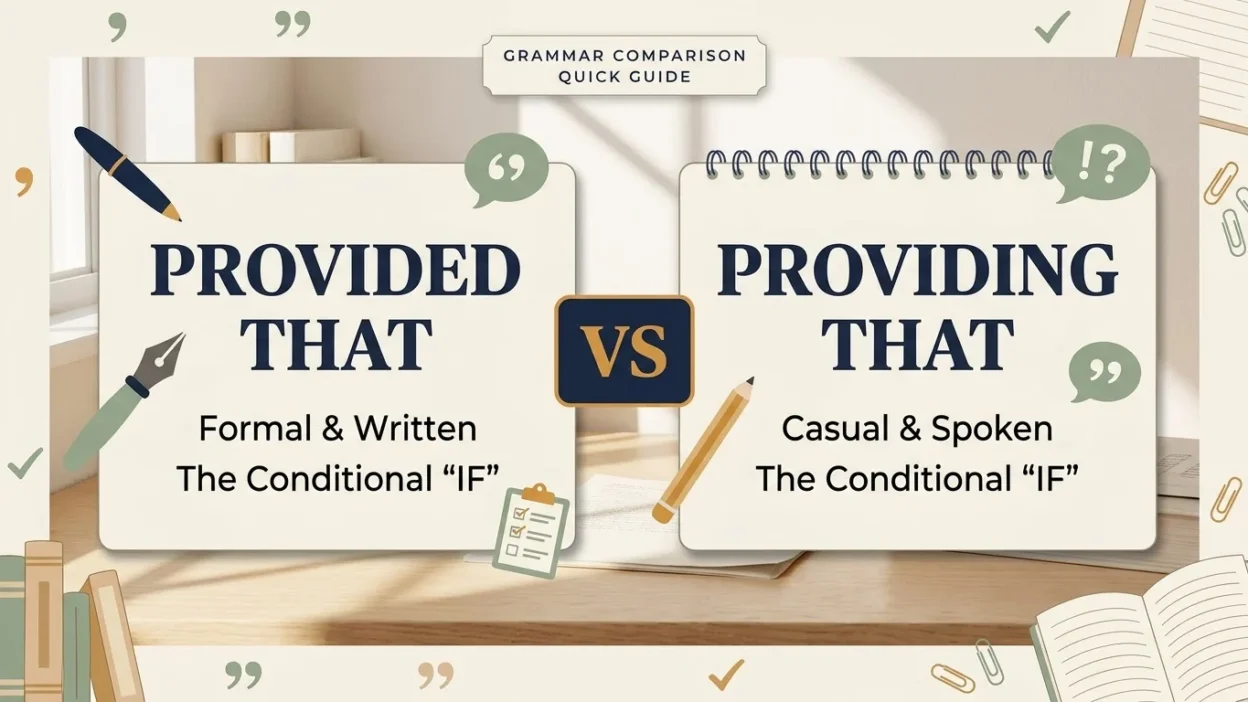
“Provided that” and “providing that” both mean “if” or “on the condition that.” They introduce a condition that must be satisfied. “Provided that” is generally preferred in formal writing, legal documents, and professional communication. “Providing that” is also correct and is commonly used in everyday English. In most sentences, either expression works.
Why Do People Confuse Provided That and Providing That?
People confuse these expressions because they have nearly identical meanings and can often replace each other without changing the message.
Both expressions introduce a condition. The main difference is usually stylistic rather than grammatical.
For example:
- You may leave early provided that you finish your work.
- You may leave early providing that you finish your work.
Both sentences mean that leaving early is allowed only if the work is finished.
The confusion often comes from the words “provided” and “providing.” Learners may assume that one is grammatically correct and the other is incorrect. In reality, both forms are accepted in standard English when used to introduce a condition.
What Does Provided That Mean?
“Provided that” means “if,” “as long as,” or “on the condition that.” It introduces a requirement that must be met before something else can happen.
This expression is particularly common in formal, academic, professional, and legal contexts.
Examples of Provided That
- You can attend the event provided that you register in advance.
- We will approve your request provided that you meet all the requirements.
- She can borrow the car provided that she drives carefully.
- The contract will remain valid provided that both parties follow its terms.
- You may use this room provided that you keep it clean.
When Should You Use Provided That?
Use “provided that” when you want to express a clear condition, especially in formal or professional communication.
It works well in:
- Business agreements and contracts
- Academic writing
- Official instructions
- Professional emails
- Formal explanations and policies
For example, “Employees may work remotely provided that their managers approve the arrangement” sounds appropriate in a workplace policy.
What Does Providing That Mean?
“Providing that” also means “if,” “as long as,” or “on the condition that.” It introduces a condition that must be satisfied for a particular result or action to be possible.
Although it can be used in formal contexts, it often sounds natural in everyday conversation and less formal writing.
Examples of Providing That
- You can come with us providing that you finish your homework.
- We can go hiking providing that the weather stays clear.
- I will lend you the money providing that you pay me back next week.
- You may join the team providing that you attend the training sessions.
- They will accept the invitation providing that they can arrange transportation.
When Should You Use Providing That?
Use “providing that” when expressing a condition in ordinary conversation or general writing. It is correct English and does not automatically make a sentence informal or incorrect.
For example, “We can have the picnic outside providing that it does not rain” is a natural way to express a condition.
In highly formal writing, however, “provided that” is often the safer choice because it is widely established in formal and legal language.
Provided That vs Providing That: Comparison Table
| Feature | Provided That | Providing That |
|---|---|---|
| Meaning | If or on the condition that | If or on the condition that |
| Grammar | Correct | Correct |
| Formality | Generally more formal | Often sounds more conversational |
| Legal writing | Commonly preferred | Less commonly preferred |
| Everyday conversation | Natural | Natural |
| Academic writing | Usually a safe choice | Acceptable when appropriate |
| Can introduce a condition? | Yes | Yes |
| Can usually replace the other? | Yes | Yes |
The main takeaway is that both expressions are grammatically acceptable. The choice often depends on tone and context rather than meaning.
When Should You Use Each Expression?
Use Provided That in Formal Writing
Choose “provided that” when writing contracts, official policies, academic assignments, or professional documents.
Example: “The scholarship will be awarded provided that the applicant meets all eligibility criteria.”
This wording clearly establishes the condition for receiving the scholarship.
Use Providing That in Everyday English
Choose “providing that” when speaking naturally or writing less formal messages.
Example: “We can visit the beach tomorrow providing that the weather is good.”
The sentence sounds natural and communicates the condition clearly.
Use Either Expression When the Meaning Is the Same
In many ordinary sentences, both forms are correct.
Example:
- You can stay here provided that you remain quiet.
- You can stay here providing that you remain quiet.
Both sentences mean that staying is allowed on the condition that the person remains quiet.
Consider Using If for Simpler Writing
Sometimes, “if” is shorter and easier to understand.
Instead of saying, “You can borrow the book provided that you return it on Friday,” you can say, “You can borrow the book if you return it on Friday.”
Both versions express a condition, although “provided that” can emphasize the requirement more strongly.
12 Examples of Provided That vs Providing That
Here are 12 examples showing how the expressions work in practical situations.
- Work: You can leave early provided that you finish your assigned tasks.
- Work: You can leave early providing that you finish your assigned tasks.
- School: Students may retake the test provided that they submit a request.
- School: Students may retake the test providing that they submit a request.
- Travel: We will travel tomorrow provided that the roads are safe.
- Travel: We will travel tomorrow providing that the roads are safe.
- Money: I will lend you the money provided that you repay it on time.
- Money: I will lend you the money providing that you repay it on time.
- Permission: You can use my phone provided that you handle it carefully.
- Permission: You can use my phone providing that you handle it carefully.
- Business: The offer will remain available provided that payment is received by Monday.
- Business: The offer will remain available providing that payment is received by Monday.
In each pair, the basic meaning remains the same. The version with “provided that” may sound more formal, particularly in professional and official contexts.
Common Mistakes to Avoid
Mistake 1: Thinking Providing That Is Always Incorrect
Incorrect assumption: “Providing that” is bad grammar.
Correct understanding: Both “provided that” and “providing that” are accepted when used to express a condition.
Example: “You can attend providing that you register first.”
Mistake 2: Using the Expression Without a Clear Condition
The condition should explain what must happen for the main statement to be true or possible.
Unclear: “You can join provided that.”
Clear: “You can join provided that you complete the registration form.”
Mistake 3: Confusing Providing That With Providing Something
“Providing” can also mean supplying or making something available. This is a different use of the word.
Example of supplying: “The company is providing free meals.”
Example of a condition: “You can attend providing that you register in advance.”
Look at the meaning of the whole sentence to determine which use applies.
Mistake 4: Assuming Provided That Means the Same as Provided
“Provided” can appear in other grammatical structures, and its meaning depends on context.
Example: “The documents were provided by the manager.”
Here, “provided” means supplied, not “on the condition that.”
Memory Trick: How to Remember the Difference
Remember this simple rule:
Provided that = the formal favorite.
Providing that = another correct way to express the condition.
Both expressions answer the question, “Under what condition?”
For example, “You can borrow the car provided that you return it by six” tells you the condition for borrowing the car.
If you are unsure which expression to use in a formal document, choose “provided that.” If you are speaking casually, either form will usually work.
American vs British English
Both “provided that” and “providing that” are used in British and American English. Neither expression belongs exclusively to one variety.
The choice is generally influenced by context, style, and personal preference rather than a strict regional grammar rule. “Provided that” is a particularly safe choice in formal writing in either variety.
For example, an American writer might write, “The application will be accepted provided that all documents are submitted.” A British writer could use the same wording or choose “providing that” in a less formal context.
Similar Words and Expressions
Several other expressions can introduce a condition similar to “provided that” and “providing that.”
1. If
“If” is the simplest and most common way to introduce a condition.
Example: “You can come if you finish your work.”
2. As Long As
“As long as” means that something is allowed or possible while a particular condition is met.
Example: “You can stay as long as you keep the room clean.”
3. On the Condition That
This phrase explicitly emphasizes a requirement or agreement.
Example: “She agreed to help on the condition that everyone contributed.”
4. Only If
“Only if” emphasizes that a condition is necessary.
Example: “You can enter only if you have a valid ticket.”
5. Assuming That
“Assuming that” introduces something accepted as true for the purpose of reasoning or planning. It does not always establish a strict requirement.
Example: “Assuming that the weather stays clear, we will leave tomorrow.”
6. Unless
“Unless” means “except if” or “if not.” It expresses a negative condition and may require a different sentence structure.
Example: “We will go outside unless it rains.”
These expressions are related, but they are not interchangeable in every sentence. Choose the one that communicates your intended condition most clearly.
Final Verdict: Provided That or Providing That?
Both “provided that” and “providing that” are correct English expressions that mean “if” or “on the condition that.” The difference is mainly one of style and formality.
Choose “provided that” for formal documents, business communication, academic writing, and situations where you want a conventional, precise tone. Choose “providing that” when it feels natural in everyday conversation or general writing.
If you want one reliable option that works across nearly every context, use “provided that.” You can also use “if” when you want a simpler and more direct sentence.
Frequently Asked Questions
1. Is provided that grammatically correct?
Yes. “Provided that” is grammatically correct and means “if” or “on the condition that.” It is commonly used in formal writing, agreements, instructions, and everyday English.
2. Is providing that grammatically correct?
Yes. “Providing that” is also correct when it introduces a condition. For example, “You can borrow the car providing that you return it tomorrow” is acceptable English.
3. What is the main difference between provided that and providing that?
The main difference is usually style and formality, not meaning. Both expressions introduce a condition. “Provided that” is generally preferred in formal writing, while “providing that” is also common in ordinary English.
4. Can I use provided that and providing that interchangeably?
In many sentences, yes. Both can express the same condition without changing the main meaning. However, “provided that” may be more suitable for formal documents and legal language.
5. Which is better for formal writing, provided that or providing that?
“Provided that” is generally the safer choice for formal writing, academic work, contracts, and official policies. “Providing that” is not automatically wrong, but the first expression is more conventional in these contexts.
6. Does provided that mean the same as if?
In many contexts, yes. Both can introduce a condition. For example, “You can join provided that you register” and “You can join if you register” express a similar meaning.
7. Is providing that informal English?
Not necessarily. “Providing that” is accepted English and can appear in both spoken and written language. It may sound more conversational in some contexts, but it is not inherently incorrect or restricted to informal speech.
8. Can I start a sentence with provided that?
Yes. You can begin a sentence with “provided that” when introducing a condition.
Example: “Provided that everyone agrees, we will proceed with the plan.”
When the condition comes first, a comma is normally used before the main clause.
Remember This
- Both expressions are grammatically correct.
- Both mean “if” or “on the condition that.”
- “Provided that” is generally the better choice for formal writing.
- “Providing that” works well in everyday English.
- “If” is often the simplest alternative.
- Choose the expression that makes your sentence clear and natural.
Conclusion
“Provided that” and “providing that” are two correct ways to express a condition in English. They usually communicate the same idea, so you can use either one in many everyday sentences. The most noticeable distinction is that “provided that” is often preferred in formal and professional writing, while “providing that” is also natural in conversation and general writing.
For the clearest and most versatile choice, use “provided that” when writing formal documents or explaining requirements. Use “providing that” when it suits your tone, and remember that “if” is a simple alternative in many situations. By understanding how these expressions work, you can choose the right wording for your audience and communicate conditions clearly and confidently.

Adam Aaron is a language enthusiast and content writer at SimileHive, creating clear, engaging guides on similes, idioms, metaphors, and figurative language to help readers improve English confidently every day.